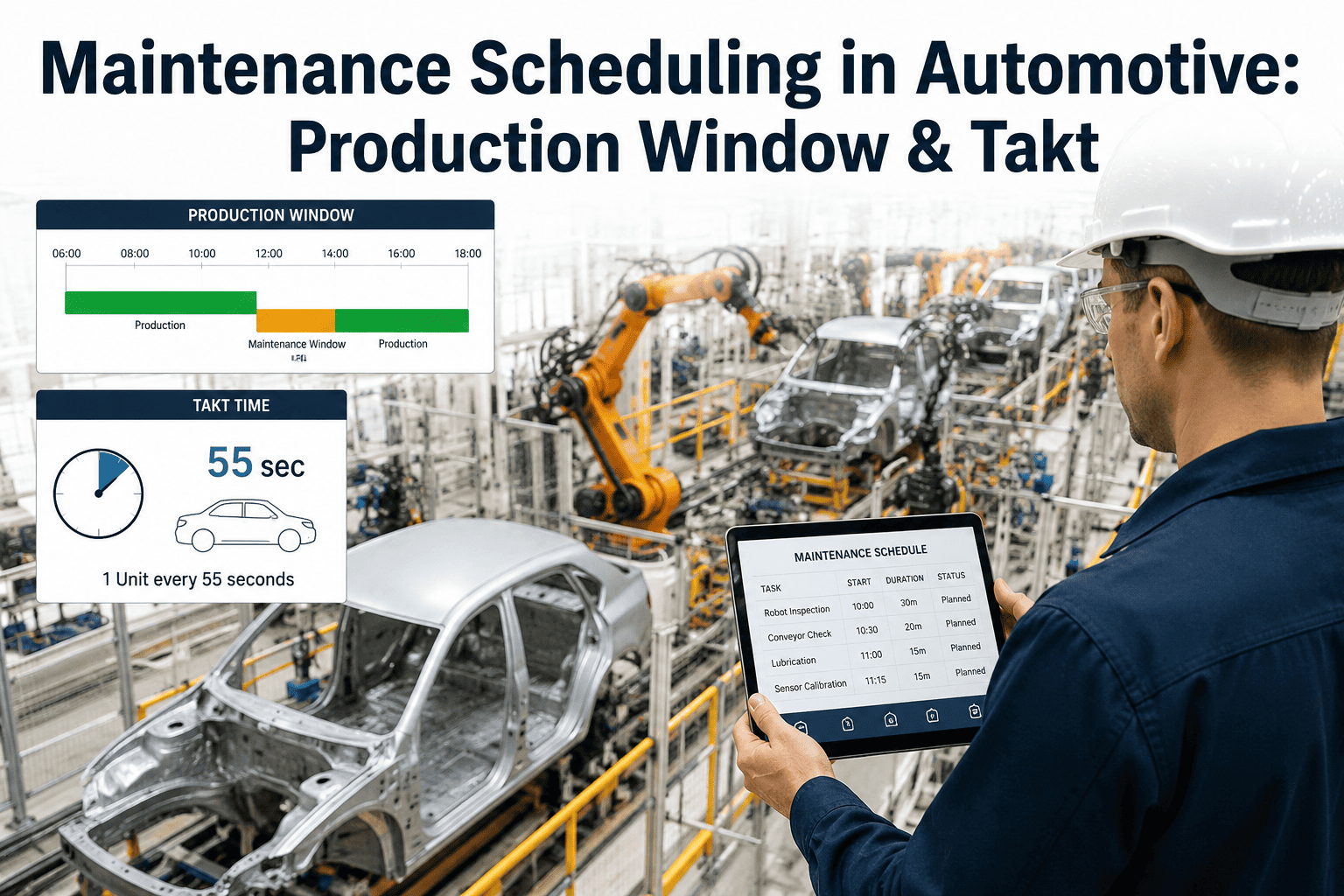
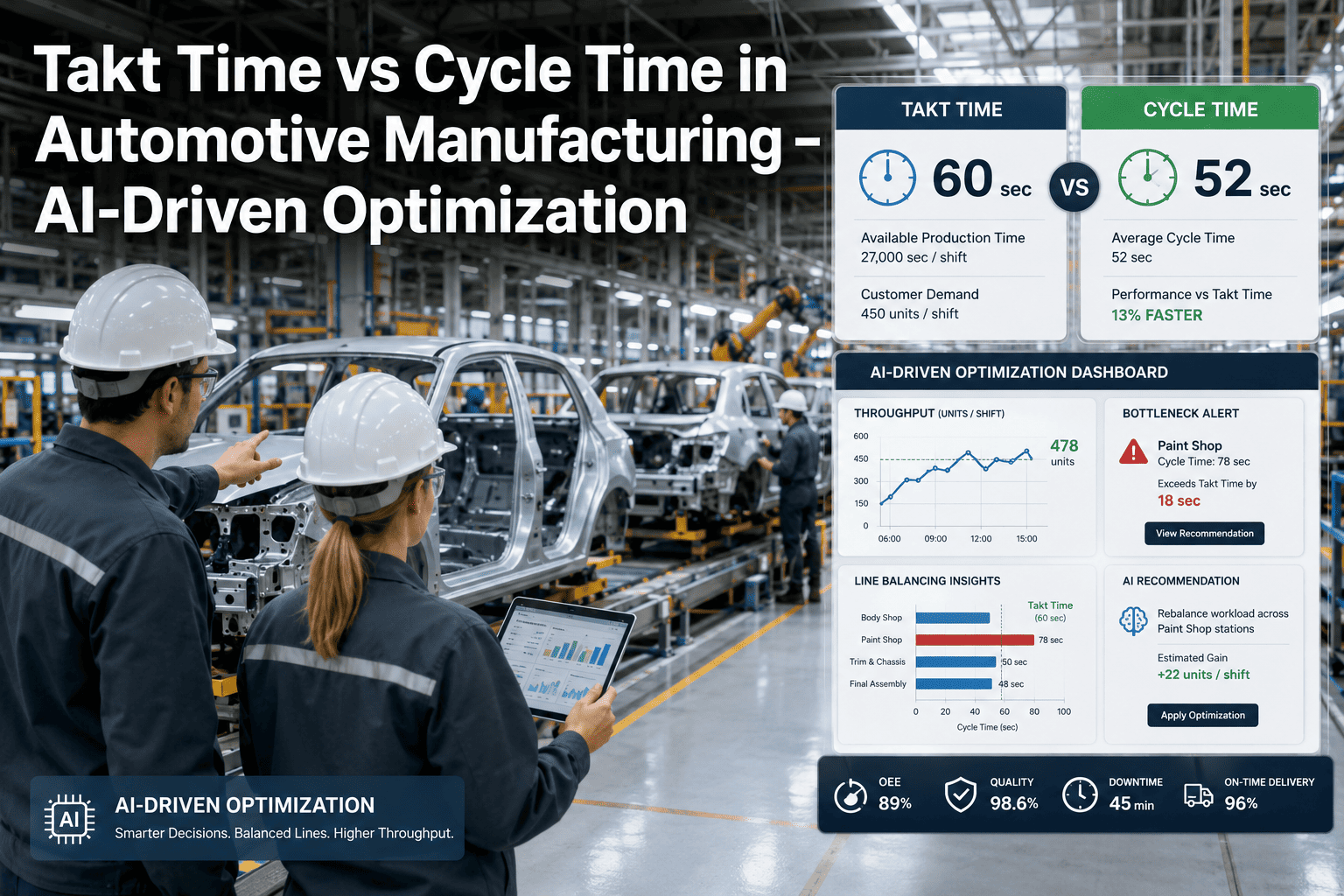
Takt time is the one number an automotive line can't negotiate with — it's set by customer demand, and every station either keeps pace with it or becomes the reason the whole line falls behind. Manual inspection stations are one of the most common places that pace breaks down, because a human checking dimensional or cosmetic quality at speed introduces exactly the kind of variability takt time was designed to eliminate. iFactory's inspection throughput team works with automotive plants to quantify what happens to productivity once inspection stops being the bottleneck station on the line.
If Your Bottleneck Station Is Inspection, Every Other Station Is Waiting on It
Takt adherence measures how consistently a line hits its required cycle time. When inspection can't keep pace, the delay doesn't stay local — it propagates backward through the whole line as work-in-process buildup and forward as shipment risk.
Why Inspection Becomes the Bottleneck Station So Often
A manual inspection station has to do something no other station on the line does: make a judgment call, not just perform a fixed motion. That judgment takes variable time depending on the inspector, the specific units being checked, and how tired the inspector is by hour six of a shift — which is exactly why inspection so often runs above takt while the stations around it run comfortably under it. The fix most plants reach for first, adding a second inspector, only shifts the cost from cycle time to headcount without solving the underlying variability.
Takt Time
The maximum time allowed per unit to meet customer demand — calculated as available production time divided by required output. Every station must operate at or under this number.
Cycle Time
The actual time a station takes to complete its work on one unit — the number that gets compared against takt to determine whether a station is keeping pace or falling behind.
Takt Adherence
The percentage of cycles where a station's actual cycle time stayed at or under takt — a station with poor adherence creates unpredictable buildup even if its average cycle time looks acceptable.
Bottleneck Propagation
The way a single slow station's delay spreads backward as queue buildup and forward as gaps — a bottleneck station's impact is rarely contained to itself.
What Changes When Inspection Runs at Line Speed
AI inspection systems check each unit in a fixed, repeatable amount of time regardless of fatigue, shift, or the specific defect pattern present — which converts inspection from the line's least predictable station into one of its most predictable. That predictability is what actually drives the productivity gain, more than raw speed alone.
| Throughput Factor | Manual Inspection Station | AI Inspection Station |
|---|---|---|
| Cycle Time Variability | High — shift, fatigue, and inspector-dependent | Low — fixed processing time per unit |
| Takt Adherence | Often below 85% on complex checks | Typically above 98% once tuned |
| WIP Buildup Before Station | Grows across a shift as fatigue increases | Stays flat, since cycle time doesn't drift |
| Added Headcount to Hit Takt | Frequently required at peak volume | Rarely required once deployed |
The WIP buildup row is where a lot of hidden productivity loss actually lives. Line balancing studies routinely show that a station running above takt for even a portion of a shift creates queue buildup that a second, faster station downstream can't fully absorb — the gain isn't just at the bottleneck station, it's in how much smoother the entire line runs once that one station stops being unpredictable.
Find Out Which Station Is Actually Costing You Throughput
iFactory measures real cycle time against takt at every station on your line, so you know exactly where full-coverage AI inspection would recover the most capacity.
Common Mistakes When Estimating Productivity Gain
Measuring Average Cycle Time Only
A station can have an acceptable average cycle time while still frequently exceeding takt during specific cycles — averages hide exactly the variability that causes real bottleneck behavior.
Ignoring Downstream Ripple Effects
Calculating the productivity gain only at the inspection station itself misses the recovered capacity at every downstream station that no longer waits on a delayed handoff.
Assuming Faster Always Means More Throughput
A station that's already under takt doesn't create additional throughput by getting faster — the gain only materializes at stations that were actually the constraint.
Overlooking Shift-to-Shift Variability
A bottleneck that only appears on the third shift, when fatigue is highest, won't show up in a single-shift throughput study — multi-shift data is required to see the full pattern.
Recovering Capacity: The Calculation Path
Map actual cycle time by station, by shift
Collect real cycle time data across multiple shifts, not a single observation window, since variability often differs meaningfully between shifts.
Identify the true constraint station
Compare takt adherence, not just average cycle time, to find the station actually limiting overall line output.
Model the throughput gain from stabilized cycle time
Project the output increase from bringing the constraint station's cycle time consistently under takt, including recovered downstream capacity.
Convert recovered units into value
Translate additional daily units into revenue capacity, avoided overtime, or deferred capital for a new line, whichever applies to your plant's actual constraint.
A Composite Scenario: The Second Shift That Was Quietly Losing 40 Units a Day
A wire harness assembly plant running three shifts had a final visual inspection station that looked acceptable on paper — its average cycle time across all shifts sat just under the line's 48-second takt target. A closer, shift-separated review told a different story: first shift averaged 44 seconds, comfortably under takt, but third shift averaged 58 seconds, well above it, as inspector fatigue and lower ambient lighting slowed judgment calls on cosmetic defects. The blended average had been masking a bottleneck that only existed for a third of the day.
Once the plant deployed full-coverage AI inspection at that station, cycle time flattened to a consistent 41 seconds across all three shifts, since the system didn't experience fatigue or lighting-dependent judgment variance the way human inspectors did. The recovered capacity on third shift alone was roughly 40 units per day — volume the line had effectively been losing every night without it showing up clearly in any single-shift report, because nobody had looked at the shifts separately before making the investment decision.
Stop Guessing Which Shift Is Losing You Capacity
iFactory breaks down cycle time and takt adherence by shift and by station, so hidden bottlenecks like a slow third shift stop hiding inside a plant-wide average.
Frequently Asked Questions
How do I know if inspection is actually my bottleneck station?
Compare actual cycle time against takt at every station, broken out by shift rather than blended into a single average, since a station can look acceptable overall while still running above takt during specific shifts or peak periods. Visit support to get help mapping cycle time across your own line.
Does faster inspection always mean higher line throughput?
Only if inspection was the actual constraint station to begin with — speeding up a station that was already running comfortably under takt doesn't increase total line output, since the line's throughput is set by its slowest station, not its fastest one.
How much throughput gain is realistic from full-coverage AI inspection?
It depends entirely on how far above takt the inspection station was running beforehand — a station with severe variability and frequent takt violations sees a much larger gain than one that was only mildly over. Book a demo to model the gain against your own cycle time data.
Can adding a second manual inspector solve a takt problem?
It can relieve the symptom by splitting volume across two people, but it adds headcount cost permanently and doesn't address the underlying variability that caused the bottleneck in the first place — the same fatigue and judgment inconsistency simply gets spread across two inspectors instead of one.
How does throughput gain connect to avoiding a new production line?
Recovered capacity from eliminating a bottleneck station can sometimes absorb demand growth that would otherwise require a new shift or a new line entirely, which makes the throughput gain worth far more than its face value in recovered units per day. Contact support to explore whether your current constraint has room to absorb projected volume growth.