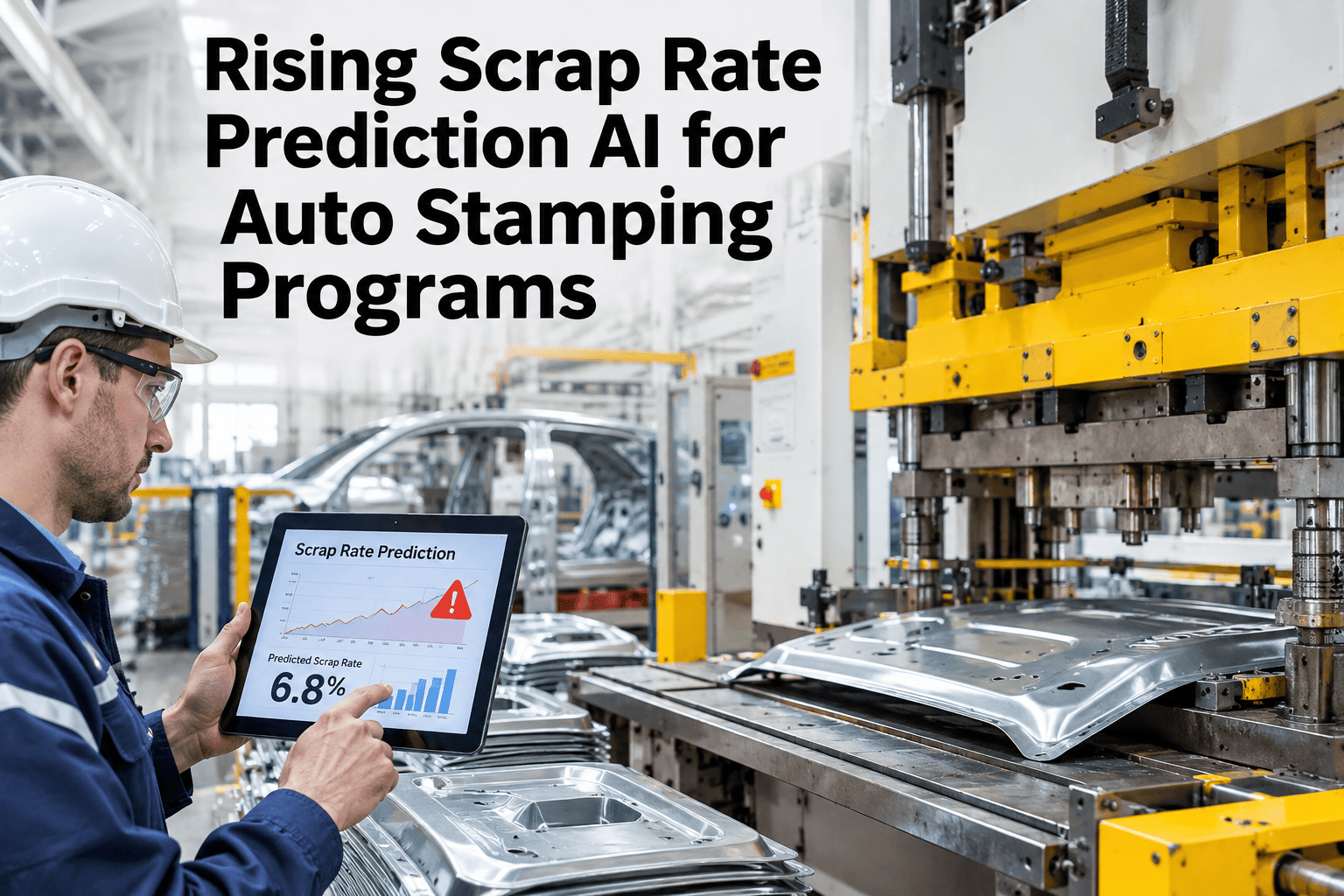
Scrap rate creep in automotive stamping is one of the most expensive quality patterns a press shop can develop — and one of the least visible until it has already cost the program. A part that had a 0.8% scrap rate in January and a 2.1% scrap rate in April did not change overnight. The change accumulated through die wear that shortened the effective punch radius by 0.04 mm per thousand strokes, through a material lot that ran 0.05 mm thicker than nominal, through a coil camber that shifted the blank position by 1.5 mm toward the trim line. Each of these process-drift indicators is individually subtle and collectively catastrophic when they converge — and they are all detectable from press line data weeks before the scrap rate shows a step-change on the quality report. Rising scrap rate prediction AI connects these signals into a forward-looking alert that gives stamping ops teams the window to act. Teams that want to see this built for their own program data can book a session with iFactory AI.
Flag the Scrap-Rate Climb Three Weeks Before the Quality Report Confirms It
iFactory AI correlates die-wear signals, material-lot variation, and process-drift indicators to predict rising scrap rates — giving stamping programs a forward-looking quality alert, not a backward-looking report.
What Is Rising Scrap Rate Prediction AI for Stamping?
Rising scrap rate prediction AI is the application of multi-signal correlation and process-drift detection to stamping press data — identifying leading indicators that precede a scrap rate increase and generating a forward-looking alert before the rate change appears in the quality system.
The prediction is built on the observation that scrap rate increases in stamping are not random events — they are the downstream result of upstream process drift that is detectable from press line data. Die wear advances at a measurable rate and its effect on part geometry is predictable. Material-lot variation shifts the forming force balance in a characteristic pattern. Process parameter drift — lubrication, blank position, tonnage — changes the part-to-die contact in ways that leave signatures in the tonnage monitor and the part count data well before the scrap rate itself moves. Catching these signals 2–4 weeks before the scrap rate rises gives stamping programs a planned intervention rather than a reactive response.
The Four Leading Indicators of Rising Scrap Rate
These four signals, monitored individually or in combination, account for the majority of scrap rate increases in automotive stamping programs. Each has a different time horizon between first detection and scrap rate impact.
Stop Reading the Scrap Report. Start Reading the Signals That Precede It.
iFactory AI correlates die wear, material lot, blank position and process drift into a forward-looking scrap rate alert — giving your program team the window to act, not the report that confirms the loss.
Die-Wear Correlation: Building the Tonnage-to-Scrap Model
The die-wear prediction model is specific to each die and part combination — because the relationship between cumulative strokes, tonnage trend, and scrap rate depends on the die steel grade, the part geometry, the material, and the speed. The model is built from historical production data and updated continuously as new strokes accumulate.
Scrap Rate Benchmarks for Automotive Stamping Programs
Scrap rate targets vary significantly by part complexity, die type, and material. The table below provides illustrative ranges drawn from automotive stamping operations — for context only, as program-specific targets depend on OEM quality requirements and part geometry.
| Part Type | Typical Current Scrap Rate | World-Class Target | Primary Scrap Driver |
|---|---|---|---|
| Body side outer (deep draw) | 1.5–4.0% | Under 0.8% | Splits from lubrication and blank position |
| Door inner (progressive die) | 0.8–2.5% | Under 0.5% | Trim-line variation from coil camber and feed drift |
| Structural reinf. (high-strength) | 2.0–5.5% | Under 1.2% | Springback from material tensile variation; edge cracks |
| Hood / roof outer (Class A) | 3.0–6.0% | Under 1.5% | Surface defects from die condition; lubrication; blank position |
Frequently Asked Questions
How does the system differentiate die-wear scrap from material-lot scrap?
Die-wear-driven scrap builds gradually over thousands of strokes, correlated with cumulative tonnage trend, and persists across multiple coil lots. Material-lot-driven scrap appears at lot change timestamps and resolves or changes when the lot changes. iFactory AI separates these patterns by correlating scrap rate trend with both stroke count and lot change events simultaneously. See how the attribution analysis is displayed in a live walkthrough.
What data does the model need to start producing scrap rate predictions?
The minimum starting dataset is: part scrap count by stroke window (not just per shift), tonnage monitor readings, and material lot identifiers per coil. Feed accuracy and lubrication flow data improve prediction accuracy but are not required to start. Our team can review your current data availability and estimate prediction quality from your existing signals.
Can the model generate automatic die service recommendations to the tool room?
Yes. When the predicted remaining useful strokes before scrap rate impact fall below a configurable threshold, iFactory AI generates a die service recommendation pushed to the tool room planning system — with the predicted remaining strokes and the primary wear indicator as context for the tool room team. Book a session to configure the service recommendation trigger for your die and program portfolio.
How is scrap rate prediction different from real-time scrap detection?
Real-time scrap detection identifies a defective part as it is produced — it is a quality gate, not a prevention tool. Scrap rate prediction identifies the conditions that will cause scrap before they reach the threshold where scrap begins — allowing process correction before parts are scrapped. Both are needed; they address different points in the quality intervention sequence. Ask our team how prediction and detection work together in the iFactory AI quality layer.
Can the prediction model handle high-strength steel programs with more complex springback behaviour?
Yes. High-strength and advanced high-strength steel programs have a different leading-indicator profile — springback sensitivity to material tensile strength variation is the primary scrap driver, rather than lubrication or die edge condition. iFactory AI builds material-specific scrap prediction models per program, with the leading indicators weighted by the dominant scrap mechanism for that part and steel grade. See how AHSS program models are configured in a session.
Catch the Scrap Climb in the Signals — Not in the Report
iFactory AI correlates die-wear signals, material-lot variation, and process-drift indicators into a 2–4 week advance scrap rate alert — giving your stamping program team time to act before the quality system confirms the loss. Book a session built around your program data.