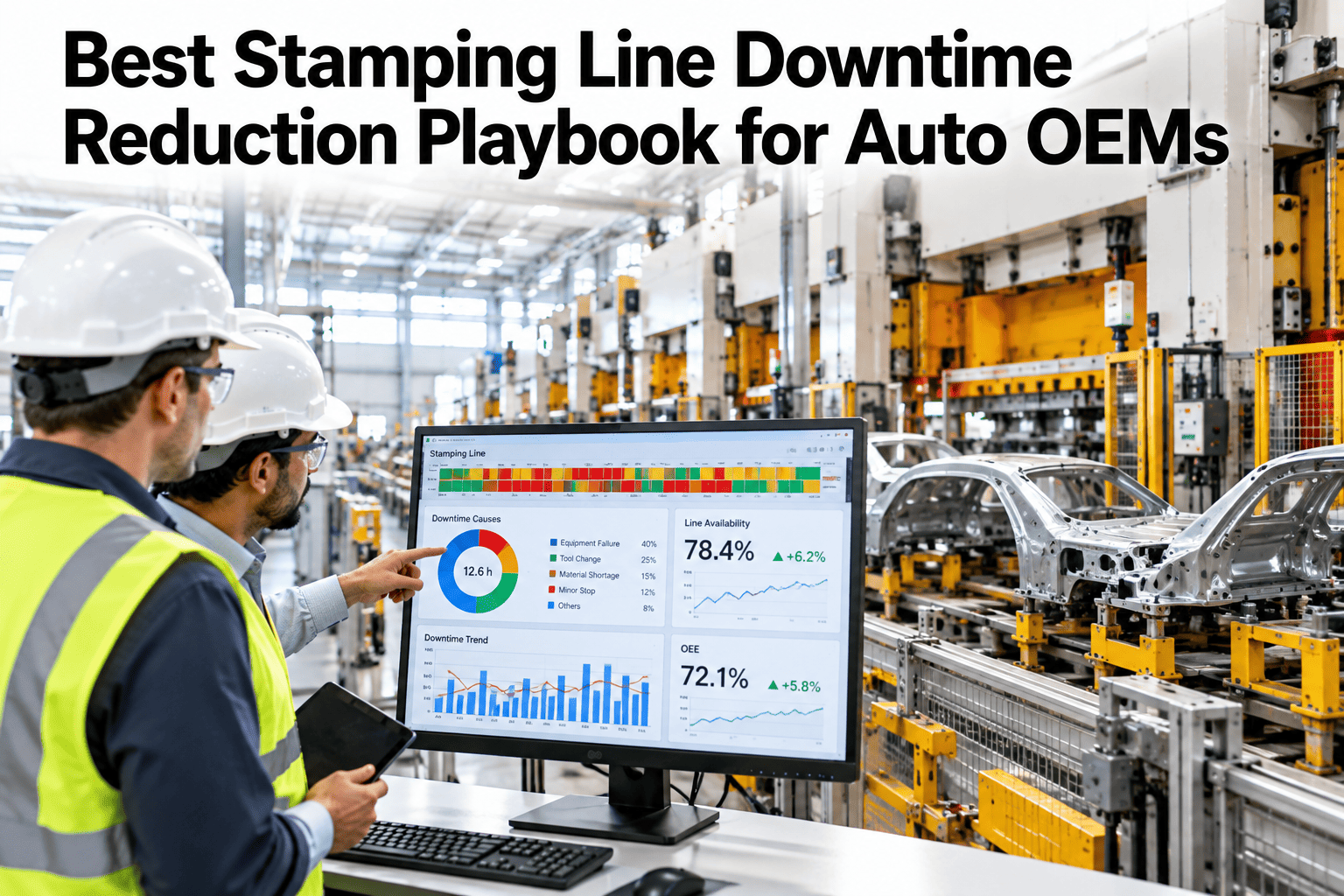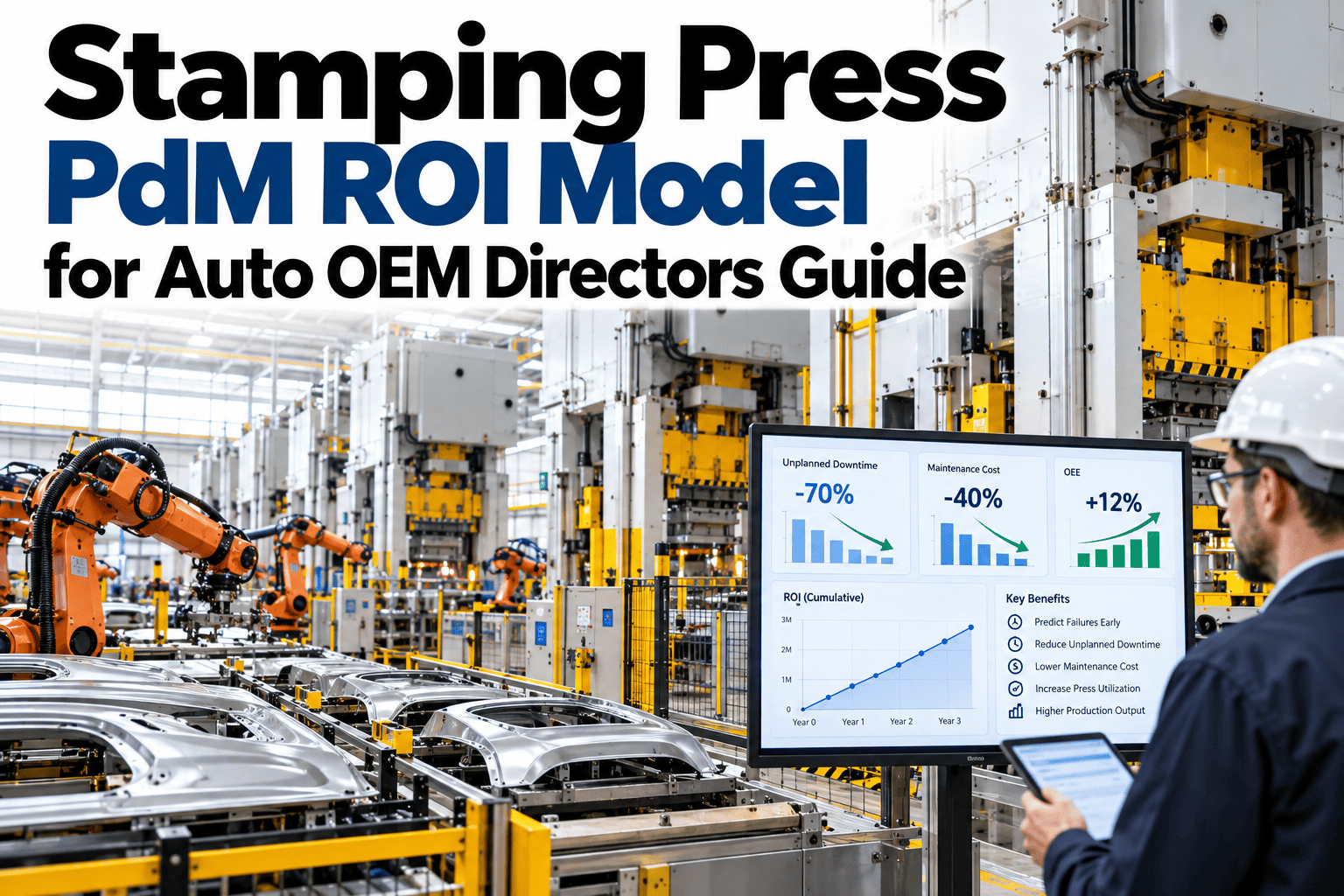
A press-shop head does not need a vendor's slide deck, they need a number their plant director will actually sign. Stamping OEE prediction ROI comes from three stacked sources: the dollar value of each OEE point, downtime avoided through early tonnage and die-wear detection, and scrap cut through tighter quality prediction. Put those three together across a real press line and the case holds up to finance scrutiny, not just a pitch. Press-shop heads who want this modeled against their own tonnage can build a stamping ROI case with the iFactory team.
Three Numbers Stack Into One Defensible Press-Shop Case
iFactory, an on-premise AI platform for stamping analytics, turns tonnage drift, die wear and scrap data into a three-year ROI case a plant director will sign.
What a Stamping ROI Case Actually Needs
A credible case is not one number, it is three. Each driver moves independently on a press line, and a plant director will want each one defended with its own data.
OEE-Point Value
Each point of availability, performance and quality converted to dollars.
Downtime Avoidance
Tonnage drift and die wear caught before a line stop.
Scrap Reduction
Out-of-spec parts caught before they leave the press.
Driver One: What an OEE Point Is Actually Worth
A press line's OEE point value depends on its own throughput and part price, not a generic industry figure. The math is straightforward once those two numbers are known.
Driver Two: Catching Drift Before It Becomes a Stop
Tonnage and ram velocity drift for a while before a press actually fails. Catching that drift early is the difference between a scheduled die change and an unplanned line stop.
See the Downtime Number for Your Own Press Line
Share your current unplanned downtime hours, and iFactory will model the avoidance driver of your ROI case.
Driver Three: What Tonnage Drift Actually Costs in Scrap
Drift does not usually stop a press, it quietly produces parts at the edge of print tolerance. On a fast transfer press, that adds up within minutes.
| Drift Duration | Scrap Produced | Illustrative Cost |
|---|---|---|
| 10 minutes undetected | ~200 scrap parts | ~$2,800 |
| 30 minutes undetected | ~600 scrap parts | ~$8,400 |
Why a Press Line Has No Buffer to Hide Behind
In a just-in-time automotive plant, a single minute of unplanned downtime on a critical press line can halt an entire assembly plant. There is no inventory cushion absorbing the loss.
A Real Example: 16 Presses, 25 Million Parts, 20 Months
The most extensively documented predictive OEE deployment in stamping operations ran across 16 presses for 20 months, monitoring 25 million parts. The result was a 46 percent scrap reduction and a 31 percent OEE improvement, from 64 to 84 percent.
This kind of result is specific to that deployment. Your own gain will depend on your starting scrap rate, line speed and part value.
Why Micro-Stops Hide From the OEE Number
A large share of downtime events on a press line last under three minutes, short enough that a standard MES never logs them. At high cycle rates, each one still costs real units.
Common Mistakes in a Stamping ROI Pitch
| Mistake | Fix |
|---|---|
| One blended savings number | Show OEE value, downtime and scrap separately |
| Using a generic industry benchmark | Use your own line's throughput and part value |
| No year-one deployment cost shown | Show the full three-year curve, not just the end state |
Stacking the Case Over Three Years
Who Signs Off on This Case Before It Reaches Capital
A press-shop ROI case usually needs sign-off from more than one function before it reaches a capital committee. Getting each perspective right the first time avoids a slower second pass.
Press-Shop Head
Owns the operational numbers and the pilot scope.
Plant Finance
Validates the OEE-point value and payback math.
Quality Engineering
Confirms the scrap baseline and target Cpk.
What a Pilot Quarter Typically Looks Like
Most plants prove the case on one line before deciding whether to scale, which keeps the first capital ask small and the result measurable within a single quarter.
Where iFactory AI Fits
iFactory connects tonnage, die-wear and quality signals to a dollar-value dashboard a press-shop head can defend in a capital review. Deployment runs on your own server, so tonnage and production data stay inside the plant network rather than a third-party cloud.
Tonnage Drift Detection
Stroke-by-stroke monitoring flags drift before a failure.
Dollar-Value Dashboard
OEE, downtime and scrap tracked against the original case.
Pilot-to-Scale Path
One line proves the case before committing to the full plant.
Keeping the Case Honest After Go-Live
A model built before deployment is a forecast. The number that actually matters is the one tracked against real press data once the system is running.
Frequently Asked Questions
How fast does a stamping ROI case typically pay back?
Reported deployments range from under a year to as little as a few months, depending mainly on the plant's starting scrap rate and downtime baseline. Model your own timeline with us.
Do we need new sensors to start?
Many plants already have tonnage monitors and PLC fault-code signals that just need connecting into one dashboard, rather than new hardware on the press. Ask support about your current sensors.
Which driver should a first pilot focus on?
Scrap reduction usually shows the fastest measurable result, since it can be verified directly against existing scrap-rate records within the first weeks. Discuss a pilot scope with the iFactory team.
How many presses should a pilot cover?
Most plants start with a single line, often the constraint line or the one the plant director complains about most, before deciding whether to scale. Scope a single-line pilot for your plant.
What data do you need to build our case?
Current scrap rate, unplanned downtime hours and line throughput are the three core inputs, and a year of existing records is usually enough to start. Send your current numbers for a first model.
Give Your Plant Director a Number, Not a Pitch
Book a session with iFactory and get a three-driver ROI model built against your own press line data.