A stamping press fails fast. A die crash, a breached guard or a hydraulic failure can go from normal running to a stopped line in less than a second, and what the operator and the team do in the next few minutes decides whether it is a short stop or a multi-week repair. A written, drilled response removes hesitation at the worst possible moment. Ops teams building or refreshing theirs can see how iFactory AI flags press conditions before they reach an emergency stop before the next safety review.
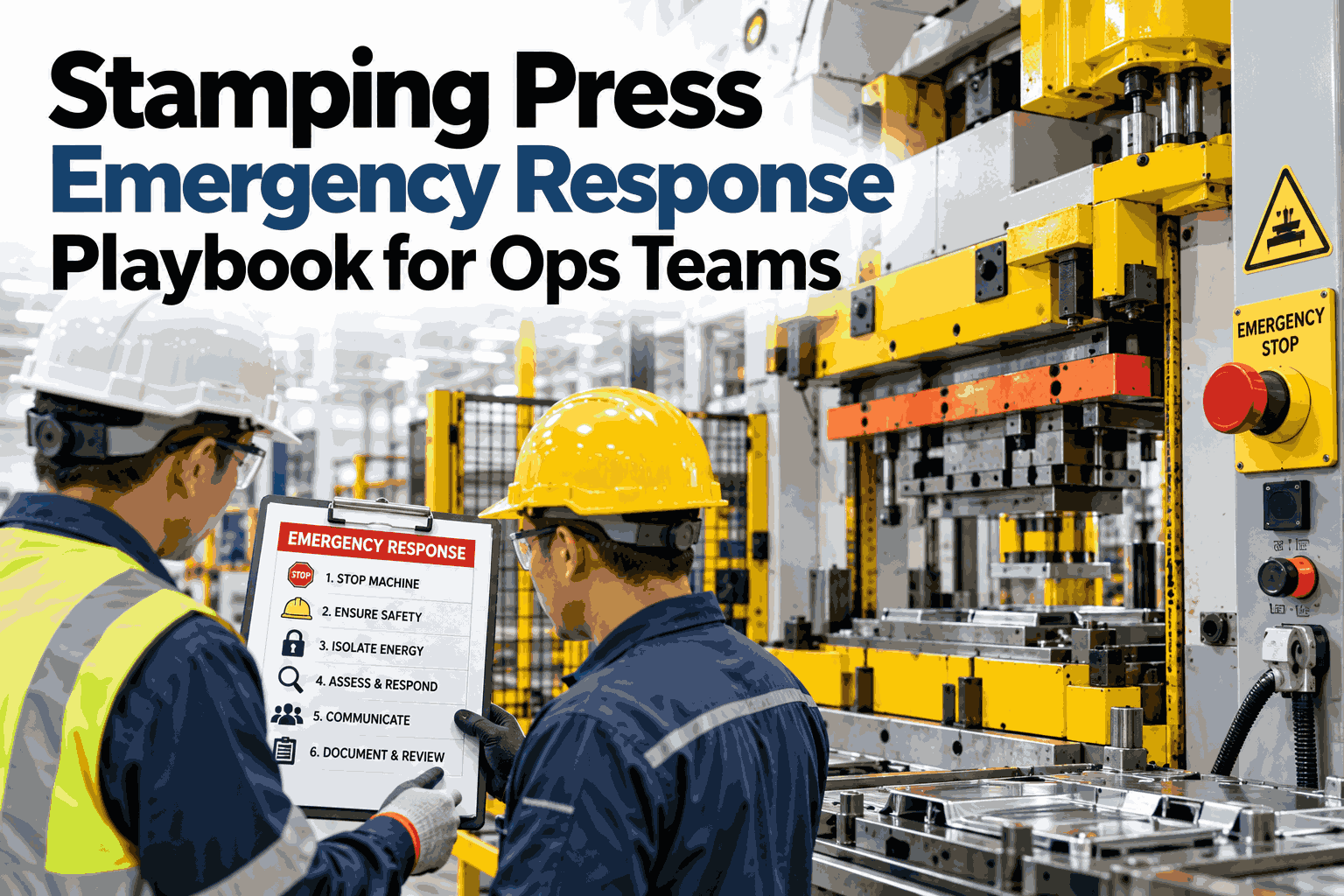
Stamping Press Emergency Response Playbook for Ops Teams
Three failure modes, three response sequences, one standard everyone on the line should know by heart.
Priorities, in Order, Every Time
Whatever the failure, the order of concern does not change. Train it until it is automatic.
People first: stop, clear, confirm no one is at risk.
Contain: prevent a second failure or a wider spread.
Tooling: protect the die and press from further damage.
Record: capture what happened while it is fresh.
Checklist: Die Crash
A crash can bend pins, crack sections or misalign the die. Moving too fast to restart risks turning a repairable crash into a scrapped die.
Catch the Conditions That Lead to a Crash
Book a 30-minute session and iFactory AI will show how die health and press signals are watched for early signs of a developing crash.
Checklist: Guard Breach
A breach means the safety barrier protecting the point of operation has failed or been bypassed. Treat every breach as a near miss until proven otherwise.
Checklist: Hydraulic Failure
A hydraulic failure can mean lost pressure, a leak under high pressure, or sudden uncontrolled motion. Fluid under pressure is dangerous even after the press stops.
See Hydraulic Drift Before It Becomes a Failure
Book a 30-minute session and iFactory AI will show how pressure, temperature and cycle data flag a hydraulic system drifting out of normal range.
Roles During the First Ten Minutes
Confusion over who does what wastes the minutes that matter most. Assign these roles in advance.
Stops the press, clears the area, raises the alarm.
Confirms lockout, notifies maintenance and EHS, controls access.
Diagnoses the failure and decides what can be safely restarted.
Inspects tooling damage or leads the incident investigation.
What to Capture for the Post-Incident Review
A good record turns one incident into a lesson for the whole plant. Capture these before memory fades.
| Field | Why It Matters |
|---|---|
| Press, die and part number | Links the event to the right asset and tooling history |
| Time and cycle count | Helps spot patterns against shift, speed or run length |
| Immediate cause | What was observed at the moment of failure |
| Contributing factors | Conditions that made the failure more likely |
| Downtime and damage | Supports the cost case for prevention |
Drilling the Playbook
A checklist nobody has practised is a checklist nobody follows under stress. A review of your own drill schedule can help set a realistic cadence.
Tabletop walkthrough of each failure mode with the full shift team.
Live drill with lockout, communication and roles tested in sequence.
Review what worked, what was missed and update the checklist.
Where iFactory AI Fits
iFactory AI watches press and die signals continuously, so some emergencies are prevented rather than only responded to.
Early die health flags
Shifts in force, alignment or vibration are flagged before they reach a crash.
Hydraulic condition tracking
Pressure and temperature trends show drift ahead of a failure.
Incident history by asset
Past events are stored against the press and die, informing the next inspection.
Ask in plain language
Ask which press shows rising risk this week and receive the ranked answer.
iFactory AI arrives pre-configured on an NVIDIA server that ships racked and ready with software pre-loaded. Scope covers cabling, network, ERP and MES integration, team training and 24x7 remote monitoring.
Frequently Asked Questions
What should the first action be in any press emergency?
Stop the press and clear personnel from the point of operation, before anything else is assessed. People come before tooling in every version of this checklist. You can watch how early warning signals are surfaced before an emergency stop in a live session.
Can predictive maintenance prevent a die crash?
It can reduce the chance by flagging drift in force, alignment or vibration before a crash occurs, though it cannot remove all risk from a mechanical process. The response checklist still matters for the events that do happen. To see how flags are set, request a die health review with the iFactory AI team, or ask support what sensor data is needed.
Who should be notified after a guard breach?
Maintenance, supervision and EHS should all be notified, since a breach is both an equipment issue and a safety incident. Production should not resume until the guard is verified and tested. A short product tour of incident logging shows how these events are tracked.
How often should emergency drills be run?
A common pattern is a tabletop walkthrough quarterly and a full live drill yearly, with a review after every real incident. The right cadence depends on your plant's risk profile and regulatory requirements. See how incident history can inform drill planning in a guided walkthrough.
What data should every incident record include?
Capture the press, die and part number, time and cycle count, the immediate cause, contributing factors, and downtime and damage. This supports both the investigation and the business case for prevention. Schedule a walkthrough of incident data views to see how records are organised.
Respond Fast, and Prevent More of the Calls
iFactory AI watches press and die health continuously, so fewer emergencies reach the checklist at all. Book a walkthrough to see it built around your own line.