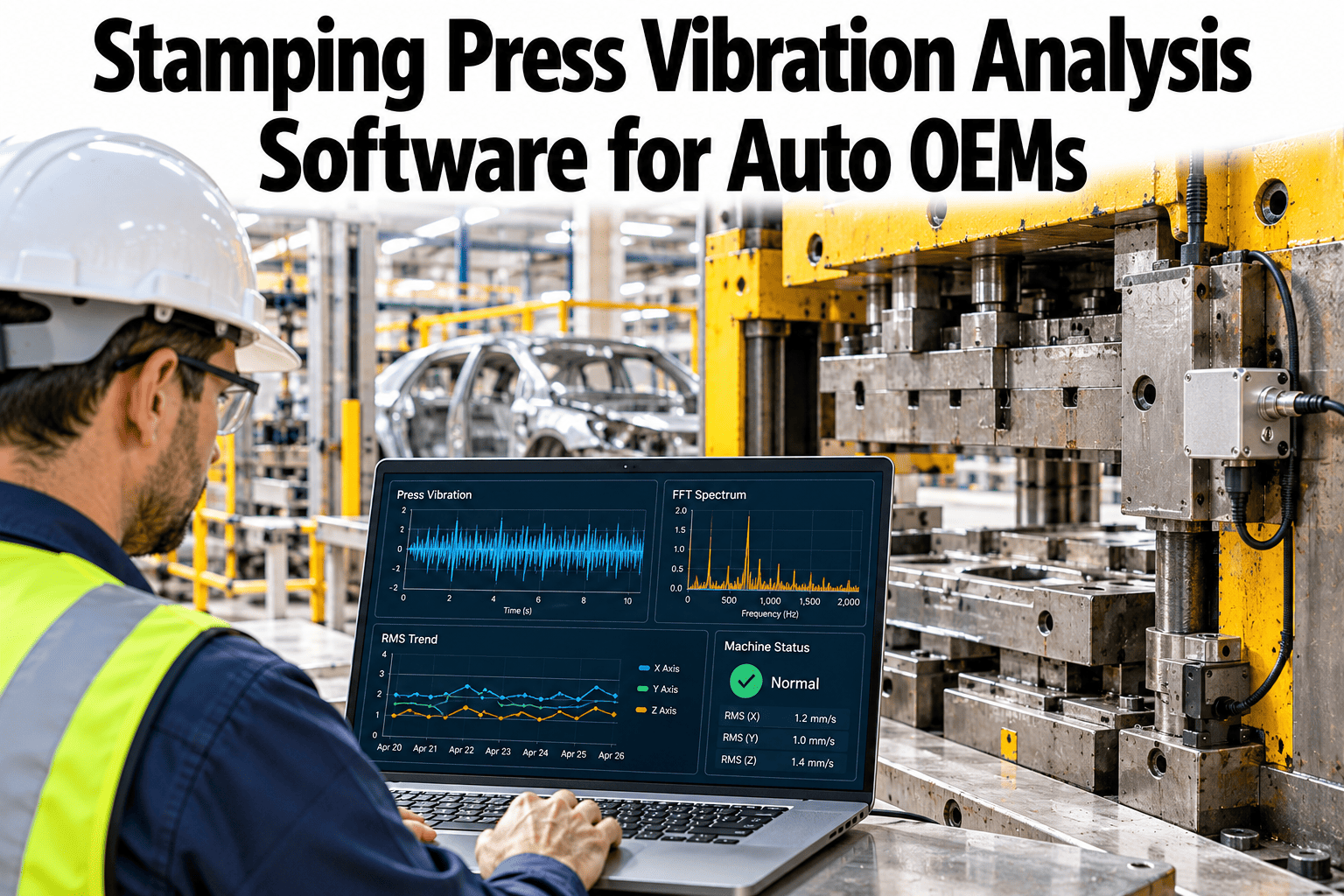
A stamping press rarely fails without warning. Weeks before a frame crack or a gib seizure takes a line down, the press is already vibrating differently than it did the month before, but that shift is invisible to an operator listening for a loud bang. Most auto OEM plants still rely on scheduled teardown or the operator's ear to catch structural trouble, which means the press has to get loud before anyone acts, and by the time it is loud the damage is already expensive. Vibration signature analysis changes that timeline by reading the frame, gib and slide continuously, and teams who want to see what that looks like on a real press can walk through a live vibration trend on their own stamping line.
Hear the Press Fail Before It Sounds Like Failure
iFactory AI reads frame, gib and slide vibration signatures continuously, flagging structural drift in a stamping press weeks before a crack, a seized gib or a slide misalignment forces an unplanned line stop.
Why Stamping Presses Hide Their Own Damage
A stamping press is a closed steel frame absorbing enormous repeated impact loads, and that structure is very good at masking early fatigue. Small cracks, loosening gibs and shifting slide alignment all change how the frame rings under load long before any of it shows up as noise a person can hear on the floor, which is exactly why structural failures on a press still catch maintenance teams off guard.
Without a baseline, there is nothing to compare a new reading against, so a drifting signature just looks like normal press noise until the drift is severe enough to be obvious. By then the gib has already worn unevenly or the frame has already propagated a crack, and the fix is a full teardown instead of a tightened gib or a shimmed rail.
The Three Signals Worth Watching
Not every vibration reading predicts the same failure mode. Frame, gib and slide each produce a distinct signature, and reading them together is what separates a useful early warning from background noise.
From First Signature to Confirmed Fault: A Timeline
Structural drift rarely appears overnight. The pattern below reflects how a typical gib wear fault progresses across weeks once vibration monitoring is in place, moving from a flagged anomaly to a scheduled repair instead of an unplanned stop.
| Week | Signature Behavior | Recommended Action | Without Monitoring |
|---|---|---|---|
| Week 1 | Baseline stable | None | No visibility |
| Week 2 | Gib amplitude up 8% | Log and watch | No visibility |
| Week 3 | Gib amplitude up 19% | Flag for inspection | No visibility |
| Week 4 | Amplitude crosses threshold | Schedule gib service | Press still running normally on the floor |
| Week 6 | Fault would be audible | Repair already completed | Unplanned stop, likely mid-shift |
Put Your Press Signature on the Table
Book a 30-minute session and see how iFactory AI reads frame, gib and slide vibration on a stamping line like yours, using your own sensor placement.
Why a Fixed Teardown Calendar Misses Both Directions
Most stamping lines still inspect presses on a fixed calendar interval regardless of how the press is actually behaving, which fails in two opposite ways at once. A press that is drifting fast gets inspected too late, after the fault has already progressed past the point of a simple fix. A press that is running cleanly gets torn down anyway, consuming labor hours and production time on a structure that did not need the attention yet.
Vibration-based condition monitoring replaces that fixed calendar with a signal tied to the press itself. A press running clean can safely go longer between teardowns, while a press showing early drift gets flagged well before the next scheduled inspection would have caught it. The net effect is fewer total teardown hours across a fleet of presses, not just fewer surprises on any single one.
Where Sensors Belong on a Stamping Press
Sensor placement determines whether a vibration monitoring program catches real structural trouble or just collects noise. These four placement zones cover the failure modes that account for most unplanned stamping press stops.
Frame Uprights
Accelerometers mounted near the base of each upright catch resonance shifts from early fatigue before a crack reaches the surface.
Gib Rails
Sensors at the top and bottom of each gib rail isolate wear patterns that a single mid-rail sensor would average out and miss.
Slide Corners
Four-corner slide sensors catch asymmetric vibration that a center-mounted sensor cannot distinguish from normal operation.
Bed and Bolster
A bed-mounted reference sensor separates press-structure vibration from floor and foundation vibration transmitted from nearby equipment.
How a Single Gib Fault Ripples Into Quality Rejects
A worn gib does not just risk a press breakdown, it risks the parts the press is making right now. As gib clearance opens up, the slide loses some of its precision on the way down, which can show up first as a dimensional drift on parts long before the press itself is loud enough to raise concern.
Quality teams often catch this before maintenance does, through a rise in rejected parts or a tightening tolerance window that keeps slipping. Connecting vibration data to the quality side closes that loop, so a dimensional trend on the quality floor can be checked against the press's own gib signature instead of being treated as a separate, unexplained problem.
What Changes When Maintenance Trusts the Signature
The real value of vibration analysis is not the sensor data itself, it is the decision a maintenance planner can make with it. A trusted signature turns a vague "the press sounds a little off" into a specific, schedulable repair.
The Cost Comparison Maintenance Leaders Actually Use
When a vibration program is proposed, the first question from a plant manager is usually about cost, but the more useful comparison is not sensor cost against nothing, it is the cost of a planned repair against the cost of an unplanned one. The gap between those two numbers is where the program pays for itself.
| Cost Category | Planned Gib Service | Unplanned Frame Repair |
|---|---|---|
| Labor | Scheduled shift, standard crew | Emergency callout, often overtime |
| Parts | Ordered ahead of time | Expedited freight, premium pricing |
| Line downtime | Planned around production schedule | Mid-shift stop, unplanned backlog |
| Secondary damage | None, caught early | Possible, if fault propagated before shutdown |
The parts and labor for a planned gib service and an unplanned frame repair might look similar on paper, but the surrounding costs rarely do. A planned repair fits into an existing production schedule, while an unplanned one usually forces a line to absorb a stop it had no way to plan around, which is where most of the real cost actually lands.
Where iFactory AI Fits
Vibration data is only useful if it reaches the people who schedule repairs, in a form they can act on without interpreting raw waveforms themselves. iFactory AI turns continuous frame, gib and slide readings into a maintenance-ready signal, connected to the systems a plant already uses to plan work.
Continuous Signature Capture
Frame, gib and slide accelerometers stream data around the clock, building a baseline unique to each press rather than a generic threshold.
Drift Detection and Alerting
Deviations from baseline are flagged automatically and routed to the maintenance team before the drift becomes audible on the floor.
Work Order Integration
Confirmed anomalies generate a scoped work order directly in the plant's CMMS, with the affected zone already identified.
Press-by-Press History
Every press keeps its own signature history, so a planner can see whether a repair actually reset the baseline or only masked the symptom.
Building the Case Inside the Plant
A vibration monitoring proposal usually needs sign-off from more than one department, and each one is weighing a different concern. Maintenance wants fewer surprise teardowns. Finance wants a defensible payback period. Quality wants fewer dimensional rejects traced back to the press. A proposal that only speaks to one of those groups tends to stall in review.
Expert Review
Stamping maintenance leads who have run vibration programs for years tend to agree on one point: the hardest part is not the sensors, it is trusting a quiet press that the data says is already drifting. Teams that act on the signature instead of waiting for the sound consistently report fewer surprise teardowns and shorter repair windows, because the scope of the fix is known before the press is opened. Bring your own press history to a working session and see how a real signature compares to the thresholds a generic sensor package would use.
Frequently Asked Questions
How long does it take to build a reliable baseline signature?
Most presses need two to four weeks of continuous running data to establish a stable baseline, since the signature has to capture normal variation across different die sets and production speeds. Ask how baseline length varies for your press mix in a short session.
Can vibration analysis predict die-related problems too?
Frame and slide signatures can surface die-related issues like uneven loading, but die-specific wear is better tracked with separate die health monitoring. The two data sets complement each other rather than replacing one another.
Does this work on older presses without factory sensors?
Yes, accelerometers are retrofit-mounted externally on the frame, gib and slide, so the press does not need built-in instrumentation. Most retrofits are completed without extended downtime. Ask support about retrofit timing on older press models.
How many false alerts should a plant expect?
Early weeks typically produce more alerts while thresholds are tuned to each press's own baseline, and that number drops sharply once the model has enough history to separate normal variation from real drift.
Who receives the drift alerts once the system is live?
Alerts route to whichever maintenance planning workflow the plant already uses, typically the CMMS work order queue, so the people who schedule repairs see the signal without needing to watch a separate dashboard. Ask how alert routing is configured for your maintenance team's structure.
Catch Structural Drift Before the Press Does
iFactory AI reads frame, gib and slide vibration continuously against your press's own baseline. Book a walkthrough to see a real signature in action.