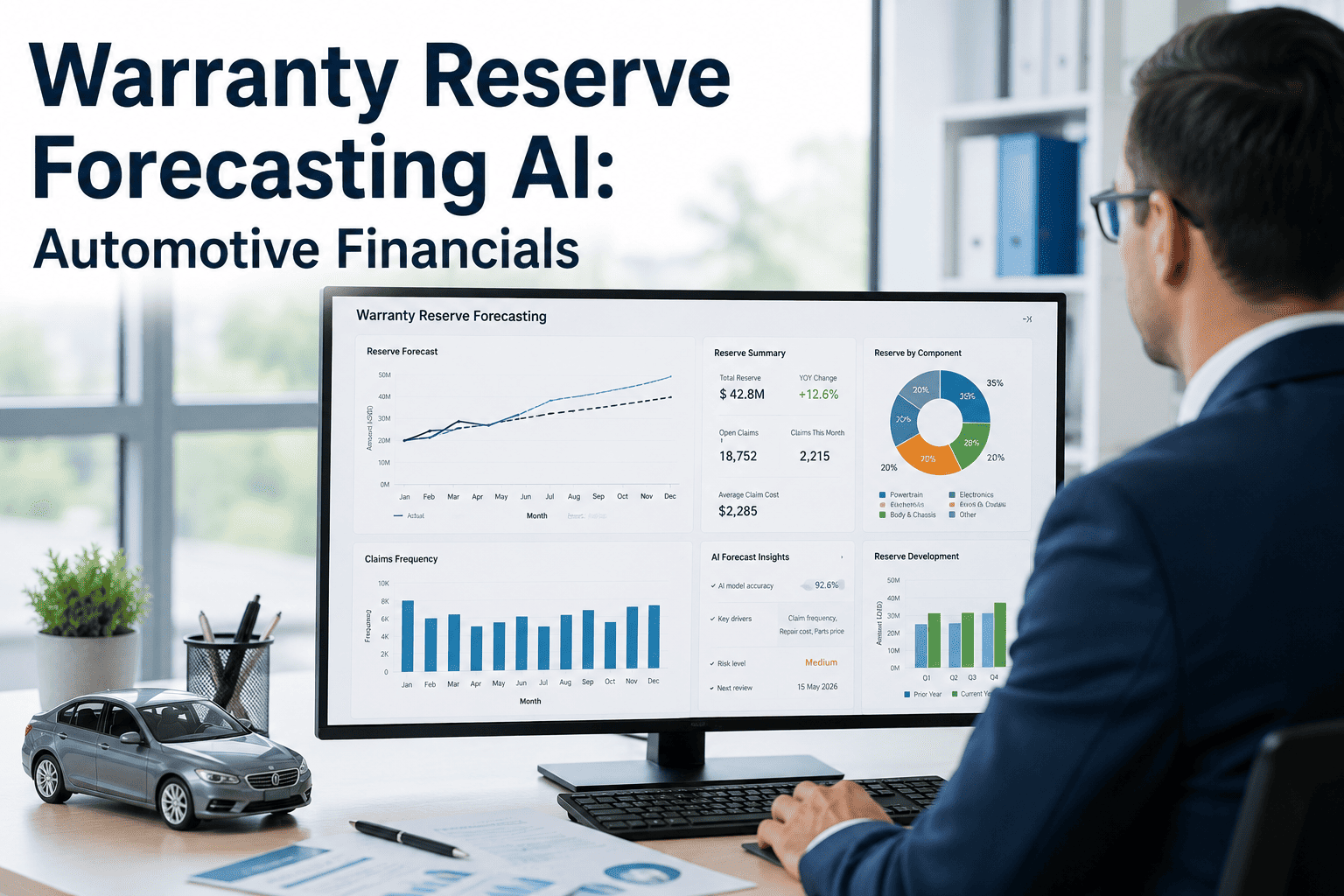
Warranty reserves sit on the balance sheet as an estimate of future claim cost for vehicles already sold, and getting that estimate wrong in either direction creates real financial pain. Under-reserving means a nasty earnings surprise when claims come in above forecast, while over-reserving ties up capital that could be deployed elsewhere and can draw questions from auditors about forecasting discipline. The traditional approach, extrapolating claim rates from historical averages by model year, works reasonably well when nothing has changed, but breaks down whenever a new component, a supplier change, or a shift in customer usage patterns moves actual claim behavior away from what history alone would predict. This page looks at where standard reserve forecasting methods fall short, how AI-based prediction models improve on them, and what it actually takes to get a forecasting model trustworthy enough for a finance team to rely on. You can book a demo to see how iFactory connects claim trend data to reserve forecasting models built for your specific fleet.
Warranty Reserves Built on Predicted Claim Behavior, Not Just Historical Averages
iFactory models claim volume and cost trajectories against your actual fleet composition, so reserve estimates reflect what's likely to happen next, not just what happened last year.
Reserve Models Built on Last Year's Claims Miss What's Changing This Year
The classic warranty reserve method takes historical claim rates by model, model year, and time-in-service, and applies them forward against projected vehicle population to estimate future claim volume and cost. This approach works reasonably well in a stable environment, but automotive manufacturing rarely stays stable for long. A supplier changes a component mid-model-year, a software update shifts how a feature gets used, or a new plant starts building a portion of the volume with slightly different process parameters, and each of these can move actual claim behavior meaningfully away from what the historical baseline predicts.
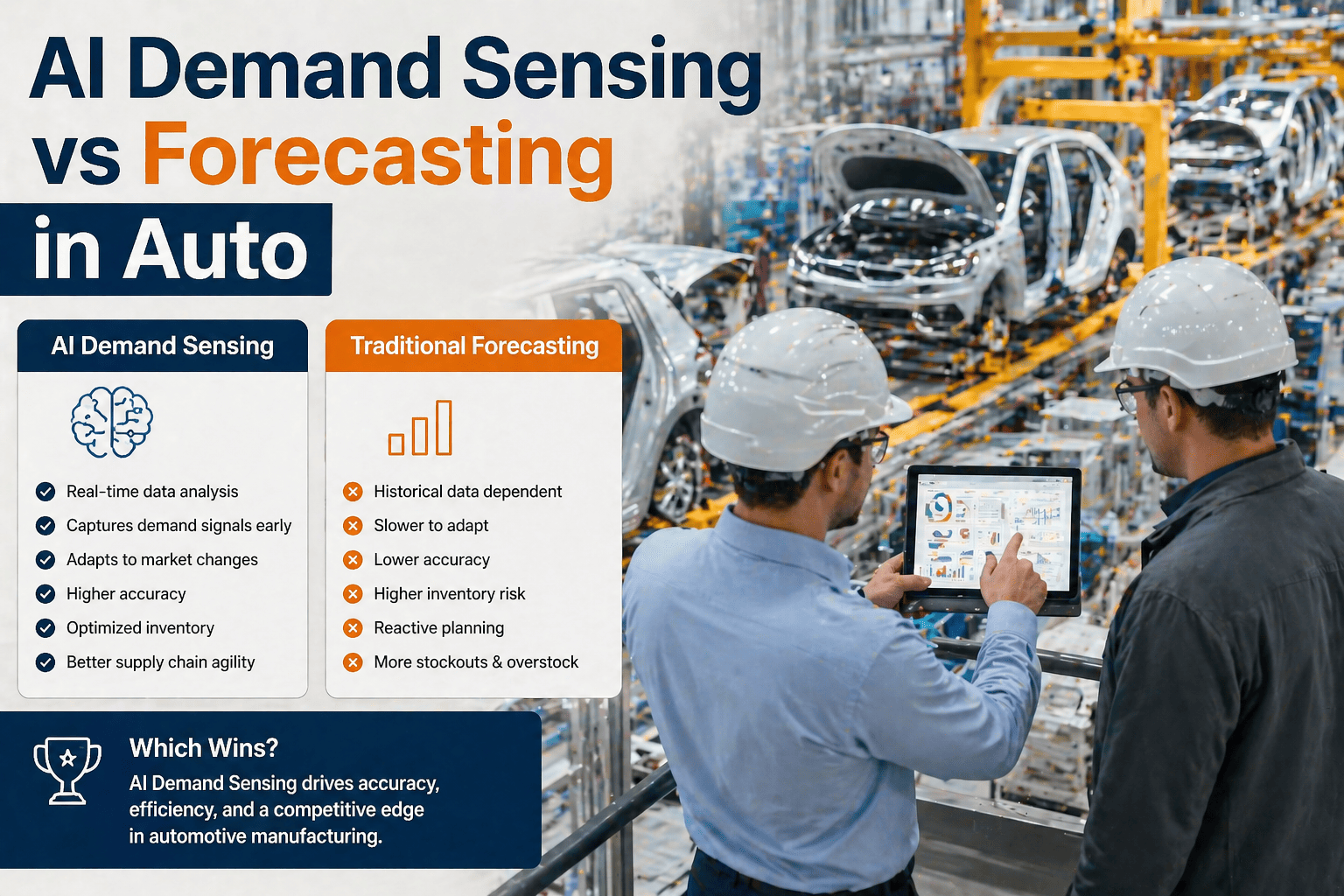
- Assumes future claim behavior mirrors past claim behavior
- Slow to react to mid-year component or supplier changes
- Treats all vehicles in a model year as equivalent
- Reserve adjustments typically made quarterly, after the fact
- Incorporates leading indicators like early claim rate shifts
- Adjusts predictions as new claim data arrives continuously
- Accounts for component, supplier, and plant-level variation
- Surfaces reserve risk changes closer to real time
The Inputs That Make a Forecast More Than a Historical Average
An AI-based reserve forecasting model isn't a black box guessing at future claims; it's a statistical model trained on the same underlying data a finance analyst would want to see, just processed at a scale and speed a manual review couldn't match. The quality of the forecast depends heavily on how many of these inputs are actually connected and current.
How claim frequency typically develops over a vehicle's warranty period, segmented by component category rather than treated as a single blended rate.
Current and projected fleet size by model, trim, and build plant, since claim exposure scales directly with how many vehicles are actually in service.
A record of when specific components or suppliers changed mid-production, so the model can separate vehicles built before and after a change that might affect claim rates.
Leading indicators such as early complaint volume or first-90-day claim rates that tend to correlate with how a defect category will trend over the full warranty period.
Labor rate changes, part cost inflation, and shifts in repair procedure that affect the cost side of the equation independent of claim volume itself.
Claim patterns for certain component categories vary meaningfully by region and climate, and folding that variation into the model improves accuracy over a single national average.
Prediction Confidence Improves as a Model Year Matures
No forecasting model, human or AI, can predict warranty cost for a brand new model year with the same confidence as one that's been in service for eighteen months and has real claim data accumulating. What AI-based forecasting adds is a more disciplined way of updating that confidence as data comes in, rather than waiting for a scheduled quarterly review to revise the estimate.
Forecast relies heavily on prior model year and platform-level history; wide confidence interval expected.
Early claim data starts refining the forecast; component-specific deviations from prior year become visible.
Enough claim volume exists to substantially tighten the forecast range for most component categories.
Model behaves close to a stable historical baseline, with ongoing monitoring for late-developing failure modes.
Why Reserve Accuracy Matters Beyond the Warranty Team
Warranty reserve adequacy isn't just an operational metric buried in a quality dashboard; it directly affects reported earnings, and material reserve adjustments draw scrutiny from auditors and, for public companies, from investors trying to understand whether the business has visibility into its own product quality trends. A reserve forecast that's consistently too conservative overstates liabilities and depresses reported earnings unnecessarily, while one that's consistently too optimistic risks a sudden reserve charge that surprises the market.
Finance teams working with quality and engineering to build more responsive forecasting models aren't just improving an internal process metric, they're reducing the frequency and size of the reserve true-ups that create noisy, hard-to-explain swings in quarterly results. A forecasting approach that incorporates leading indicators and updates continuously tends to produce smaller, more frequent adjustments rather than large, infrequent ones, which is generally easier to explain to both internal leadership and external stakeholders.
A Practical Path to Better Reserve Forecasting
Pick a single model line with reasonably clean historical claim data as the pilot for a more responsive forecasting approach before expanding to the full lineup.
Break the forecast down by major component system rather than a single blended vehicle-level rate, since claim behavior varies significantly across systems.
Maintain a running record of mid-year component or supplier changes so the model can properly separate before-and-after claim populations.
Run the forecasting approach against a prior model year where actual outcomes are already known, to validate accuracy before relying on it for live reserve decisions.
Agree with finance leadership on how often forecast updates get reviewed and what threshold of change triggers a formal reserve adjustment discussion.
Keep a clear record of what data feeds the model and what assumptions it makes, since auditors will want to understand the forecasting methodology, not just the output number.
Keeping a Forecasting Model Trustworthy Over Time
A forecasting model that produces accurate numbers when it launches can quietly drift out of alignment with reality if it isn't monitored and revalidated on a regular basis. Vehicle mix changes, new component categories get introduced, and claim adjudication practices sometimes shift in ways that affect what counts as a valid claim in the first place. Without ongoing governance, a model built carefully at launch can end up producing forecasts that no longer reflect current conditions, and because the output still looks like a confident number, the drift can go unnoticed for longer than a simpler, more obviously approximate method would allow.
Building a regular backtesting cadence into the process, where recent actual claim results are compared against what the model predicted several months earlier, is the most reliable way to catch this kind of drift early. When the gap between predicted and actual results starts widening beyond a defined tolerance, that's the signal to review whether something in the underlying fleet composition, claim adjudication process, or component mix has changed enough to warrant retraining the model rather than continuing to rely on its existing assumptions.
It's also worth maintaining version history on the model itself, documenting when it was last retrained, what data window it was trained on, and what assumptions changed between versions. This kind of documentation matters not only for internal confidence in the numbers but also for satisfying external audit review, which will want to understand not just the current forecast but how the methodology has evolved and why.
Mistakes That Undermine Forecast Accuracy
Forecasting warranty cost as a single blended rate per vehicle hides the fact that different component systems have very different claim timing and cost profiles, reducing forecast precision.
Failing to log when a supplier or component changes mid-model-year makes it impossible for the model to separate before-and-after claim populations, muddying the forecast for both groups.
Relying too heavily on the most recent model year's claim curve without weighing multiple prior years can make the forecast overly sensitive to one-off anomalies from that specific year.
Building a model and then not revisiting its accuracy against real outcomes for a year or more allows drift to accumulate unnoticed until a large correction becomes necessary.
Catching a Reserve Gap Before the Quarterly True-Up
A mid-cycle supplier change on a climate control component went into production without a corresponding update to the reserve model, which continued forecasting based on the prior supplier's historical claim rate. Early claims on vehicles with the new component were trending noticeably higher, but that signal wasn't reflected anywhere until the next scheduled quarterly review.
With supplier change data connected to the forecasting model, the elevated early claim rate on the new component was flagged within the first quarter of production. Finance was able to make a smaller, proactive reserve adjustment rather than absorbing a larger correction three months later, and the underlying component issue was escalated to engineering in parallel.
Who Should Own What in a Forecasting Program
Warranty reserve forecasting sits at the intersection of quality, engineering, and finance, and programs that succeed tend to have clear ownership for each part of the process rather than treating it as a single team's responsibility end to end. Quality and engineering typically own the underlying claim, complaint, and component change data feeding the model, since they're closest to understanding what a given trend actually means from a root cause perspective. Finance and actuarial teams typically own translating model output into an actual reserve figure, applying business judgment about risk tolerance, timing, and materiality that a statistical model alone can't fully capture.
A model owner, whether that's a dedicated analytics role or a rotating responsibility within the quality organization, is also worth designating explicitly. This person is responsible for the technical health of the model itself, including backtesting cadence, retraining decisions, and documentation, distinct from the business decision of what reserve figure to actually book. Without this distinction, it's common for model maintenance to fall through the cracks between teams that each assume someone else is responsible for keeping it current.
- Maintains claim and complaint data feeds
- Logs component and supplier change history
- Investigates flagged forecast anomalies
- Provides root cause context for model inputs
- Translates model output into booked reserve figures
- Applies business judgment on timing and materiality
- Manages audit documentation and review cadence
- Sets thresholds that trigger reserve true-up review
Why Clean Claim Data Matters More Than Model Sophistication
It's tempting to focus energy on the statistical sophistication of a forecasting model, but in practice the biggest driver of forecast accuracy is usually the quality and consistency of the underlying claim data feeding it, not the modeling technique applied on top. Inconsistent claim coding, missing time-in-service fields, or duplicate claim records from repeat repair attempts on the same issue can all quietly degrade forecast accuracy in ways that no amount of modeling sophistication can fully correct for.
Before investing heavily in a more advanced forecasting approach, it's worth auditing how consistently claims are coded across dealers and regions, whether time-in-service and mileage fields are reliably populated, and whether there's a reasonable process for flagging and consolidating repeat claims tied to the same underlying issue. A simpler model built on clean, consistent data will generally outperform a more sophisticated model built on noisy inputs, which makes data quality work one of the highest-leverage investments a program can make before focusing on the forecasting technique itself.