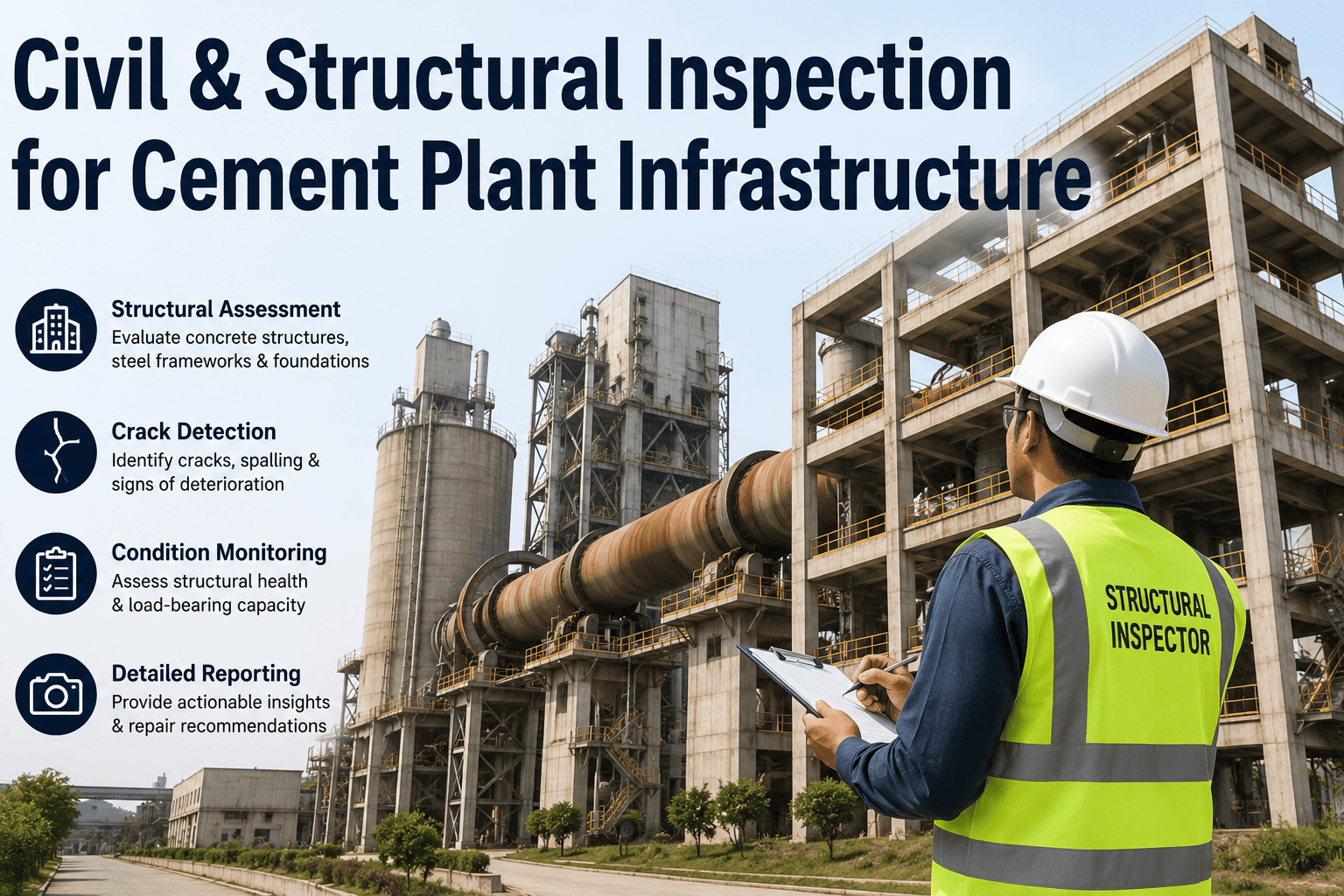
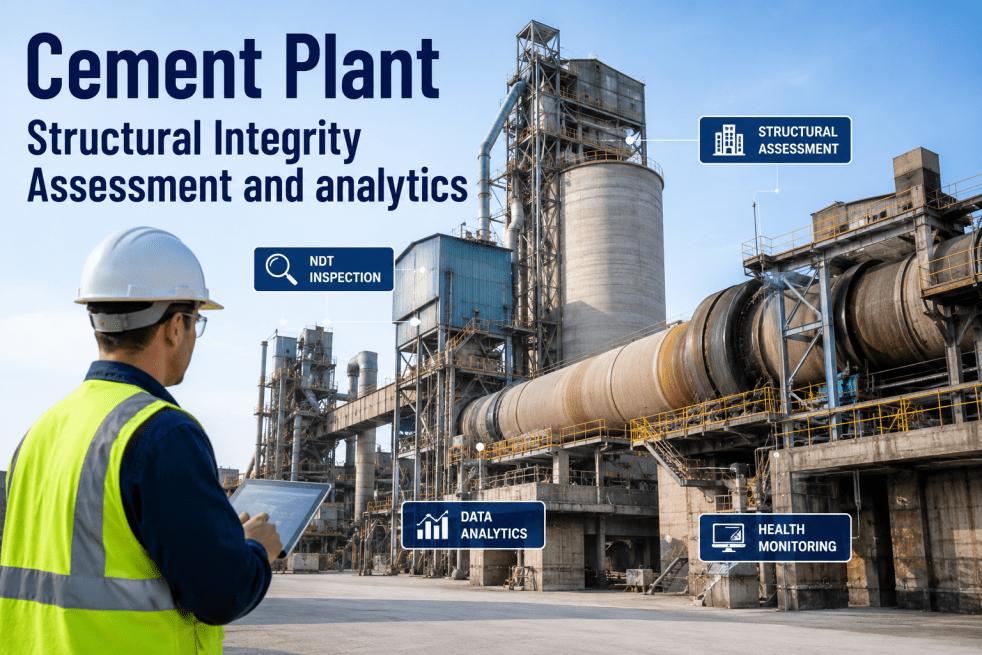
A cement plant tracks vibration on every bearing, thermal profiles on every kiln shell, and oil analysis on every gearbox — and then stores fifty thousand tonnes of clinker in a concrete dome that hasn't had a formal structural inspection in over a decade. Reinforced concrete silos, kiln piers, and preheater towers carry millions of dollars of value and represent the plant's single largest capital investment, yet they are consistently the least-monitored assets on site. Book a demo to see how structural inspection gets scheduled with the same discipline as rotating equipment maintenance.
CIVIL & STRUCTURAL · CEMENT PLANT INFRASTRUCTURE
The $15M Structure With Zero Scheduled Inspections
Rotating equipment gets vibration analysis. Kilns get refractory surveys. The concrete dome storing your clinker inventory gets nothing — until a crack becomes a collapse.
!
A documented case: a U.S. Midwest cement plant suffered a silo collapse from undetected internal corrosion in 2026, resulting in over $2 million in direct losses and weeks of forced shutdown — a failure mode that routine ultrasonic thickness testing would very likely have caught years earlier.
WHY THESE STRUCTURES GET SKIPPED
Structural Assets Are Invisible to Maintenance Systems Built for Mechanical Equipment
A CMMS tracks assets with moving parts by default — motors, bearings, gearboxes, conveyors. A kiln pier foundation or a preheater tower's steel frame has no moving parts and no vibration signature to trend, so it never enters the maintenance planning conversation the way a failing bearing does. The deterioration is real regardless — carbonation eating into concrete cover, corrosion advancing on rebar, settlement shifting a foundation out of alignment — it simply progresses silently, undetected until it becomes visible as a crack, or catastrophic, as a failure.
The economics are stark. A hairline crack found during a routine inspection in a silo cone transition zone is a bounded repair. The same crack, discovered only after it propagates into structural distress, becomes a multi-month shutdown and a repair bill that dwarfs the cost of every inspection that could have caught it years earlier.
ASSET-BY-ASSET RISK
What Deteriorates, Where, and How Fast
Preheater Tower Steel Frame
80–120m Height · Annual Inspection
Wind loading, thermal expansion, and cyclone dust buildup stress connection points between stages. Hidden corrosion beneath insulation requires ultrasonic thickness testing to detect — it doesn't show up on a walk-down.
Concrete Storage Silos & Domes
CO₂-Driven Corrosion · 8–12 Year Critical Window
Clinker off-gassing CO₂ penetrates concrete cover, dropping pH and destroying the passive film protecting rebar. Asymmetric loading or variable soil conditions create differential settlement and diagonal shear cracks in walls.
Kiln & Mill Foundations
Dynamic Load · Annual Settlement Monitoring
Vertical roller mills and ball mills transfer significant dynamic load into their foundations. Settlement, cracking, and anchor bolt loosening compromise equipment alignment before they're visible as a structural symptom.
Multi-Story Process Buildings
Thermal Micro-Cracking · 12-Month Cycle
Thermal stress near hot process equipment induces micro-cracking that accelerates carbonation penetration and rebar corrosion — a deterioration pathway that compounds faster than in unheated structures.
DETECTION METHODS
Matching the Inspection Method to What You're Actually Trying to Catch
No single inspection method catches every failure mode. Visual inspection remains the foundational starting point and the most widely used method in cement plant structural assessment, but it only catches what's already visible on an accessible surface — by the time a crack is visible, deterioration has often been progressing for years underneath.
01
Ultrasonic Thickness Testing
Detects hidden corrosion and section loss in steel structures beneath insulation or coatings — the standard method for preheater tower and silo shell integrity.
02
Ground-Penetrating Radar
Maps reinforcement position and detects internal voids in concrete without invasive drilling — critical for assessing foundations and silo walls non-destructively.
03
Half-Cell Potential Mapping
Identifies active corrosion in reinforcement before it produces visible cracking or spalling — an early-warning method for carbonation-driven rebar deterioration.
04
Acoustic Emission Monitoring
Continuously listens for the high-frequency signature of active crack propagation or corrosion activity between scheduled inspections — valuable where deterioration rate is uncertain.
05
Laser Scanning & Photogrammetry
Produces millimeter-scale 3D models compared against prior scans to detect deformation and settlement over time — the clearest way to quantify structural movement.
A Structural Inspection That Finds a $4,000 Repair Beats an Emergency That Costs $2 Million and Closes the Plant for Weeks
Photographic condition records attached to each structural asset in a CMMS-scheduled program turn silent deterioration into a tracked, budgeted maintenance item instead of an eventual emergency.
BUILDING THE PROGRAM
Four Steps to Turning Invisible Deterioration Into a Managed Asset Class
1. Inventory Every Civil Asset
List every silo, dome, foundation, tower, and structural building as a distinct asset — the step most plants skip because civil structures were never entered into the CMMS in the first place.
2. Assign Risk-Based Frequency
Match inspection interval to deterioration mechanism and consequence of failure — a storage-critical silo and a lower-risk secondary building don't belong on the same schedule.
3. Standardize Condition Records
Photographic documentation, crack width measurements, and NDT results attached to each asset build a trendable history instead of a one-off inspector's memory.
4. Route Findings Into Work Orders
A finding that doesn't generate a tracked, assigned corrective action is a finding that gets forgotten by the next budget cycle — closing that loop is what makes the program self-sustaining.
RECORD KEEPING
Why a Trended Condition History Matters More Than Any Single Inspection
A single inspection tells an engineer the condition of a structure on one day. A trended history — the same crack measured at the same location across five consecutive annual inspections — tells the engineer whether that crack is stable, growing slowly, or accelerating, which is the information that actually drives a repair-now-versus-monitor decision. Without that history, every inspection starts from zero, and genuine acceleration in a deterioration rate is easy to miss because there's no baseline to compare against.
This is also the record a plant needs when insurers, auditors, or a new engineering team ask for evidence that structural risk has been actively managed rather than simply assumed away. A documented, photograph-backed inspection history is difference-making evidence in exactly the conversations that matter most — after an incident, during due diligence, or when justifying a capital repair budget to plant leadership.
WHAT TO LOOK FOR
The Warning Signs That Should Trigger an Immediate Engineering Evaluation
Certain visual indicators separate normal aging from active structural distress, and every plant reliability team should know them on sight. Cracking wider than roughly 0.3mm, especially in pattern or diagonal orientation, concrete spalling that exposes reinforcement, rust staining bleeding through a concrete surface, and efflorescence deposits are all signs that deterioration has moved from cosmetic into structural territory. Unusual vibration or visible movement during normal operation, and water penetration through joints that weren't designed to admit it, complete the list of findings that warrant escalation rather than a note for the next scheduled inspection.
Steel structures carry a parallel set of signals — coating failure exposing bare metal, surface pitting, measurable section loss under ultrasonic testing, and loosening at bolted or welded connections. Any one of these findings, caught during a routine walk-down or a scheduled NDT survey, is the difference between a planned repair and a structure that fails without warning.
FREQUENTLY ASKED QUESTIONS
Common Questions on Cement Plant Structural Inspection Programs
How often should silos, foundations, and process buildings actually be inspected?
Frequency depends on the deterioration mechanism at play. Structures under thermal stress near hot process equipment need annual inspection due to accelerated micro-cracking, while kiln and mill foundations carrying dynamic mechanical loads need annual settlement monitoring to catch alignment drift before it damages the equipment above. A structural engineer setting up a program typically assigns inspection frequency asset-by-asset based on load type and environmental exposure, not a single blanket schedule.
Book a demo to see how inspection frequency gets set for each structure type in your plant.
Can structural inspection be scheduled through the same CMMS we already use for mechanical equipment?
Yes, and doing so is what closes the visibility gap that leaves civil infrastructure unmonitored in the first place. Structural assets can be entered into a CMMS as tracked assets with their own inspection schedules, condition history, and photographic records — treated with the same planning discipline as a pump or a gearbox rather than existing outside the maintenance system entirely.
Contact structural support to discuss adding civil assets to your existing CMMS structure.
Is drone or remote inspection actually reliable for confined spaces like silo interiors?
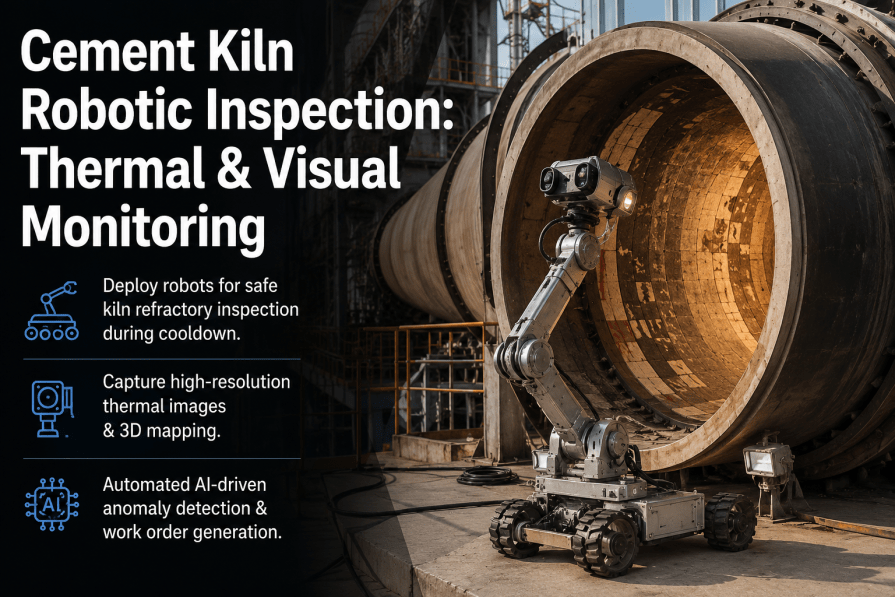
Modern drone inspection with high-resolution cameras and infrared sensors documents surface detail, moisture intrusion, and thermal anomalies at a level comparable to manual confined-space entry, while removing the safety exposure of entering a permit-required confined space with atmospheric and engulfment hazards. Machine learning-assisted defect classification adds consistency that manual visual grading can vary on between inspectors.
What does carbonation depth testing tell an engineer that a visual inspection can't?
Carbonation testing, typically performed with a phenolphthalein indicator on a fresh concrete break or core sample, measures how far CO₂ has penetrated the concrete cover toward the reinforcement — the exact mechanism that eventually destroys the passive film protecting rebar from corrosion. A visual inspection can only show the outcome of that process once it's already produced cracking or rust staining; carbonation testing catches the underlying condition years before it becomes visible.
Book a session to see carbonation and half-cell testing incorporated into a structural condition assessment.
How much does a proactive structural inspection program typically cost compared to reactive repairs?
A routine structural inspection finding an early-stage crack in a silo cone transition zone is typically a bounded repair in the low tens of thousands of dollars. The same deterioration, left undetected until it produces a structural emergency, has been documented to cost millions in direct losses plus weeks of forced shutdown — a cost differential that makes even a modest annual inspection budget one of the highest-return maintenance investments a plant can make.
Talk to structural support about building a cost case for your plant's civil inspection program.
$15M IN INFRASTRUCTURE DESERVES A MAINTENANCE PLAN
Give Your Silos, Foundations, and Towers the Same Scheduled Discipline as Your Rotating Equipment
A structural inspection program built into your existing CMMS turns invisible deterioration into a tracked, budgeted line item — before it becomes an emergency shutdown.