A bag rated for 130°C dry service that gets dropped into a raw mill duct running hot, moist exhaust gas will not last a season — it will blind, hydrolyze, or scorch, and the plant will be back on the parts order within weeks instead of years. Filter bag selection in a cement plant is not one decision, it is four: temperature, chemistry, abrasion, and moisture, evaluated separately for every duct run from raw mill to clinker cooler to finish mill. Get the material wrong on any one of those axes and differential pressure creeps, cleaning cycles shorten, and emissions drift upward long before anyone schedules a bag change. This guide breaks down how to match filter media to each cement process zone, and closes with how booking a demo of real-time baghouse monitoring turns bag replacement from a guessing game into a scheduled event.
CEMENT · DUST CONTROL · FILTER MEDIA · BAGHOUSE
Every cement duct run runs a different temperature, a different gas chemistry, and needs a different bag.
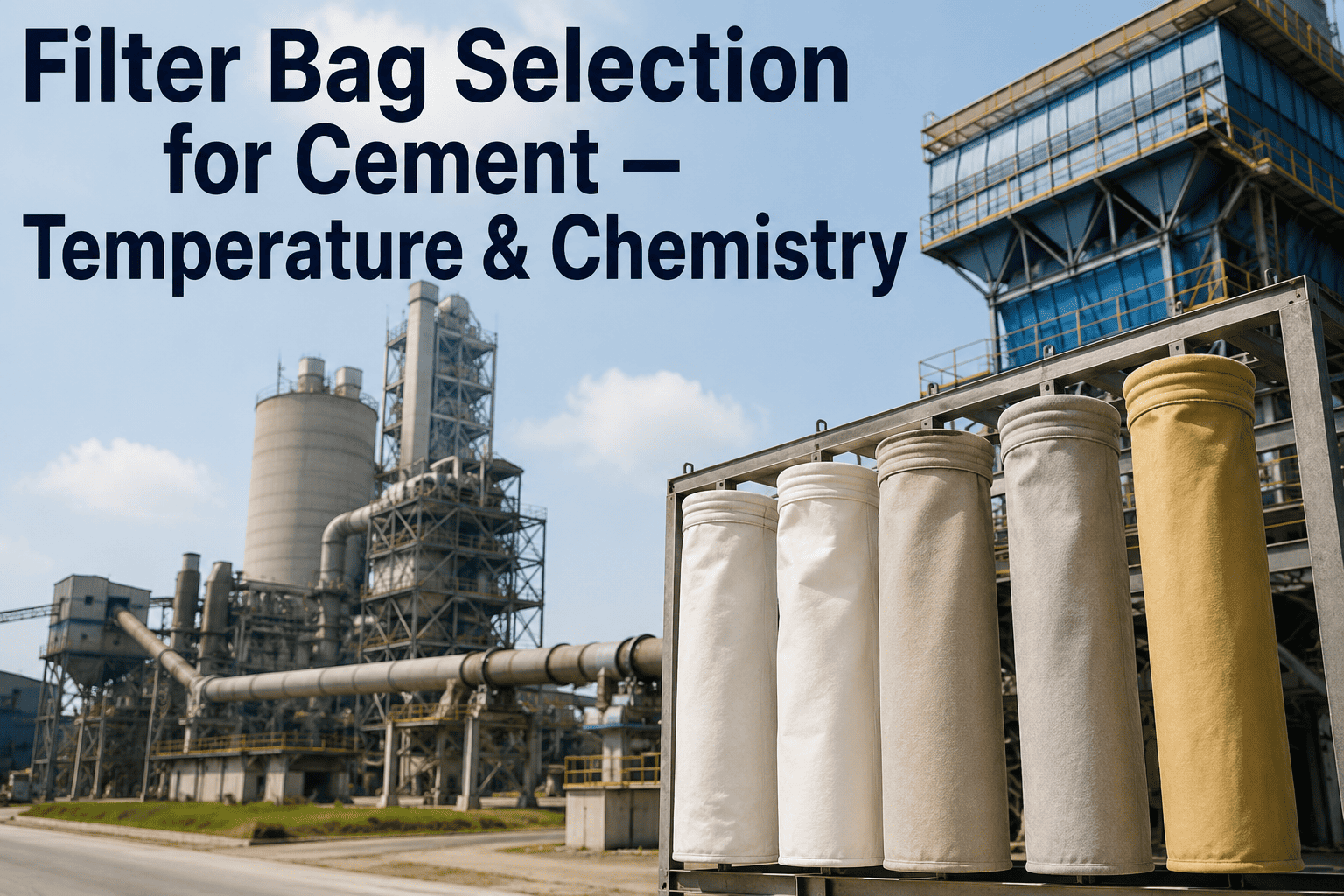
Aramid, PPS, P84, PTFE membrane, and fiberglass all have a place in a cement plant — but only if they are matched to the right zone. Get the assignment wrong and the plant pays for it in blinding, hydrolysis, or premature bag failure long before the rated service life is up.
130°C
Ceiling for standard polyester before hydrolysis sets in under moist gas.
190°C
Sustained operating range where PPS and aramid felts hold dimensional stability.
260°C
Peak service temperature for PTFE-coated fiberglass in kiln and cooler sections.
3–5 yrs
Typical service life for correctly matched aramid bags in cement duty.
The four variables that decide whether a bag survives
Every filter bag failure in a cement plant traces back to one of four variables being underestimated at the specification stage. Get all four right for the specific duct run, not the plant average, and bag life stops being a surprise. Plants that skip this step and specify by rule of thumb usually discover the gap only after differential pressure trends start drifting or a compartment starts failing well ahead of schedule.
V-01
Sustained Temperature
Not the peak spike during an upset, but the sustained operating temperature the bag sees shift after shift. A bag rated for a spike will still degrade under constant exposure near its ceiling.
V-02
Gas Chemistry
Acid gases from alternative fuel combustion, alkali chlorides in kiln bypass streams, and mineral oxides in raw mill dust each attack certain fibers while leaving others untouched.
V-03
Moisture Load
Raw mill on/off cycling exposes bags to repeated condensation. Polyester hydrolyzes under this cycling far faster than its dry-service rating would suggest.
V-04
Abrasion and Dust Loading
High-silica raw meal and clinker dust are mechanically abrasive. Fiberglass without a protective finish fails from flex abrasion long before chemical attack becomes the limiting factor.
Filter media compared across the metrics that matter
No single fiber wins on every axis. The table below lines up the six media types cement plants actually specify against temperature ceiling, chemical resistance, abrasion performance, and where each one earns its keep.
| Media | Max Sustained Temp | Chemical Resistance | Abrasion | Best Cement Zone |
| Polyester |
130°C |
Weak vs. moisture and hydrolysis |
Good, low cost |
Packing, dry finish mill runs |
| Aramid |
190°C |
Good vs. alkalis, weak vs. acids and oxides |
Very good, flexible |
Raw mill, coal mill |
| PPS |
190°C |
Strong vs. acids, alkalis, and moisture |
Good |
Kiln bypass, high-humidity ducts |
| P84 |
260°C |
Excellent vs. alkali and chlorides |
Moderate, needs support cage |
Preheater, kiln inlet |
| PTFE Membrane (on fiberglass) |
260°C |
Excellent, broad spectrum |
Weak alone, coating compensates |
Clinker cooler, kiln exhaust |
| Fiberglass (uncoated) |
260°C |
Strong vs. acids, weak vs. hydrofluoric acid |
Poor without cage support |
High-temperature legacy installs |
See which of your duct runs are already running past their bag's temperature margin
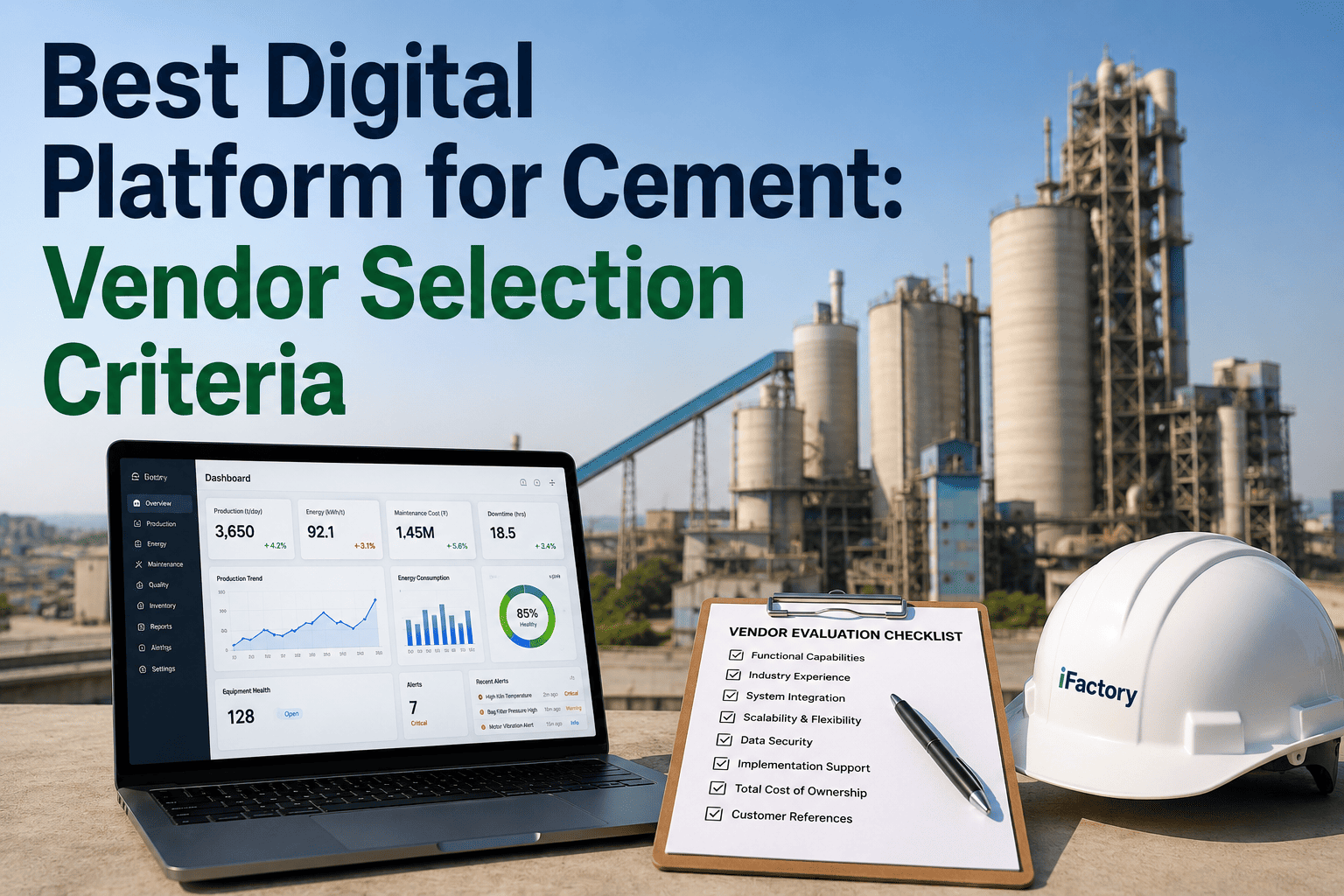
iFactory logs baghouse differential pressure and temperature continuously against the rated envelope of the installed media, flagging zones running hotter or wetter than the bag was specified for.
Matching media to the five duct zones in a cement plant
A single plant-wide bag specification is almost always wrong for at least one zone. Walking the process from raw mill to packing shows why the material assignment has to change section by section, and why a specification that looks conservative on paper for the whole plant is often quietly overspending in one zone while underprotecting another.
01
Raw Mill
Cycling on and off with the mill exposes bags to repeated condensation. Aramid or PTFE-treated media resists the moisture swings that break down standard polyester.
02
Kiln Preheater and Bypass
Sustained heat combined with alkali chlorides favors P84 or a P84/aramid blend, which holds up against the corrosive volatile compounds concentrated in bypass streams.
03
Clinker Cooler
High sustained temperature with abrasive clinker dust calls for PTFE-membrane fiberglass, where the membrane surface resists both blinding and mechanical wear.
04
Finish Mill
Fine cement dust with moderate temperature suits a PTFE-membrane polyester or aramid, where the membrane finish improves cake release and reduces cleaning cycle frequency.
05
Packing and Load-Out
Dry, low-temperature dust with light chemical exposure is standard polyester's home ground, where its lower cost is not offset by any hidden degradation risk.
Coating and finish options that change the outcome
The base fiber is half the specification. Finish and coating choices determine cake release, moisture resistance, and how the bag behaves under pulse cleaning — and two bags of the same fiber can perform very differently depending on which finish was applied.
PTFE Membrane Lamination
A thin PTFE film laminated to the base fabric raises filtration efficiency toward 99.9% and improves cake release, cutting cleaning frequency and extending bag life in fine-particulate duty.
Singed Finish
Burning off surface fibers reduces dust penetration into the felt structure, improving initial filtration efficiency and reducing the seasoning period a new bag needs before reaching rated performance.
Glazed Finish
A calendered, smoothed surface improves cake release for sticky or hygroscopic dusts, common in cement plants running high alkali content or humid ambient conditions for part of the year.
Hydrophobic / Oleophobic Treatment
Surface treatments that repel moisture and oil reduce blinding risk in raw mill and coal mill applications where condensation and hydrocarbon carryover both threaten filtration efficiency.
Cost per bag versus cost per year of service
The cheapest bag on a purchase order is rarely the cheapest bag over a maintenance budget year. Lifecycle cost has to weigh purchase price against replacement frequency, unplanned downtime, and the compliance risk of a bag that fails between scheduled changeouts. A specification chosen on unit price alone tends to look like a saving right up until the first unplanned baghouse outage erases several years of that saving in one event.
01
Standard Polyester in a Dry, Cool Zone
Lowest purchase price and a full multi-year service life when kept within its dry, low-temperature envelope — the right economic choice in packing and load-out.
02
Aramid in a Moist, Moderate-Heat Zone
Higher purchase price offset by three to five years of service where polyester would need annual replacement, making aramid the better lifecycle economics in raw mill duty.
03
PTFE-Coated Media in High-Heat, Abrasive Zones
Highest purchase price, but avoiding a mid-campaign bag failure in the clinker cooler or kiln exhaust prevents an unplanned shutdown that dwarfs the material cost difference.
04
The Hidden Cost of the Wrong Match
A bag underspecified for its zone does not fail gracefully — rising differential pressure, more frequent pulse cleaning, and shortened compressed air life all show up before the bag itself is replaced.
A five-step framework for specifying the right bag
Skipping straight to a material name without walking through process conditions is how mismatches happen. This sequence is the order plants that get bag selection right actually follow.
01
Log Sustained Temperature, Not Just Design Temperature
Pull actual operating data for the duct run over a full production cycle, including startup and mill-off conditions, not the design sheet's single number.
02
Characterize the Gas Chemistry
Identify acid gas content, alkali chloride concentration, and any alternative fuel combustion byproducts specific to that duct, since fuel mix changes chemistry zone by zone.
03
Assess Moisture Cycling
Note how often the section cycles through startup condensation, since repeated wet-dry cycling degrades hydrolysis-prone media faster than continuous exposure at the same average humidity.
04
Match Media and Finish to the Full Profile
Select the base fiber against temperature and chemistry first, then choose a coating or finish to address cake release and abrasion for that specific dust characteristic.
05
Validate Against Differential Pressure Trend
Track differential pressure after installation against the expected curve for the chosen media, since deviation early in service life is the first signal of a specification mismatch.
Why correctly specified bags still fail early
Material selection solves half the problem. The other half is installation and cleaning-cycle discipline, and a well-matched bag installed or cleaned incorrectly will still fail before its rated service life, which is why plants that get the longest life from their filter media treat these as part of the same specification exercise rather than a separate maintenance task.
Over-Aggressive Pulse Cleaning
Cleaning cycles set too frequently or at too high a pulse pressure strip the dust cake before it forms a protective layer, accelerating fiber wear on aramid and PPS media well ahead of their rated life.
Cage Mismatch
A support cage with damaged wires, wrong pitch, or a coating incompatible with the bag surface creates abrasion points that show up as premature holes, regardless of how well the fiber itself was chosen.
Skipped Break-In Period
New bags need a seasoning period at reduced cleaning frequency to establish a stable dust cake. Running full production cleaning cycles from day one shortens usable life across every media type.
Mixed-Age Bag Populations
Replacing bags individually as they fail, rather than in planned rows, leaves a compartment with mismatched permeability, forcing air preferentially through the newest bags and wearing them out faster.
Rolling out a new bag specification without a full shutdown
Once a zone-by-zone review flags a mismatch, most plants cannot justify pulling an entire compartment offline to swap media in one pass. A staged rollout across the normal replacement schedule gets the plant to the right specification without adding an unplanned outage, provided the transition is tracked rather than left to whichever bag happens to fail next.
R-01
Pilot Row First
Install the new media in one row of a compartment and monitor differential pressure and pulse frequency against the neighboring rows for a full production cycle before committing to the rest.
R-02
Replace by Row, Not by Individual Bag
Swapping bags one at a time as they fail creates a mixed-permeability compartment; rolling a full row or compartment together keeps airflow distribution even and each bag aging on the same clock.
R-03
Recheck the Cage and Support Hardware
A media switch often changes the required cage coating or wire spacing. Reusing old cages with a new bag type is a common source of early abrasion failure after a specification change.
R-04
Track the New Baseline
Log differential pressure and cleaning frequency for the new media from day one, so the plant has its own performance baseline instead of relying on the manufacturer's generic service-life estimate.
Frequently asked questions
Can one bag material be used across the whole cement plant to simplify inventory?
It is possible but usually costs more over a maintenance year than it saves in inventory simplicity. A high-spec media like P84 or PTFE-coated fiberglass will survive the packing house, but at several times the cost of polyester for a zone that never needed that temperature or chemical resistance. Most plants settle on two to three media types matched to distinct temperature and chemistry bands rather than one plant-wide standard.
Contact our support team to map your zones against a rationalized media list.
How do we know if a bag is failing before differential pressure spikes?
Differential pressure trend is the leading indicator, but by the time it spikes sharply the bag is often already compromised. Watching the rate of DP rise per cleaning cycle, rather than the absolute value, surfaces gradual blinding or early degradation weeks before a hard failure. Continuous monitoring against the expected curve for the installed media type catches drift that a periodic manual check would miss entirely.
Book a demo to see this trend tracked automatically against your baghouse.
Does switching to alternative fuels change the filter bag specification?
Yes, and it is one of the most common causes of unexpected bag failure after a fuel program changes. Alternative fuels often shift the acid gas and chloride content of kiln exhaust, and a bag that was correctly specified for a coal-fired baseline can degrade rapidly once combustion chemistry changes without a corresponding review of the media. Any fuel mix change is a trigger to re-walk the selection framework, not just re-order the same bag part number.
Contact our support team to review your fuel program against current bag specifications.
What is the real difference between aramid and P84 for kiln applications?
Aramid tops out around 190°C sustained and handles alkalis well but is more vulnerable to acid gas and mineral oxide attack, making it a strong fit for raw mill and coal mill duty. P84 pushes to roughly 260°C with excellent resistance to alkali and chloride compounds, which is why it is the standard choice for preheater and kiln inlet zones where both heat and chloride concentration are higher. The two are often blended in a single bag to balance performance against cost.
Book a demo to see how your kiln section temperature and chemistry data map to this choice.
How often should filter bag performance be reassessed after installation?
A formal reassessment at the midpoint of the expected service life catches specification issues before a full replacement cycle is wasted on the wrong media. Any process change — a new fuel blend, a raw mix adjustment, or a production rate increase — should also trigger an off-cycle review, since these shift the temperature and chemistry profile the original bag was matched against. Continuous differential pressure monitoring makes this an ongoing check rather than a periodic project.
Contact our support team to set up a standing review cadence for your baghouse fleet.
Stop replacing bags on a calendar and start replacing them on evidence
iFactory continuously tracks differential pressure, temperature, and cleaning cycle frequency against the rated envelope of your installed filter media, flagging mismatches before they turn into emissions events or unplanned downtime.