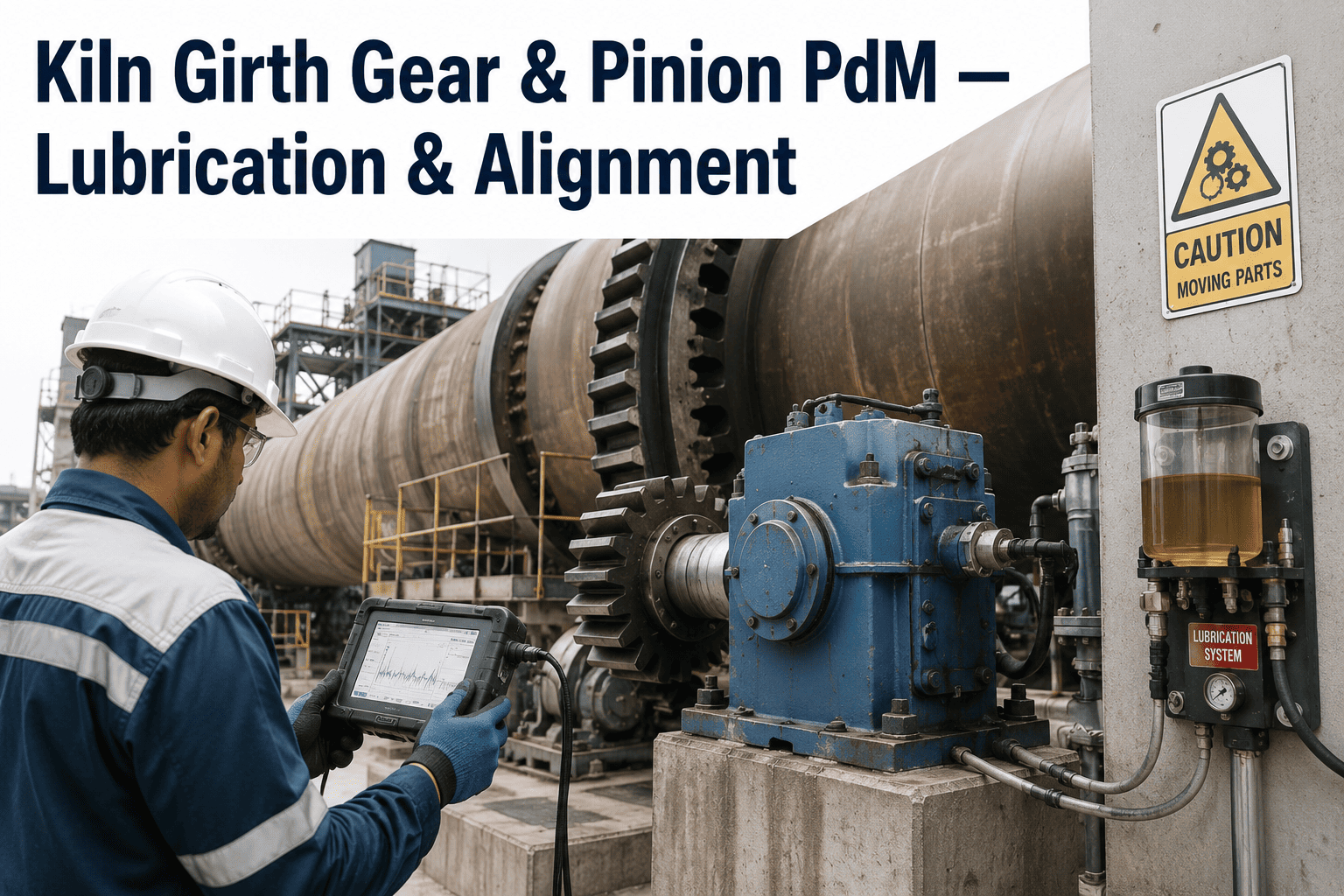
The pinion and girth gear mesh on a cement kiln does one job for twenty-five years or more: transmit torque from the main drive to a rotating steel cylinder that can weigh well over four thousand tonnes once loaded with clinker and refractory. Nothing about that job changes from year one to year twenty, but the lubrication film protecting the tooth flanks is consumed and reapplied every few seconds of kiln rotation, which is why the single factor most likely to decide whether this gear lasts fifteen years or fails at year six is not the casting metallurgy — it is whether spray coverage, backlash, and tooth contact are actually being tracked with any discipline. Most plants inspect the gear during shutdowns and hope the lubrication system did its job in between stops. Reliability teams who want to see what continuous lubrication and wear tracking looks like on a running kiln can book a demo before their next planned outage.
Stop Guessing Whether Your Girth Gear Is Actually Lubricated
iFactory tracks spray coverage, tooth contact pattern, and backlash trend on every kiln girth gear and pinion continuously, so a lubrication gap or an alignment drift shows up as a work order weeks before it shows up as a shutdown.
Why Lubrication Discipline, Not Gear Quality, Decides Service Life
A kiln girth gear is an open gear — the tooth mesh sits exposed to ambient dust, kiln radiant heat, and weather, with no sealed housing protecting it the way an enclosed gearbox is protected. That exposure means the lubricant film is the only barrier between two hardened steel surfaces carrying the full torque of the kiln drive, and it has to be reapplied continuously because dust, heat, and gravity are working against it every revolution. Plants that maintain consistent spray coverage, correct backlash, and verified alignment routinely see girth gears run fifteen to twenty years. Plants where lubrication PM gets deferred during busy periods, or where a misalignment is left uncorrected because the kiln is "running fine," typically see the same gear fail somewhere between year six and year ten — not because the casting was inferior, but because the maintenance discipline around it was inconsistent.
Choosing and Verifying an Open Gear Lubrication Method
Open gear lubrication is not a one-size-fits-all decision, and the method a kiln was commissioned with is not always the method it should still be running years later as duty, dust load, or ambient conditions change. The three approaches below cover most cement kilns in operation today, and the right choice depends on kiln diameter, mesh speed, dust exposure, and how much manual verification the plant is realistically able to sustain shift after shift. What matters more than which method is chosen is whether coverage is actually being confirmed rather than assumed, since a spray nozzle that has drifted out of position or partially clogged will keep running for months without triggering any alarm on its own.
| Method | How It Applies | Best Suited For | Main Failure Point |
|---|---|---|---|
| Automated Spray Lubrication | Timed nozzle cycles apply metered lubricant directly to the mesh point | Large-diameter kilns running continuous production | Nozzle drift, partial clogging, or pump wear going unnoticed between checks |
| Tacky Open Gear Compound | High-viscosity compound brushed or sprayed on to resist sling-off and dust pickup | Dusty environments and slower mesh speeds | Compound build-up masking early tooth wear or cracking during visual inspection |
| Manual Brush or Drip Application | Technician applies lubricant on a fixed walk-round schedule | Smaller kilns or plants without automated infrastructure | Coverage consistency depends entirely on the technician and the schedule being kept |
Confirming Coverage: The Blue Paper Test, Checkpoint by Checkpoint
The standard field method for verifying spray coverage is simple enough that most plants already know it, but it is frequently skipped because it takes the kiln crew a few extra minutes during a stop. A sheet of blue transfer paper is pressed against the gear teeth immediately after a spray cycle, and the resulting mark shows exactly where lubricant landed and where it did not. The four checkpoints below are what a technician should be reading on that paper, because a spray system can look like it is working — misting visibly, cycling on schedule — while still leaving specific zones of the tooth face dry.
Root Coverage
The base of the tooth carries the highest bending stress in the mesh, so a dry root is the checkpoint most directly tied to fatigue cracking if it goes uncorrected for an extended period.
Pitch-Line Film
This is where sliding contact between the gear and pinion is greatest, and a thin or missing film here is the most common precursor to visible pitting on the flank.
Flank Wrap
Coverage should wrap smoothly across the full tooth face rather than stopping partway, since a partial wrap usually points to a nozzle angle that has shifted out of position.
Contamination Check
Dust or moisture mixed into the lubricant film shows up as a gritty or discolored mark on the blue paper, and it accelerates wear faster than a thin film alone ever would.
A Realistic Monitoring Cadence for Lubrication and Wear
The frequency at which each check needs to happen is not the same across the board, and treating every measurement as a monthly or quarterly task either wastes labor on checks that do not need to be that frequent or, more dangerously, leaves fast-moving indicators like coverage and temperature checked too rarely to catch a developing problem before it compounds. The cadence below reflects how quickly each parameter typically drifts and how much warning it gives before becoming a shutdown-driving issue.
| Cadence | Task | Trigger for Escalation |
|---|---|---|
| Daily | Visual spray cycle confirmation and mesh noise check | Missed cycle, audible clicking, or irregular mesh sound |
| Weekly | Lubricant reservoir level and pump pressure log | Pressure drop or consumption rate deviating from baseline |
| Monthly | Backlash spot-check at four circumferential positions | Reading exceeding as-commissioned baseline by manufacturer tolerance |
| Quarterly | Full tooth contact pattern check and vibration survey | Contact pattern shifted off-center or new mesh-frequency sidebands |
Reading the Tooth Contact Pattern Correctly
Marking compound applied to the pinion teeth and briefly engaging the drive produces a contact pattern on the gear face that tells an experienced technician more about alignment condition than any single backlash reading can. The tolerance most manufacturers specify is uniform contact across at least eighty percent of the tooth face width, and the four patterns below are what a plant is most likely to see when that tolerance has drifted, along with what each one usually points back to.
Centered, Full-Face Contact
An even band spanning most of the tooth width is the target pattern, confirming both radial and angular alignment are within tolerance under the load condition tested.
Edge-Biased Contact
Contact concentrated at one end of the face usually points to angular misalignment between pinion and gear, often from differential thermal expansion or a shifted pier.
Tip-Heavy Contact
A pattern riding high near the tooth tip generally indicates backlash has opened beyond specification, letting the mesh point ride out of its intended profile.
Dedendum-Heavy Contact
Contact concentrated low near the tooth root suggests the center distance has closed tighter than design, which raises load concentration and accelerates root fatigue.
Turn Blue Paper Checks Into Continuous Coverage Data
iFactory's AI platform correlates spray cycle data, vibration signatures, and lubricant particle counts against your gear's baseline, flagging coverage gaps and wear trends before the next scheduled inspection would have caught them.
The Backlash Trend Line: Four Stages From Normal to Critical
Backlash does not stay static over a gear's life — it opens gradually as tooth flanks wear, and the rate of that opening is one of the clearest early signals available on the entire kiln drivetrain. Reading a single backlash measurement in isolation tells a technician very little; reading it as a trend against the as-commissioned baseline tells a technician almost exactly how much runway remains before intervention is required. The four stages below describe how that trend typically progresses on a kiln girth gear.
What a Missed Lubrication Gap Actually Costs
The economics here are lopsided enough that they are worth stating plainly. An unplanned girth gear failure typically runs into parts and specialist labor costs well into six figures, before a single day of lost production is even counted, and a full gear replacement with an extended shutdown pushes the total cost and downtime significantly higher. Because these gears are frequently cast to order rather than kept in stock, a plant that discovers a critical fault without warning is often looking at many months of lead time layered on top of the repair itself. One pattern shows up again and again in incident reviews: a faint noise or a slightly stiff mesh gets dismissed as normal kiln behavior for weeks, sometimes months, because nobody was tracking a quantified trend against it. By the time a technician places a dial indicator on the pinion bearing housing during a routine stop and finds the reading far outside tolerance, the gear may already have been running with partial metal-to-metal contact for an extended period, turning what would have been a scheduled repair into an emergency one.
Layering AI Monitoring Onto an Existing Lubrication Program
Adding condition monitoring to a girth gear and pinion does not mean replacing the lubrication system already in place, and it does not require a long commissioning shutdown. It means giving the checks the crew is already performing — coverage, backlash, contact pattern, vibration — a consistent baseline to be measured against, and a way to escalate automatically when a reading moves outside that baseline instead of waiting for the next scheduled review to notice.
Establish the Baseline
As-commissioned backlash, contact pattern photographs, and spray cycle parameters are logged as the reference point every future reading is measured against.
Instrument the Mesh Point
Vibration sensors on the pinion bearing housing and integration with spray system controls bring lubrication and mechanical data into a single platform.
Correlate the Trend Lines
Backlash drift, vibration sideband growth, and coverage gaps are cross-checked against each other so a genuine wear trend is distinguished from a one-off sensor blip.
Automate the Work Order
Once a reading crosses the threshold that matters for that specific gear, a prioritized work order is generated directly instead of waiting for the next manual review cycle.
Kiln Girth Gear Lubrication and Wear — Frequently Asked Questions
How often should backlash actually be measured on a kiln girth gear?
Most manufacturers recommend measuring backlash at a minimum of four circumferential positions roughly every three months, logged against the as-commissioned baseline rather than a generic industry number. A gear that has recently shown any drift, or one that has had a spray system issue corrected, should be checked more frequently until the trend stabilizes again. Teams who want this trend tracked automatically rather than transcribed from a clipboard can contact support to see how the readings feed directly into a maintenance record.
Can a lubrication problem really cause misalignment, or are they separate issues?
They are closely connected in practice, even though they start as separate root causes. Inconsistent lubrication accelerates uneven tooth wear, and uneven wear changes the effective contact geometry between the pinion and gear, which then shows up as a shifted contact pattern that looks like a pure alignment problem. Correcting the alignment without addressing the underlying lubrication gap usually means the same drift reappears within months rather than years.
What does an early-stage lubrication gap actually look like on the tooth face?
It rarely looks dramatic at first. A slightly dry patch on the blue paper test, a marginally higher mesh temperature reading, or a faint change in mesh sound that a millwright might dismiss as normal kiln noise are usually the first signs. The gap between when these subtle signals first appear and when they become a visible defect on the tooth face is exactly the window that continuous monitoring is designed to catch.
Does switching lubrication methods require a kiln shutdown?
Switching between spray, tacky compound, and manual application generally does not require an extended shutdown, since the transition is typically completed during a planned maintenance window rather than a dedicated stop. What does take longer is validating that the new method is delivering consistent coverage across several full casting or kiln cycles before fully retiring the old verification routine. Plants considering a change can book a demo to see how coverage data from a transition period is tracked.
Is vibration monitoring enough on its own, without lubrication and backlash checks?
Vibration monitoring on its own will catch some failure modes, particularly bearing degradation and certain gear mesh anomalies, but it is not a complete picture without lubrication coverage data and backlash trending alongside it. A gear can show a slowly rising vibration reading for reasons ranging from lubrication starvation to misalignment to early pitting, and it is the correlation between vibration, coverage, and backlash that tells a reliability engineer which of those is actually happening.
Give Your Girth Gear the Full Fifteen to Twenty Years It's Built For
iFactory's AI platform gives kiln maintenance teams continuous visibility into lubrication coverage, backlash trend, and tooth contact condition, converting gradual wear into scheduled maintenance instead of an unplanned kiln stop.