A rotary kiln that is thermally perfect on paper can still burn 8-12% more fuel than it should, and the reason is rarely the burner or the refractory — it is the gap between the shell and the hood, or the seal at the kiln inlet where the riser duct meets the rotating drum. False air pulled in through worn inlet and outlet seals cools the flame, dilutes kiln gases, forces the ID fan to work harder, and quietly inflates specific heat consumption month after month while the DCS trends look almost normal. Most plants do not discover how much a seal is costing them until they measure oxygen levels on either side of it, or until the seal fails outright and dust starts blowing back into the operating floor. If your kiln has not had a documented seal inspection in the last shutdown cycle, book a demo and we will show you what continuous seal monitoring looks like on a live kiln.
Why Inlet and Outlet Seals Matter More Than Most Plants Realize
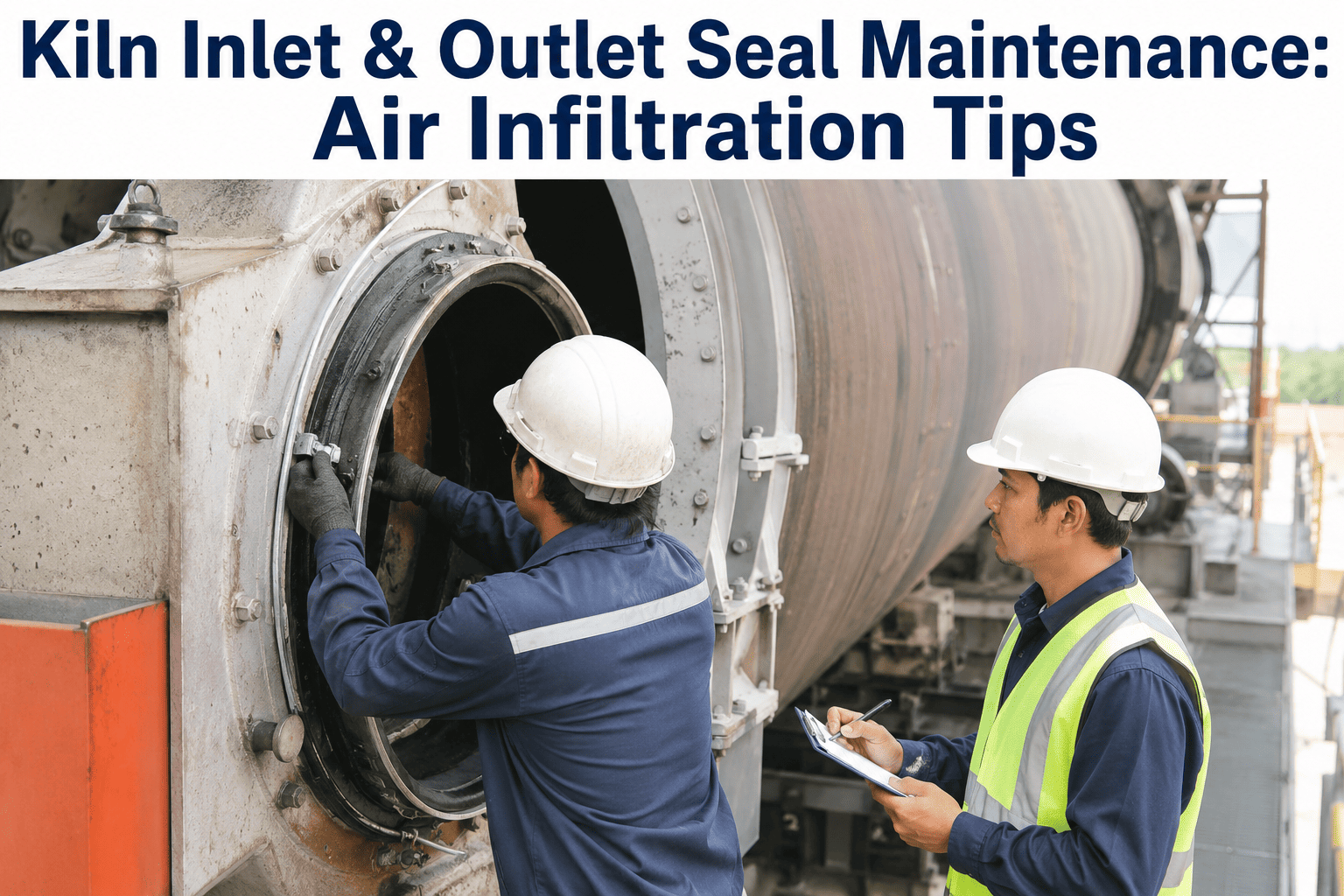
The kiln inlet seal sits between the stationary riser duct and the rotating kiln shell at the feed end, and the outlet seal sits between the kiln nose ring and the stationary hood at the discharge end. Both locations experience continuous relative motion between a fixed structure and a rotating one, both operate under negative draft that actively pulls ambient air inward through any gap, and both are exposed to abrasive dust, thermal cycling, and mechanical shock from kiln shell ovality. When either seal degrades, the plant does not lose product quality overnight — it loses fuel efficiency gradually, in a way that is easy to attribute to weather, coal quality, or burner tuning instead of the actual cause sitting in plain sight at the kiln ends.
False air entering through a degraded seal has three compounding effects. It cools the flame and the gas stream near the point of entry, which the burner has to compensate for with additional fuel. It dilutes the oxygen and CO2 concentration in the kiln gas, which distorts combustion control and can push the system toward either incomplete combustion or excess air firing. And it adds volume to the gas stream that the ID fan and preheater fan must move, increasing power draw across the entire pyroprocessing line for gas that is doing no useful work. A 10mm growth in seal gap width at a typical kiln inlet can pull in enough false air to measurably shift oxygen readings at the kiln inlet analyzer, and that shift compounds every hour the kiln runs until the seal is repaired.
Seal Types and When Each One Fits
There is no single correct seal design for every kiln — the right choice depends on shell diameter, kiln speed, ovality history, dust loading, and whether the seal sits at the high-abrasion inlet or the high-temperature outlet. Choosing the wrong type for the application is one of the most common reasons a seal that looked fine on the datasheet fails within months of installation.
| Seal Type | Best Application | Typical Service Life | Key Limitation |
|---|---|---|---|
| Graphite block seal | High-temperature outlet, moderate shell movement | 18-24 months | Block wear accelerates with high ovality |
| Leaf/flexible steel seal | Inlet seal with variable shell runout | 12-18 months | Leaf fatigue cracking under thermal cycling |
| Spring-loaded plate seal | Outlet seal, high dust environments | 15-20 months | Spring tension loss reduces contact pressure over time |
| Labyrinth/air-purged seal | High-precision inlet applications | 24-36 months | Higher capital cost and purge air power draw |
| Rope/gasket seal | Secondary backup sealing at flange joints | 6-12 months | Not suited as a primary rotating seal |
Graphite block and spring-loaded plate designs dominate outlet applications because they tolerate the higher temperatures near the nose ring while maintaining reasonable contact pressure against the rotating shell. Leaf and labyrinth designs are more common at the inlet, where shell diameter is typically smaller and ovality-driven runout is the dominant wear mechanism rather than raw temperature. Plants running kilns with a documented history of high ovality should weight seal selection toward designs that tolerate movement rather than designs optimized purely for temperature resistance, since a seal that cannot flex with the shell will wear unevenly regardless of its thermal rating.
Material selection within a given seal type also matters more than it is usually given credit for. Two graphite block seals from different suppliers can behave very differently in service depending on the grade of graphite used, the binder chemistry, and how the blocks are mounted against the shell. A lower-cost block that looks identical on a spec sheet can wear at twice the rate of a premium grade under the same thermal and abrasive conditions, which means the true cost comparison between seal suppliers has to include expected service life, not just the purchase price of the replacement segments. Plants that track actual field life against supplier and grade over several replacement cycles tend to converge on one or two preferred sources rather than buying on price alone for each individual order.
Recognizing Seal Wear Before It Becomes a Leak
Seal degradation is progressive and almost always visible before it becomes a measurable fuel penalty, provided someone is looking in the right place at the right interval. The signs below represent the sequence most seals go through from healthy to failed.
The gap between Stage 1 and Stage 6 can be as short as a few months on kilns with high ovality or as long as a year or more on well-aligned kilns with stable shell geometry, which is why relying on a fixed inspection calendar instead of condition-based signals leaves plants blind to the kilns that are degrading fastest. A seal that was fine at the last quarterly shutdown can be well into Stage 3 or 4 by the next one if ovality has worsened in the interim, and few plants have continuous visibility into that trend without dedicated monitoring in place.
The practical challenge most maintenance teams face is not a lack of interest in seal condition, but a lack of continuous data connecting the seal to the numbers that would justify prioritizing it over other shutdown work. A kiln inlet oxygen sensor already exists on nearly every kiln, and the DCS historian already stores its trend, but almost no plant has that trend automatically correlated against seal inspection dates, shell ovality readings, and fuel consumption in a way that produces an actionable early warning. Building that correlation manually in a spreadsheet once a quarter catches the obvious failures but misses the slow drift that represents most of the annual fuel loss, simply because nobody is watching the trend daily the way an automated system would.
There is also a tendency to treat seal maintenance as a purely mechanical decision when it is really a combined mechanical and combustion decision. A maintenance team evaluating seal wear in isolation might reasonably decide a small visible gap does not justify shutdown work, while a process engineer looking at the same kiln's oxygen trend and fuel consumption might see clear evidence the gap is already costing real money. Bringing both data sets into the same view, rather than leaving mechanical inspection and combustion trending as separate conversations between separate departments, is what turns seal management from a reactive repair task into a planned efficiency program with a measurable return.
How Seal Design Interacts With Kiln Speed and Production Rate
Seal performance is not static across a kiln's operating range. As kiln speed increases to support higher production rates, the relative velocity between the rotating shell and the stationary seal face increases as well, which accelerates wear on contact-type seals like leaf and graphite block designs. Plants that have recently increased kiln speed as part of a production ramp-up sometimes see seal life drop noticeably compared to historical experience, and the seal itself is rarely the first place anyone looks for the explanation, since the change in wear rate lags the speed change by weeks or months.
Non-contact designs such as labyrinth and air-purged seals are largely immune to this speed-related wear acceleration, since they rely on a controlled clearance gap rather than direct mechanical contact with the shell. This is one of the strongest arguments for upgrading to a non-contact design on kilns that have undergone or are planning a capacity increase, even if the existing contact-type seal has performed adequately at the prior production rate. The capital cost difference is easier to justify once the expected service life reduction under the new operating profile is quantified rather than discovered after the fact through a shortened replacement cycle.
Building a Seal Management Program That Sticks
Individual seal replacements solve individual problems, but plants that consistently keep false air infiltration low tend to treat seal condition as an ongoing program with clear ownership rather than a one-off maintenance task assigned whenever someone notices a visible gap. A durable program typically includes a named owner for kiln-end sealing performance, a standard inspection checklist completed at every shutdown regardless of visible urgency, a documented gap measurement history for both inlet and outlet locations, and a review of kiln inlet oxygen trend as a standing agenda item in monthly energy performance meetings rather than something only discussed after a fuel consumption target is missed.
The plants that get the most value from this kind of program are usually the ones that stop treating seal replacement cost as a pure expense and start treating it as a fuel cost avoidance investment with a calculable payback period. When a seal replacement that costs a modest sum in parts and labor demonstrably reduces specific heat consumption by even a small percentage, the payback period is often measured in weeks rather than months, and that framing makes it far easier to secure budget and shutdown time for the work before the seal fails outright rather than after.
Planning Seal Replacement Without Adding Shutdown Days
Seal replacement is one of the most schedulable maintenance tasks on a kiln, provided the plant has enough lead time to procure the correct seal type and stage the work against an already-planned shutdown rather than triggering an emergency stoppage. The planning sequence below reflects how well-run cement plants approach it.
A seal replacement staged into a planned shutdown costs a fraction of an emergency repair triggered by dust blowback or a failed inspection. Book a demo to see how condition trending feeds directly into your shutdown planning workflow.