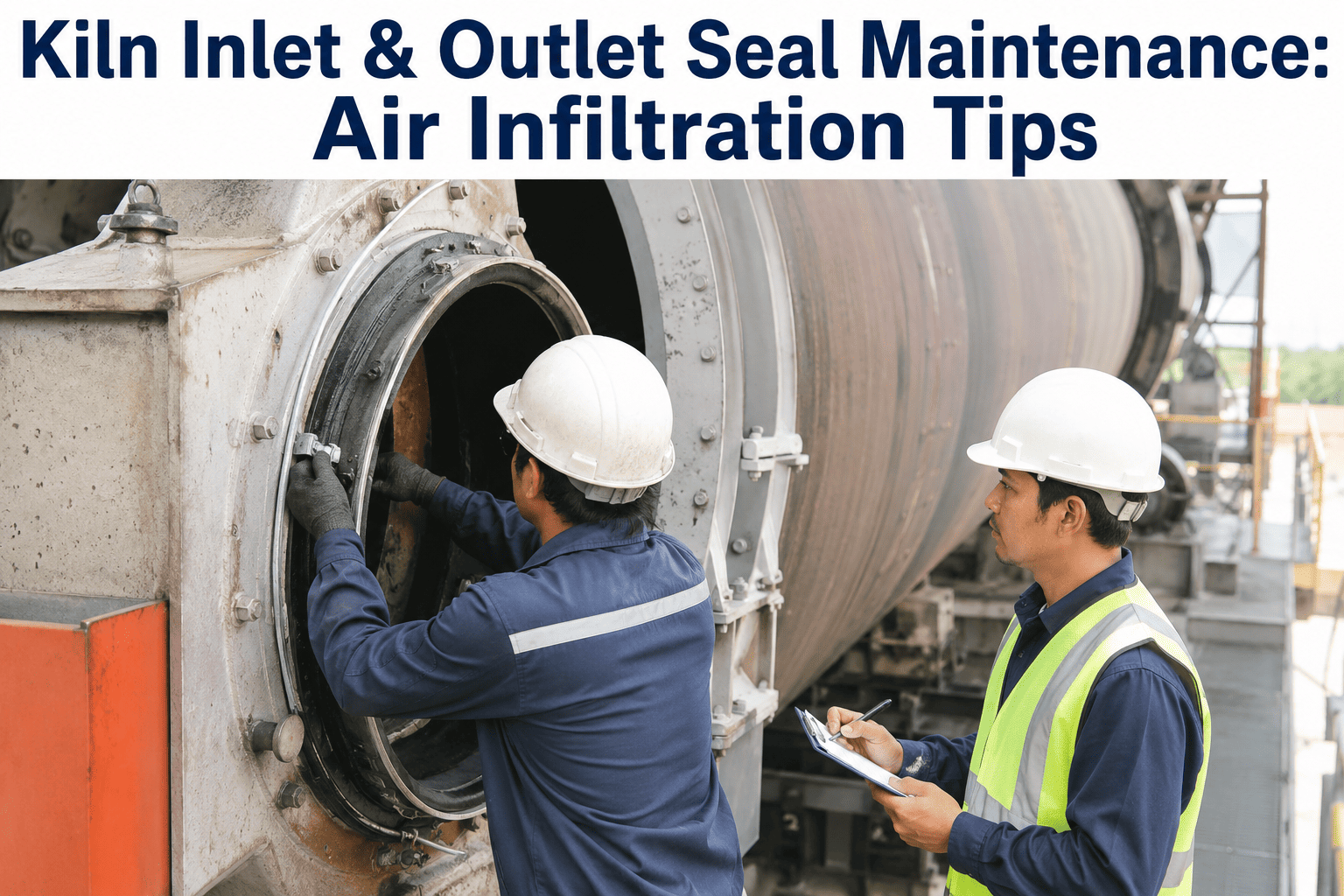
Ask a kiln operator where false air enters their system and most will list a handful of suspects — expansion joints, feed chutes, inspection doors. Few will name the two locations that actually matter most: the kiln inlet seal and the kiln outlet seal, which together account for 60 to 75 percent of total false air infiltration in a typical cement plant. Each seal degrades slowly, invisibly, buried in paper inspection logs that rarely get tied back to the fuel consumption they're quietly driving up — which is exactly the gap continuous seal condition monitoring is built to close.
Kiln Seal & False Air Management
Two Seals Cause Most of Your False Air — And Nobody's Watching Them
Every 1% of false air adds roughly 3 kcal/kg of wasted heat to your clinker. A kiln running on degraded inlet and outlet seals can burn tens of extra kcal per kilogram, forever, without a single alarm going off.
60-75%
Of total false air from just two seal locations
3 kcal/kg
Wasted heat per 1% of false air infiltration
8-10%
Acceptable false air ceiling in a well-sealed kiln
Why Two Small Gaps Cost So Much Fuel
Every cubic meter of unintended air pulled into the kiln has to be heated from ambient temperature to process temperature, and that heating comes directly out of the fuel budget. Because the inlet and outlet seals sit at the two points where a stationary hood meets a continuously rotating shell, they are mechanically the hardest interfaces in the entire kiln system to keep sealed — and the ones most plants inspect least often. In extreme cases, a degraded inlet seal alone can pull 10 percent false air, with the outlet seal pulling another 8 percent, for a combined leak that quietly rewrites the kiln's fuel economics.
Fuel Consumption
Every percent of false air adds heating load the burner has to compensate for, directly raising specific fuel consumption per ton of clinker.
Combustion Stability
Unaccounted air dilutes oxygen readings and destabilizes the burning zone, making combustion control less precise and less predictable.
Secondary Air Temperature
Air bypassing the cooler through a degraded seal reduces secondary air temperature, forcing even more fuel at the burner to compensate.
ID Fan Load
Extra volume from false air increases induced-draught fan power demand, adding an electrical cost on top of the fuel penalty.
The Four-Stage Wear Progression Nobody Tracks
Seal degradation isn't a binary working-or-failed condition — it moves through a predictable progression, and each stage has a distinct inspection signature and a specific maintenance response. The problem is that without a system to track wear grade against schedule, plants generally only discover which stage they're in when it's already the expensive one.
Stage 1
Full Contact
Seal elements aligned, counterweights balanced. False air from this location under 1%.
Stage 2
Early Wear
Visible edge wear on lamella or minor graphite block erosion. False air rising toward 2-3%.
Stage 3
Advanced Wear
Counterweight tension loosening, contact gaps forming intermittently. False air climbing past 5%.
Stage 4
Failure Risk
Persistent gap, material leakage possible alongside air infiltration. False air can exceed 8-10% at this single point.
A kiln seal degrading from Stage 1 to Stage 3 without anyone noticing doesn't announce itself with an alarm — it shows up gradually in a specific fuel consumption number that keeps drifting upward and nobody can quite explain. See what your own seal wear grade and false air trend actually look like.
Book a 30-minute demo and bring your last seal inspection log.
Inlet Seal vs. Outlet Seal: Different Jobs, Different Failure Modes
The kiln inlet and outlet seals both close the gap between rotating shell and stationary hood, but they operate under different thermal and mechanical conditions, and monitoring strategy needs to reflect that difference rather than treating them identically.
Kiln Inlet Seal
Sits between the kiln and the riser duct, exposed to high dust loading and thermal cycling from material transfer.
Degradation often first visible as gas analyzer readings drifting from actual kiln inlet chemistry due to dilution.
Higher false air share in most extreme cases due to larger diameter and dust-driven wear.
Kiln Outlet Seal
Sits at the hot end near the burner, exposed to the highest sustained temperature of any seal location on the kiln.
Degradation directly reduces secondary air temperature recovery from the cooler, adding a compounding fuel penalty.
Thermal cycling from kiln stops and starts accelerates wear faster than steady-state operation alone would suggest.
What Continuous Seal Monitoring Looks Like
Rather than waiting for the next scheduled shutdown inspection, a continuous monitoring approach ties seal condition directly to the fuel consumption metric it actually controls, closing the loop between a mechanical observation and its process cost.
1
O2 & CO2 Balance
Oxygen analyzers at kiln inlet and outlet establish a real-time false air baseline through gas balance calculation.
2
Wear Grade Logging
Inspection findings are logged against a defined wear grade scale rather than a subjective pass or fail note.
3
SEC Correlation
Seal wear grade is tracked alongside specific energy consumption, turning an invisible mechanical trend into a quantified cost.
4
Scheduled Replacement
Replacement is planned for the next scheduled shutdown once wear grade and false air trend justify it, instead of guessing at intervals.
Frequently Asked Questions
How is false air actually measured without shutting the kiln down?
False air is calculated from an oxygen or CO2 balance between two measurement points, typically kiln inlet and a downstream reference point, using standard combustion gas analyzers that are already common equipment in most cement plants. The kiln runs normally throughout — no stop is required to establish a false air baseline or track its trend over time. What continuous monitoring adds is turning what's often a one-time annual shutdown measurement into an ongoing trend that's connected back to seal condition specifically.
See how this maps to your existing gas analyzer setup.
Which seal type is easiest to monitor continuously — lamella, graphite, or spring seals?
All major seal types can be monitored through the same underlying approach, since the monitoring strategy centers on outcome measurements — false air trend and gas balance — rather than requiring a sensor embedded in the seal itself. That said, graphite block seals tend to show a more gradual, trackable wear signature, while lamella and spring seal assemblies can show step-change behavior when a counterweight loses tension, which is why combining wear-grade visual inspection logging with continuous gas balance data gives a more complete picture than either alone.
Ask our team about your specific seal configuration.
How much fuel could we realistically save by fixing seal-driven false air?
Because each percentage point of false air adds roughly 3 kcal per kilogram of clinker in wasted heat, a kiln running with a combined 10 to 15 percent false air from degraded inlet and outlet seals compared to a well-maintained baseline near 8 percent could be carrying a meaningful, continuous fuel penalty. The exact savings depend on your kiln's current baseline, clinker output, and fuel cost, which is why the first step is establishing an accurate false air measurement rather than estimating from a general industry figure.
Bring your current SEC numbers to a demo and we'll help you estimate the opportunity.
Can seal wear actually cause a full kiln stop, or is it just a fuel efficiency issue?
In advanced stages, yes — a seal that has progressed beyond air infiltration to material leakage can create both a safety concern and an operational disruption requiring an unplanned stop to address, particularly at the outlet seal where hot material and gas escape is a more serious event than air simply entering the system. Most seal-related production impact stays in the fuel-efficiency category, but tracking wear grade continuously is what prevents a slow degradation from silently crossing into that more serious failure territory.
Does seal condition data connect to anything beyond fuel consumption tracking?
Yes — seal condition and false air trend data are also valuable inputs for combustion optimization and NOx control, since diluted oxygen readings from false air infiltration complicate SNCR or SCR emission control tuning. A cleaner, better-sealed kiln gives both fuel consumption models and emissions control systems a more accurate baseline to work from, which means seal monitoring often pays back through multiple connected process improvements rather than fuel savings alone.
Stop Paying a Fuel Penalty for Seals Nobody's Tracking
See Your Kiln's False Air and Seal Wear Trend, Mapped From Real Data
Bring your last seal inspection log and recent SEC numbers. We'll show you where your inlet and outlet seals likely sit on the wear progression, and what closing that gap could be worth in fuel.