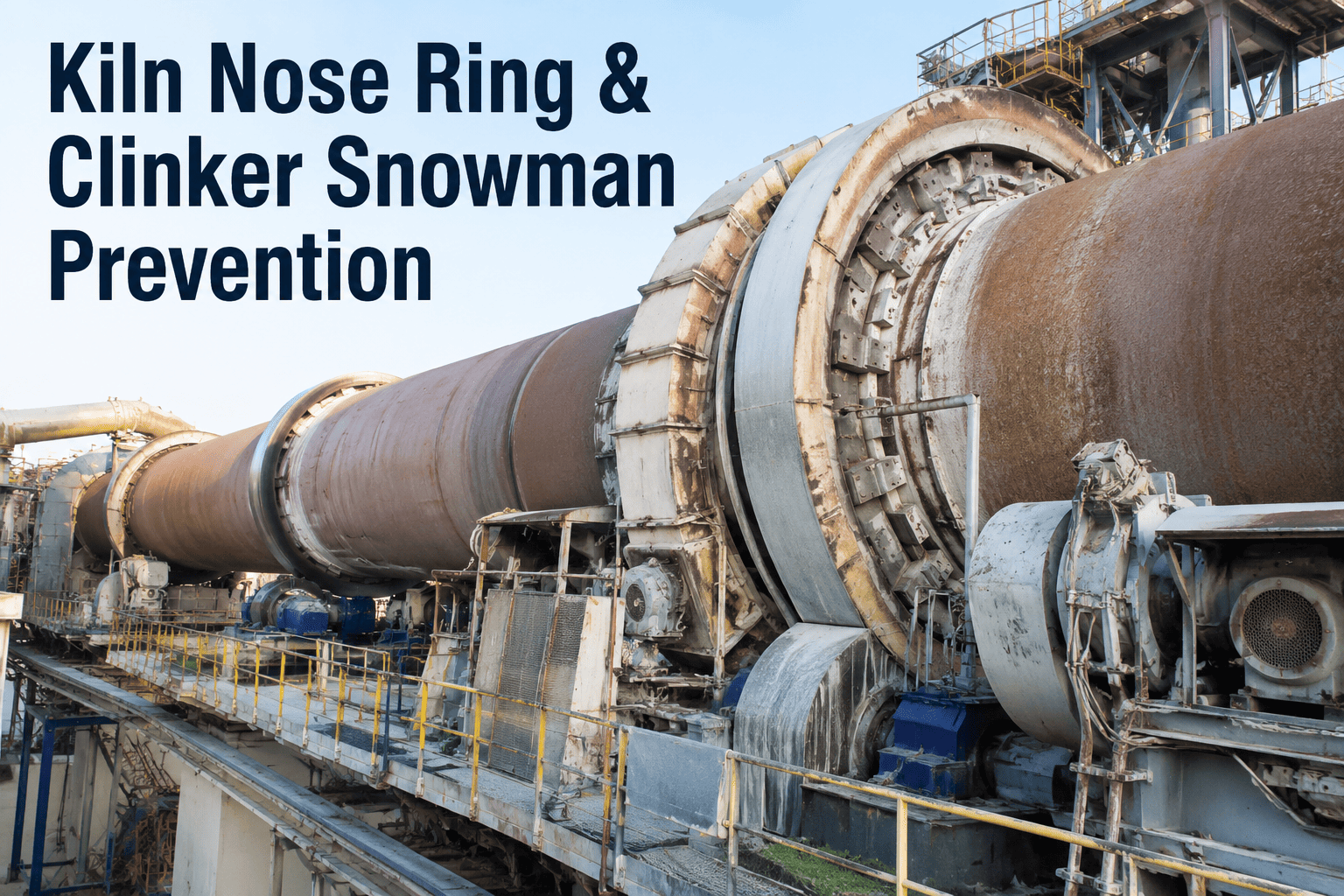
A snowman at the kiln outlet does not build gradually the way most coating problems do — it can grow from a minor deposit to a flow-blocking mass within days once the underlying chemistry and cooling conditions line up against you. A nose ring, forming just inside the kiln discharge, is often the early warning sign that those same conditions are developing, which is exactly why plants that treat nose ring buildup as a routine inconvenience are frequently surprised by the snowman that follows it weeks later. Both are extreme forms of the same underlying problem — too much liquid phase clinker staying too hot for too long in the wrong place — and both are preventable once the chemistry and airflow signals driving them are tracked rather than discovered during a shutdown. Book a free kiln discharge and cooler inlet monitoring assessment.
Quick Answer
Nose rings form just inside the kiln discharge and snowmen form at the kiln outlet or grate cooler inlet, both driven by excess liquid phase clinker that stays semi-molten too long due to high burning zone temperature, poor cooling air distribution, or unbalanced raw mix chemistry. Tracking the alkali-sulfur ratio, burner pipe positioning, and cooler inlet airflow together typically catches developing buildup twenty-four to forty-eight hours before it restricts material flow enough to force a shutdown.
Catch the Buildup Before It Becomes a Shutdown
iFactory tracks the chemistry ratios, burner positioning signals, and cooler airflow data that predict nose ring and snowman formation — before the next planned inspection finds it the hard way.
Nose Ring vs Clinker Snowman: What's the Difference
Both problems share the same root chemistry, but they differ enough in location and behavior that plants need to recognize each one separately.
Nose Ring
Forms at the lower transition zone, just inside the kiln discharge
A ring-shaped buildup of clinker that adheres to the kiln wall near the discharge end, sometimes called an ash ring on coal-fired kilns. It grows relatively gradually and is often removable with a targeted cold burn or mechanical clearing before it becomes severe.
Clinker Snowman
Forms at the kiln outlet or the grate cooler inlet
A massive, irregular buildup of sticky, semi-molten clinker rather than a uniform ring. It is considered the more dangerous of the two because of both its location, directly blocking material and air flow into the cooler, and its capacity to grow rapidly once conditions favor it.
What Causes These Buildups to Form
No single factor causes nose ring or snowman formation on its own. It is almost always a combination of chemistry and operating conditions pushing clinker toward staying liquid longer than the process design intends.
01
Excess liquid phase from raw mix chemistryElevated Fe2O3, Al2O3, MgO, and alkali content lowers the clinker melting point and increases the proportion of liquid phase at clinkering temperature, making the material inherently stickier and more prone to adhering wherever it contacts a surface.
02
Burning zone temperature running too highOverheating pushes more of the clinker into a molten state than the mix chemistry alone would produce, and this excess liquid phase carries through to the discharge end where it has nowhere to go but the kiln wall or cooler inlet.
03
Burner pipe positioned too far backRetracting the burner pipe tip shortens the primary cooling zone under the burner, giving the clinker less distance and time to begin solidifying before it reaches the nose ring area, which allows more melt to persist right where the ring tends to form.
04
Insufficient or uneven cooler inlet air distributionIf cooling air at the grate cooler inlet is inadequate or unevenly distributed, clinker remains in a high-temperature, high-viscosity state for longer than it should, sharply increasing the risk that it adheres and accumulates rather than falling cleanly onto the grate.
05
High dust recirculation from cooler secondary airFine clinker dust carried back into the kiln inlet with the secondary air stream clings readily to surfaces when a liquid phase is present, effectively gluing itself onto an already-forming deposit and accelerating its growth.
See Which of These Five Conditions Is Building Toward a Problem Right Now
iFactory correlates raw mix chemistry, burning zone temperature, burner position signals, and cooler inlet airflow continuously, flagging the specific combination that historically precedes nose ring and snowman events on your kiln.
The Chemistry Ratios That Predict Ring Risk
Raw mix and fuel chemistry set the stage for buildup risk well before any physical deposit forms. These two ratios are the most consistently cited indicators across kiln operations literature.
| Chemistry Ratio |
Balanced Range |
Risk When Out of Range |
| Molar SO3 / (Na2O + K2O) |
Near 1.0 |
Ratio drifting significantly above or below unity promotes alkali sulfate or alkali chloride deposition |
| Sulfur / alkali ratio |
Roughly 0.83–1.2 |
Above 1.2 generates calcium sulfate that sticks to particles; below 0.83 favors low-melting alkali salt rings |
| Liquid phase content at clinkering temperature |
Within plant-specific target band |
Excess Fe2O3, Al2O3, MgO, or alkali content raises liquid phase and increases stickiness |
| Fuel sulfur and chlorine content |
Screened per fuel load |
High-sulfur coal or petcoke and chlorine-bearing alternative fuels both accelerate deposit formation |
Prevention and Response Checklist
1
Track raw mix chemistry continuously, not just at lab sampling intervalsRegular chemical analysis of the raw meal feed, checked against the sulfur-alkali balance, catches a chemistry drift toward high liquid phase before it reaches the kiln rather than after the fact.
2
Verify burner pipe tip position against the current flame profileConfirm the burner pipe is positioned to maintain an adequate primary cooling zone length under the burner, since a tip set too far back is a common and correctable contributor to nose ring formation.
3
Improve and monitor cooler inlet air distributionUneven or insufficient cooling air at the grate cooler inlet is one of the most consistently cited causes of snowman formation, so confirming even distribution across the inlet width deserves regular attention, not just a one-time commissioning check.
4
Minimize fine dust recirculation from the coolerManaging dust capture and reducing the volume of fine clinker particles carried back into the kiln inlet with secondary air reduces the material available to adhere to an already-forming deposit.
5
Remove developing rings early with a controlled cold burn or mechanical clearingAddressing a nose ring while it is still thin, using a controlled cold burn, cutting tools, or a targeted CO2 cartridge system, is far less disruptive than waiting until it has grown into a flow-restricting dam that forces an extended shutdown.
Our Numbers
24–48 hrs
Typical Advance Warning Before Flow Restriction
2
Chemistry Ratios Tracked Against Formation Risk
5
Contributing Conditions Monitored Together
Days
Typical Snowman Growth Time Once Conditions Align
Zero
New Sensors Required on Most Kiln Discharge Zones
~1.0
Target Molar SO3 to Alkali Ratio
We used to find out about a snowman forming when the cooler operator called up to say material flow had gone strange. By the time that call came in, we were already looking at a multi-day clearing job with a crew working at the cooler inlet. Once we started tracking our sulfur-alkali ratio alongside cooler inlet airflow, we caught a drift building over about two days before it reached the point of restricting flow, adjusted the raw mix and cooling air distribution, and never let it develop into anything the crew had to physically clear.
Kiln Operations Manager
3,800 TPD Cement Line — Northern India
Frequently Asked Questions
QIs a nose ring always a warning sign that a snowman is coming?
Not always, but the two share enough of the same underlying chemistry and thermal conditions that a plant seeing recurring nose ring buildup should treat it as a signal worth investigating rather than routine maintenance noise. Kilns with frequent nose ring problems often also experience snowman formation for the same reasons, since both point toward excess liquid phase clinker persisting longer than the process design intends. Tracking the same chemistry and airflow indicators that drive nose rings gives early visibility into snowman risk as well.
Book a demo to see both tracked together on your kiln.
QWhat is the fastest way to remove a nose ring once it has formed?
The appropriate removal method depends heavily on how severe and how well-adhered the ring has become. Thin, recently formed rings can often be addressed with a controlled cold burn that thermally shocks the deposit loose, while more established rings typically require mechanical clearing with cutting tools, pneumatic hammers, or high-pressure water jets. Some plants use CO2 cartridge systems affixed to the kiln shell for controlled blasting that requires only a short kiln stop to load and trigger. Removing a ring while it is still thin is consistently less disruptive than waiting.
QCan raw mix chemistry alone cause a snowman, or does it always require an operational trigger too?
Chemistry sets the risk level, but an operational trigger — burning zone overheating, unstable flame shape, or inadequate cooler airflow — is usually what turns that risk into an actual event. A raw mix running slightly high in liquid-phase-promoting elements may operate without incident for extended periods if burning zone temperature and cooler cooling capacity stay well controlled, while the same chemistry combined with a temperature excursion or cooler air distribution problem can produce a snowman within days. This is why tracking chemistry and operating conditions together matters more than watching either alone.
QHow does burner pipe position specifically contribute to nose ring formation?
The primary cooling zone, the section of the kiln directly under the burner flame, is where clinker begins solidifying after leaving the burning zone. When the burner pipe tip is positioned too far back from the discharge end, that cooling zone effectively shortens, giving clinker less time and distance to solidify before reaching the nose ring area. More of the material arrives at the discharge end still carrying excess liquid phase, which is exactly the condition that promotes adhesion and ring buildup at that location.
QWhat data do we need to start monitoring nose ring and snowman risk continuously?
Most kilns already generate the core data needed — raw mix chemistry from lab analysis, burning zone temperature from existing pyrometers, burner position from the burner pipe control system, and cooler inlet airflow from existing fan and damper instrumentation. The gap is usually not missing sensors but a missing analysis layer that correlates all of these signals together and compares them against the specific combinations that have preceded buildup events on your kiln historically.
Talk to an expert about what your current instrumentation already covers.
Stop Discovering Snowmen From a Phone Call at the Cooler Inlet
iFactory correlates raw mix chemistry, burning zone temperature, burner position, and cooler airflow continuously, flagging developing nose ring and snowman risk days before a crew has to clear it manually.
Chemistry Ratio Tracking
Burner Position Monitoring
Cooler Airflow Analysis
24–48 Hour Early Warning