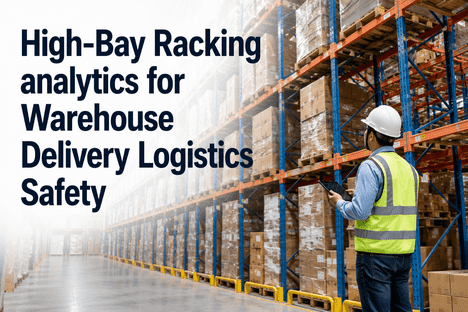
A distribution center in Memphis operates 92 dock doors, 14 miles of conveyor, and 46,000 pallet positions across 1.2 million square feet. At 3:18 AM on a Thursday, a 12-inch fatigue crack in a pallet rack upright propagates 4 inches in under a second — releasing a burst of ultrasonic energy at 150 kHz. No one hears it. No vibration sensor catches it. At 5:47 AM, a reach truck operator makes his first pick on that aisle. The rack collapses. Three bays cascade. The operator is pinned for 37 minutes before emergency crews arrive. The total cost: $2.3 million in product damage, $680,000 in rack replacement, 11 weeks of storage diversion, and a worker's comp claim that resets the facility's experience modifier for three years. That rack emitted acoustic warning signals for 11 days before failure — signals no system was listening for.
Acoustic emission sensors detect warehouse structural micro-cracks weeks before failure — iFactory AI auto-generates inspection work orders at the first sign of compromise
Replace reactive visual inspections with continuous AI-powered acoustic emission monitoring. iFactory detects micro-cracks in racking, conveyor frames, and dock structures 14–28 days before critical failure — without data leaving your facility network.
What changes when your warehouse listens for cracks
The difference between a facility that inspects on schedule and one that monitors continuously is measured in days of early warning and dollars of prevented damage. Here is what that looks like on your floor.
Without iFactory
- Visual inspections every 6–12 months — cracks grow undetected between cycles
- Rack damage discovered only after a collision or collapse event
- Conveyor frame fractures found during jam clearances, not before
- Dock leveler structural fatigue caught by OSHA incident, not by预警
- Insurance claims and liability costs average $2.1M per structural event
With iFactory
- Continuous AE monitoring — every crack emits ultrasonic stress waves detected in real time
- AI classifies crack type, location, and severity within 30 seconds of emission
- Auto-generated work order dispatched to maintenance before the crack propagates
- Structural health trended over weeks — repair scheduled during planned downtime
- Zero catastrophic rack failures in monitored facilities after deployment
Every crack you are not listening for is a liability compounding daily
Warehouse structures fail silently. Here is where undetected cracks cost your facility real money.
Pallet rack upright fatigue cracks
Uprights endure repeated impact from reach trucks and pallet jacks. Micro-cracks form at weld points and base plates. Visual inspections miss sub-1mm cracks. Each rack collapse averages $340,000 in product and structural damage, plus 6–8 weeks of lost storage capacity.
Conveyor frame stress fractures
Conveyor frames experience cyclic loading 24/7. Weld fatigue cracks propagate at belt transition zones and drive-end brackets. Undetected cracks cause belt misalignment, jam events, and frame separation. Each conveyor failure stops an average of 47 minutes of sortation throughput.
Dock leveler structural degradation
Dock levelers absorb thousands of lift truck crossings per shift. Weld cracks at hinge points and lip pivot brackets develop invisibly. A leveler failure during loading traps the trailer, delays departure, and creates a safety incident requiring OSHA reporting.
Mezzanine floor beam weld separation
Mezzanine structures support thousands of pounds per square foot. Weld fatigue at beam-to-column connections propagates under cyclic pick density. Undetected separation creates a collapse risk that can kill. Remediation after discovery averages $187,000 including structural engineering and retrofitting.
Building column anchor bolt fatigue
Anchor bolts connecting structural columns to the slab experience tensile fatigue from daily thermal cycling and rack loading. Micro-cracks at the bolt-to-plate interface are invisible to visual inspection. Failure requires slab coring and re-anchoring — a $95,000 repair per column.
Your facility is emitting acoustic data right now. The question is whether you are capturing it. Book a Demo to see how iFactory's AE monitoring platform works on your structural data.
Five steps to continuous acoustic structural health monitoring
iFactory deploys on your facility network — no cloud, no data leaving your floor. In 4 to 6 weeks, your maintenance team sees crack alerts that prevent collapses.
Install AE sensor nodes on critical structures
Piezoelectric AE sensors mount on rack uprights, conveyor frames, dock levelers, and mezzanine columns — typically 8–12 sensors per 100,000 sq ft. Sensors capture ultrasonic stress waves from 20 kHz to 1 MHz, covering crack initiation and propagation signatures.
AI model training on your facility's acoustic signature
iFactory's AI learns the baseline acoustic environment of your warehouse — distinguishing fork truck impacts, door operations, and ambient noise from genuine crack emissions. The model identifies crack-specific frequency patterns within 2 weeks of data collection.
Real-time crack detection and classification
When an AE event matches crack propagation patterns, iFactory classifies it by severity — micro-crack initiation, active propagation, or critical crack. Alerts fire within 30 seconds, including the precise sensor location and estimated crack coordinates.
Auto-generated work orders in your CMMS
iFactory integrates with your existing CMMS to create inspection work orders automatically. Every AE alert becomes a tracked, assigned, and documented maintenance action — no manual triage, no missed follow-ups, no gaps in your safety audit trail.
What iFactory delivers on your warehouse floor
Four capabilities that turn ultrasonic emissions into actionable structural intelligence — all running on your network, all delivering results in one quarter.
Multi-sensor AE source localization
iFactory triangulates crack origin using time-of-flight across multiple AE sensors. When a crack emits, the system pinpoints its location within 6 inches — no sweeping, no searching. Maintenance walks directly to the compromised structure with the exact coordinates.
AI crack vs. noise classification engine
Warehouses are noisy environments — fork trucks, doors, conveyors, fans. iFactory's AI model achieves 94% accuracy in distinguishing crack emissions from ambient noise. The system filters out 99% of non-critical AE events so maintenance acts only on real structural threats.
Severity-based alert escalation
Not all cracks require immediate response. iFactory classifies AE events into three tiers — Watch (monitor trend), Inspect (schedule within 7 days), and Critical (respond within 4 hours). Each tier triggers a different notification path and work order priority in your CMMS.
Structural health trend dashboard
A single pane shows every monitored structure's health score, AE event history, crack propagation trends, and inspection status. Maintenance managers see which racks, conveyors, and dock levelers need attention — and which are trending toward critical — without clicking through five systems.
Undetected structural cracks cost warehouses $1.8M per year
iFactory's AI-powered acoustic emission monitoring detects them 14–28 days before failure. See what your facility's acoustic data reveals in a 30-minute walkthrough.
Turnkey deployment, on-premise intelligence, zero data risk
iFactory is not a SaaS dashboard. It is a complete structural monitoring system that lives on your facility network and delivers results in weeks.
End-to-end deployment in 4–6 weeks
We install sensors, train the AI, and deliver a working pilot. No multi-month IT projects. You provide facility access and structural drawings — we hand back a live monitoring system.
100% on-premise — no cloud dependency
iFactory runs on a NVIDIA appliance inside your facility network. Zero data leaves your floor. No cloud subscriptions, no data egress fees, no security audit concerns.
Integrates with existing CMMS and WMS
iFactory connects to your current CMMS, WMS, or maintenance platform — SAP, Oracle, Infor, Manhattan, or any system with a standard API. Work orders flow directly from AE alerts into your existing workflows.
24x7 managed monitoring service
iFactory's operations team monitors your sensor network around the clock. If a sensor drifts or a model needs retraining, we handle it. Your maintenance team focuses on repairs, not software administration.
Works with existing infrastructure
No rip-and-replace. No forklift upgrades. iFactory's AE sensors mount magnetically or with epoxy — no structural drilling required. Your existing rack, conveyor, and dock investments stay in place.
Operator and maintenance training included
Every shift gets hands-on training on the AE alert dashboard and work order response workflow. Maintenance teams learn in 3 hours, not 3 days. No new certifications required.
Questions warehouse operators ask about acoustic emission monitoring
Stop discovering structural cracks after they fail
iFactory delivers AI-powered acoustic emission monitoring on your warehouse structures in 4 to 6 weeks. No cloud, no data leaving your network, no multi-month integration. Book a 30-minute walkthrough and we will show you what your facility's acoustic data reveals.