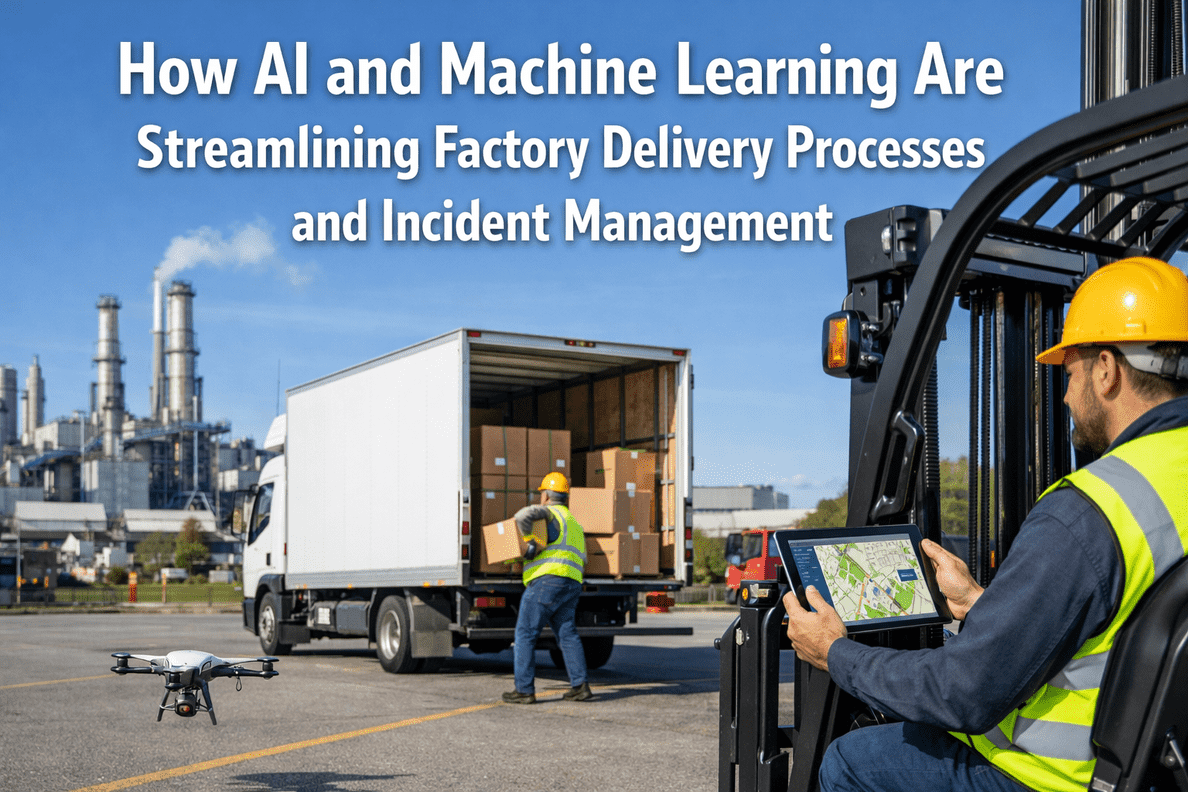
How AI and Machine Learning Are Streamlining Factory Delivery Processes and Incident Management

By Fury Tycoon on March 5, 2026

ai-deliveries-operations-machine-learning

86% of manufacturers track OEE. Almost none track gate pass processing time, dispatch SLA compliance rates, or incident resolution speed — the exact metrics where artificial intelligence delivers its most immediate ROI in a factory delivery department. AI and machine learning are not arriving at the factory gate as a future capability. They are deployed in 2026 across the most operationally advanced plants in India, the USA, Germany, and the UAE — analyzing gate dwell patterns, predicting dispatch errors before they occur, surfacing incident trends before they escalate, and turning every inbound receiving event into a traceable, compliance-ready data point. This guide covers exactly how AI and machine learning are transforming factory delivery operations — gate pass management, inbound receiving, dispatch sequencing, vehicle inspection, internal material tracking, and incident management — and what the data shows about where the greatest operational gains are concentrated. If you manage a factory delivery department and want to see what this looks like in a live environment, talk to our support team directly.

AI & Machine Learning  ·  Factory Delivery Operations  ·  2026

How AI and Machine Learning Are Streamlining Factory Delivery Processes and Incident Management

The global AI in manufacturing market is growing at 37.9% annually and will reach $128.8 billion by 2034. The factories capturing that ROI fastest are the ones digitizing their delivery departments first — gate passes, dispatch, inspections, receiving, and incident resolution — because that is where data gaps are widest and process losses are largest.

$128.8B
AI in manufacturing market by 2034 — growing at 37.9% annually from 2026
87%
Reduction in gate pass processing time with AI-driven digital workflows
90%
Fewer dispatch errors when AI-priority sequencing replaces manual decision-making
14 days
iFactory deployment timeline — from decision to fully operational AI-powered delivery department
The Data Gap

Where AI Makes the Biggest Difference in Your Factory Delivery Department

What AI Can Optimize When Data Exists
Gate dwell time — AI surfaces peak queue hours and vehicle processing bottlenecks
Dispatch SLA prediction — ML flags shipments at risk of missing their SLA window 2–3 hours early
Inbound receiving anomalies — AI detects PO mismatch patterns before they become disputes
Incident escalation — ML identifies repeat incident types and triggers automatic escalation
Vehicle inspection trends — AI correlates failed inspection items to vehicle age, mileage, and operator
Material location prediction — AI tracks internal transfer patterns and predicts production availability
Receiving cycle benchmarking — ML compares dock performance against historical and peer baselines
Auto-escalation routing — AI routes incidents to correct owner without manual triage
What Remains Invisible Without Digital Operations
Gate queue wait time — no data exists beyond a guard's handwritten log
Dispatch SLA compliance rate — manual sequencing misses are discovered only at customer complaint
Inbound discrepancy rate per supplier — paper POD provides no pattern analytics
Incident response time — no timestamp on discovery, escalation, or resolution
Vehicle inspection failure rate by vehicle or operator — paper checklists are untracked
Material location after dock entry — production search time is invisible and unrecorded
Receiving cycle time per dock team — no performance comparison is possible
Repeat incident patterns — each incident treated as isolated without historical record
8 AI-Powered KPIs

8 Factory Delivery KPIs That AI and Machine Learning Measurably Improve

87%
Gate Pass Processing Time Reduction
AI pre-screening of pre-registered vehicles, driver credentials, and cargo manifests cuts gate processing from 15–20 minutes to under 2 minutes. A factory processing 20 vehicles daily recovers 280+ minutes of dock time — every single day.
Manual: 15–20 min/vehicleAI-powered: under 2 min
78%
Faster Inbound Receiving Completion
Machine learning PO-matching on mobile cuts inbound receiving from 45–60 minutes to under 10 minutes per shipment. AI flags discrepancies at point of receipt — not three days later when a production shortage reveals the gap.
Manual: 45–60 min/shipmentAI-powered: under 10 min
90%
Dispatch Error Rate Reduction
AI-priority dispatch sequencing reduces error rates from 2–3% to under 0.3%. Machine learning continuously adjusts sequencing based on live vehicle availability, SLA urgency tiers, and real-time dock capacity — decisions no dispatcher can make manually at speed and scale.
Manual: 2–3% error rateAI-powered: under 0.3%
100%
Audit Trail Coverage
AI ensures every gate event, receiving transaction, inspection result, material transfer, and dispatch decision is timestamped and person-attributed. No manual documentation step. No incomplete records. Compliance documentation is a byproduct of daily AI-assisted operations — not a separate reporting exercise.
Manual: incomplete, fragmentedAI-powered: 100% coverage
40%
Reduction in Inbound Delays
AI pre-registration workflows and intelligent gate scheduling reduce inbound delays by 40% across factories that have deployed digital delivery department platforms. Machine learning identifies peak arrival windows and recommends pre-scheduled gate slots to eliminate queue buildup before it forms.
Manual: uncontrolled queueAI-powered: 40% delay reduction
30–40%
Material Search Time Eliminated
Most production stoppages attributed to "material unavailability" are locating failures — not stock-outs. AI-powered internal tracking records every transfer in real time, enabling instant location queries and eliminating the 30–40% of production search time that disappears into warehouse walkabouts under manual operations.
Manual: no location after dockAI-powered: real-time location
3–6 mo
Full Platform Payback Period
Recovered dock time, eliminated dispatch errors, reduced incident response overhead, and compliance documentation savings combine to deliver full platform payback within 3–6 months of iFactory go-live. AI does not require months of model training — it begins surfacing insights from day one of data capture.
Legacy systems: 18–24 moiFactory: 3–6 months
72%
Manufacturers with Smart Factory Gap in Delivery
72% of manufacturers have partially implemented smart factory strategy — but delivery departments consistently lag behind every other function. AI adoption is already advanced in production, quality, and maintenance. The delivery department is the last undigitized function and the highest ROI opportunity remaining in most factories.
72% still manually operating deliveryiFactory closes this gap in 14 days
Your production floor has AI. Your delivery department deserves the same intelligence.
iFactory brings AI-powered gate pass automation, intelligent dispatch sequencing, ML-driven incident management, and real-time material tracking to the factory delivery department — the most data-poor function in most manufacturing operations. Talk to our support team to assess your factory's delivery data gap.
How AI Works Here

6 Factory Delivery Workflows Where AI and Machine Learning Deliver Measurable Results

01
AI-Powered Gate Pass Automation — Pre-Arrival to Exit
Drivers pre-register via mobile before arrival. iFactory's AI cross-checks driver credentials, vehicle compliance status, and cargo manifest against the expected delivery schedule — flagging mismatches before the vehicle reaches the gate. At the gate, security completes a mobile checklist in under 2 minutes. Machine learning analyzes gate arrival patterns over time to recommend optimal pre-registration windows for peak arrival hours, reducing queue formation before it begins. Every gate event generates an automatic timestamped record capturing vehicle type, dwell time, arrival and exit, and operator — the same data used for compliance documentation and operational analytics. A factory processing 20 vehicles daily recovers 280+ minutes per day by moving from manual to AI-assisted gate operations.
87% gate time reduction Auto compliance record Queue pattern analytics Zero manual logging
02
ML-Driven Inbound Receiving — PO Verification and Discrepancy Detection
Receiving staff verify inbound materials against purchase orders on mobile — scanning barcodes, capturing discrepancy photos, and logging exceptions in real time. Machine learning PO-matching detects quantity shortfalls, wrong item codes, and supplier substitutions at point of receipt — not 72 hours later when production raises a shortage flag. Over time, ML builds a supplier discrepancy profile for each vendor, enabling receiving teams to apply heightened verification protocols to suppliers with historically elevated error rates. Every receiving event generates a digital chain of custody record linking supplier, carrier, material, quantity, and timestamp — eliminating the manual paperwork that consumes 45–60 minutes per shipment under traditional operations. AI also compares dock team cycle times against historical benchmarks, surfacing performance gaps before they become systemic bottlenecks.
78% faster receiving Supplier anomaly profiling Real-time discrepancy flags Auto chain of custody
03
SLA-Priority AI Dispatch — Intelligent Sequencing and Error Prevention
Manual dispatch sequencing produces error rates of 2–3% — SLA misses that go undetected until a customer complaint arrives days later. iFactory's AI-priority dispatch engine sequences orders automatically based on SLA urgency tier, vehicle type, load capacity, dock availability, and real-time traffic conditions. Machine learning continuously refines sequencing decisions based on historical SLA outcome data — identifying which order combinations, vehicle types, and time windows produce the highest compliance rates. The system flags shipments at risk of missing their SLA window 2–3 hours before departure, giving dispatchers actionable intervention time rather than a post-incident apology. Dispatch error rates drop from 2–3% to under 0.3% — and every dispatch event captures the vehicle ID, fuel type, route, and departure data that downstream operations and compliance reporting require.
90% fewer dispatch errors Proactive SLA alerts Continuous ML refinement Auto dispatch records
04
AI Vehicle Inspection — Digital Checklists with Predictive Fault Patterns
Yard tractors, forklifts, shunters, and delivery vehicles complete digital pre-use inspection checklists on mobile. Failed inspection items are logged with timestamp, operator ID, and photo evidence — and vehicles with critical failures are automatically blocked from dispatch until a verified repair work order is completed. Machine learning correlates inspection failure patterns against vehicle age, mileage, operator history, and maintenance records — surfacing vehicles approaching recurring failure before the next inspection finds a safety-critical defect. This transforms inspections from a compliance checkbox into a predictive maintenance input: AI analyzes the pattern of minor failed items that historically precede major failures, enabling proactive service scheduling that prevents unplanned yard equipment downtime. Inspection data feeds directly into vehicle lifecycle records, supporting data-backed replacement decisions.
Failed vehicle auto-block Predictive fault patterns Operator performance tracking Full inspection audit trail
05
AI Internal Material Tracking — Real-Time Location at Every Transfer Point
Materials are logged at every internal transfer — dock to stores, stores to production, production to quality, quality to dispatch. Machine learning builds a predictive model of material flow velocity for each material type, flagging transfers that are running behind their expected production availability timeline before the production team raises a shortage alert. This eliminates the 30–40% of production search time that disappears into manual warehouse walkabouts under paper-based operations — where most production stoppages attributed to "material unavailability" are actually locating failures, not stock-outs. AI also identifies transfer bottlenecks — locations and transitions where material dwells significantly longer than the baseline — enabling operations managers to reallocate dock resources proactively rather than reactively.
Real-time material location 30–40% search time eliminated Bottleneck identification Production schedule protection
06
ML Incident Management — Auto-Escalation and Pattern Detection
Under manual operations, incidents in the factory delivery department are typically discovered days after occurrence — discovered by a customer complaint, a missing shipment, or a compliance audit finding. iFactory's AI incident management captures exceptions in real time with timestamped records, photo documentation, and immediate auto-escalation to the correct owner based on incident type, severity, and operational impact. Machine learning analyzes incident patterns over time — identifying repeat incident types, recurring vehicle-operator-location combinations, and systemic causes that individual incident records do not surface. Operations managers receive weekly AI-generated incident pattern summaries that convert isolated events into actionable operational intelligence. By 2026, 40% of manufacturers have adopted AI scheduling and operational tools — but incident pattern analysis in the delivery department remains one of the most underutilized AI applications available.
Real-time incident capture Auto-escalation routing Pattern analysis and alerts Full incident audit trail
Measurable Results

What iFactory's AI Delivers Within 90 Days of Go-Live

280+
Minutes Recovered Daily
A factory processing 20 vehicles/day at 15–20 minutes manual gate time recovers 280+ minutes of dock time daily by switching to AI-assisted 2-minute processing — equivalent to 2+ full-time labor hours per day redirected to productive work.
87%
Gate Pass Time Reduction
AI pre-screening and mobile gate verification reduces gate processing from 15–20 minutes to under 2 minutes per vehicle. Every gate event simultaneously generates timestamped compliance documentation — no manual record creation required.
78%
Faster Receiving Completion
ML-powered PO matching and real-time discrepancy detection cuts inbound receiving from 45–60 minutes to under 10 minutes per shipment. Supplier anomaly profiles improve over time as the ML model accumulates receiving history.
100%
Audit Trail Coverage
Every gate, receiving, inspection, dispatch, material transfer, and incident event is timestamped and person-attributed automatically. AI generates compliance documentation as a byproduct of operations — retrievable in under 60 seconds for any regulatory or internal audit.
3–6 mo
Full Platform Payback
Recovered dock time, eliminated dispatch errors, reduced compliance overhead, and incident response savings combine to deliver full iFactory payback within 3–6 months of go-live. AI begins generating operational insights from day one — not after a 90-day training period.
14 days
Go-Live Timeline
From decision to fully operational AI-powered delivery department in 7–14 days. Cloud-based, mobile-first, no server infrastructure, no IT department project. iFactory goes live faster than most factories can schedule a traditional software implementation kickoff meeting.
Before vs. After

Factory Delivery Department — Manual Operations vs. iFactory AI Platform

Department Function
Manual Operations
iFactory AI Platform
Gate Pass Processing
15–20 min/vehicle. No dwell time data. No pattern analytics. No compliance record generated automatically.
Under 2 min. AI pre-screening. Dwell time captured automatically. Compliance record generated per vehicle.
Inbound Receiving
45–60 min/shipment. Manual PO matching. Discrepancies discovered 72 hours later. Paper POD only.
Under 10 min. ML PO matching. Real-time discrepancy flags. Digital chain of custody auto-generated.
Dispatch Sequencing
Manual sequencing. 2–3% error rate. SLA misses undetected until customer complaint arrives.
AI-priority sequencing. Under 0.3% errors. Proactive SLA risk alerts 2–3 hours before departure.
Vehicle Inspection
Paper checklists. No timestamp. No operator attribution. Failed vehicles not blocked. No pattern analysis.
Digital checklists with ML fault pattern analysis. Auto-block on failures. Predictive maintenance inputs generated.
Internal Material Tracking
No location record after dock entry. Production search time invisible. Stoppages blamed on stock-outs.
Real-time AI tracking at every transfer. 30–40% search time eliminated. Bottlenecks surfaced automatically.
Incident Management
Incidents discovered days after occurrence. No timestamp. No escalation. No pattern visibility across events.
Real-time capture with auto-escalation. ML pattern analysis across incident history. Weekly summaries generated.
Compliance Documentation
Hours of manual assembly per audit. Paper records incomplete. Audit findings create enforcement exposure.
100% auto-generated from daily operations. Retrievable in under 60 seconds. Zero manual assembly required.
Deployment Timeline
Legacy systems: 6–18 months. IT project. Hardware procurement. High upfront cost. Slow ROI realization.
iFactory: 7–14 days. Cloud-based. Mobile-first. No IT project. AI insights from day one of data capture.
iFactory  ·  AI-Powered Factory Delivery Operations

Your delivery department is the last AI-free zone in your factory. iFactory changes that in 14 days.

iFactory brings AI-powered gate pass automation, ML-driven dispatch sequencing, predictive vehicle inspection analysis, real-time material tracking, and intelligent incident management to the factory delivery department — the highest ROI AI application most plants have not yet deployed. No IT project. No hardware procurement. Live in 7–14 days. Book a demo to see iFactory running in a live factory delivery environment.

Frequently Asked Questions

AI and Machine Learning in Factory Delivery Operations — What Operations Leaders Ask First

How does AI specifically improve gate pass management in a factory delivery department?
AI improves factory gate pass management through four mechanisms that manual operations cannot replicate. First, pre-arrival AI screening cross-checks driver credentials, vehicle compliance status, and cargo manifest against the expected delivery schedule before the vehicle arrives — flagging mismatches that would otherwise consume gate staff time during peak processing. Second, AI-assisted mobile gate verification reduces the physical processing time from 15–20 minutes to under 2 minutes by presenting security staff with a pre-verified checklist requiring confirmation, not data entry. Third, machine learning analyzes historical gate arrival patterns to identify peak queue windows and recommend pre-registration slots — reducing queue formation before it begins rather than managing it after the fact. Fourth, every gate event automatically generates a timestamped compliance record capturing vehicle type, dwell time, and operator — data that paper gate logs never capture and that operations managers need to identify and eliminate recurring bottlenecks. A factory processing 20 vehicles daily recovers 280+ minutes of dock time per day through this transition. Book a demo to see AI gate pass management running in a live factory environment.
What does machine learning do in factory dispatch sequencing that manual processes cannot?
Manual dispatch sequencing is inherently limited by human cognitive bandwidth — a dispatcher can evaluate a handful of variables (vehicle availability, load size, destination proximity) simultaneously. Machine learning eliminates that ceiling by evaluating dozens of variables in real time: SLA urgency tier, vehicle type, fuel type, load compatibility, dock availability, historical delivery time for each route, current traffic conditions, and the SLA performance history of each vehicle-driver combination. The result is dispatch error rates dropping from 2–3% (manual) to under 0.3% (ML-sequenced). More importantly, machine learning improves over time — each completed dispatch cycle adds to the model's understanding of which sequencing decisions produce the highest SLA compliance rates in your specific operational context. It also provides something manual dispatch cannot: a proactive SLA risk alert that flags shipments at risk of missing their delivery window 2–3 hours before departure, giving dispatchers intervention time rather than a post-incident customer complaint to manage. Talk to our support team about dispatch sequencing configuration for your factory's SLA structure.
How does AI incident management differ from a standard digital incident log?
A standard digital incident log captures what happened and when — replacing a paper record with a database entry. AI incident management does three things a log cannot. First, auto-escalation: AI routes each incident to the correct owner based on incident type, severity, operational impact, and escalation rules — without requiring a manager to triage and redirect every event manually. Second, pattern detection: machine learning analyzes incident history to identify recurring incident types, vehicle-operator-location combinations that generate disproportionate incidents, and systemic operational causes that individual event records do not surface. Third, predictive prevention: as the ML model accumulates incident data, it begins surfacing early indicators that historically precede high-severity incidents — enabling interventions before the incident occurs. Under manual operations, incidents in the factory delivery department are typically discovered days after occurrence. iFactory's AI incident management captures them in real time, escalates immediately, and converts individual events into organizational operational intelligence through pattern analysis. Book a demo to see the incident management dashboard running on live factory data.
How quickly does iFactory's AI begin delivering insights after deployment?
iFactory begins generating operational data from the first gate pass processed on the platform — there is no pre-training period or data accumulation requirement before the core AI functions operate. Gate pass AI screening, ML PO matching for inbound receiving, SLA-priority dispatch sequencing, and incident auto-escalation are active from day one of go-live. Pattern analysis capabilities — supplier discrepancy profiling, vehicle inspection fault trends, incident pattern summaries, and dispatch optimization refinement — begin producing statistically meaningful outputs within 2–4 weeks as the ML models accumulate operational data from your specific factory environment. The full deployment timeline from decision to go-live is 7–14 days. Most iFactory customers are processing digital gate passes, receiving shipments with ML PO matching, and dispatching with AI sequencing within their first week of operation. Talk to our support team about your specific deployment timeline and configuration requirements.
Can iFactory's AI platform integrate with our existing ERP, WMS, or production systems?
iFactory is designed to integrate with your existing technology stack — not replace it. Standard integrations cover SAP (for PO data and receiving confirmation), common WMS platforms (for inventory sync and material location), ERP systems (for supplier master data and vendor management), and production scheduling platforms (for material pull timing and dispatch prioritization). The integration layer is built on open APIs that allow iFactory's AI to consume data from your existing systems and return operational insights back to them — creating a unified data layer across your inbound, internal, and outbound delivery department workflows. For the AI functions specifically, integration with ERP and WMS enables the ML models to cross-reference inbound receiving data against production requirements, identify material availability risk before it becomes a production stoppage, and flag dispatch priorities based on real-time production schedule pull signals. iFactory also integrates with GPS and telematics hardware for delivery vehicle tracking and supports multi-site deployments covering all facilities in your portfolio from a single dashboard. Book a demo to walk through integration configuration for your specific technology stack.
What ROI should a factory realistically expect from deploying AI in its delivery department?
The ROI from AI-powered factory delivery operations has five independently measurable components. Recovered dock time: a factory processing 20 vehicles daily recovers 280+ minutes per day — equivalent to 1.5–2 full-time labor hours daily redirected from gate administration to productive operations. Dispatch error elimination: reducing dispatch errors from 2–3% to under 0.3% eliminates re-dispatch costs, SLA penalty exposure, and the management time consumed by customer complaint resolution — typically significant in operations with time-sensitive production delivery windows. Receiving efficiency: cutting inbound receiving from 45–60 minutes to under 10 minutes per shipment frees receiving staff capacity equivalent to handling 4–6 additional shipments per shift without headcount increase. Incident response reduction: AI auto-escalation and real-time capture eliminates the management overhead of manual incident triage and the delayed discovery costs (production stoppages, shipment failures, compliance findings) that characterize paper-based incident management. Compliance documentation savings: audit-ready documentation auto-generated from daily operations eliminates the 4–8 hours per audit event consumed by manual record assembly. Full platform payback is typically achieved within 3–6 months of iFactory go-live when all five components are included in the calculation. Talk to our support team for an ROI calculation specific to your factory's vehicle volume, shipment frequency, and dispatch complexity.
iFactory  ·  AI-Powered Factory Delivery Department

72% of manufacturers have a smart factory strategy. Almost none have applied it to their delivery department. iFactory closes that gap in 14 days.

iFactory brings AI gate pass automation, ML dispatch sequencing, predictive vehicle inspection, real-time material tracking, and intelligent incident management to the most data-poor function in manufacturing. Free to explore. Live in 14 days. No IT project required. Book a demo to see iFactory running in a live factory delivery environment and get a same-day ROI estimate for your operation.
Share This Story, Choose Your Platform!