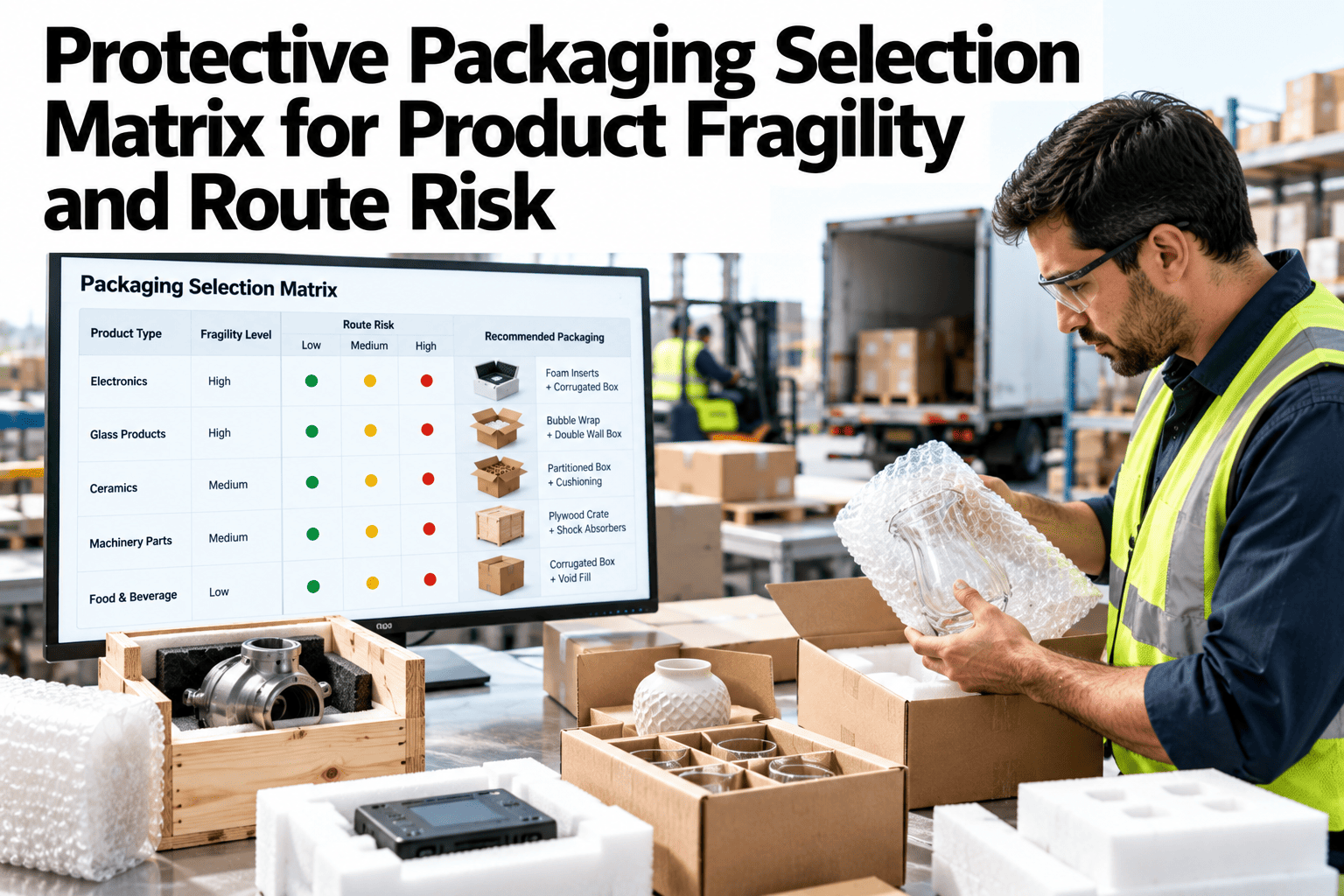
A single cushioning standard applied across an entire catalog treats a dense, impact-resistant product the same as a thin-walled, fragile one, which means either the fragile product is under-protected or the durable one is carrying more protective material, and more shipping cost, than it actually needs. The right cushioning choice depends on two things together: how fragile the product actually is, and how rough the specific route it travels tends to be, since a route with multiple manual sort transfers carries meaningfully more risk than a direct point-to-point lane. Building a selection matrix around both variables, rather than a single blanket standard, is what a structured protective packaging matrix looks like against a real product catalog.
Fragility and Route Risk Decide the Cushioning Together
iFactory AI helps packaging teams match cushioning choice to both product fragility and the actual handling risk of a shipping route, not a single blanket standard.
Why a Single Cushioning Standard Fails Half the Catalog
A blanket protective packaging standard is usually set against the most fragile product in the catalog, or against the average, and both choices create a predictable problem.
Durable Products Carry Unnecessary Cost
A product that could ship safely with minimal cushioning still gets the catalog's standard protective treatment, adding material cost and weight for no actual benefit.
Fragile Products on Risky Routes Are Under-Protected
A standard built for an average route doesn't account for a specific lane with multiple manual sort transfers, where the same product faces meaningfully more handling risk.
Route Risk Rarely Gets Documented
Most packaging decisions are made against product fragility alone, since route-specific handling risk is rarely tracked or fed back into the packaging decision at all.
Comparing Cushioning Options
Different cushioning materials trade off protection, cost, and space differently, which is why the matrix needs real options to assign, not just a single default material.
| Cushioning Type | Protection Level | Best Fit |
|---|---|---|
| Paper void fill | Low to moderate impact absorption | Low fragility products, low-risk routes |
| Foam-in-place | High, molds to irregular product shapes | Fragile or irregularly shaped products |
| Corrugated inserts | Moderate, structural support plus some cushioning | Products needing position control more than shock absorption |
| Engineered foam | High, consistent and testable performance | High fragility products on high-risk routes |
Engineered foam and foam-in-place typically carry a higher material cost than paper void fill, which is exactly why reserving them for the genuinely high-risk combination, rather than applying them catalog-wide, keeps protection matched to actual need.
Score Your Own Products by Fragility and Route Risk
Bring your product catalog and shipping lanes to a 30-minute session and build a selection matrix matched to your actual risk profile.
Building the Matrix, Step by Step
A usable matrix starts from two independent scores, assigned separately, so the final decision reflects both factors rather than one dominating.
Weighing Cost Against Damage Risk
The matrix isn't just a protection decision, it's also a cost allocation decision, since upgrading cushioning tier by tier adds real material cost that has to be justified by avoided damage.
An Illustrative Comparison: Matrix-Based vs Blanket Standard
The figures below are a labeled illustrative composite, not a reported customer result, showing how total protective packaging cost and damage rate can shift when moving from a single blanket standard to a fragility-and-route matrix.
The counterintuitive result teams often see is that a matrix-based approach can lower total packaging cost and improve damage rates at the same time, which feels impossible until you realize a blanket standard is usually over-protecting most of the catalog to compensate for under-protecting a small, genuinely high-risk segment. Separating the two lets each product get exactly what it needs instead of a single compromise applied to everything.
Frequently Asked Questions
How do we score route risk without detailed carrier handling data?
In the absence of detailed carrier data, the number of transfer points, whether automated sort equipment is used, and historical damage claim rates by lane are reasonable proxies for route risk, and the score can be refined later as better data becomes available. Build an initial route risk score from available data in a short session.
How many cushioning tiers should the matrix actually define?
Three or four tiers typically balance meaningful differentiation against operational complexity, since too many tiers make the packing line harder to manage while too few fail to distinguish genuinely different risk combinations. Ask the iFactory AI team how many tiers fit your operation.
Should the matrix be validated with actual transit testing?
Yes, the matrix assigns a starting cushioning tier based on fragility and route scoring, but confirming that assignment actually holds up against real vibration, drop, and compression testing is what turns the matrix from a reasonable estimate into a validated decision. Validate your matrix assignments with transit testing in a demo.
How often should fragility and route scores be reassessed?
A product's fragility score rarely changes unless the product itself changes, but route risk can shift when a carrier changes its network or sort process, so route scores benefit from a more frequent review than fragility scores do. Set a review cadence for your route risk scores on a call.
Can this matrix work alongside our existing packaging specifications?
A selection matrix is meant to inform which existing packaging specification gets assigned to which product and route combination, not replace your specifications outright, so it works as a decision layer on top of the packaging options you already have. Discuss how this fits your current packaging specs with the support team.
Match Protection to Actual Risk, Not a Single Default
iFactory AI helps build a selection matrix around product fragility and route risk together. Book a walkthrough built around your own catalog and lanes.