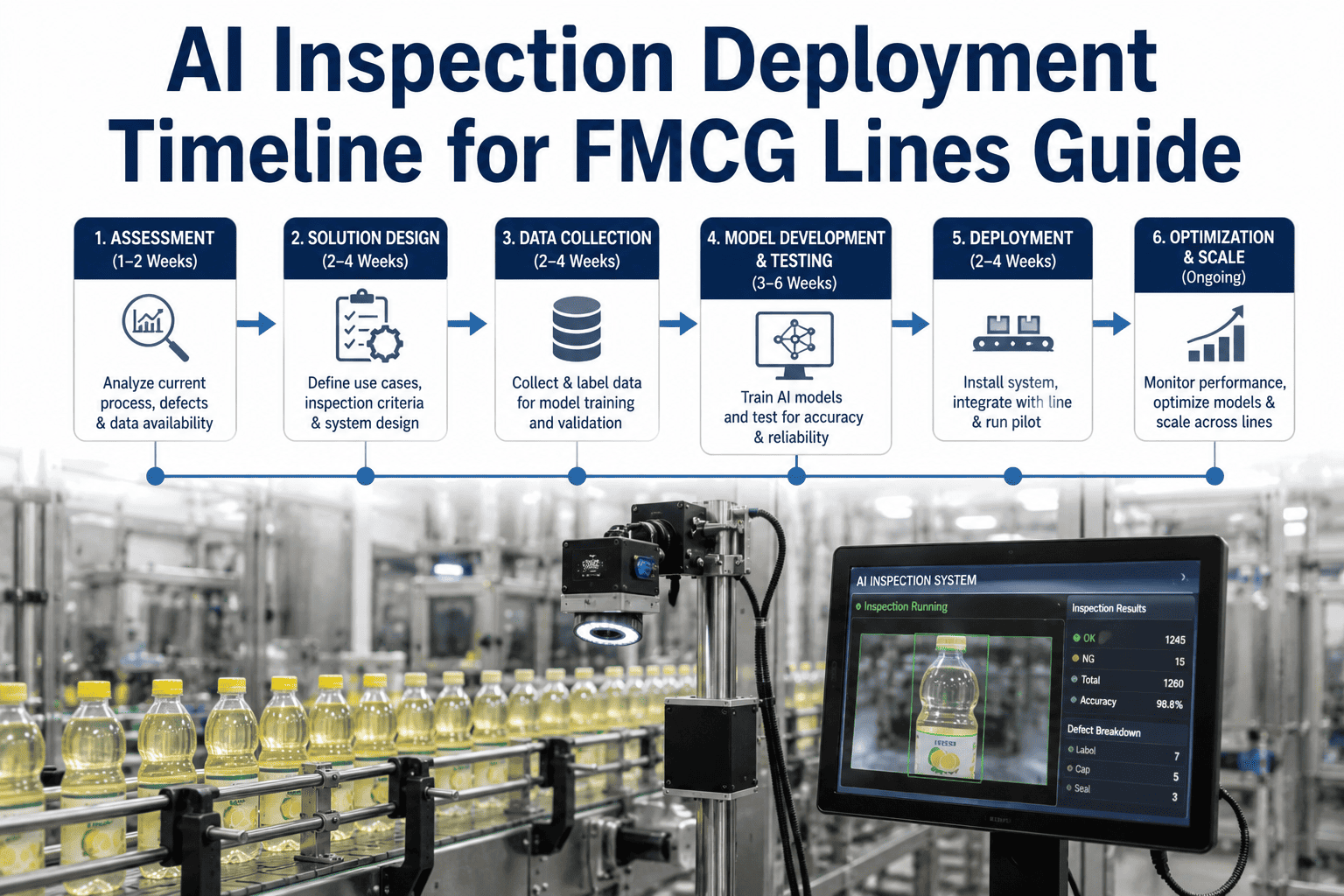
Ask three vendors how long an AI vision deployment takes and there is a reasonable chance you get three different answers, not because any of them is lying, but because "deployment" means something different depending on which phase they are quoting. A proof of concept that runs for two weeks and a plant-wide rollout that runs for six months are both accurate answers to the same question, asked at different points in the process.
FMCG QUALITY VISION · DEPLOYMENT TIMELINE
What an AI Inspection Deployment Timeline Actually Looks Like, Phase by Phase
Proof of concept, pilot, hardening, and rollout, with realistic week counts and the specific gating criteria that determine whether a project moves to the next phase.
Weeks 1–2
Proof of Concept
A small labeled sample of your actual product, both passing and defective units, is collected and run against a candidate detection model to establish whether the defect categories you care about are visually distinguishable at all with the available lighting and camera setup.
Weeks 3–7
Pilot
A single line or station runs the system in shadow mode alongside your existing inspection process, comparing AI-flagged defects against what your current process catches, without yet diverting any product based on the AI decision.
Weeks 8–11
Hardening
The system moves to active decision-making on the pilot line, reject or hold logic goes live, edge cases discovered during the pilot are addressed, and the hybrid arbitration threshold is tuned against real production conditions rather than pilot-scale sample data.
Weeks 12–20+
Rollout
The validated configuration is extended to additional lines, with each new line requiring its own calibration pass for lighting and camera positioning, but benefiting from the model, workflow, and integration groundwork already proven on the pilot line.
WHY THE TIMELINE VARIES SO MUCH BETWEEN PLANTS
The Week Counts Above Are a Starting Reference, Not a Guarantee
The phase durations above reflect a representative single-line deployment for a moderately complex defect category, but several factors routinely push a specific project longer or shorter than that reference range. A plant with clean, well-organized historical defect samples already photographed and labeled can compress the proof of concept phase considerably, while a plant starting from zero labeled data needs additional weeks built into that first phase simply to collect a representative sample set.
Integration complexity is a second major variable. A line where reject diversion can use existing pneumatic reject infrastructure moves through hardening faster than one requiring new mechanical diversion equipment to be installed and commissioned, since that installation work runs on its own timeline independent of the AI model's readiness.
Finally, the number of distinct SKUs or product variants running through a single line changes pilot duration meaningfully, because each meaningfully different product variant typically needs its own validation pass rather than assuming a model validated on one SKU transfers automatically to every other product sharing that line.
GATING CRITERIA BY PHASE
What Has to Be True Before Moving to the Next Phase
Get a realistic timeline scoped to your specific line
iFactory reviews your current data readiness, integration constraints, and SKU mix before quoting a phase-by-phase schedule.
WHERE PROJECTS ACTUALLY LOSE TIME
The Delays That Are Rarely in the Original Schedule
The single most common source of schedule slippage is not the AI model itself, it is data collection. Plants frequently underestimate how long it takes to assemble a representative labeled sample covering the full range of normal variation and genuine defects, particularly for defect categories that occur infrequently enough that a two-week collection window simply does not produce enough examples to train against reliably.
A second common delay source is integration dependency on equipment or IT approvals outside the quality team's direct control, such as network access for camera systems on a plant floor with strict OT security policies, or a capital approval process for reject diversion hardware that runs on its own procurement timeline. Surfacing these dependencies during the proof of concept phase, rather than discovering them during hardening, is one of the most effective ways to protect the overall schedule.
Single Line
Pilots start on one line to produce a clean, comparable result before scaling
Shadow Mode
No product is diverted based on AI decisions until the pilot comparison clears its gate
Faster
Each additional line in rollout typically moves faster than the first pilot line
FREQUENTLY ASKED QUESTIONS
Common Questions on AI Inspection Deployment Timelines
Can the proof of concept phase be skipped if we are confident the defect is visually distinguishable?
Skipping this phase is possible but not generally recommended, since the proof of concept step is what confirms the specific lighting, camera angle, and model configuration actually work for your defect category before any larger investment of time is committed to a full pilot. A defect category that seems obviously visible to a human eye under normal factory lighting does not always translate cleanly to a camera sensor, and finding that out during a two-week proof of concept is far less costly than finding it out during week eight of a pilot.
Book a demo to discuss whether your specific defect category warrants a shortened proof of concept.
How much of the timeline depends on us versus on the vendor?
A significant share of the early-phase timeline depends on the plant's own data readiness and internal approval processes, such as how quickly a representative labeled sample can be assembled and how fast IT or OT security approvals for camera network access move through internal review. The vendor-controlled portion, model training and tuning, generally moves faster and more predictably than the plant-side dependencies, which is why surfacing internal approval requirements early is one of the most effective ways to protect the schedule.
Contact our support team to map out which parts of your specific timeline depend on internal approvals.
Does hardening mean the system stops improving once it goes live?
No, hardening refers to the phase where the system moves from shadow-mode observation to active production decisions with a stable, sustainable arbitration workflow, not a point at which improvement stops. Model retraining using accumulated arbitration data continues well past the hardening phase, as described in the hybrid model workflow, meaning accuracy and arbitration volume both continue to improve during normal ongoing operation.
If we already have an AI vision system on one line, does adding a new line follow the same full timeline?
Generally no, a new line running the same product and defect categories as an already-validated line moves through a compressed version of the timeline, since the model, integration pattern, and workflow are already proven. What still needs its own validation pass is the physical calibration, lighting, and camera positioning specific to that line's equipment and layout, since even identical product on a different physical line can present different visual conditions.
Book a demo to scope a rollout timeline for additional lines.
What is the minimum viable timeline if we need results quickly?
A compressed proof of concept and pilot on a single, well-scoped defect category with clean existing labeled data can move faster than the reference range above, but compressing the schedule works best when it comes from strong data readiness rather than from skipping gating criteria. Cutting a gate to save time on the schedule tends to surface as rework later in hardening or rollout, which usually costs more time than it saved.
Contact our support team to discuss an accelerated timeline for a specific, well-scoped defect category.
GET A SCHEDULE BUILT FROM YOUR OWN CONSTRAINTS
See a Realistic Phase-by-Phase Timeline for Your Line
iFactory reviews your current data readiness, integration environment, and product mix before committing to a schedule, so every gate reflects your actual starting point.