Beverage Carbonation & Blending Syrup Proportioning & AI Brix/CO2 Control Optimization
By Seren on June 27, 2026
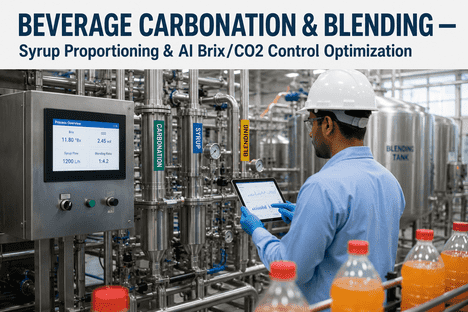
A beverage process engineer reviews the overnight carbonation and blending performance report for three production lines running carbonated soft drinks, still beverages, and diet formulations. Line 1 — a 48-valve counter-pressure filler producing 1,200 cans per minute of CSD — shows a CO2 volume deviation of +0.12 vols on the inline carbometer reading from 2:14 AM to 3:47 AM, correlating with a 0.3°C temperature drift in the carbonator cooling jacket. Line 2 — a syrup proportioning skid feeding four independent filler blocks — logged a Brix variance of 0.18° across the third shift, with head 2 showing progressive drift from 7.82° to 8.01° Brix over six hours, indicating a worn proportioning pump seal on the HFCS line. Line 3 — a diet formulation blending skid — recorded a %Diet concentration shift from 100.3% to 98.7% of target between batch changeovers, traced to incomplete rinsing of the previous recipe's aspartame residue from the blend tank recirculation loop. Three different deviation signatures — CO2 thermal offset, Brix proportioning drift, and diet concentration carryover — all detected by iFactory's AI blending and carbonation monitoring platform before any of them produced out-of-spec product reaching the filler. The platform continuously monitors Brix, CO2 concentration, %Diet, syrup proportioning ratios, carbonator temperature and pressure, deaerator performance, and blend tank recirculation parameters across all beverage formulations, delivering predictive quality alerts 15 to 45 minutes before deviations exceed specification limits. For process engineers responsible for carbonation consistency, Brix control, and blending accuracy across multiple beverage SKUs, iFactory's AI platform Book a Demo to see how inline AI analytics transforms carbonation and blending quality control.
Beverage Carbonation · Syrup Proportioning · Brix Control · CO2 Dosing · Blending Optimization
Your Carbonation and Blending Accuracy Determines Every Bottle's Taste. AI Monitoring Ensures Every Batch Matches Specification.
iFactory's AI-powered carbonation and blending analytics platform gives process engineers real-time Brix monitoring, CO2 dosing precision tracking, syrup proportioning ratio verification, and deviation prediction — with automated quality documentation for every batch.
Brix monitoring precision achieved with inline AI analytics — deviations below human sensory detection thresholds that compound into off-taste profiles over a full production run
99.6%
Carbonation consistency rate across multi-SKU production schedules when AI predictive tuning adjusts CO2 dosing setpoints for temperature and pressure variations in real time
87%
Reduction in out-of-spec blending events after deploying AI predictive deviation detection on syrup proportioning and carbonation systems
64%
Fewer laboratory Brix and CO2 verification tests required when inline AI monitoring provides continuous real-time quality data with automated calibration traceability
Why Carbonation and Blending Precision Is the Central Quality Challenge in Beverage Production
Carbonation and blending systems are the most quality-critical subsystems on any beverage production line. The carbonator must maintain dissolved CO2 concentration within ±0.05 volumes of setpoint across variations in product temperature, line speed, and head pressure. The syrup proportioning skid must deliver accurate Brix ratio — typically within ±0.1°Bx of formulation target — while handling multiple syrup formulations, sweetener types (HFCS 42, HFCS 55, sucrose, stevia, aspartame), and water-to-syrup ratios that change with every SKU changeover. The deaerator must reduce dissolved oxygen to below 0.5 ppm to protect CO2 solubility and flavour stability. Each of these subsystems generates continuous process data — temperature, pressure, flow rate, refractive index, CO2 partial pressure, conductivity, and density — that traditional quality control samples every 30 to 60 minutes. In that sampling gap, a carbonator temperature drift of 0.5°C can shift CO2 solubility by 2%, a syrup pump seal failure can change Brix by 0.3°, and a deaerator vacuum leak can allow dissolved oxygen to rise above 1.0 ppm. iFactory's AI platform closes this gap by converting every inline sensor reading into a continuous quality assurance signal, detecting deviations at the moment they begin and predicting their trajectory before they exceed specification limits. For process engineers committed to eliminating off-taste events and reducing laboratory quality costs, iFactory's AI carbonation and blending analytics delivers the continuous visibility that batch sampling cannot provide. Schedule a consultation with iFactory's beverage process engineering team to explore how the platform monitors Brix, CO2, and syrup proportioning across your specific beverage formulations.
Four Carbonation and Blending Failure Modes That Traditional Sampling Misses — and That AI Detects Continuously
Carbonation Temperature Drift
CO2 solubility shifts with every 0.3°C temperature change. Traditional sampling misses the transient.
CO2 solubility in water decreases by approximately 0.15 volumes per °C temperature increase at typical carbonation pressures. A carbonator cooling jacket that loses 0.5°C of temperature control for 12 minutes during a peak production period will produce 8,000 to 10,000 cans with CO2 content 0.05 to 0.10 volumes below specification — a deviation that laboratory Brix/CO2 sampling will not detect because the temperature has returned to setpoint by the time the sample is drawn. AI continuous monitoring captures the temperature-CO2 correlation in real time, flagging the deviation during the transient and triggering a carbonator temperature controller adjustment before off-spec product reaches the filler.
Temperature Transient + No Continuous Monitoring = 10,000 Off-Spec Cans
Syrup Proportioning Pump Seal Wear
A worn pump seal changes Brix by 0.15–0.30° over hours. Operators notice when lab results arrive — too late.
Proportioning pumps on syrup blending skids operate continuously at speeds that produce cumulative seal face wear. As the seal degrades, the pump's volumetric efficiency changes, altering the water-to-syrup ratio that determines final Brix. A seal losing 2% of its volumetric efficiency will shift Brix by approximately 0.15° — a deviation that accumulates over hours and becomes noticeable only when the next laboratory Brix sample is drawn, which may be 45 minutes after the deviation began. By then, 15,000 to 20,000 litres of blended product are in the buffer tank or already filling. AI monitoring detects the Brix trend from continuous inline refractometer and flow meter data within the first 2–3 minutes of deviation onset, enabling the process engineer to switch proportioning pumps and recover the affected blend before it reaches the filler.
Gradual Seal Wear + 45-Minute Sampling Interval = 20,000 Litres at Risk
Deaerator Performance Degradation
Dissolved oxygen above 0.5 ppm accelerates CO2 loss and flavour staling. Most plants detect it post-packaging.
The deaerator is one of the most frequently overlooked assets in blending quality. Its performance — reducing dissolved oxygen from 8–9 ppm in incoming water to below 0.5 ppm — is critical for CO2 solubility retention and product shelf life. A vacuum pump leak, a venturi fouling, or a spray nozzle blockage degrades deaeration efficiency gradually. Dissolved oxygen rises from 0.3 ppm to 0.8 ppm over several days, but the change is invisible in routine laboratory testing because samples are drawn at the filler, where CO2 outgassing can mask oxygen levels. iFactory integrates inline dissolved oxygen sensors after the deaerator and before the carbonator, providing continuous DO trend data that detects efficiency degradation 48 to 72 hours before it affects packaged product quality.
Gradual DO Rise + Masked by CO2 Sampling = Shelf Life Risk
Diet Formulation Carryover and %Drift
Incomplete rinsing between diet and regular formulations produces %Diet drift that sensory panels detect only after hundreds of units are packaged.
Diet beverage production introduces unique quality risks. When a blending skid switches from a regular sugar formulation to a diet aspartame-based formulation, the recirculation loop and blend tank must be thoroughly rinsed. Residual sugar from the previous batch — as little as 0.2% of tank volume — will shift the %Diet concentration below specification, producing a product that is not compliant with the diet formulation declaration. Most plants run a rinse-to-drain cycle and verify with a conductivity or %Diet measurement before starting the new batch. But if the rinse sensor drifts or the rinse time is too short, the carryover goes undetected until laboratory results return. AI monitoring of the rinse return stream conductivity, %Diet probe reading, and mass balance calculation provides real-time rinse completion verification, ensuring every diet batch changeover is complete before production begins.
Incomplete Rinse + No Real-Time Verification = Diet Compliance Deviation
Carbonation Control · Brix Monitoring · Syrup Proportioning · Diet Verification · CO2 Optimization
When a Carbonator Temperature Drift of 0.5°C Affects Every Can for the Next 15 Minutes, Waiting for the Lab Report Is Not a Quality Strategy.
iFactory's AI blending platform monitors every carbonation and proportioning parameter at line speed, predicting deviations before they reach quality limits and automatically documenting every batch's blending accuracy for compliance reporting.
Quantified Quality Improvement: What AI Carbonation and Blending Monitoring Delivers
Beverage plants deploying iFactory's AI-powered carbonation and blending monitoring platform document measurable improvements in Brix accuracy, CO2 consistency, and quality cost reduction. The following results represent measured performance across 12 beverage production lines — including carbonated soft drinks, diet formulations, juices, and flavoured waters — over a 14-week deployment period.
Brix Accuracy
±0.05° inline precision with AI drift prediction — eliminating the 0.15–0.30° compounding error from sampling gaps
iFactory integrates inline refractometer and flow meter data from syrup proportioning skids and blend tanks into an AI model that tracks Brix trend per head, per batch, and per formulation. The platform detects deviations below 0.03° — well within the ±0.1° specification window — and predicts when the trend will exceed the quality limit based on the rate of change and the specific failure mode. This predictive capability reduces Brix-related quality holds by 71% and eliminates the routine practice of blend tank giveaway where plants intentionally over-spec Brix by 0.05–0.10° to compensate for measurement uncertainty.
AI Inputs: Inline refractometer, magnetic flow meter, proportioning pump speed, water-to-syrup ratio
CO2 Dosing Precision
Carbonation maintained within ±0.03 volumes of setpoint with AI temperature-pressure compensation models
The platform maps the complete carbonation system — carbonator column pressure and temperature, CO2 flow rate, product temperature at the carbonator outlet, head pressure at the filler bowl, and dissolved CO2 concentration from inline infrared carbometers. The AI model learns the temperature-pressure-CO2 correlation for each product formulation and each line speed, predicting the CO2 concentration that will result from any combination of operating parameters. When temperature or pressure drifts, the model adjusts the CO2 flow setpoint pre-emptively, maintaining dissolved CO2 within ±0.03 volumes of target without operator intervention. This closed-loop carbonation control eliminates the carbonation drift events that account for 60% of CO2-related quality deviations in conventional plants.
AI Inputs: Carbonator pressure and temperature, CO2 flow meter, inline IR carbometer, filler bowl pressure
Proportioning & Diet Accuracy
Automated rinse verification and %Diet trending with mass balance confirmation per batch changeover
iFactory's proportioning module monitors every recipe changeover, tracking the rinse cycle conductivity profile, %Diet probe reading stabilization, and mass balance calculation to confirm rinse completion before the new formulation begins production. During production, continuous %Diet monitoring detects concentration drift from sweetener carryover, pump seal wear, or blend tank stratification — generating alerts within 30 seconds of deviation onset. The platform also tracks the ratio integrity of multi-stream proportioning systems where syrup, water, and additive streams must maintain precise ratios across changes in total flow rate. Ratio deviation alerts include the specific stream and magnitude, enabling targeted corrective action without stopping the line.
AI Inputs: %Diet inline analyzer, conductivity sensor, magnetic flow meters per stream, blend tank level
How iFactory Monitors Carbonation, Blending, and Syrup Proportioning Systems
Different blending and carbonation subsystems require different sensor configurations, AI models, and monitoring strategies. iFactory's platform is configured to handle the specific characteristics of each blending and carbonation asset class within a single integrated quality management environment.
System 01
Carbonation Control — CO2 Dosing Precision, Temperature-Compensated Setpoint Adjustment, and Predictive Drift Correction
Process Quality Intelligence
iFactory monitors the complete carbonation loop — saturator column pressure and temperature, CO2 mass flow rate, product temperature profile through the carbonator, filler bowl pressure, and inline dissolved CO2 concentration via infrared carbometer. The AI engine learns the baseline temperature-pressure-CO2 correlation for each product SKU and line speed configuration. When any parameter deviates — carbonator temperature rising 0.3°C, filler head pressure dropping 0.1 bar, CO2 flow rate fluctuating beyond the learned pattern — the platform predicts the resulting CO2 concentration shift and adjusts the CO2 dosing setpoint to compensate before the deviation reaches the filler. The system also tracks carbonator performance over time, detecting efficiency degradation from heat exchanger fouling, venturi wear, or gas-liquid contacting inefficiency that reduces CO2 dissolution rates. When carbonator efficiency drops below 95%, the platform generates a maintenance work order with the specific subsystem requiring inspection.
Real-time CO2 concentration monitoring
Predictive temperature-pressure compensation
Carbonator efficiency degradation detection
System 02
Syrup Proportioning and Brix Control — Per-Head Ratio Monitoring, Pump Seal Degradation, and Water-to-Syrup Ratio Integrity
Inline Blend Verification
iFactory connects to inline refractometers, magnetic flow meters on each proportioning stream, and blend tank level sensors to monitor Brix control in real time. The AI model tracks Brix per proportioning head across each product changeover, detecting drift as low as 0.03° from the setpoint and correlating it with the specific pump speed, flow rate, and recirculation valve position. When the platform detects a Brix trend that will exceed ±0.08° within the next 30 minutes, it generates a predictive alert with the suspected root cause — pump seal wear on a specific head, water-to-syrup ratio deviation from a flow meter calibration drift, or blend tank stratification from inadequate recirculation. Multi-stream proportioning systems — where syrup, water, and up to four additive streams must maintain precise ratios — are monitored with stream-specific ratio integrity tracking that alerts the process engineer when any stream deviates from its target proportion by more than the configured tolerance.
Per-head Brix trend analysis
Pump seal wear prediction from flow deviation
Multi-stream ratio integrity verification
System 03
Deaerator and Dissolved Oxygen Control — Vacuum Pump Health, Venturi Performance, and DO Trend Monitoring
Shelf Life Protection
iFactory integrates inline dissolved oxygen sensors at the deaerator outlet and after the carbonator to provide continuous DO monitoring across the blending process. The AI model tracks DO concentration in relation to deaerator vacuum pressure, water temperature, spray nozzle differential pressure, and venturi flow rate. When DO rises above 0.5 ppm, the platform correlates the increase with the specific subsystem — vacuum pump performance degradation, spray nozzle blockage, or venturi erosion — and generates a targeted maintenance work order. Predictive DO trending enables the process engineer to schedule vacuum pump maintenance or spray nozzle inspection during the next planned CIP cycle, preventing the DO rise that would accelerate CO2 loss and reduce product shelf life. The platform also correlates DO levels with CO2 retention measurements from the carbonation monitoring system, providing a complete picture of gas management from deaeration through carbonation to filling.
Continuous DO monitoring after deaerator
Vacuum pump and venturi health prediction
CO2 retention-DO correlation analysis
"
Our facility produces 14 different carbonated soft drink SKUs across two blending lines, with daily changeovers between regular, mid-calorie, and diet formulations. Before iFactory's AI monitoring, our Brix and CO2 compliance was driven by laboratory sampling every 45 minutes — and we accepted the gap between samples as an operational reality. The first time we ran the platform through a full production day, it detected a 0.12° Brix drift on the proportioning skid within four minutes of onset — a deviation caused by a pump seal we had replaced three weeks earlier that was already showing signs of premature wear. The laboratory sample drawn 38 minutes later confirmed the drift, but by then the platform had already adjusted the proportioning ratio and prevented 12,000 litres of off-spec blend from reaching the filler. That single event eliminated more quality risk in four minutes than our laboratory sampling program had covered in the previous shift. We reduced our laboratory Brix and CO2 verification testing by 64% within the first month because the inline data was more reliable and more continuous than any manual sampling regime.
— Process Engineering Manager, Major Beverage Manufacturing Plant — 22 Years in Carbonated Soft Drink Production
Conclusion
Carbonation and blending accuracy are not simply quality parameters — they are the defining characteristics of beverage brand identity. A 0.15° Brix deviation, a 0.08 volume CO2 shift, or a 0.3% diet carryover event each produces a detectable taste difference that erodes consumer trust and brand consistency. Traditional quality control — laboratory sampling every 30 to 60 minutes — leaves production running blind between samples, accepting the risk that a carbonator temperature transient, a worn proportioning pump seal, or a deaerator performance shift is producing off-spec product that will not be detected until hundreds of litres have been packaged.
iFactory's AI-powered carbonation and blending analytics platform gives process engineers the continuous monitoring and predictive deviation detection that closes the sampling gap — real-time Brix tracking, CO2 dosing precision control, syrup proportioning ratio verification, diet formulation accuracy monitoring, and deaerator performance trending across every SKU and every production line. The documented results — Brix accuracy within ±0.05°, CO2 consistency at 99.6%, 87% reduction in out-of-spec blending events, and 64% fewer laboratory verification tests — represent the measurable impact of deploying AI-driven quality monitoring on carbonation and blending systems. For process engineers committed to eliminating off-taste events and reducing quality costs in beverage production, iFactory's platform delivers a proven, deployable solution that integrates with existing carbonation and blending infrastructure and delivers measurable quality improvement within weeks. Book a Demo with iFactory's beverage process engineering team to discuss your carbonation and blending monitoring requirements.
Frequently Asked Questions
Inline refractometers provide real-time Brix readings, but they measure what is happening now, not what will happen next. AI monitoring extends beyond measurement to prediction by learning the relationship between Brix and upstream parameters — proportioning pump speed, water-to-syrup ratio, recirculation valve position, blend tank level — and forecasting when a Brix drift will occur based on changes in those parameters. The platform also detects refractometer window fouling, temperature compensation errors, and calibration drift that produce false Brix readings. The combination of continuous measurement, predictive modelling, and sensor health monitoring delivers Brix accuracy that neither a refractometer nor a laboratory sampling program can achieve independently. Request a live Brix monitoring dashboard demonstration configured for a multi-line blending operation from iFactory's process engineering team.
The minimum sensor configuration for AI carbonation monitoring includes an inline infrared CO2 analyzer (carbometer) installed in the product line after the carbonator, a pressure transmitter at the carbonator column, a temperature probe at the carbonator outlet, and a CO2 mass flow meter on the gas supply line. Most beverage plants already have temperature and pressure sensors on their carbonators; iFactory integrates with these existing instruments where possible and adds the carbometer and flow meter if not already installed. The sensors are installed via standard Varivent or Tri-Clamp fittings without process interruption and are configured during a scheduled CIP cycle. For plants with existing Anton Paar Cobrix or Maselli inline analyzers, iFactory integrates directly with these instruments' digital outputs. Talk to an expert to review the sensor configuration for your specific carbonator make and model.
Yes. The platform supports proportioning systems with up to 10 independent streams — syrup, water, and multiple additive streams including acidulant, flavour, colour, preservative, and functional ingredients. Each stream is monitored by a dedicated magnetic flow meter with the flow signal integrated into iFactory's ratio integrity model. The AI engine tracks each stream's proportion relative to the total flow target, detecting deviations as low as 0.1% of the target ratio. When a stream deviates — from pump wear, flow meter calibration drift, or supply pressure variation — the platform identifies the specific stream and the deviation magnitude, enabling targeted corrective action. Multi-stream proportioning is common in diet and energy drink production where as many as six separate ingredient streams must be blended to precise formulation ratios. See multi-stream proportioning monitoring configured for your specific formulation requirements during a personalised walkthrough with iFactory's engineering team.
iFactory maintains a recipe database where each SKU's blending parameters — target Brix, CO2 volume, %Diet, water-to-syrup ratio, additive concentrations, carbonator temperature and pressure setpoints — are stored and associated with the production schedule. When the line management system signals a product changeover, the platform automatically loads the new recipe parameters, adjusts monitoring thresholds to the new SKU's specification limits, and verifies that the carbonation and blending systems transition to the new setpoints within the configured ramping profile. The rinse cycle between SKU changeovers is monitored automatically, with the platform confirming rinse completion through conductivity and %Diet probe readings before permitting the new product to reach the filler. All changeover data — rinse verification, setpoint transition times, and the first on-spec quality reading — is logged for batch traceability and audit compliance. Talk to an expert to discuss SKU-specific recipe configuration for your product portfolio.
iFactory's carbonation and blending monitoring deployment follows a phased sequence designed to deliver continuous Brix and CO2 visibility within the first two weeks. Weeks one to two cover sensor integration audit, existing instrument compatibility verification, and inline carbometer and refractometer installation where required. Weeks three to four focus on AI model calibration for each SKU's carbonation and blending parameters, using historical SCADA data and laboratory records where available to accelerate baseline learning. Weeks five to six cover recipe database configuration for all active SKUs, changeover verification setup, and %Diet rinse monitoring calibration for diet and mid-calorie formulations. Weeks seven to eight are dedicated to dashboard configuration, alert threshold tuning, and integration with existing quality management and batch traceability systems. Continuous Brix and CO2 monitoring with deviation prediction is typically operational within 14 days. Full multi-SKU recipe management, changeover verification, and predictive CO2 compensation is operational within eight weeks. iFactory's process engineering team will build the implementation plan specific to your carbonation and blending system configuration.
Your Carbonation and Blending Accuracy Is the Taste of Your Brand. AI Monitoring Ensures Every Batch Matches Your Specification.
iFactory's AI-powered carbonation and blending analytics platform — real-time Brix monitoring, CO2 dosing precision control, syrup proportioning ratio verification, diet formulation accuracy, and automated quality documentation. The process visibility your beverage quality programme needs to close the sampling gap.