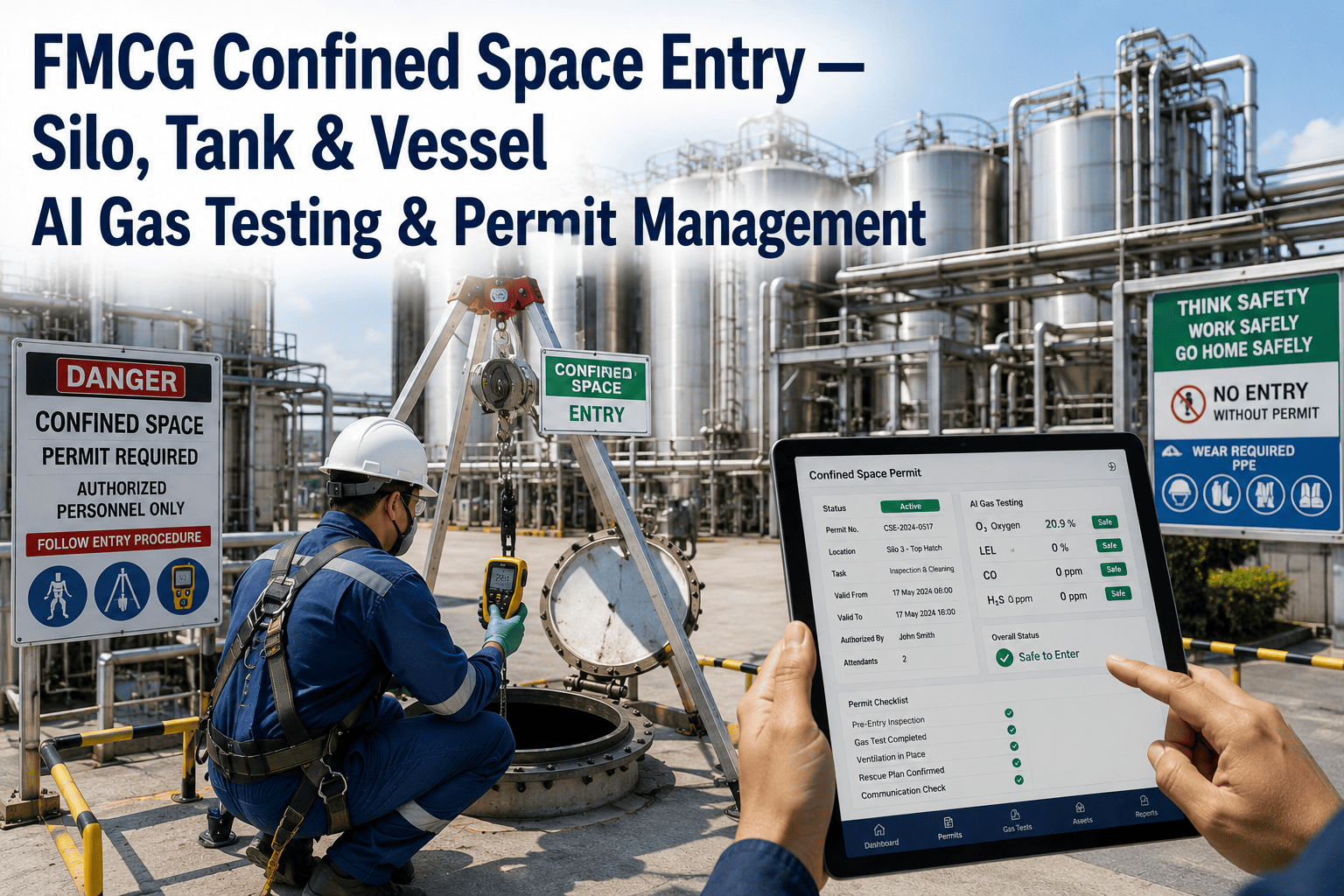
The permit was signed, the gas meter read normal at the door, and the entry log shows the crew went in at the time it should have. None of that tells an EHS manager what the atmosphere inside a grain silo or a mix tank actually did twenty minutes into the job, after product residue started off-gassing or after a nearby process line changed the ventilation pattern without anyone in the confined space knowing. Confined space entry in FMCG plants carries oxygen depletion, toxic atmosphere, and engulfment risks that don't stay fixed at whatever the entry reading showed. See how AI-verified gas testing and permit management keeps confined space entries monitored for the full duration, not just at the door.
Safety & EHS · Confined Space Entry
An Entry Permit Is a Snapshot. The Atmosphere Inside Keeps Changing.
AI gas testing verification and permit management for FMCG silos, mix tanks, and process vessels — built to catch atmospheric changes for the full duration of entry, not just the reading taken at the door.
Why the Entry Reading Isn't Enough
Three Hazards That Develop After the Permit Is Signed
A confined space permit process built around a single pre-entry gas reading assumes the atmosphere at the moment of testing represents the atmosphere for the whole duration of the job. In FMCG plants, that assumption breaks down more often than most permit systems account for. Grain and powder residue in a silo can off-gas as it's disturbed by entry activity itself. A mix tank connected to a process line can have its ventilation pattern change the moment a valve elsewhere in the plant is opened or closed. And engulfment risk in a hopper or silo isn't a gas reading at all — it's a structural and material condition that a handheld meter was never designed to detect.
Oxygen Depletion
Displacement by nitrogen purge residue, fermentation off-gassing, or rusting metal surfaces inside a vessel can drop oxygen levels gradually after an initial reading showed normal atmosphere.
Toxic Atmosphere Buildup
Residue from cleaning chemicals, fermentation byproducts, or product decomposition can release toxic gas concentrations that weren't present at the pre-entry test but build up as the space is disturbed.
Engulfment Risk
Bridging and rat-holing in silos holding flour, sugar, or granular product can collapse without warning once an entrant disturbs the surface, a hazard no gas reading captures at all.
Permit Reality Check
What a Point-in-Time Permit Process Misses
1
gas reading typically taken before entry on a standard permit, regardless of planned job duration
0
continuous verification of atmosphere once entry begins under a paper-based, single-check permit system
↑
risk trend as job duration extends beyond the original permit's assumed atmospheric conditions
Verify the Whole Entry, Not Just the Start
Extend Gas Testing Verification Across the Full Duration of Entry
iFactory connects continuous gas monitoring to permit management, so atmospheric changes during entry are flagged in real time, not discovered afterward.
How Permit Verification Works
Five Checks That Run Continuously, Not Once
✓Pre-entry atmospheric baseline is logged and time-stamped against the permit record automatically, closing the gap where a paper log can be filled in after the fact.
✓Continuous gas readings during entry are compared against the baseline and permit thresholds, flagging any drift toward oxygen depletion or toxic gas buildup in real time.
✓Ventilation status tied to nearby process changes is cross-checked so a valve opened elsewhere in the plant that affects the confined space's airflow gets flagged before it changes the atmosphere.
✓Entrant and attendant presence is verified against the permit's authorized personnel list, so the record reflects who was actually in the space, not just who was scheduled to be.
✓Permit closeout is logged with the full atmospheric history of the entry attached, giving EHS a complete record rather than a single pre-entry snapshot.
What Changes for EHS Teams
From Paper Compliance to Verified Safety
01
Real-Time Alerts, Not After-Action Reviews
If atmospheric conditions shift during an active entry, the attendant and EHS team are alerted immediately rather than discovering the change during a post-incident investigation.
02
Audit-Ready Permit Records
Every permit closes with a full continuous atmospheric history attached, which stands up far better to an OSHA or internal audit than a single handwritten reading.
03
Fewer Permit Process Gaps
Automated cross-checks against ventilation status and authorized entrant lists catch the administrative gaps that account for a large share of confined space permit violations.
04
Faster Incident Investigation
When something does go wrong, the complete atmospheric and personnel timeline is already logged, cutting root-cause investigation from days of reconstruction to a direct data review.
Fitting Into Existing Programs
Working With the Permit Process You Already Have
Most FMCG plants already run a confined space program built around OSHA's permit-required framework, with trained attendants, entry supervisors, and documented gas testing procedures. The goal of continuous verification isn't to replace that structure but to close the specific gap where a program built around point-in-time checks struggles to catch conditions that develop mid-entry. That means connecting existing portable gas monitors and any fixed atmospheric sensors already installed near silos, tanks, and vessels into a system that logs and cross-checks readings automatically against the permit record, rather than asking attendants to manually re-test and re-log conditions throughout a job.
Rollout typically starts with the highest-risk spaces in a plant — silos and tanks with a history of residue buildup, off-gassing, or ventilation dependent on nearby process lines — before extending to the full confined space inventory. Attendants and entry supervisors keep their existing roles and authority; the system adds a verification layer behind the permit process rather than changing who makes the go/no-go call on an entry.
Common Questions
Frequently Asked Questions
Does this replace our attendant and entry supervisor roles?
No — the system is built to support the existing attendant and entry supervisor structure required under a permit-required confined space program, not replace the human judgment calls they make. It adds continuous atmospheric verification behind the scenes so those roles have better real-time information to act on.
Talk to support about how it layers onto your current program.
Can this work with the gas monitors we already own?
In most cases, yes — the system is designed to pull readings from portable and fixed gas monitors already deployed in a plant rather than requiring a full hardware replacement, though older monitors without a data output may need a compatible upgrade to be included in continuous logging.
How does the system detect engulfment risk if it isn't a gas reading?
Engulfment risk in silos and hoppers is addressed separately from atmospheric monitoring, typically through material level and flow pattern checks specific to the vessel's contents, since bridging and rat-holing are structural and material conditions rather than something a gas sensor detects directly.
What happens if atmospheric conditions change mid-entry?
The attendant and any designated EHS contact receive an immediate alert if readings drift toward a threshold, giving the entry supervisor the information needed to order an evacuation before conditions become dangerous rather than relying on the entrant noticing symptoms themselves.
Book a demo to see the alert workflow in practice.
Is the atmospheric history usable for OSHA audit purposes?
Yes — every entry produces a time-stamped record covering pre-entry baseline, continuous readings throughout, and closeout conditions, which gives EHS teams a documented history that supports both internal review and regulatory audit far more completely than a single handwritten pre-entry reading.
Verify the Whole Job
Give Every Confined Space Entry a Continuous Safety Record
iFactory connects gas testing and permit management so atmospheric changes during entry are caught in real time and logged for the full duration of the job.