A plant manager finds out an operator is only certified on one packaging line the same morning that operator calls in sick and the line has no qualified replacement. That gap usually is not a training failure, it is a visibility failure, because the skill matrix showing who can run what almost always lives in someone's memory or a spreadsheet nobody updates consistently. When absenteeism, a new SKU, or a sudden volume spike hits, plants that cannot see their own workforce flexibility in real time end up scrambling instead of simply reassigning a trained operator. Building that visibility is what a multi-skill competency system is actually for, and it is a core part of what ifactory support helps FMCG plant managers put in place.
iFactory Operator Training & Competency
Know Exactly Who Can Run What Before You Need Them To
AI-managed multi-skill matrices and competency assessments that turn workforce flexibility into a visible, current picture, instead of a guess made under pressure on a short-staffed shift.
Why Flexibility Matters More on FMCG Lines Than Almost Anywhere Else
FMCG production schedules change constantly, driven by promotions, seasonal SKU rotations, and short lead times from retail customers. A line that ran one product yesterday may need to run a completely different packaging format tomorrow, and the plant's ability to respond depends entirely on whether enough operators are actually qualified to run more than one station or line. Plants that rely on a small pool of specialists find themselves constrained every time a schedule shifts, while plants with a genuinely flexible, cross-trained workforce can reassign people the way they reassign equipment. The gap between the two is rarely about how many people are trained, it is about whether that training is actually tracked and visible when a scheduling decision needs to be made.
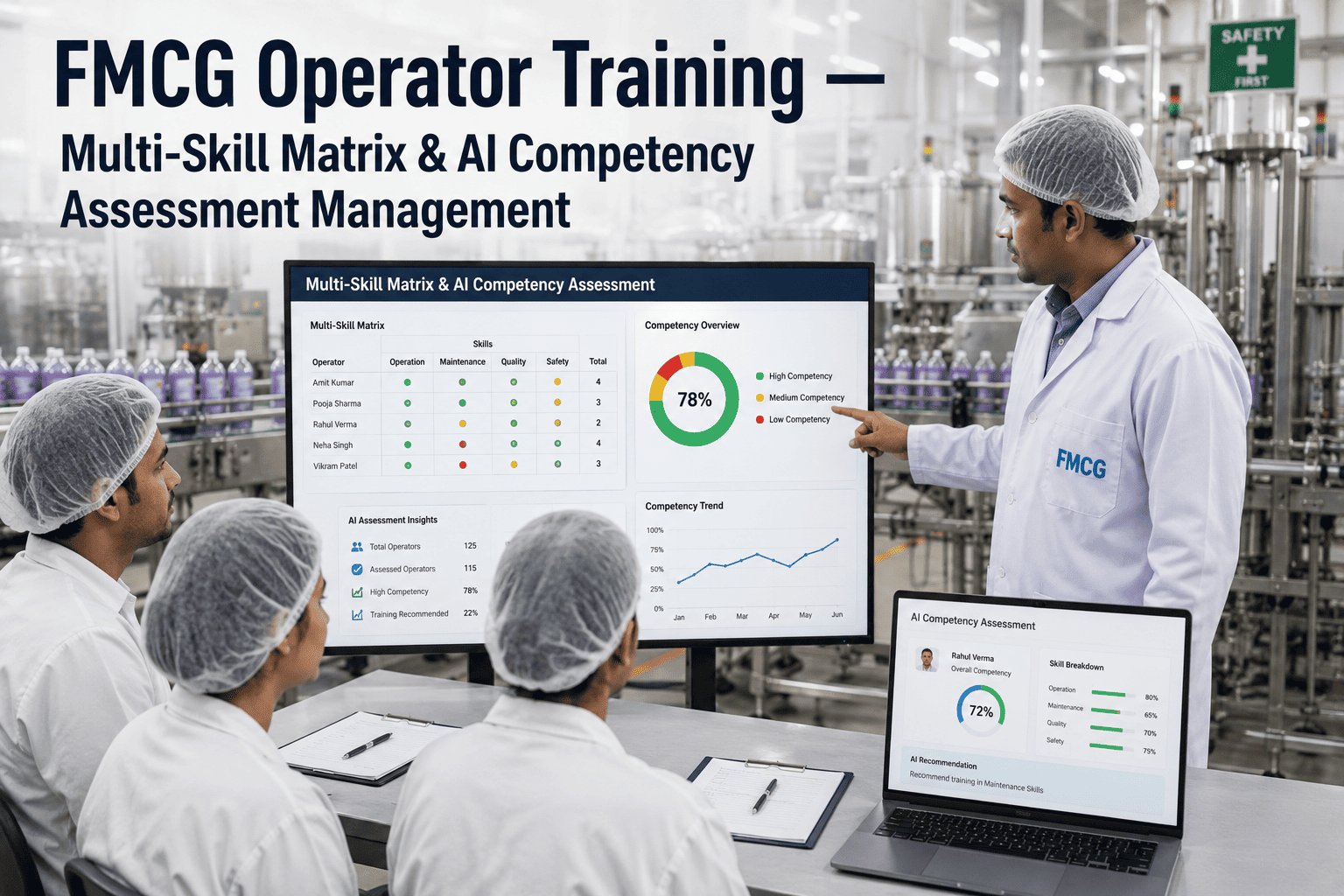
A Sample Multi-Skill Matrix View
What an AI-Managed Competency Assessment Actually Adds
A skills matrix on its own is just a record of who was trained on what at some point in the past. The value of managing it with AI is that the record stays current and starts to predict where the plant's flexibility risk actually sits, rather than requiring a supervisor to remember to update it every time someone completes a new certification.
Live Coverage Gaps
The system flags stations where too few operators are qualified, before an absence turns that gap into a scheduling emergency.
Assessment Scheduling
Recertification and skill assessments are scheduled automatically based on time elapsed or performance signals, not manual tracking.
Shift-Level Matching
When building a shift schedule, the system can flag whether the assigned crew actually covers every required skill for that day's SKU mix.
Training Prioritization
Recommends which operator should be cross-trained next based on where the plant's flexibility gap is largest, not just who volunteers.
See Your Own Coverage Gaps
Bring Your Current Skill Matrix, However It's Tracked Today
We will walk through where your biggest single-point-of-failure stations are and what a training plan to close them would look like.
Building a Multi-Skill Program Without Disrupting Output
Cross-training takes operators off their primary station temporarily, which understandably makes plant managers cautious about how aggressively to pursue it. A structured rollout balances building flexibility against protecting near-term output.
From Single-Skill to Flexible Workforce
1
Baseline the Current Matrix
Capture who is actually qualified on what today, replacing whatever informal tracking currently exists.
2
Identify the Riskiest Gaps
Rank stations by how few backup-qualified operators exist, surfacing the highest-risk single points of failure first.
3
Assign Targeted Cross-Training
Schedule cross-training for the highest-risk gaps first, rather than training broadly and evenly across the entire workforce.
4
Assess and Certify
Competency is verified against a defined standard before an operator is marked qualified on a new station in the matrix.
5
Monitor and Recertify
The matrix stays current through scheduled recertification, so skills that go unused for a long stretch get refreshed before being relied on.
Not sure which station represents your biggest coverage risk right now? Send us your current staffing pattern and we will help identify it.
Frequently Asked Questions
How is this different from the spreadsheet we already use to track certifications?
A spreadsheet records what has happened but rarely gets checked against the actual schedule being built, which means a coverage gap can go unnoticed until an absence exposes it. An AI-managed matrix is actively cross-referenced against shift assignments and SKU requirements, so a gap is flagged before it becomes a scheduling problem rather than after.
Talk to our team about migrating your existing tracking into an active system.
Does cross-training operators actually pay off, or does it just spread everyone thin?
The value comes from targeted cross-training on the highest-risk gaps rather than broad, unfocused training across the whole workforce, which is exactly what a prioritized rollout is designed to avoid. Plants that focus first on their single-point-of-failure stations typically see the biggest reduction in scheduling scrambles relative to the training hours invested.
Book a walkthrough to see how prioritization would work for your specific line layout.
How often should an operator be reassessed once they are certified on a station?
Recertification timing depends on how frequently that skill is actually used, since a skill that goes unused for months tends to degrade even after a strong initial certification. The system tracks usage frequency alongside time elapsed and can flag when a recertification is due, rather than relying on a fixed calendar date that ignores how often the operator has actually worked that station.
Reach out to our team to discuss a recertification cadence for your operation.
Can the matrix account for skills that differ slightly by line, not just by station type?
Yes, the matrix is built at the level of detail your plant actually operates at, which for many FMCG plants means tracking qualification by specific line rather than just a general station category, since equipment and settings can differ meaningfully between two lines running the same product type.
Book a scoping call to define the right level of granularity for your plant.
Will this integrate with our existing shift scheduling process?
Yes, the goal is for the competency matrix to actively inform shift scheduling rather than sit as a separate reference document, so a scheduler can see at a glance whether a proposed shift assignment actually covers every skill the day's production plan requires.
Contact our team to talk through your current scheduling workflow and where this would plug in.
Build Real Flexibility.
Turn Your Skill Matrix Into a Live, Actionable System
Bring your current training records, however informal. We will show you where your coverage risk actually sits and how to close it.