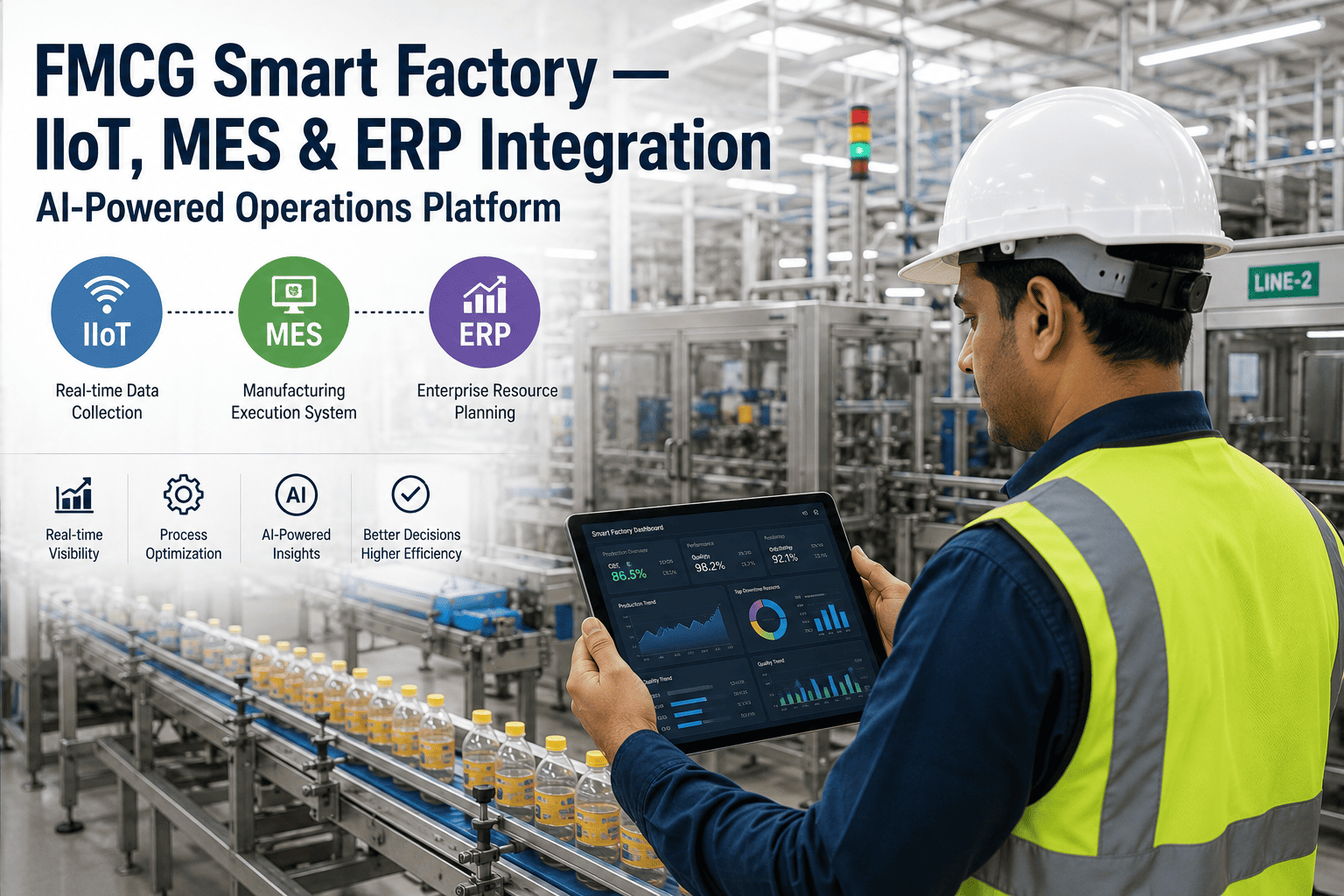
A bag of chips that leaves the line ten minutes late rarely traces back to one broken machine. It traces back to three systems that never actually talk to each other: a PLC that knows the filler jammed, a SCADA screen that shows a vague alarm code, and an ERP that still thinks the order is on schedule because nobody told it otherwise. Plant teams spend hours every week manually reconciling numbers between spreadsheets, MES exports, and ERP reports just to answer a question that should already have an answer. Closing that gap is the entire premise of a connected smart factory, and it starts with getting IIoT, MES, and ERP genuinely synchronized rather than loosely reporting to the same building. See how ifactory support approaches this for FMCG lines.
Connect the Sensor Floor to the Boardroom Without Losing Data in Between
IIoT connectivity, MES work orders, and ERP inventory and cost data unified into one operating picture, so a changeover decision on the floor and a demand shift in planning are working from the same numbers.
Why FMCG Plants Feel This Gap More Than Most
Automotive and heavy industry plants tend to run a handful of high-value lines with long, predictable cycles. FMCG plants run the opposite pattern: dozens of SKUs, frequent changeovers, thin margins, and a demand signal that can shift within a single week because of a promotion or a weather pattern. That combination punishes disconnected systems especially hard. A changeover that MES logs correctly but never reaches ERP means procurement keeps ordering packaging for the wrong SKU mix. A demand spike that ERP sees but never reaches the floor means the line keeps running yesterday's schedule while a customer order sits unfulfilled. Every layer needs the same picture, updated at the pace the business actually moves.
What Breaks When These Layers Stay Siloed
Most plants do not lack data. They lack agreement between the data sets sitting in different systems, and the symptoms show up in predictable places across the operation.
Walk Through Your Own SCADA, MES, and ERP Setup With Us
Bring a list of the systems you currently run. We will map where they already connect, where they don't, and what a realistic integration sequence looks like.
How an AI-Powered Integration Platform Closes the Gap
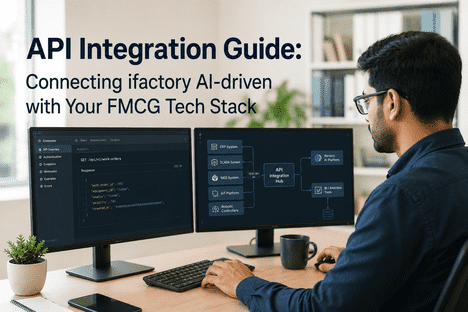
Rather than forcing every plant onto a single monolithic system, an AI-powered integration layer sits between IIoT sensors, SCADA historians, MES modules, and ERP, translating and synchronizing data as it moves. Machine-level events get normalized through standard protocols, matched to the batch and SKU running at that moment, and pushed upward without waiting for a nightly batch job. Planning decisions made in ERP flow back down the same path, reaching the floor within minutes rather than at the next shift change. The AI layer's job is not just moving data, it is reconciling it, flagging mismatches between what MES reports and what ERP expects before those mismatches turn into a stockout or a missed order.
| Function | Disconnected Systems | Integrated Platform |
|---|---|---|
| Order changes | Re-keyed manually, hours of delay | Pushed to the floor within minutes |
| Inventory accuracy | Reconciled weekly by hand | Continuously synchronized in real time |
| Downtime cost tracking | Rarely linked to specific SKUs | Automatically tied to batch and product |
| Quality holds | Sometimes missed by planning | Instantly reflected in available-to-promise |
A Realistic Path to Full Integration
Full-stack integration does not need to happen in one project, and trying to do it that way is usually what causes these initiatives to stall. A phased approach lets a plant prove value on one line before extending the same pattern across the site.
Curious what phase one looks like for your specific PLC and MES combination? Send us your current setup and we will map out a realistic starting point.
What Connected Plants Are Actually Reporting
The gains from integration are not theoretical. Manufacturers running standardized IIoT-to-ERP connectivity across multiple sites have reported measurable output and availability improvements once machine states, downtime, and performance data became visible across every layer instead of trapped in siloed reports. FMCG plants tend to see the effect concentrated in three places: fewer manual reconciliation hours, faster reaction to changeover and quality events, and materially tighter alignment between what the floor is actually producing and what planning believes is happening.
Where Integration Projects Commonly Go Wrong
The most common failure mode is not a technical one, it is scope. Plants that try to connect every system across every line simultaneously tend to stall for months without a single working integration to show for it, because the number of edge cases multiplies faster than the team can resolve them. A second common mistake is treating the integration as a one-way data push from the floor upward, without building the return path that lets planning decisions reach the floor just as quickly. Without that return path, the plant ends up with better visibility but no faster reaction time, which is only half the value integration is supposed to deliver.
A third mistake is underestimating the IT-OT governance conversation. Integration surfaces questions about who owns which data and who is accountable when a synchronized number is wrong, and plants that skip this conversation early often find themselves relitigating it mid-project once the first data mismatch appears. Defining ownership and escalation paths before the pilot line goes live avoids that friction later, when the team should be focused on proving the pattern works rather than resolving organizational disputes.
Frequently Asked Questions
Connect Your Sensors, MES, and ERP on One Platform
Bring your current systems list to the call. We will show you what a phased integration path looks like for your plant, starting with a single pilot line.