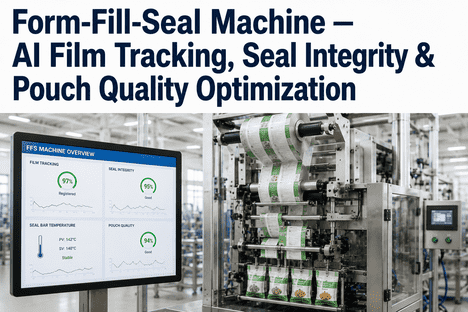
Form Fill Seal Machine AI Film Tracking, Seal Integrity & Pouch Quality Optimization

By Seren on June 22, 2026

form-fill-seal-ffs-machine-ai-film-tracking-seal-integrity-url.png_optimized_300

A process engineer managing form-fill-seal machines in flexible packaging operations faces a recurring contradiction: every FFS machine is equipped with sensors that monitor film tension, registration mark position, seal bar temperature, and jaw closure force — yet leaking pouches still reach customers, misregistered prints still generate scrap, and seal integrity failures still appear as customer complaints traced back to production shifts where every individual parameter was within the machine's acceptable operating range. The sensor says the seal bar temperature was 145°C. The specification says 140°C to 150°C. The seal looks visually acceptable on the line. The pouch leaks during distribution because the seal bar temperature controller was reading from a thermocouple that had drifted 4°C below actual bar temperature over three months of continuous operation, the jaw closure force had decayed 8 percent due to pneumatic cylinder seal wear, and the film's sealant layer thickness was at the low end of its incoming material specification — producing a seal that met the visual acceptance criteria but not the burst pressure requirement. The problem is not that the FFS machine lacks data. The problem is that the quality system evaluates each parameter against a static limit while the actual seal quality is determined by the dynamic interaction between film properties, machine condition, and process settings — an interaction that no single-parameter threshold alarm is designed to detect. iFactory's AI-powered film tracking, seal integrity monitoring, and pouch quality analytics close this gap by correlating every registered film position, every seal cycle, and every pouch quality outcome with the machine's real-time mechanical state and the film's actual material properties — identifying the specific wear patterns, temperature control deviations, and film registration drifts that produce quality failures before the pouch reaches the customer.

50-70%
Reduction in leaking pouch complaints when AI seal integrity monitoring correlates seal bar temperature trends, jaw force decay, and film material variance into a real-time seal quality score
60-80%
Of film registration drift events detected by AI tracking before they produce a misregistered pouch — enabling corrective adjustment during a planned splice rather than during a scrap-producing run
30-50%
Reduction in pouch scrap from seal quality issues when temperature control degradation and jaw wear are detected and corrected before they produce out-of-spec seals
15-25%
Improvement in FFS machine OEE when AI-driven film tracking adjustments and predictive seal component replacement eliminate unplanned stops for registration correction and seal quality troubleshooting
AI Film Tracking · Seal Integrity Score · Temperature Trend Analysis · Pouch Quality Forecasting
The Pouch That Leaks in Distribution Announced Its Failure on the FFS Machine Three Shifts Earlier. The Sensors Recorded the Data. The Question Is Whether Your Quality System Was Watching the Right Pattern.
iFactory's AI-powered FFS monitoring platform gives process engineers real-time visibility into film registration stability, seal bar temperature control accuracy, jaw closure force trends, and pouch integrity forecasting — correlating mechanical condition and film material variance with seal quality outcomes before pouches leave the machine.

Why FFS Machines Produce Quality Failures That Individual Sensors Cannot Predict

Form-fill-seal machines are among the most sensor-rich machines in flexible packaging — and among the most difficult to monitor for predictive quality because the relationship between individual sensor readings and final pouch quality is nonlinear, multivariate, and material-dependent. A seal bar temperature reading of 148°C is acceptable when the jaw closure force is at nominal specification, the dwell time is at setpoint, and the film sealant layer thickness is in the middle of its tolerance range. The same 148°C reading becomes a leak risk when the jaw closure force has decayed by 10 percent due to pneumatic cylinder seal wear, the film reel is from a batch whose sealant layer thickness is at the low end of specification, and the machine speed has been increased to meet the production target — reducing effective dwell time by 5 percent. The temperature sensor reports normal. The seal fails.

The same pattern applies to film registration. A registration mark sensor that tracks the leading edge of each print repeat zone reports the actual position accurately. The process engineer sees the position reading and compares it to the acceptable window. What the sensor cannot report is the trend — whether the registration position is drifting incrementally across consecutive cycles due to film tension variation, dancer arm position drift, or unwind brake degradation. The incremental drift accumulates over hundreds of cycles until the print position shifts outside the acceptable window and the machine produces misregistered pouches that must be scrapped. The registration sensor was correct at every individual measurement point. The drift between measurements was invisible to the single-point threshold check.

iFactory's AI platform addresses this structural limitation by building a continuous multivariate model of the FFS process — correlating seal bar temperature trends, jaw closure force profiles, film tension dynamics, registration mark position drift, and incoming film material properties with downstream pouch quality test results. The model detects interactions between parameters that individual threshold monitors miss, and it generates quality forecasts that give the process engineer actionable lead time before the interaction produces a defect. Book a Demo to see how iFactory's AI platform translates your FFS machine's existing sensor data into predictive quality intelligence.

AI Film Registration Tracking — Detecting Drift Before It Produces Misregistered Pouches

Film registration drift is one of the most common and most costly failure modes on vertical and horizontal FFS machines. A registration drift event that produces misprinted pouches at 120 pouches per minute generates scrap at a rate of over 7,000 pouches per hour before the operator detects the drift and makes a correction. The scrap cost is compounded by the fact that misregistered pouches often look acceptable on the line — the print shift is within the tolerance that the operator can detect visually — but fail downstream quality inspection because the barcode position, expiration date placement, or brand graphic alignment is outside the specification required by the customer.

iFactory's AI film tracking analytics correlate registration mark position data from every cycle with the machine parameters that influence film position — unwind brake tension, dancer arm position, film draw roll servo position, and film reel diameter change across the run. The AI builds a model of the relationship between these parameters and the actual registration position, then monitors the model accuracy continuously. When the actual registration position begins to deviate from the model's prediction — even if the deviation is still within the acceptable absolute tolerance — the platform generates an alert with the specific parameter combination driving the drift and a recommended corrective adjustment. The process engineer receives the alert before the drift has accumulated enough to produce a misregistered pouch, with enough lead time to make the correction during the next film splice or product changeover rather than during a scrap-producing production run.

The platform also tracks registration stability across film reel changes — identifying whether a registration drift event that begins immediately after a new reel splice is caused by a film material variation (different reel tension-wound, different coefficient of friction) or by a machine condition that the reel change has exposed. This distinction saves the process engineer hours of troubleshooting time by directing the investigation to the correct root cause category from the first alert. Book a Demo to see how iFactory's film tracking analytics detect registration drift patterns on your FFS machines.

Seal Integrity Monitoring — From Temperature Control to Seal Quality Forecasting

Seal integrity is the single most important quality attribute of any pouch produced on an FFS machine — and the most difficult to monitor continuously because seal strength is determined by the interaction of five variable groups: seal bar temperature profile, jaw closure force and alignment, dwell time (determined by machine speed and jaw dwell angle), film sealant layer properties, and cooling station effectiveness. Conventional quality monitoring checks seal bar temperature at the controller, measures jaw closure force during scheduled maintenance, and tests seal strength through periodic burst or peel testing on sampled pouches. The gap between the periodic sample and the continuous process is where leaking pouches are produced.

iFactory's seal integrity analytics correlate every seal cycle's parameter set — temperature controller setpoint and actual reading from each seal bar zone, jaw closure force from pneumatic pressure sensors or servo current data, machine speed and dwell angle, and film reel identification — with the seal quality test results from the pouches produced during that cycle. The correlation model learns which parameter combinations produce passing seal tests and which produce borderline or failing results, then generates a real-time seal quality score for every pouch produced. When the seal quality score for a specific machine, film, or parameter combination drops below a configurable threshold, the platform generates an alert with the specific parameter driving the decline — a temperature controller whose actual reading is diverging from setpoint due to thermocouple drift, a jaw whose closure force is decaying due to pneumatic seal wear, or a film reel whose sealant layer is producing consistently lower seal strength than the previous reel.

For the process engineer, the seal integrity dashboard provides a single view of every FFS machine's current seal quality performance — the seal quality score trend, the specific parameter combination driving the score, and the recommended corrective action. The engineer can see which machines are producing seals that meet the burst pressure specification with margin, which are borderline and need attention, and which have parameter trends that will produce out-of-spec seals if left uncorrected. The shift from periodic seal testing to continuous seal quality scoring transforms the process engineer's ability to intervene before leaking pouches are produced. Book a Demo to see iFactory's seal integrity monitoring configured for your FFS machine types and film specifications.

The Four FFS Quality Failure Patterns That Cost Process Engineers the Most — and How AI Analytics Intercepts Each
A
Seal Bar Thermocouple Drift Producing Cold Seals
A seal bar thermocouple that drifts 3-5°C over months of operation causes the temperature controller to report correct temperature while the actual bar temperature is below specification. The seals look acceptable on visual inspection but fail burst testing. AI temperature trend analytics detect the divergence between the controller reading and the expected thermal response profile — flagging the thermocouple for recalibration before the temperature error produces a cold seal failure.
AI fix: Temperature trend deviation alert schedules thermocouple recalibration — cold seal prevention before pouches fail burst testing.
B
Jaw Closure Force Decay Producing Weak Seals
Pneumatic cylinder seal wear, jaw guide rail degradation, and jaw alignment drift all reduce the effective closure force applied to the seal bar during each cycle. The force reduction is gradual — 1-2 percent per week — and invisible to the operator because the machine continues to cycle. AI jaw force monitoring tracks pneumatic pressure profiles, servo current signatures, and closure timing to detect force decay trajectories before the seal quality is affected.
AI fix: Force decay trend alert triggers cylinder seal inspection — weak seal prevention before leak path develops.
C
Film Tension Variation Producing Registration Drift
Film tension variation across a reel run — caused by unwind brake wear, dancer arm control degradation, or film reel diameter change — produces incremental registration position drift that accumulates until pouches are misregistered. Each individual print is in position. The drift between consecutive prints is the failure mode. AI film tracking analytics detect the tension-to-registration correlation and flag the specific tension control component causing the drift before the cumulative position error exceeds tolerance.
AI fix: Tension drift correlated to registration position generates unwind brake adjustment recommendation — misregistration prevented before scrap is produced.
D
Dwell Time Reduction From Machine Speed Changes
Machine speed increases to meet production targets reduce effective seal dwell time. When the speed increase coincides with marginal film sealant layer properties or elevated seal bar temperature variance, the combination produces incomplete seal fusion that leak testing detects but visual inspection misses. AI seal quality scoring tracks the interaction between speed, temperature, and film properties — flagging speed settings that push the seal quality score below the acceptable threshold for the specific film grade running.
AI fix: Speed-seal quality correlation generates alert when throughput target exceeds quality-safe operating range for current film and machine condition.

Temperature Control Analytics — Detecting Thermocouple Drift and Heater Degradation

Seal bar temperature control is the most critical process parameter in FFS pouch quality — and the most likely to degrade gradually in ways that individual threshold checks miss. A seal bar heater that has accumulated thermal cycling fatigue may produce a zone temperature profile that is 3°C lower at the centre than at the edges, creating a cold spot that produces incomplete seals in the centre of the pouch while the edge seals remain acceptable. A thermocouple that has drifted high over time causes the controller to underheat the bar — the controller shows correct temperature, the bar is cold, and the seals are weak. Neither condition triggers an alarm because each sensor reports what it measures, and the measurement is within the acceptable range for that individual sensor.

iFactory's temperature control analytics build a thermal model of each seal bar zone — the expected temperature profile across the bar width, the expected heater power demand to maintain setpoint at the current machine speed, and the expected thermal recovery behaviour between cycles. When the actual measurements diverge from the model — heater power demand increasing to maintain setpoint indicating heater degradation, temperature recovery time increasing indicating thermal mass change, or zone-to-zone temperature variance increasing indicating heater element imbalance — the platform generates a temperature control alert with the specific component and degradation mode identified. The process engineer receives the alert before the temperature degradation is large enough to affect seal quality, with enough lead time to schedule heater or thermocouple replacement during planned maintenance rather than during an emergency troubleshooting call.

What the iFactory FFS Dashboard Shows the Process Engineer

The process engineer's FFS dashboard is built around the decisions that define the role: which machines are producing pouches within quality specification, which film reels are performing as expected, which seal bar zones need temperature calibration, and where corrective action will produce the highest quality improvement. Each view surfaces the actionable output of the AI analytics rather than the raw sensor data.


Dashboard View 01
Pouch Quality Score — All Machines, All Film Grades
A single-screen view of every FFS machine's current pouch quality score derived from the AI's seal integrity, film registration, and temperature control models. Machines producing pouches within specification are displayed in green, machines with borderline quality trends in amber, and machines whose quality score has dropped below the acceptable threshold in red — with the specific parameter combination driving the low score displayed at the machine level. The process engineer sees at a glance which machines need attention, what the specific issue is, and whether the issue is machine-specific (jaw wear, temperature drift) or film-specific (reel variation, sealant layer property shift).
Process engineer action: Machines with declining quality scores receive targeted investigation — specific root cause identified before out-of-spec pouches are produced.

Dashboard View 02
Seal Bar Zone Temperature — Actual vs Model Profile
Every seal bar zone displays its current temperature reading, the AI-model predicted temperature for the current operating conditions, and the variance trend between the two. Zones where the actual temperature diverges from the model prediction are flagged with the specific degradation mode — heater power demand increase indicating element wear, thermal recovery time increase indicating contamination or mechanical binding, zone-to-zone variance increase indicating heater imbalance. The process engineer sees which zones need thermocouple recalibration, which need heater inspection, and which are operating within normal range.
Process engineer action: Divergent temperature zones scheduled for thermocouple verification — cold seal prevention before leak path develops.

Dashboard View 03
Film Registration Stability — Drift Trend by Machine and Film Reel
Every FFS machine displays the current registration stability score — a measure of how consistently the film position is held across consecutive cycles — with the trend over the last 1,000 pouches. Machines showing increasing registration drift are flagged with the specific parameter driving the drift — unwind brake tension trend, dancer arm position variance, or draw roll servo deviation. The view also segments registration performance by film reel, enabling the process engineer to identify whether a drift event correlates with a specific reel or is consistent across reels on the same machine. Registration stability alerts are generated before the drift has accumulated enough to produce a misregistered pouch — giving the engineer time to adjust during the next planned splice.
Process engineer action: Increasing drift flagged for tension control adjustment — misregistration prevented before scrap is produced.

Dashboard View 04
Film Reel Performance — Variation Across Incoming Material Lots
Every film reel used in production is tracked for its performance characteristics — seal quality score achieved at standard operating parameters, registration stability across the reel run, tension control demand level. Reels that perform outside the statistical norm for the film grade are flagged with the specific performance deviation — lower seal quality score indicating sealant layer property variation, higher registration drift indicating winding tension variation. The process engineer can use this data to provide specific feedback to the film supplier — with data showing the exact performance impact of the material variation — and to adjust FFS machine parameters pre-emptively when a new reel from a known-variant lot is loaded.
Process engineer action: Flagged reels trigger parameter pre-adjustment on loading — quality maintained despite material variation.
"

We had been fighting a leaking pouch issue on one of our VFFS machines for months. Every investigation followed the same pattern — check seal bar temperature at the controller, check jaw pressure at the regulator, run a burst test on a sample, adjust something, cross our fingers. The problem would disappear for a day or two and then come back. The iFactory platform identified the pattern in the first week: the rear seal bar zone was running 4°C below the front zone, but the controller showed both zones at setpoint because the rear zone thermocouple had drifted high over time. The temperature variance was intermittent because it only affected seal quality when the film reel changed to one with slightly lower sealant layer thickness — the combination of the cold rear zone and the marginal film material produced the leaks. We recalibrated the thermocouple, the zone temperatures matched, and the leak complaints stopped. The root cause was invisible to our conventional checks because no single parameter was outside its individual threshold. The AI saw the interaction between the temperature drift and the film variation.

— Process Engineer, Flexible Packaging Operation — 6 VFFS and 4 HFFS Machines, Multiple Film Grades, National Distribution

How Process Engineers Calculate ROI for AI-Powered FFS Quality Monitoring

The return on investment for AI-powered FFS quality monitoring operates across three cost categories that are independently significant and collectively transformative for flexible packaging process economics.

Scrap Reduction
Pouch scrap from misregistered prints, incomplete seals, and film registration drift during reel changes is one of the largest avoidable cost categories in flexible packaging. A VFFS machine running at 120 pouches per minute that produces misregistered pouches for 10 minutes before the drift is detected generates 1,200 pouches of scrap — representing material cost, production time cost, and waste disposal cost. AI film tracking that detects the drift pattern 5 to 10 minutes earlier reduces the scrap per event by 50 percent or more. Across a six-machine FFS fleet running three shifts, the scrap reduction from earlier drift detection alone typically recovers enough material cost to justify the platform investment within the first year.
Customer Complaint Reduction
Customer complaints about leaking pouches carry costs that extend far beyond the claim value: product replacement, return freight, internal investigation and corrective action documentation, and the risk of account loss or supplier qualification removal. A single significant complaint from a key account can cost 10 to 50 times the product value when all associated costs are included. AI seal integrity monitoring that prevents leaking pouches from leaving the facility eliminates the root cause of the most serious FMS quality complaint category. Preventing two to three significant leaking pouch complaints per year typically covers the platform cost for most operations.
OEE Improvement
Unplanned FFS machine stops for registration adjustment, seal quality troubleshooting, and temperature controller recalibration reduce OEE across the packaging line. Each stop consumes 10 to 30 minutes of production time while operators clear the machine, make adjustments, and restart. AI monitoring that predicts registration drift before it causes misregistration, detects temperature control degradation before it produces cold seals, and alerts the process engineer to jaw force decay before it requires emergency adjustment — eliminates the most frequent causes of unplanned FFS stops. The OEE improvement from converting these stops from unplanned events to scheduled adjustments during planned changeovers is typically 15 to 25 percent on the machines receiving active AI monitoring.

Conclusion

Pouch quality on form-fill-seal machines is not determined by individual sensor readings meeting their threshold limits. It is determined by the interaction between seal bar temperature profiles, jaw closure force, film tension dynamics, registration mark position stability, and incoming film material properties — an interaction that no single-parameter threshold alarm is designed to detect. The sensor that reports correct temperature while the seal bar is cold due to a drifted thermocouple is reporting truthfully. The sensor that reports correct registration position while the film is drifting incrementally across consecutive cycles is reporting truthfully. Both are providing data that is individually correct and collectively insufficient to predict the quality failure that the interaction between their measured parameters will produce.

iFactory's AI-powered film tracking, seal integrity monitoring, and pouch quality analytics close this gap by building a continuous multivariate model of the FFS process — correlating every parameter trend and material property with downstream quality outcomes, generating real-time quality scores that reflect the interaction effects, and providing the process engineer with actionable alerts before the interaction produces a defect. The platform does not require additional sensors, does not disrupt production, and does not replace the process engineer's expertise. It adds a pattern-aware intelligence layer above the existing sensor and control systems — making the knowledge of what is happening on every FFS machine continuous, predictive, and directly correlated with pouch quality outcomes.

iFactory's FFS monitoring platform is designed for process engineers who need to eliminate leaking pouch complaints, reduce scrap from misregistration and seal failures, and maximise FFS machine OEE across flexible packaging operations running multiple film grades and pouch formats. Book a Demo to see the AI film tracking and seal integrity dashboard configured for your FFS machine fleet and film specifications, or talk to an expert about a free FFS quality assessment for your operation.
Frequently Asked Questions

The platform connects to existing FFS machine PLCs, temperature controllers, servo drives, and registration mark sensors through read-only integration using standard industrial protocols — OPC-UA, Modbus TCP, EtherNet/IP, and Siemens S7. The data required includes seal bar temperature controller setpoint and actual readings for each zone, jaw closure pneumatic pressure or servo motor current, film tension sensor readings, dancer arm position, registration mark sensor position data per cycle, machine speed and dwell angle settings, and film reel identification data. No additional sensors or control system modifications are required. The platform reads data from the existing sensor and control infrastructure without write access to any control parameter — preserving the machine's existing control loop integrity and operator safety systems. Talk to an expert about data requirements for your specific FFS machine models and control system configurations.

Yes. The platform supports all common FFS configurations — vertical form-fill-seal (VFFS), horizontal form-fill-seal (HFFS), and thermoform-fill-seal (TFFS) machines. The AI model architecture adapts to the machine kinematics and process flow of each type. For VFFS machines, the platform monitors film draw roll servo position, vertical seal jaw timing and temperature, and cross seal jaw closure profile. For HFFS machines, the platform monitors film web tracking through the forming station, horizontal seal jaw timing across multiple stations, and cooling station effectiveness. For TFFS machines, the platform monitors forming temperature, web position registration, and seal station parameters. The film tracking, seal integrity, and temperature control analytics are configured to match the specific machine type and control system on each machine. Book a Demo to see the platform configured for your specific FFS machine types and film specifications.

The platform maintains a separate quality baseline model for each film grade and specification combination registered in the system. When a new film reel is loaded, the system identifies the film grade from the reel label or operator entry and loads the corresponding model — seal quality expectation at standard parameters, registration stability characteristics, tension control profile. The AI continuously updates the film grade model as new reels are processed, building a statistical profile of the normal variation range for each film grade from the supplier. When a reel produces quality outcomes or process parameter demands that fall outside the normal variation for its grade — a reel requiring significantly higher seal bar temperature to achieve the same seal quality score, or a reel producing registration drift at normal tension settings — the platform flags the reel for supplier feedback with specific data showing the deviation. Films that are new grades with no historical data operate in a baseline learning mode for the first reel run, with conservative alert thresholds that tighten as data accumulates. Book a Demo to see how the platform manages film grade transitions and supplier quality feedback.

A typical deployment for a facility with 4 to 10 FFS machines follows a phased timeline. Phase one (weeks one to two) covers data connectivity: establishing read-only integration with machine PLCs, temperature controllers, and film registration sensors for the highest-impact machines. Phase two (weeks two to five) covers model training: collecting and processing operational data while the AI builds baseline models for film tracking, seal integrity, and temperature control for each machine and film grade combination. Phase three (weeks five to seven) covers dashboard configuration and process engineer training: setting up the pouch quality score view, seal bar temperature zone monitoring, film registration stability tracking, and film reel performance analysis to match the facility's specific reporting requirements. Full deployment across an entire FFS machine fleet is typically complete within seven to nine weeks. Book a Demo to see a typical deployment timeline mapped to your FFS machine fleet size and film specifications.

Yes. The platform integrates with downstream pouch inspection equipment — leak testers, checkweighers, metal detectors, and vision inspection systems — through standard industrial data interfaces. When a leak tester detects a failed pouch, the platform correlates the failure with the FFS machine parameters and film reel data from the time that pouch was produced — enabling the process engineer to identify the specific machine condition or film material variation that produced the leak. The correlation between downstream test results and upstream process parameters is what enables the AI model to improve its seal quality predictions over time. As more test results are correlated with process data, the seal quality score becomes more accurate at predicting which parameter combinations will produce passing or failing pouch seals. The closed-loop feedback between pouch test results and FFS process parameters is the mechanism that drives the continuous improvement in leak complaint reduction over the first six to twelve months of platform operation. Talk to an expert about integrating your downstream inspection equipment with the iFactory FFS monitoring platform.

Every Leaking Pouch Complaint Started as a Parameter Interaction Your FFS Machine Sensors Recorded. AI Finds the Pattern Before the Next Leak Reaches Your Customer. Get a Free FFS Quality Assessment.
iFactory's AI-powered FFS monitoring platform for flexible packaging — film registration tracking, seal integrity monitoring with real-time quality scoring, seal bar temperature control analytics, and pouch quality forecasting — all integrated with your existing machine sensors, film specifications, and downstream inspection equipment.

Share This Story, Choose Your Platform!