A batch record that shows what was made, and a quality record that shows whether it passed, are often stored in two different places by two different teams, and the gap between them is where an investigation loses time it cannot afford. In-process checks, finished-product test results and microbiological data each tell part of the story, but only when they're linked to the specific batch they belong to does that story become something an investigator can read in one place instead of three. Quality teams tired of chasing down scattered results can see how iFactory AI links quality records directly to batch traceability data before the next audit.
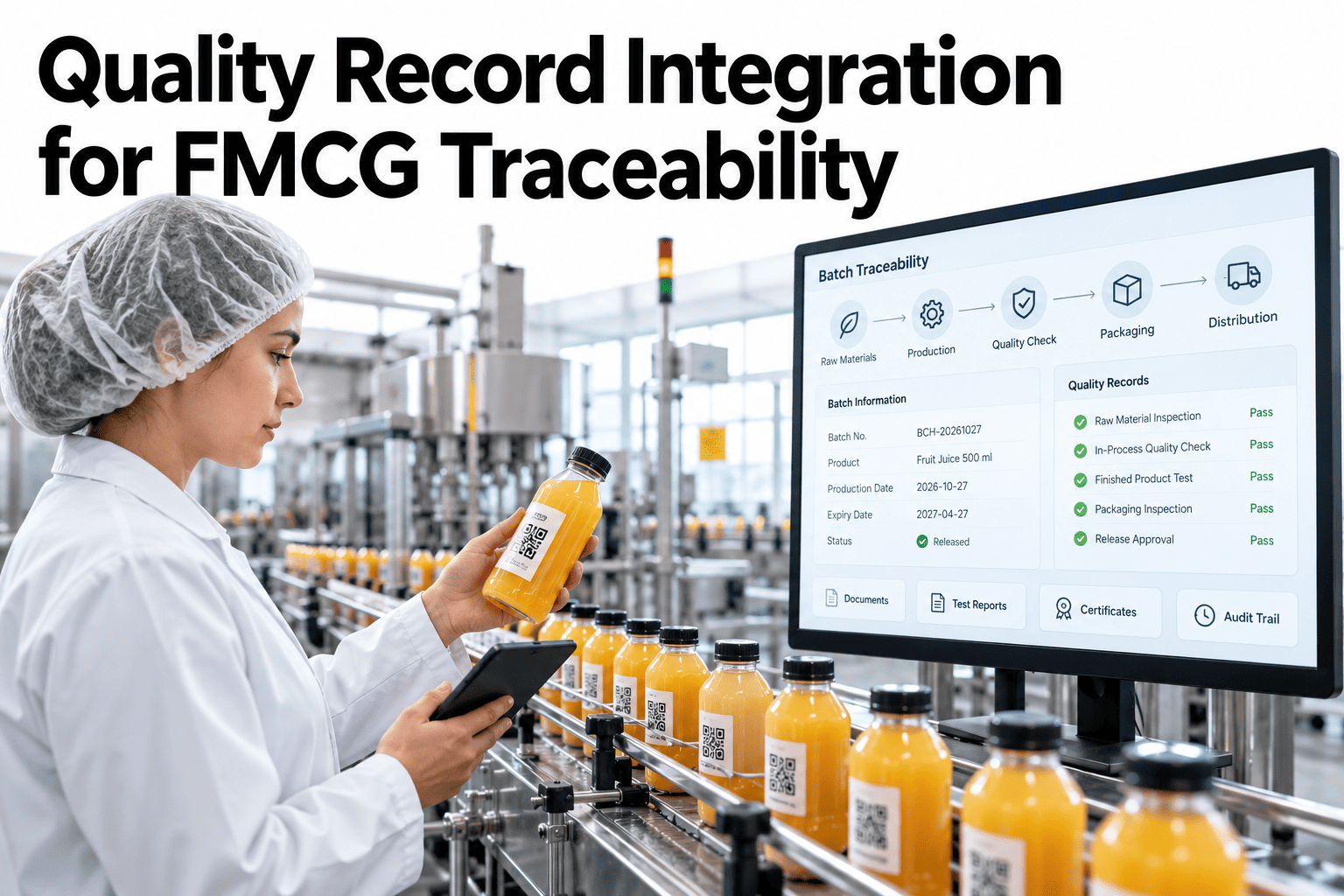
Quality Record Integration for FMCG Traceability
In-process checks, finished-product tests and micro results, linked to the batch record for a true one-stop trace.
Three Records, Usually Three Separate Systems
Each quality record type tends to get captured where it's convenient at the moment, which rarely matches where the other two end up.
Logged on the line, often in a paper log or a standalone system tied to a specific checkpoint.
Run in a lab, often recorded in a LIMS that may not reference the production batch number consistently.
Frequently delayed relative to the batch, since microbiological testing takes longer to complete.
None of these systems are wrong on their own. The problem is that none of them automatically knows about the other two.
What Gets Lost When Records Stay Separate
The cost of disconnected quality records shows up most clearly during an investigation, when someone has to manually reassemble a story the systems should already tell.
| Scenario | Disconnected Records | Linked Records |
|---|---|---|
| Complaint investigation | Quality team manually looks up in-process and test results by batch number | Full quality history for the batch is already assembled |
| Delayed micro result | Batch may already have shipped before the result is checked against it | Batch record flags as pending until the micro result links in |
| Audit request | Separate exports pulled from multiple systems and cross-referenced by hand | One query returns the complete quality record for the batch |
See How Many Systems Your Own Quality Trace Currently Spans
Book a 30-minute session and iFactory AI will walk through pulling a complete quality record for one batch, showing how many separate systems it currently takes.
The Micro Result Timing Problem
Microbiological testing often cannot complete before a batch ships, which creates a specific integration challenge that other quality data does not face.
Building the Link in Four Steps
Integration does not require replacing every quality system at once. It requires a consistent batch reference that each system can share.
Establish a shared batch key
Every quality system references the same batch identifier consistently.
Connect in-process data
Line checks are captured against the batch key as they happen.
Connect lab results
Finished-product and micro results link back as they complete.
Query from one place
The full quality record for any batch is available in a single view.
The plants with genuinely integrated quality records are the ones that solved the shared batch key problem first, before worrying about dashboards or reporting layers on top. Without a consistent identifier that every quality system, line logging, LIMS and micro lab, references the same way, no amount of reporting tooling can truly connect the records, because the underlying data has no common thread to join on. Fix the identifier consistency across systems before investing in anything downstream of it, since that is almost always the actual blocker, not a lack of analytics capability.
Where iFactory AI Fits
iFactory AI links in-process, finished-product and micro quality data to the batch record automatically, so a complete quality history is available without manual cross-referencing.
One batch, one quality record
In-process, finished-product and micro results are all linked to the same batch key automatically.
Pending result tracking
Batches awaiting a delayed micro result are flagged, with alerts if a later result comes back out of spec.
One-query audit response
A complete quality history for any batch is retrievable in a single query, not a multi-system export.
Ask in plain language
Ask for the full quality history of a specific batch and receive it in one answer.
Frequently Asked Questions
Why are quality records usually spread across separate systems?
In-process checks, lab tests and microbiological results are typically captured by different teams at different points in the process, each using whatever system is most convenient for that specific task, with no inherent requirement that they reference each other consistently. You can watch a quality record assembled across these sources on sample batch data in a live session.
What is the first step toward integrating these records?
Establishing a consistent batch identifier that every quality system references the same way, since without that shared key, no amount of reporting or dashboard tooling can actually join the records together. To work through this for your own systems, request an integration review with the iFactory AI team, or ask support what systems are currently supported.
How do we handle micro results that come back after a batch has already shipped?
The batch record should carry a pending flag until the micro result links in, and if that result comes back out of specification, it should trigger an alert against the already-shipped batch automatically rather than depending on someone remembering to check. A short product tour of pending result tracking shows how this works.
Does integrating quality records require replacing our existing LIMS or line systems?
Not necessarily. The core requirement is a shared batch reference each system can use, which often allows existing systems to stay in place while their records are linked together through that common key. See how integration works alongside existing systems in a guided walkthrough.
How does integrated quality data help during an audit?
A single query returning the complete in-process, finished-product and micro history for a batch replaces the manual process of pulling separate exports from multiple systems and reconciling them by hand, which saves significant time during an audit response. Schedule a walkthrough of audit-ready quality record retrieval to see how this is presented.
Give Every Batch One Complete Quality Story
iFactory AI links in-process, finished-product and micro quality data to every batch automatically. Book a walkthrough to see it built around your own quality systems.