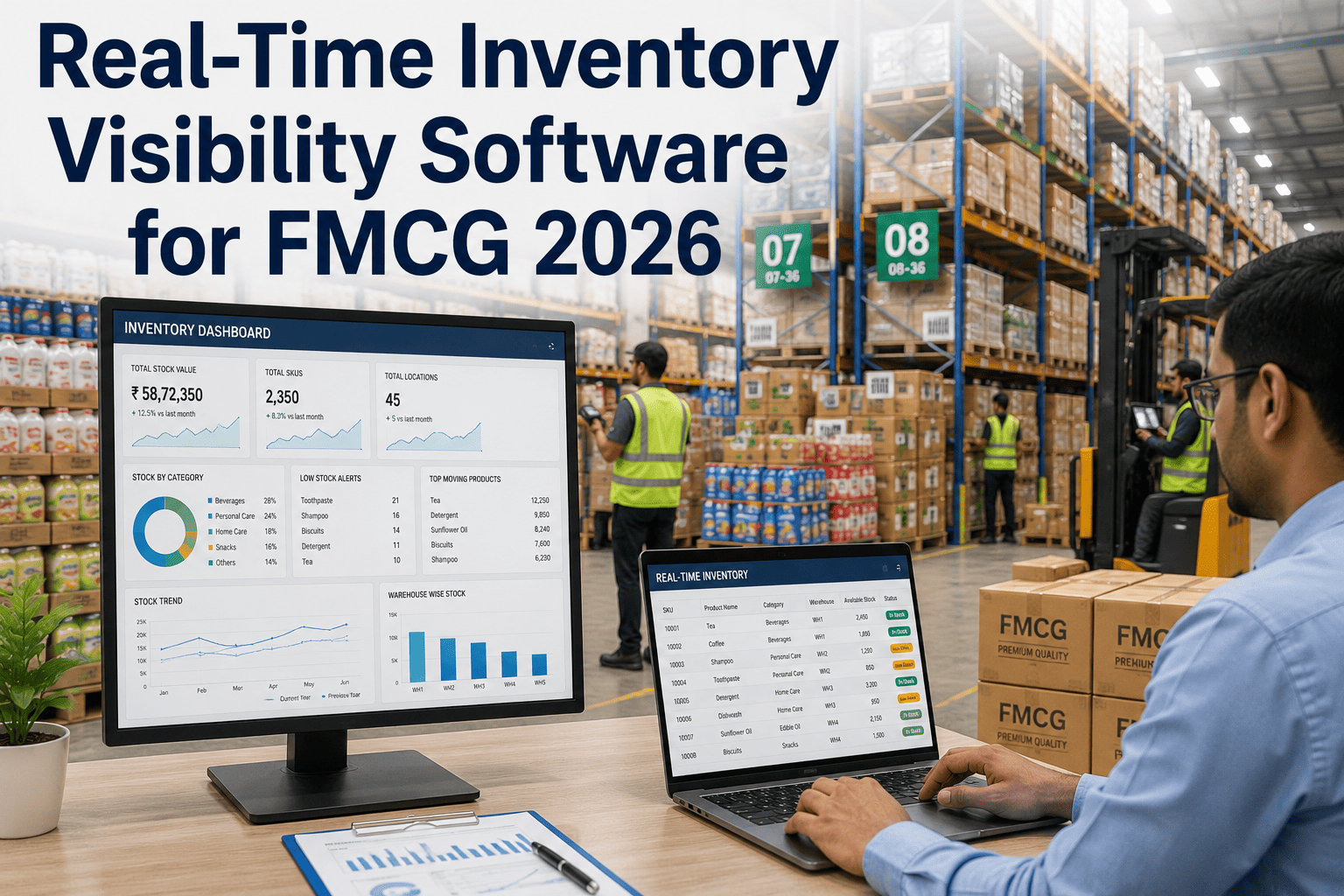
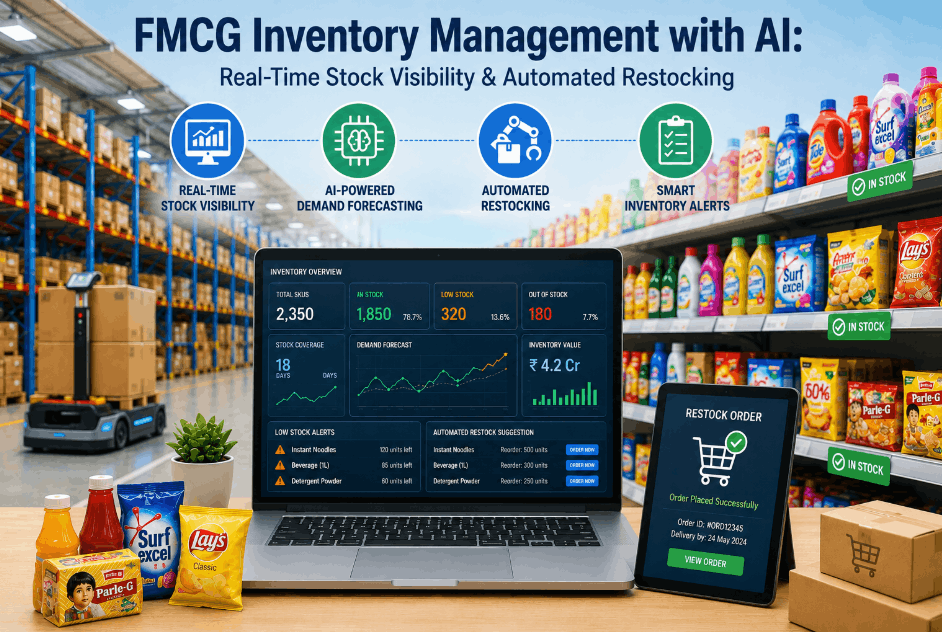
FMCG brands live and die by stock availability. A single stockout on a top-selling SKU doesn't just mean a missed sale — it triggers a loyalty break, pushes shoppers toward a competitor, and leaves a gap in shelf revenue that takes weeks to recover. At the same time, overstock is equally punishing: capital locked in slow-moving inventory, warehouse costs mounting daily, and markdowns that erode the margin you worked to build. The painful reality is that most FMCG operations are still managing inventory reactively — waiting for depletion signals before replenishing, relying on seasonal calendar assumptions instead of real-time demand signals, and reconciling stock counts manually across disconnected systems. AI-powered real-time inventory management changes all of this. It gives FMCG brands a live, continuously updated picture of stock across every SKU, every location, and every channel — and it acts on that picture automatically, before problems occur.
Traditional Inventory Management Is Structurally Broken for FMCG
FMCG demand doesn't move in straight lines. It spikes around promotions, shifts with weather, responds to competitor stockouts, and fluctuates by region, channel, and day of week. Traditional inventory systems — built on weekly batch updates, static reorder points, and historical averages — simply cannot track demand at the speed it actually moves. By the time a replenishment trigger fires in a legacy system, the shelf may have already been empty for two days. Sign up for iFactory to see how real-time AI inventory tracking eliminates the lag that costs FMCG brands millions each year.
Systems that update inventory once daily or weekly cannot detect intraday depletion events — the most common cause of shelf stockouts in FMCG retail.
Fixed reorder thresholds ignore promotional spikes, seasonal acceleration, and competitor disruptions — generating either early overstocking or late-triggered shortfalls.
When retail, e-commerce, and wholesale inventory data live in separate systems, brands are managing multiple incomplete pictures instead of one accurate one.
Waiting for depletion before triggering a restock order guarantees service gaps. Lead times ensure that reactive replenishment always arrives after the damage is done.
The Five Pillars of AI-Driven Real-Time Inventory Management
AI doesn't just digitize the existing inventory workflow — it replaces the logic that drives it. Real-time AI inventory platforms continuously ingest data from POS systems, warehouse sensors, supplier feeds, and external signals like weather and promotional calendars, then use machine learning to calculate the optimal stock position for every SKU at every location in real time. Book a demo with iFactory to see all five pillars working together for FMCG operations.
AI aggregates data from dozens of demand signals simultaneously — historical sales, weather forecasts, local events, promotional schedules, social sentiment, and competitor pricing — weighting each signal dynamically based on its predictive power for each specific SKU. The result is a demand forecast that updates continuously, not on a weekly planning cycle.
Rather than holding fixed safety stock buffers calibrated to average demand variability, AI calculates optimal safety stock in real time based on current demand velocity, supplier lead time reliability, and service level targets. This eliminates both the excess capital tied up in over-buffered SKUs and the service risk created by under-buffered ones.
When AI determines that a SKU's projected stock level will breach the optimal threshold before the next replenishment delivery can arrive, it automatically generates and routes the replenishment order — with the right quantity, the right supplier, and the right delivery window. Human approval workflows apply only for outlier quantities or new supplier selections.
AI continuously monitors stock distribution across warehouses, distribution centers, and retail locations — identifying imbalances where one location is overstocked while another faces imminent depletion. It proactively recommends inter-location transfers that resolve shortfalls without new procurement, unlocking inventory value that would otherwise sit idle.
Not all SKUs deserve the same inventory investment. AI continuously segments the portfolio by velocity, margin contribution, and substitutability — enabling FMCG planners to concentrate working capital in high-impact positions while rationalizing slow-moving SKUs before they become a write-off liability.
Stop managing inventory in the dark.
iFactory gives FMCG brands real-time AI visibility across every SKU, every channel, and every location — with automated replenishment that acts before stockouts happen.
Predicting Demand Fluctuations Before They Hit
The most expensive inventory events in FMCG are predictable — but only if you're analyzing the right data with the right tools. A beverage brand can predict a 30% sales spike two weeks before a heatwave. A snack brand can anticipate promotional cannibalization across adjacent SKUs before the campaign launches. A personal care brand can model regional demand shifts driven by a competitor's distribution gap. AI surfaces all of these signals and translates them into precise inventory adjustments weeks in advance — rather than reactive scrambling after the demand event has already unfolded. Sign up for iFactory to access AI demand forecasting built specifically for FMCG complexity.
Eliminating the Overstock-Understock Trap for Good
FMCG inventory planners are perpetually caught between two failure modes: order too much and tie up capital in ageing stock that will be marked down or written off; order too little and lose sales to an empty shelf. AI eliminates this false tradeoff by computing the genuinely optimal order quantity for each SKU at each location — balancing service level targets against carrying cost constraints dynamically, rather than applying a one-size-fits-all rule across the entire portfolio. Book a demo to see how iFactory's AI resolves the overstock-understock tradeoff for your specific SKU mix.
Real-Time Stock Visibility Across Every Channel
For FMCG brands operating across retail, e-commerce, foodservice, and wholesale channels simultaneously, inventory fragmentation is a structural risk. AI inventory platforms solve this by creating a single unified stock record that consolidates data from every channel in real time. When a promotional event drives an unexpected e-commerce surge, the AI immediately recalculates available inventory across all channels — preventing overselling, triggering inter-channel rebalancing, and alerting planning teams to the demand shift before it causes service failures downstream. Sign up for iFactory to unify your FMCG inventory visibility across all channels in a single real-time AI dashboard.
Live POS data, shelf depletion signals, store-level reorder triggers
Platform inventory sync, channel allocation rules, oversell prevention
Real-time stock levels, putaway optimization, transfer recommendations
Order pipeline visibility, account-level allocation, delivery tracking
Real-time AI inventory management that's built for FMCG scale.
From single-site operations to multi-region distribution networks — iFactory deploys in weeks, integrates with your existing ERP and WMS, and starts reducing stockouts and overstock from day one.