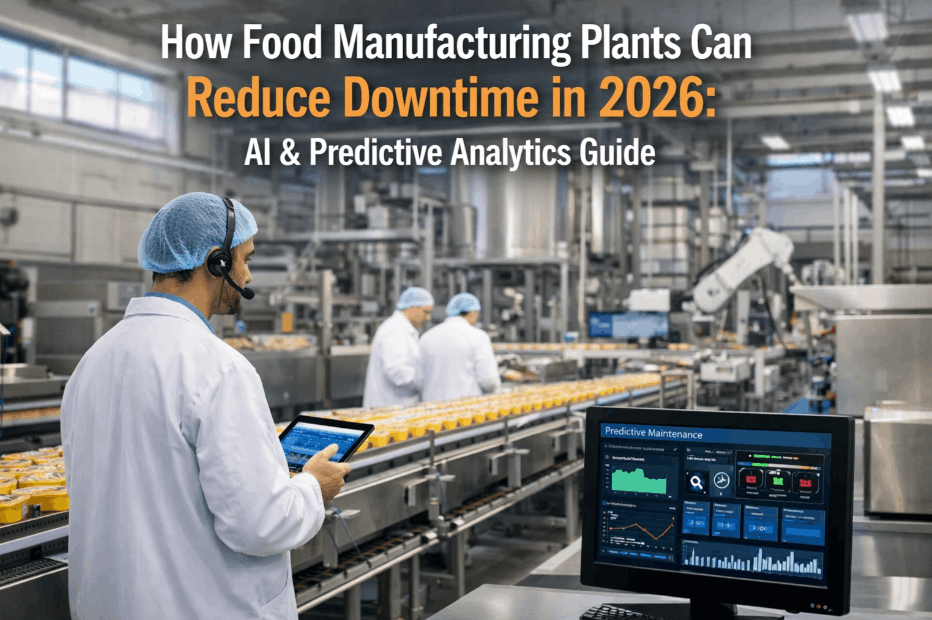
Unplanned downtime in food manufacturing no longer costs thousands per hour — it costs millions. In 2026, the average enterprise food production facility losing a single line for sixty minutes faces direct revenue erosion between $800,000 and $1.2 million when factoring in waste, spoilage penalties, retailer chargebacks, and labor idle costs. Yet most plant operations teams are still running asset reliability decisions on weekly maintenance schedules and reactive work orders. The manufacturers closing the gap are the ones rebuilding their operational intelligence around AI-driven predictive analytics platforms purpose-built for food and beverage production environments — and the performance delta between those plants and their peers is becoming structural.
Why Unplanned Downtime Costs Are Accelerating in Food Manufacturing
The Hidden Multiplier Effect of a Single Production Line Failure
The $1 million downtime figure is not a worst-case scenario — it is an increasingly typical one for mid-to-large food and beverage manufacturers operating under co-packer SLAs, just-in-time retailer agreements, and single-SKU production windows. A 2025 analysis of enterprise food production downtime events found that direct revenue loss accounts for less than 40 percent of the total financial impact. The remaining 60 percent is distributed across spoiled raw material write-offs, expedited logistics to recover fulfillment windows, retailer chargeback penalties for late or short shipments, and overtime labor premiums to recapture lost production volume.
For manufacturers running allergen-controlled or temperature-sensitive lines, the downtime cost equation is even more severe. A single unplanned stop during a high-care zone run can trigger a full line sanitation reset — adding four to six hours of lost production on top of the original failure window. Manufacturers who have deployed AI predictive maintenance analytics on these lines report eliminating between 70 and 85 percent of unplanned sanitation-triggered downtime events within the first operating quarter.
How AI Predictive Analytics Is Redefining Equipment Failure Prevention
From Scheduled Maintenance to Real-Time Asset Risk Intelligence
Traditional preventive maintenance in food manufacturing operates on fixed schedules — replace bearings every 90 days, inspect seals at each sanitation cycle, service conveyors during planned shutdowns. This interval-based model was a significant improvement over pure reactive maintenance, but it has a structural flaw: it applies the same service interval to assets operating in vastly different stress conditions. A filler head running a high-acid product at maximum throughput for three shifts degrades at a fundamentally different rate than the same component running low-viscosity beverage at 65 percent utilization.
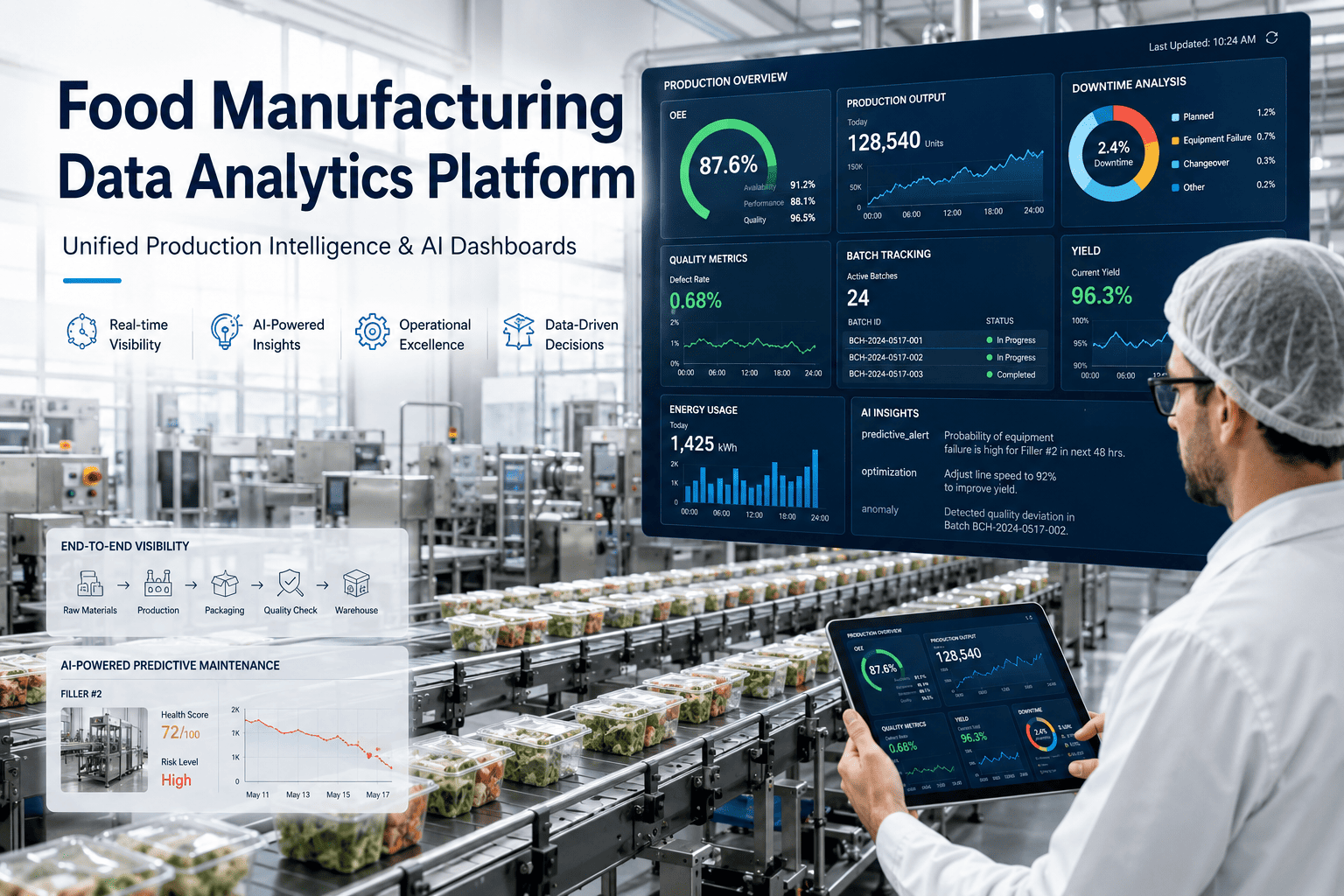
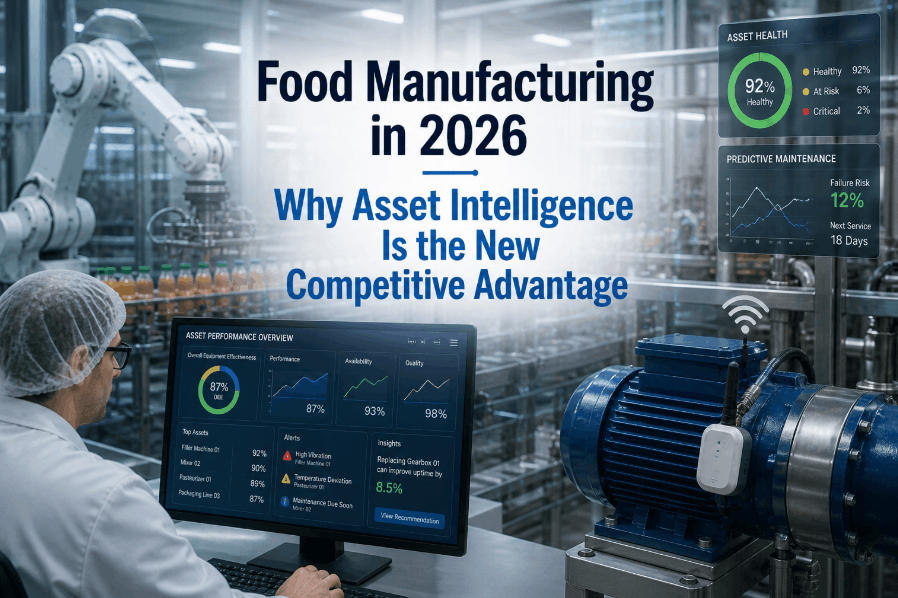
AI-driven predictive analytics platforms ingest continuous sensor data streams — vibration signatures, thermal gradients, torque variance, pressure fluctuation, motor current draw — and build dynamic failure probability models for every critical asset on the line. Rather than a fixed calendar trigger, maintenance teams receive ranked risk alerts sorted by remaining useful life estimates and production impact scores. Manufacturers exploring this transition can Book a demo to identify which assets on their lines carry the highest unmonitored failure risk today.
The AI Analytics Stack Food Manufacturers Are Building in 2026
Integrating Predictive Maintenance, Quality Risk, and Supply Chain Resilience
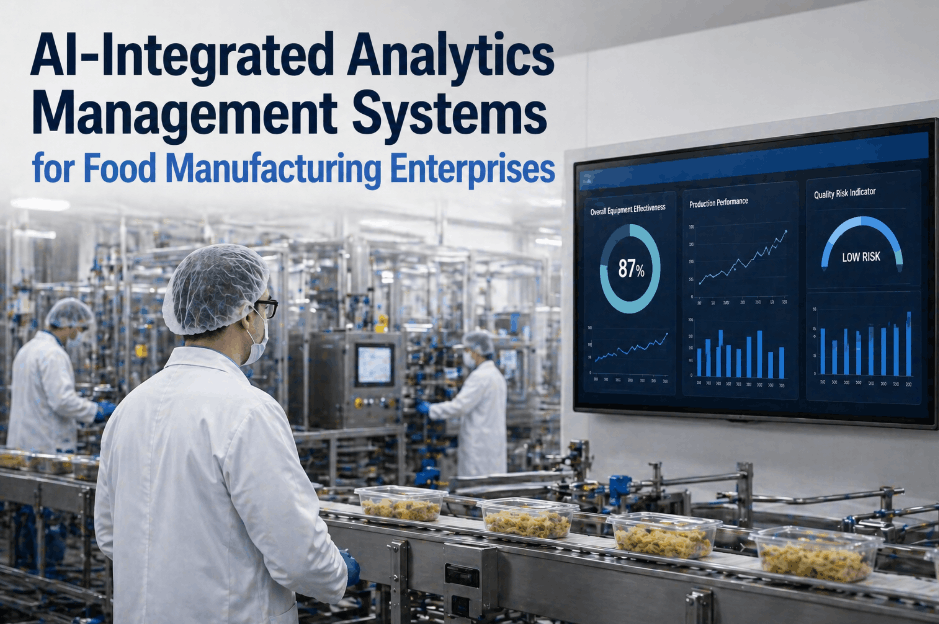
The most sophisticated food manufacturing operations in 2026 are not deploying AI analytics as a single-point maintenance tool — they are building integrated operational intelligence architectures that connect equipment health data with quality risk signals, supplier performance inputs, and demand fulfillment commitments. This convergence allows the platform to model second-order failure impacts that single-asset tools cannot see: the upstream ingredient shortage that turns a recoverable equipment delay into a full production cancellation, or the downstream retailer window that makes a 4-hour line stop more damaging than a 12-hour stop on a different day.
Manufacturers who have deployed integrated AI analytics stacks report that the compound risk visibility — seeing equipment risk, supply risk, and fulfillment risk simultaneously — changes the nature of operational decision-making at every level of the organization. Production supervisors make better shift allocation decisions. Procurement teams adjust safety stock positions ahead of predicted failures. And plant directors can present quantified operational risk posture to executive committees in terms that connect directly to P&L exposure. Manufacturers ready to build this capability can Book a Demo to map their current data infrastructure against the integrated analytics architecture.
Platform Comparison: AI Analytics Solutions for Food Manufacturing
Why Generic Industrial IoT Platforms Fall Short of Food Sector Requirements
Not every industrial analytics platform is equipped to handle the specific requirements of food and beverage manufacturing — allergen management, sanitation-driven downtime cycles, cold chain monitoring, FSMA compliance data requirements, and multi-SKU production scheduling complexity. The comparison below covers the critical evaluation dimensions for selecting an AI analytics platform in a food manufacturing environment.
| Capability | Generic IoT Platforms | Enterprise ERP Analytics | Purpose-Built Food AI Platform |
|---|---|---|---|
| Food-Specific Failure Pattern Library | Not Available | Custom Build | Pre-built Native |
| Sanitation Cycle Impact Modeling | No | No | Built-In |
| Revenue Risk Per Failure Event | Manual Calculation | Partial | Automated |
| FSMA Compliance Documentation | Not Supported | Add-On Module | Native Auto-Log |
| Cold Chain Anomaly Detection | Basic Threshold Alerts | No | AI Pattern Model |
| Multi-Line Risk Prioritization | No | Manual Ranking | Dynamic Scoring |
| Time to First Predictive Insight | 12–20 weeks | 6–12 months | 3–6 weeks |
| Executive Operational Risk Dashboard | Manual Report | Scheduled Export | Real-Time Live |
ROI of AI Predictive Analytics in Food Manufacturing: Measured Outcomes
Quantifying the Financial Return on Manufacturing Intelligence Investment
The financial case for rebuilding food manufacturing analytics around AI is not theoretical — it is documented across deployments in dairy, bakery, beverage, meat processing, and prepared foods environments. For a facility processing 120,000 to 400,000 units per day across three to six production lines, the annual cost of unmanaged unplanned downtime — counting direct revenue loss, waste, chargebacks, and recovery labor — typically falls between $4.2 million and $11.8 million. Against that baseline, AI predictive analytics platforms consistently deliver measurable, auditable returns within the first operating year. Facilities operating at this scale can Book a Demo to quantify their specific exposure and projected return on AI analytics investment.
Building the Case for AI Analytics Investment: A Guide for Plant Directors
How to Frame Operational Risk in Executive and Board-Level Language
The most common barrier to AI analytics adoption in food manufacturing is not technical readiness — it is the internal business case. Plant directors who have spent years justifying capital maintenance requests in terms of equipment age and failure frequency are now being asked to present technology investment proposals in terms of revenue protection, risk-adjusted return, and competitive resilience. This translation is not instinctive for engineering-trained operations leaders, but it is learnable — and it is the capability that separates the plants moving fast on AI analytics adoption from those waiting for a clearer mandate.
Implementation Roadmap: From Legacy Plant Monitoring to AI-Driven Intelligence
The implementation concern most frequently raised by food manufacturing operations teams is disruption risk — the fear that deploying new analytics infrastructure will itself create the production instability it is designed to prevent. Purpose-built food manufacturing AI platforms address this directly through a phased integration architecture that connects to existing sensor networks and PLC outputs without requiring line downtime, hardware replacement, or SCADA system modification. The typical deployment sequence for a four-to-six-line facility runs three to six weeks from kickoff to operational predictive alerting, with no production interruption at any stage.
Frequently Asked Questions
How much does unplanned downtime actually cost food manufacturers per hour in 2026?
For enterprise food production facilities operating under modern retailer SLAs, total unplanned downtime cost per hour — including direct revenue loss, waste write-offs, chargeback penalties, and recovery labor — ranges from $600,000 to $1.4 million depending on line throughput, product value, and retailer agreement terms. High-care and temperature-sensitive production environments carry additional sanitation reset costs that push the upper range significantly higher.
How far in advance can AI predictive analytics detect equipment failure in food manufacturing?
On critical rotating assets — fillers, conveyors, pumps, and mixing systems — AI predictive models calibrated to food manufacturing operating conditions typically generate actionable failure warnings 14 to 28 days before the predicted failure event. Thermal and electrical anomaly signatures on process equipment often provide 7 to 14 days of advance notice. These windows are sufficient to schedule corrective maintenance within planned production gaps without requiring unplanned line stops.
Can AI analytics platforms integrate with existing food plant sensor infrastructure and SCADA systems?
Yes. Purpose-built food manufacturing AI platforms connect to existing PLC outputs, SCADA data historians, inline quality sensors, and ERP production logs through standard industrial protocol integrations — including OPC-UA, MQTT, and Modbus — without requiring hardware replacement or line modification. Integration to most food plant infrastructure takes three to seven days per system and can be completed without production interruption.
What is the typical ROI timeline for AI predictive analytics investment in food manufacturing?
Most food manufacturing AI analytics deployments demonstrate positive ROI within the first two to three months of operational alerting. The initial ROI is typically driven by a single prevented downtime event — one avoided unplanned line stop on a high-throughput filler or packaging line will frequently cover the full annual platform cost. Documented multi-year ROI across enterprise food deployments averages 4.8 to 7.2 times the total investment including implementation.
Does AI analytics for food manufacturing require dedicated data science or IT staff to operate?
Purpose-built food manufacturing AI platforms are designed to be operated by maintenance supervisors and plant managers without data science expertise. Model training, alert threshold configuration, and dashboard customization are managed through guided interfaces built for operations professionals. Initial model calibration is handled by the platform implementation team and requires no ongoing data science resource from the facility.
How does AI-driven operational risk modeling differ from traditional OEE tracking in food plants?
Traditional OEE tracking measures what happened — availability, performance, and quality rates in arrears. AI-driven operational risk modeling predicts what is about to happen — assigning forward-looking failure probability scores, remaining useful life estimates, and revenue exposure values to current asset health states. This shift from lagging to leading indicators is the fundamental operating model change that separates AI analytics adoption from conventional performance management tools.