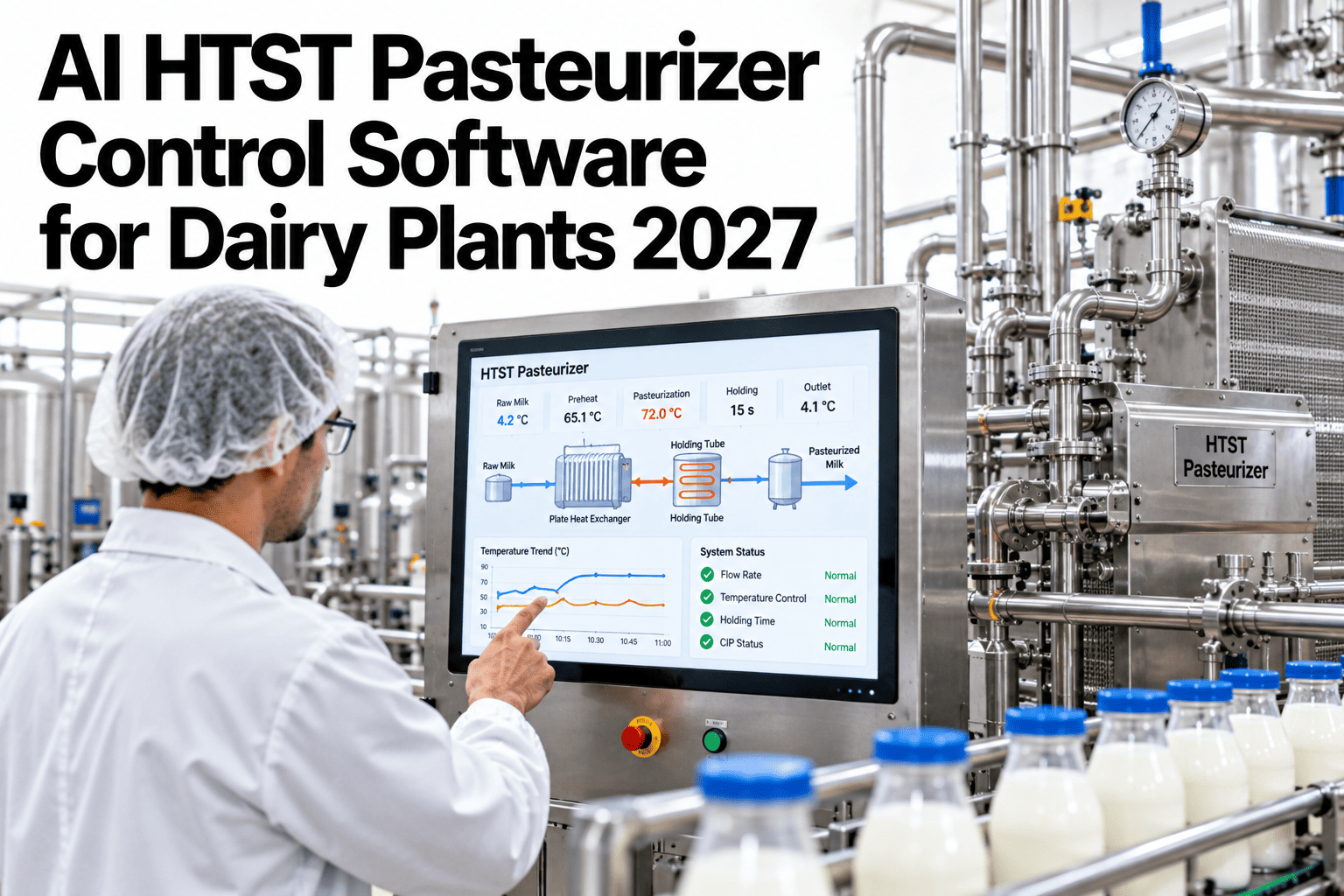
Every HTST pasteurizer has a flow diversion valve waiting to kick in the moment hold-tube temperature dips even slightly below the legal minimum, and that valve doing its job correctly is non-negotiable for food safety. The problem most dairy plants actually have is not that the valve fails, it is that the margin built in to avoid tripping it is often wider than it genuinely needs to be, because operators set flow rate conservatively to stay safely clear of a diversion event rather than running as close to the real, data-backed limit as the process would actually allow. Reading hold-tube temperature, flow and diversion history together, over a meaningful stretch of real operating data, is what lets a plant find that safe, faster operating point instead of simply guessing at it. Process teams can see this modeled against their own pasteurizer data on iFactory AI before the next internal throughput review comes around.
The Safety Margin Is Non-Negotiable. The Conservative Guess Around It Is Not.
iFactory AI reads hold-tube temperature, flow and diversion history together to lift throughput safely, without touching the safety threshold itself.
Why Flow Rate Usually Sits Below What the Process Could Support
A flow rate set once, during commissioning or an early process review, tends to stay fixed for years afterward, even as equipment, product formulation and operating experience change. The margin built into that original number rarely gets revisited once it is working.
Flow rate is often set with a wide margin during initial commissioning and left untouched.
Operators learn to run well clear of the threshold rather than close to it.
Without data showing how close the process actually runs to the limit, the margin never gets questioned.
A margin tuned for one product may be unnecessarily wide for another.
What Gets Read Together to Find the Real Limit
| Input | What It Reveals |
|---|---|
| Hold-tube temperature | The core safety variable that must never drop below the legal minimum |
| Flow rate | Directly affects hold time and therefore how much margin exists at a given temperature |
| Diversion event history | Shows how close past operation has come to actually triggering a diversion |
| Product and viscosity profile | Different products behave differently in the hold tube at the same flow rate |
Review Your Own Margin Against Real Diversion History
Bring your current flow rate settings to a 30-minute working session.
From Current Margin to a Validated Operating Point
How far current operation sits from the diversion threshold is quantified.
Viscosity and composition differences across products are accounted for.
A new operating point is identified that keeps appropriate safety margin.
The new flow rate is confirmed against hold-tube performance before full rollout.
Why Diversion History Is the Most Underused Dataset in Most Plants
Every diversion event, including the ones that never became a quality incident, is already recorded somewhere in most plants' control systems, yet that history rarely gets reviewed systematically for what it reveals about how close current operation runs to the actual safety threshold.
Treating diversion history as a planning input, not just an incident log reviewed only when something goes wrong, turns an underused dataset into the exact evidence needed to support a confident, defensible decision about flow rate, rather than relying on institutional memory of how things have always been run.
A Scenario: The Margin Nobody Had Measured
Picture a dairy plant running a standard milk pasteurization flow rate that has been unchanged for several years, set during the original commissioning with a margin nobody since has specifically quantified against actual diversion risk.
A review of hold-tube temperature against flow rate across months of operating history can show the plant has consistently run well clear of the diversion threshold, often by a wider margin than the product and equipment actually require for safe operation. That margin, once measured and understood rather than assumed, becomes the basis for a validated, incremental flow rate increase, lifting throughput while keeping the same conservative safety posture the plant has always maintained, just applied more precisely.
Guessed Margin vs Measured Margin
What a Throughput Gain Actually Means for the Plant
A modest, carefully validated flow rate increase on an HTST line compounds meaningfully across a full production run, since even a small percentage gain in throughput translates into additional processed volume across every hour the line runs.
That gain comes without any capital investment in new equipment, which is part of why measuring the existing margin is often one of the more cost-effective throughput opportunities a dairy plant can pursue, assuming it is approached with the same rigor any food safety critical process change deserves.
What Belongs in a Flow Rate Review
Why This Still Requires a Conservative, Validated Approach
Lifting throughput on a pasteurizer is not a decision to make casually, since the underlying food safety requirement around hold-tube temperature is absolute and does not bend for production targets.
The value here is not pushing closer to the edge of what is legally allowed, it is understanding precisely where that edge actually sits with real, measured data, so any change made is a deliberate, validated step rather than either an unexamined conservative guess carried forward by habit, or an unsafe push based on assumption instead of evidence.
What a Measured Margin Review Typically Uncovers
Plants running this kind of review for the first time often discover patterns in their own operating history that nobody had previously connected to flow rate, since the data existed but had never been reviewed with this specific question in mind.
The actual gap to diversion threshold often proves larger than operators estimated.
Lower-viscosity products sometimes carry more unused margin than higher-viscosity ones.
Margin can shift slightly with product temperature or composition changes by season.
Some lines show tighter real margin than others, even running the same nominal set point.
Approaching This as a Documented, Incremental Process
A throughput increase on a food safety critical process should never happen as a single large jump based on a one-time analysis. The more defensible approach treats it as a careful, incremental, documented process.
Where iFactory AI Fits
Reads temperature and flow together
Combines hold-tube temperature and flow rate into one continuous view.
Analyzes diversion history
Shows how close past operation has actually come to the threshold.
Accounts for product variation
Adjusts the picture for different viscosity and composition profiles.
Supports validated change
Builds the documented basis for a confident, safe throughput increase.
Expert Review
A dairy process engineering perspective, reviewed for accuracy before publication: throughput headroom on an HTST pasteurizer is one of the more commonly underused opportunities available to a dairy plant today, not because the opportunity is genuinely hard to find, but because most plants have simply never measured how much margin their current flow rate actually carries against real diversion risk. Measuring that margin, not guessing at it, is what makes a safe increase possible. Reviewing your own flow rate against measured diversion history is a fast way to see where the real margin sits. Confirm specific regulatory and validation requirements with your own compliance and food safety team before relying on any workflow or operating change.
Frequently Asked Questions
Does this change the legal hold-tube temperature requirement?
No, the regulatory minimum hold-tube temperature stays exactly as required, this is about finding a validated flow rate that keeps appropriate margin against that fixed requirement. Discuss how this respects your regulatory requirements and existing HACCP or validation documentation.
How much throughput increase is typically realistic?
It varies significantly by plant and current margin, some plants find meaningful headroom while others discover their current setting is already close to optimal. Ask about a realistic assessment for your specific pasteurizer and its current flow rate history.
Does a flow rate change need revalidation?
Yes, any change to a validated process parameter typically requires its own documented validation before full production rollout, which is part of why measuring the margin carefully upfront matters. Explore what a validation process would involve for your plant and how long it typically takes to complete.
How are different products on the same line handled?
Each product's viscosity and composition profile is accounted for separately, since a margin appropriate for one product may not transfer directly to a different one running on the same equipment. Talk through multi-product margin review for your line, including how each product's profile is kept separate.
How long does a margin review typically take?
Many plants can review several months of existing operating history relatively quickly, since the data already exists, with the validated change itself taking longer depending on internal approval processes. See a realistic timeline for your own margin review and validation process.
Find Your Real Margin, Not Just Your Conservative Guess
iFactory AI reads hold-tube temperature, flow and diversion history together, continuously, to lift throughput safely. See this on your own pasteurizer data.