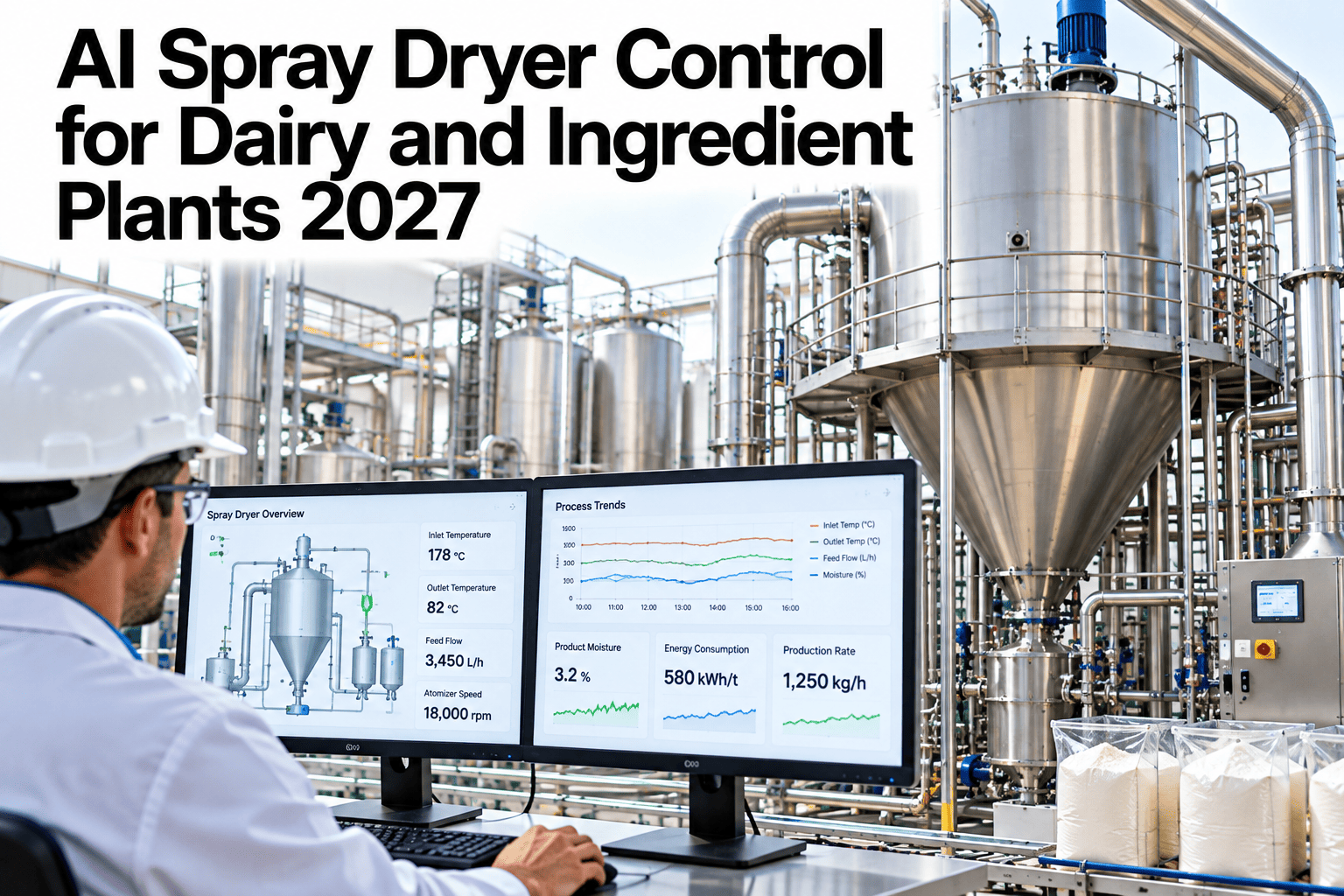
A spray dryer running inlet and outlet temperature at their usual set points can still produce a batch of powder with moisture drifting outside spec, because feed solids concentration and atomizer draw both shift independently of temperature and neither one gets watched as closely as the temperature gauges do. An operator manually nudging the inlet temperature in response to a moisture reading taken minutes or hours earlier is always reacting to a condition that has already changed by the time the adjustment lands. Reading inlet and outlet temperature, feed solids and atomizer draw together, continuously, is what keeps moisture inside spec without constant manual tuning. Process teams can see this applied to their own spray dryer data on iFactory AI before the next feed solids swing pushes a batch off spec.
Manual Adjustments Always Chase a Condition That Has Already Changed
iFactory AI reads inlet and outlet temperature, feed solids and atomizer draw together to hold moisture inside spec automatically.
Why Manual Adjustment Always Lags Behind the Dryer
A manual response to a moisture reading reacts to a condition that already happened, often several minutes or longer in the past once lab turnaround or sampling delay is factored in, which means the dryer has usually already moved on to a different operating condition by the time an adjustment is made.
Concentration shifts batch to batch, changing how much moisture needs to evaporate.
Draw changes affect droplet size and therefore how quickly moisture leaves the particle.
Moisture results often arrive after the batch condition that produced them has passed.
Adjusting temperature alone ignores what solids and draw are doing at the same time.
What Gets Read Together Through the Dry
| Input | What It Signals |
|---|---|
| Inlet temperature | The primary driver of evaporation rate entering the chamber |
| Outlet temperature | Reflects how much moisture has actually been removed by that point |
| Feed solids concentration | Determines how much water needs to evaporate for this specific batch |
| Atomizer draw | Affects droplet size, which drives drying speed and final particle moisture |
Model Your Own Dryer's Moisture Response
Bring a recent off-spec batch to a 30-minute working session.
From Feed Entering to Moisture Confirmed
Solids concentration is checked as feed enters the atomizer.
Atomizer draw and inlet temperature are adjusted to match this feed condition.
Outlet temperature trend confirms drying is proceeding as expected.
In-line or rapid moisture checks confirm the batch met target.
Why Lab-Based Moisture Checks Always Arrive Too Late
A lab moisture test performed after a batch is made confirms what already happened, but the batch that generated that result has already moved on toward packaging by the time the number comes back, which means the correction only helps the next batch.
Reading feed solids and atomizer draw continuously, before moisture even has a chance to drift, moves the response earlier in the process, catching the condition that would eventually cause an off-spec reading rather than catching the off-spec reading itself after the batch is already finished.
A Scenario: The Batch That Came in Wetter Than Usual
Picture a dairy ingredient dryer where feed solids run slightly lower than usual due to an upstream process variation, with inlet and outlet temperature set points left unchanged from the prior batch.
With more water to evaporate from the same temperature profile, the resulting powder trends toward higher final moisture, something that might not show up until a lab result returns well after the batch has moved to packaging. A system reading feed solids directly as the batch enters can adjust inlet temperature or atomizer draw to compensate for the extra water content before the first affected portion of the batch ever reaches the outlet, catching the condition rather than discovering its consequence later.
Manual Tuning vs Continuous Multi-Input Control
What Changes for Quality Review
A quality team investigating an off-spec moisture complaint benefits from the same adjustment history that helps operators, since the feed solids and draw data behind a specific batch is already logged rather than needing reconstruction after the fact.
That shortens the time it takes to close a quality deviation considerably, since the question of what was different about that batch often has a direct answer sitting in the feed and draw record rather than requiring a fresh investigation from scratch each time a batch runs off spec.
What Stays With the Process Team
Why This Matters More as Dryers Run Higher Throughput
Higher throughput on a spray dryer generally means less residence time margin to absorb a feed solids or draw variation before it shows up as a moisture deviation, which makes continuous, multi-input control more valuable as plants push for greater capacity, not less.
A control approach that worked acceptably at a lower throughput can become inadequate once that same dryer runs faster, simply because the window between a feed condition changing and an off-spec batch reaching packaging keeps shrinking as output volume increases.
Why Atomizer Draw Is Often the Overlooked Variable
Inlet and outlet temperature get the most attention on most dryer control panels, simply because they are the easiest readings to watch, but atomizer draw has a direct effect on droplet size, and droplet size is one of the strongest drivers of how quickly moisture actually leaves a particle.
A temperature-only adjustment strategy leaves this variable unmanaged, which means two batches with identical temperature profiles but different atomizer draw can still finish with meaningfully different moisture content, a gap that a temperature-focused review would struggle to explain.
Why Dairy and Ingredient Powders Face Different Challenges
A milk powder dryer and a protein or flavor ingredient dryer both benefit from the same combined-input approach, but the specific sensitivities differ enough that a generic profile rarely performs equally well across product types.
Protein denaturation risk limits how aggressively inlet temperature can be raised.
Atomizer draw settings often need to hit a specific particle size, not just a moisture target.
Higher fat feeds behave differently in the chamber than lean dairy streams.
Some ingredients need tighter outlet temperature control to preserve quality.
Starting With the Product Showing the Most Moisture Variation
A plant running several products through the same dryer rarely needs to apply this approach everywhere at once. Starting with the product showing the widest moisture variance in current quality records gives the clearest early proof point.
Where iFactory AI Fits
Reads feed condition
Checks solids concentration as feed enters the atomizer.
Coordinates all four inputs
Adjusts temperature and draw together based on current feed condition.
Tracks outlet trend
Confirms drying is proceeding on course through the chamber.
Keeps the team in control
Leaves specification and override authority with the process team.
Expert Review
A food process engineering perspective, reviewed for accuracy before publication: spray dryer moisture problems are frequently treated as a temperature tuning issue when the actual driver was a feed solids or atomizer draw shift that temperature alone cannot fully compensate for. Reading all four variables together closes a gap that single-variable tuning structurally cannot address. Reviewing a recent off-spec batch against your own feed data often shows exactly where the gap started. Confirm specific feature capabilities against your plant's systems before relying on any workflow.
Frequently Asked Questions
Does this replace the existing dryer control system?
No, it works alongside the existing controller by adjusting the targets it follows based on the combined feed, draw and temperature model, rather than replacing the underlying control hardware. See how this integrates with your current dryer setup.
What feed solids measurement is needed for this to work?
An inline density or refractometer-based solids reading at the feed line is a common starting point, giving a continuous signal rather than relying on periodic manual sampling. Ask about what feed sensing fits your current line.
Can this handle multiple products on the same dryer?
Yes, each product typically has its own target moisture specification, and the system compensates toward whichever target is active for the batch currently running through the dryer. Explore multi-product dryer profile management.
How does this handle a genuinely new recipe being trialed?
A new recipe starts with a defined target moisture set by the process team, and the compensation logic works from that baseline the same way it does for an established product. Talk through how new product trials would work with this setup.
How quickly does this typically reduce moisture variation?
Many lines see a measurable reduction in moisture variance within the first few weeks, since the most common causes of drift, like feed solids swings, tend to recur regularly and get addressed as soon as the combined model is in place. See a realistic timeline for your own spray dryer.
Keep Moisture Inside Spec Without Constant Manual Tuning
iFactory AI reads inlet and outlet temperature, feed solids and atomizer draw together. See this on your own spray dryer data.