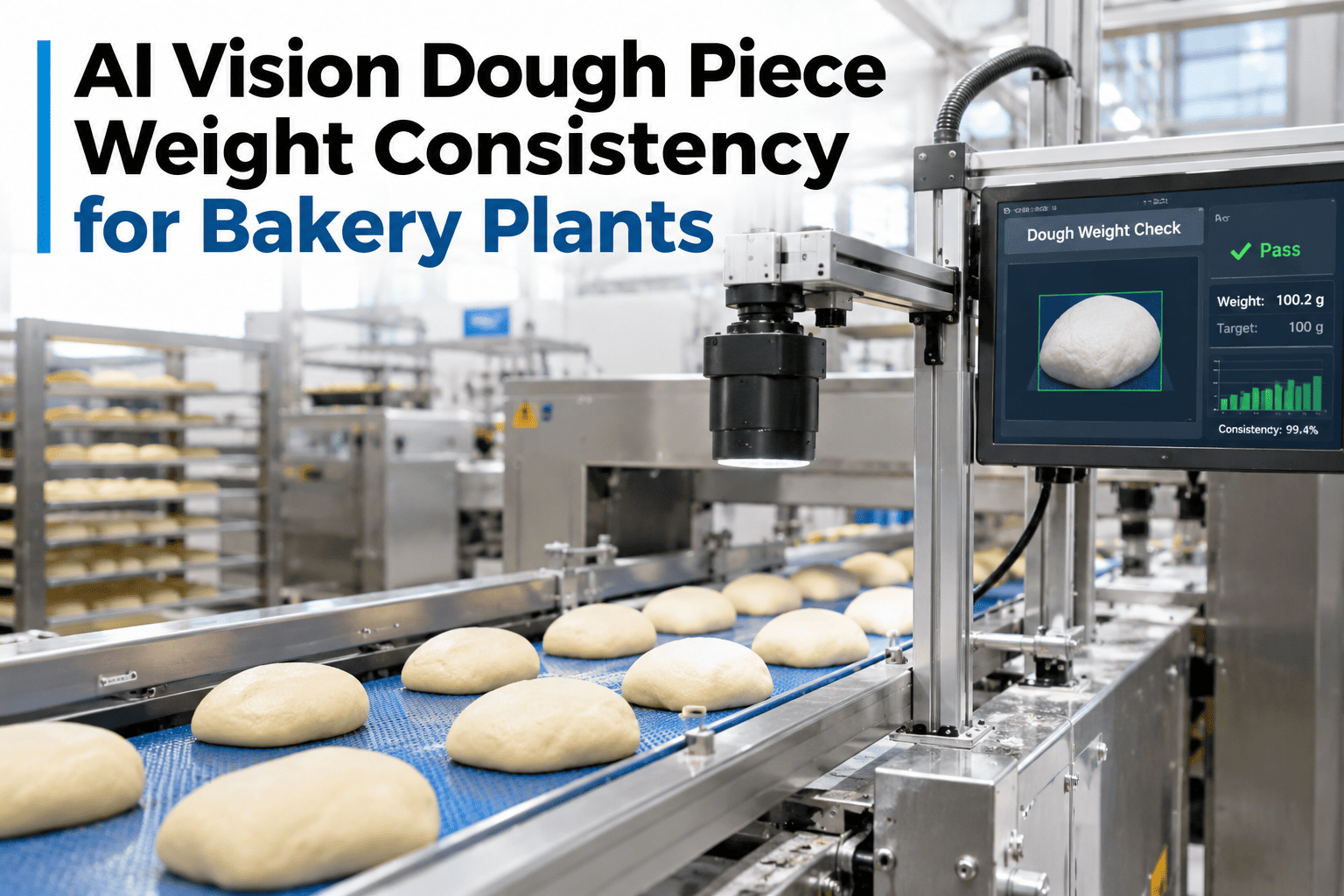
AI vision dough piece weight consistency measures every piece as it leaves the divider, estimates its weight from size and learned dough density, and shows which divider pocket is drifting, so downstream ovens run in a tight target range. Every later step depends on this one: proofing, baking time and final loaf weight all assume the pieces are alike. Food producers face rising input costs and tighter margins that make overweight product ever more expensive (Automate UK, 2026), and dough is a costly place to give it away. iFactory, an on-premise AI platform for food manufacturing, watches the divider continuously, and bakery teams can see pocket-by-pocket dough weight on a recording of their own divider in a short session.
Bakery Vision · Divider Control
One Pocket Drifts. Every Loaf After It Pays.
iFactory AI tracks dough piece weight by divider pocket, so a worn or drifting pocket is found within minutes.
Divider pockets · deviation from 450 g target · illustrative
P1+1 g
P2-2 g
P3+2 g
P4+9 g
P50 g
P6-5 g
P7+1 g
P8-1 g
Darker pockets drift further from target.
The definition
What Is AI Vision Dough Piece Weight Control?
It is camera measurement of each dough piece after the divider. Size is turned into an estimated weight and tracked by pocket, lane and time.
Piece size from camera
times
Dough density
gives
Estimated weight
Density is learned from scale checks and watched, since it moves with dough temperature and air content. To see estimates compared with scale readings, ask our team how density is calibrated per recipe.
The cost
Why Does Piece Weight Consistency Matter So Much?
A divider that runs a little heavy to stay safe gives away dough on every piece. A divider that runs light risks underweight loaves.
Target piece weight450 g
Average overshoot per piece5 g
Pieces per hour3,000
Dough given away per hour15 kg
Illustrative arithmetic: 5 g times 3,000 pieces is 15 kg of dough an hour that is baked, packed and not paid for.
Tighten the Dough Weight Range Before the Oven
Share your target weight, divider type and recent scale checks. iFactory AI will show where your pieces spread out.
The chain
How Does a Weight Error Travel Down the Line?
An error made at the divider is carried through every later step. Nothing downstream can fully correct it.
Divider
Pieces cut with weight spread.
Rounder and moulder
Shape and surface vary with piece size.
Proofer
Heavy and light pieces rise differently.
Oven
One bake time cannot suit every size.
The effect
What Happens When Pieces Run Heavy or Light?
| Piece Weight | In the Oven | At the Pack | Cost to the Plant |
|---|
| Too light | Dries and colors faster | Risk of underweight loaves | Rejects, complaints |
| On target | Bakes evenly to spec | Meets declared weight | Lowest cost |
| Too heavy | Slower to bake through | Overweight and larger | Giveaway, pack issues |
A tight range lets one bake profile suit nearly every piece. To model the saving for your line, review a giveaway estimate with our specialists.
Root causes
What Makes Divider Weight Drift?
Dough temperature
Warmer dough is softer and fills pockets differently.
Hopper level and pressure
Falling head pressure shortens fill as the hopper empties.
Pocket or piston wear
One worn pocket drifts away from its neighbors.
Flour and water batch
A new batch changes dough density and stickiness.
Rest and fermentation
Dough that rests too long gains gas and changes density.
Setpoint changes
Manual adjustments not logged leave the cause unknown.
Control
How Should the Bakery Respond to Drift?
Watch
Spread widens. Log it and check dough temperature.
Adjust
Mean drifts. Correct the divider setpoint in small steps.
Stop and check
A pocket is far off. Inspect the pocket and piston.
Small, logged steps are better than large ones. For a written response plan, ask support about a divider SOP template.
The rollout
How Do You Introduce Dough Weight Vision?
1
Choose the line with the highest volume or worst giveaway.
2
Fit the camera after the divider and map each piece to its pocket.
3
Calibrate against scale weights for each recipe.
4
Run in shadow mode for a week and compare with spot checks.
5
Turn on alerts and review the KPIs weekly.
iFactory is delivered on an on-premise NVIDIA server, live in 6–12 weeks, with integration, training and 24×7 remote monitoring in scope.
First 90 daysWhat Does a Realistic First 90 Days Look Like?
A dough weight pilot works best on one divider. The plan below shows a realistic first quarter.
Days 1–30
Fit the camera after the divider, map pieces to pockets and compare estimates with scale checks.
Days 31–60
Calibrate density per recipe, set alert levels and write the divider response plan.
Days 61–90
Turn on alerts, track pocket drift and giveaway weekly and extend to the next divider.
To plan this for your bakery, ask support about a ninety-day divider plan.
PitfallsWhat Mistakes Weaken Dough Weight Control?
Divider control looks simple but is easy to get wrong. Six mistakes are common.
Averaging across pockets
Track each pocket separately, since a good average can hide one bad pocket.
Ignoring dough temperature
Log temperature with weight so drift is linked to its cause.
Large setpoint jumps
Adjust in small steps and wait for the trend before the next change.
No scale checks
Keep regular scale checks to hold density estimates honest.
Unlogged manual changes
Record every divider adjustment so causes can be traced.
One bake profile for all pieces
Use the tighter weight range to settle on a single profile.
These habits cost little. To adopt them, discuss divider control habits with our team.
Key termsWhich Terms Do Bakery Teams Need?
Six terms keep production, quality and maintenance aligned.
Divider
The machine that cuts dough into pieces of set weight.
Pocket
One of several chambers that forms a piece.
Piston
The part that pushes dough into and out of a pocket.
Density
Mass per unit of volume of the dough.
Proof
The final rise before baking.
Setpoint
The target value a machine setting is held to.
To see them on a live view, ask our team for a divider KPI example.
Fit with the lineHow Does Dough Weight Data Support the Wider Bakery?
Divider data is useful beyond the divider. Quality teams use weight spread to explain loaf weight complaints, maintenance teams use pocket drift to plan piston service, and planners use giveaway figures to set ingredient orders. One record serves all three, which avoids separate spreadsheets and arguments about whose figures are right.
One record, many teams: the same data answers quality, maintenance and planning questions.
Joining divider data with proofing and oven data goes further, because it shows how piece weight changes bake results. To see that link, ask our team how divider and oven data are joined.
Expert review
Using Dough Vision Responsibly
Holds up
Tracking weight by divider pocket is sound practice, and vision gives far more samples than hand weighing.
Verify
That scale checks continue, that density is recalibrated per recipe and that pieces are matched to the right pocket.
Avoid
Chasing every small swing. Adjust on trends, not single pieces, to avoid over-correcting.
Questions
Frequently Asked Questions
Can a camera measure dough piece weight?
Can it tell which divider pocket is off?
Yes, when pieces are mapped to pockets by their position and timing. A pocket drifting from its neighbors is flagged for inspection.
Ask how pocket mapping works.
Does it work with different products?
Does it connect to the divider controls?
Does the data stay in our bakery?
Give Every Oven Pieces It Can Bake Evenly
Book a session to see iFactory AI track dough weight by pocket and cut giveaway at the divider.
{"@context":"https://schema.org","@type":"FAQPage","mainEntity":[{"@type":"Question","name":"Can a camera measure dough piece weight?","acceptedAnswer":{"@type":"Answer","text":"It measures size and shape precisely and converts that to weight using a density learned from scale checks. The estimate is checked regularly against the scale."}},{"@type":"Question","name":"Can it tell which divider pocket is off?","acceptedAnswer":{"@type":"Answer","text":"Yes, when pieces are mapped to pockets by their position and timing. A pocket drifting from its neighbors is flagged for inspection."}},{"@type":"Question","name":"Does it work with different products?","acceptedAnswer":{"@type":"Answer","text":"Yes, with a separate target and density per recipe. Changeovers load the right settings automatically."}},{"@type":"Question","name":"Does it connect to the divider controls?","acceptedAnswer":{"@type":"Answer","text":"It can alert operators or send setpoint suggestions, and closed-loop control can follow once results are trusted."}},{"@type":"Question","name":"Does the data stay in our bakery?","acceptedAnswer":{"@type":"Answer","text":"Yes. iFactory runs on-premise on a plant server, so images and weights stay on site."}}]}