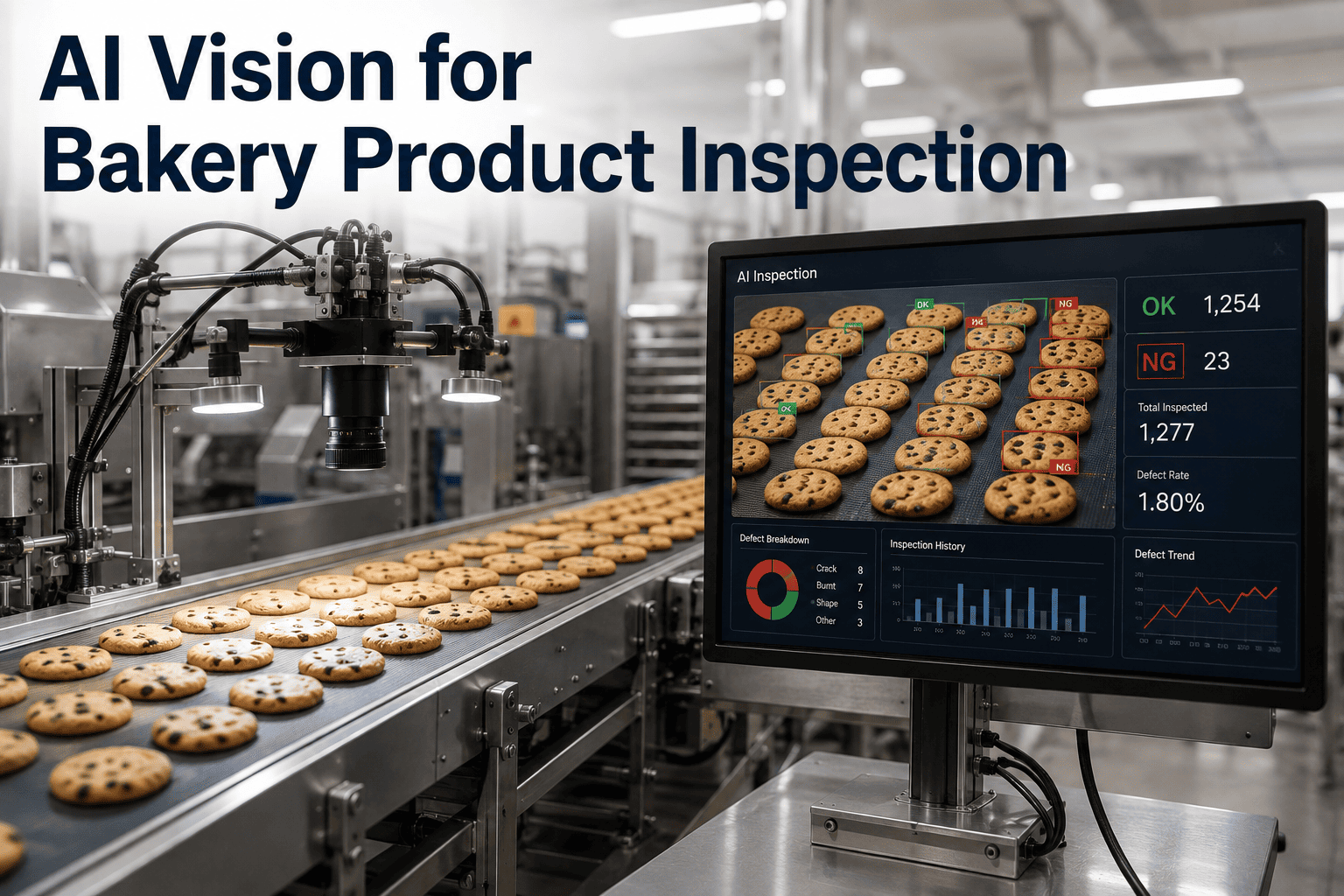
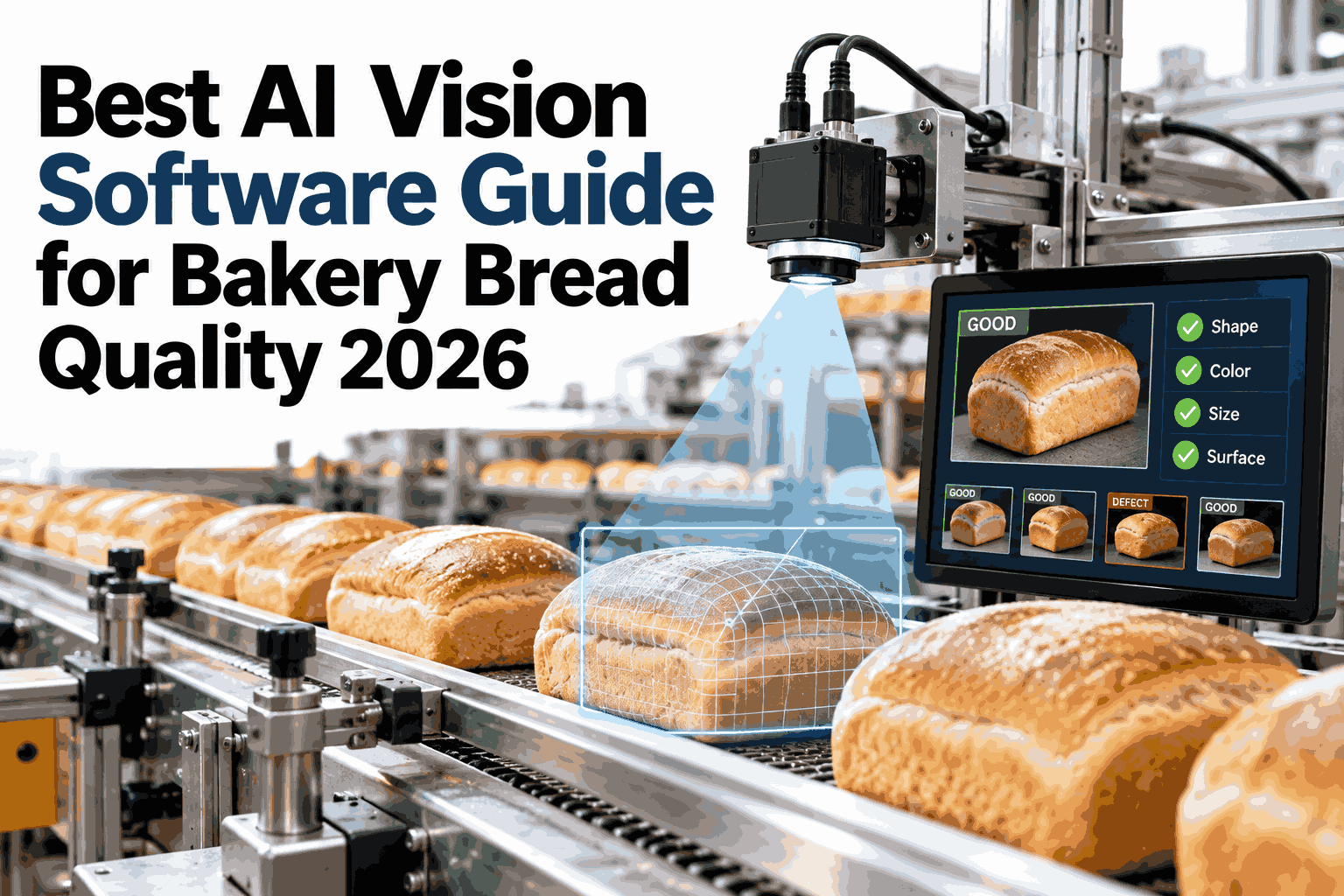
A bakery line moving eight hundred buns a minute doesn't give a human inspector time to look twice. By the time an underbaked center, a collapsed loaf, or a patch of missing seed topping registers with the eye, the product has already dropped into the tray and moved three feet down the belt. Multiply that by a ten-hour shift and the fatigue curve does the rest: accuracy that starts strong at clock-in quietly erodes by the last hour, and nobody notices until a retailer chargeback or a pallet of rejected multipacks shows up on the plant manager's desk. Bakeries have absorbed this as the cost of doing business for decades because the alternative, hiring more inspectors and slowing the line, never penciled out. AI vision cameras change that math by inspecting every single piece at full line speed instead of sampling what a tired eye can catch, and the fastest way to see what that actually looks like on your own SKUs is to book a demo.
FOOD & BEVERAGE · BAKERY & SNACK PRODUCTION
Inspect Every Loaf, Bun, and Cookie at Full Line Speed
iFactory's AI vision cameras grade bake color, shape, seed and topping coverage, and packaging integrity on every piece that crosses the line, catching the drift that a manual inspection table only notices after hundreds of units have already shipped out of spec.
THE DEFECT MAP
What Actually Goes Wrong Between the Oven and the Bagger
Bakery defects rarely come from one cause. A single SKU can pick up a shape problem at the divider, a color problem in the oven, a topping problem at the applicator, and a seal problem at the bagger, and each of those stages produces a visual signature that a generic camera setup tuned for one defect type will simply not catch in the others.
01
Shape & Dimension
Loaf height variance, bun symmetry, crust spread, and collapsed or split tops that trace back to proofing time, dough weight, or oven spring rather than anything visible until the product cools.
02
Bake Color Drift
Crust browning that runs pale or scorched across a zone of the oven, a defect that reads differently on white, wholemeal, and rye recipes and is exactly the kind of subjective call that varies from one inspector to the next.
03
Topping & Seasoning Coverage
Seed, cornmeal, chocolate chip, or icing coverage that falls below spec on a patch of the line, often invisible from a distance but obvious the moment a customer opens the package.
04
Foreign Material & Packaging
Film, paper, or packaging fragments that X-ray and metal detectors miss because they carry no density signature, plus seal misalignment and label drift at the bagger exit.
None of these four categories is caught reliably by a single rule-based check, which is why plants that bolt on one camera for one defect type still end up relying on a human at the end of the line to catch everything else.
WHERE CAMERAS ACTUALLY GO
Six Points on the Line Where Inspection Pays Off
Vision inspection works best when it's placed at the stage where a defect is easiest to see and cheapest to correct, not bolted onto the end of the line as a last resort. A camera watching the divider catches a weight problem before it ever reaches the oven; a camera at the bagger catches a seal problem before the case is sealed and shipped.
1
Divider / Sheeter
Dough-piece weight and shape variance flagged before proofing begins.
2
Proofer Exit
Under-proofed or over-proofed pieces caught before they enter the oven.
3
Oven Exit
Bake color, crust spread, and crack or collapse detection zone by zone.
4
Topping Application
Seed, icing, and seasoning coverage measured against your spec sheet.
5
Cooling Tunnel
Structural defects that only appear once the product has set fully.
6
Bagger / Packaging
Seal integrity, label alignment, and pack count verified before dispatch.
A plant doesn't need all six on day one. Most deployments start at the one or two stations where the current reject rate is highest, prove the model against real production data, and expand station by station once the results are visible on the floor.
Find out which station is costing you the most
iFactory can benchmark your current reject rate against a live camera feed on your own line before you commit to a full rollout.
WHAT CHANGES ON THE FLOOR
The Numbers Plants Actually See After Deployment
Bakeries that have moved from manual end-of-line checks to camera-based inspection consistently report the same shape of improvement: fewer units rejected overall, but a much higher share of the real defects caught before they leave the plant rather than after a retailer or a customer finds them.
99%+
Piece-level detection accuracy achievable at full line speed once a model is trained on your own SKUs and defect history.
60-70%
Reduction in false rejections compared to conservative rule-based thresholds, meaning fewer good units pulled off the line unnecessarily.
800+/min
Line speeds that camera-based inspection can sustain without the throughput trade-off that manual sampling forces on fast lines.
Under 4 mo
Typical payback window reported by plants once reduced waste and fewer customer complaints are counted against the deployment cost.
MANUAL VS AI VISION
The Comparison That Actually Matters on the Floor
The question isn't whether your inspectors are skilled, it's whether any human being can sustain full-line coverage on a fast-moving belt for a ten-hour shift without the accuracy curve bending downward well before the shift ends.
| Factor |
Manual Inspection Table |
AI Vision Inspection |
| Coverage |
Sampled units, limited by how fast the eye can scan a moving belt |
Every single piece, on every lane, at full line speed |
| Consistency |
Judgment on bake color and shape varies inspector to inspector and hour to hour |
The same tolerance applied around the clock, across every shift |
| Foreign Material |
Relies on eyesight alone, misses film and paper against similar backgrounds |
Trained specifically to spot low-contrast foreign material on the product surface |
| Documentation |
Paper logs or none, difficult to trace back for an FSMA or SQF audit |
Every defect logged automatically with lot, lane, and timestamp |
| Line Speed Impact |
Faster lines mean lower sampling rates and more escapes |
Inspection scales with the line, no speed trade-off required |
TURNKEY DEPLOYMENT
How iFactory Gets a Bakery Line Running
Every bakery's product mix is different, so the model has to be trained on your actual bake color range, your topping specs, and your own defect history rather than a generic dataset that assumes every loaf looks the same.
What Gets Installed
Cameras positioned at the one or two highest-reject stations first
Models trained per SKU on your bake color, shape, and topping specs
Real-time reject alerts routed to line operators and quality leads
Automatic per-lot defect logging for FSMA, HACCP, and SQF audits
Dashboard access for quality, production, and plant leadership
Rollout Timeline
Weeks 1-3: Line audit, camera placement, and baseline defect data collection
Weeks 4-7: Model training on your SKUs, calibration against live production
Weeks 8-10: Dashboard go-live, alert thresholds set, operator training
FREQUENTLY ASKED QUESTIONS
What Bakeries Ask Before Adding Vision Inspection
Can one system really judge something as subjective as bake color?
Bake color is exactly the kind of judgment call that varies from one inspector to the next, which is why it benefits most from a trained model rather than a fixed rule. The model learns the in-spec crust shade range for each of your SKUs from real production frames, including the acceptable variation between a rustic artisan loaf and a uniform sandwich bread, and flags the moment a batch drifts outside that learned range rather than applying a single rigid threshold to every product. That distinction between acceptable natural variation and an actual defect is the difference between a useful system and one that rejects good product constantly.
Book a demo to see it graded against your own recipes.
Does this replace X-ray and metal detection, or work alongside it?
Vision inspection works alongside your existing X-ray and metal detection rather than replacing it, because each technology catches a different category of risk. X-ray and metal detectors are built to find dense foreign objects like metal fragments and stones, but they are largely blind to soft materials like film, paper, and packaging fragments that carry no meaningful density signature. A camera trained to recognize those visual patterns closes that specific gap, and the two systems' findings can land in the same per-lot record so your quality team has one complete picture instead of two disconnected logs.
Contact our support team to map this against your current line setup.
How does the system handle a new SKU or a recipe change?
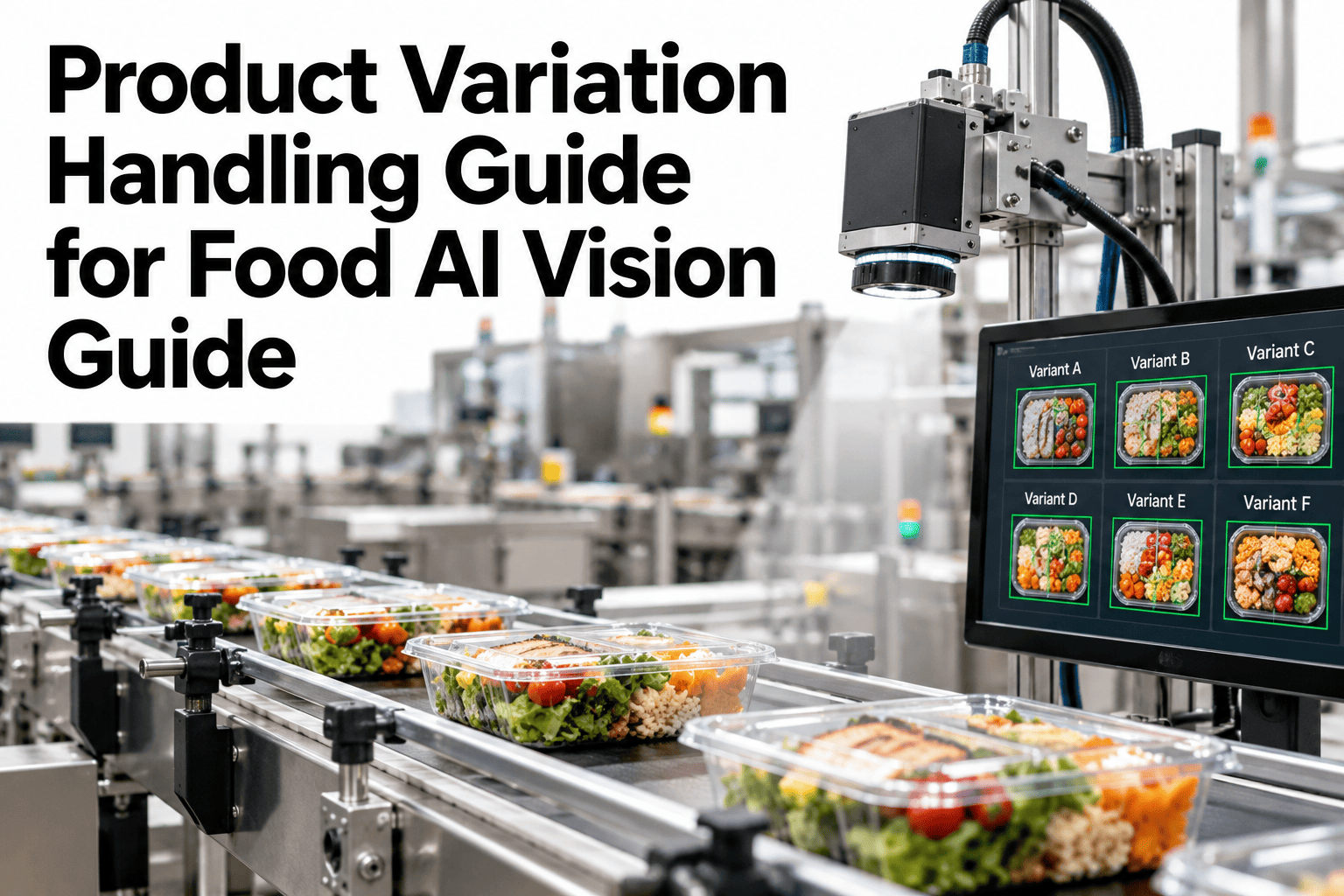
A rule-based system built around one fixed shape or color threshold typically breaks the moment you introduce a new topping, a different crust shade, or a seasonal recipe, which is one of the biggest frustrations bakeries report with older inspection technology. A learning-based model handles this far better because new SKUs and recipe variants can be added from real production frames in a single shift rather than requiring a full re-engineering of the inspection rules, so a seasonal product launch doesn't mean weeks of recalibration before the camera is useful again.
Book a demo to see how a new SKU gets onboarded.
Will this slow the line down or add a bottleneck?
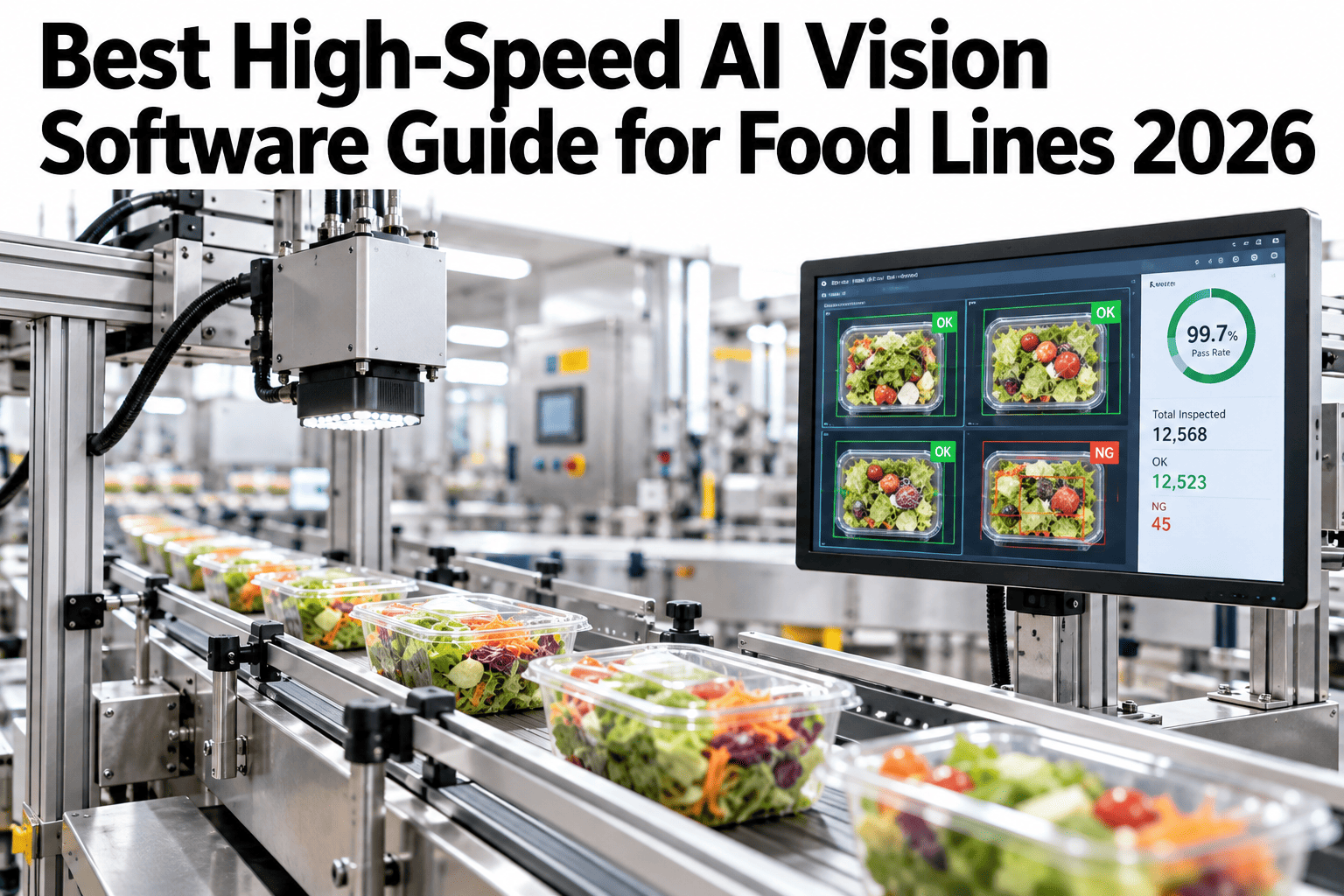
No, and this is precisely the trade-off manual inspection forces that camera-based inspection is built to avoid. A human inspector physically cannot scan every unit at eight hundred pieces a minute, so plants either accept sampled coverage or slow the line to inspect more thoroughly, and neither option is good for throughput. Vision inspection is designed to run at your actual production speed, capturing and grading every piece on every lane continuously, so there's no forced choice between full coverage and keeping the line moving at the rate your schedule requires.
Contact our support team to confirm the camera specification for your line speed.
What kind of documentation does this generate for audits?
Every inspected unit generates a per-lot record that includes the defect type if one was found, the lane and station where it was caught, and a timestamp, all captured automatically without relying on an inspector to fill out a paper log during a busy shift. That level of continuous, traceable data is exactly what FSMA, HACCP, and SQF audits ask plants to produce, and it turns a root-cause investigation after a customer complaint from a guessing exercise into a search through actual production imagery and data.
Book a demo to see a sample audit trail from a live deployment.
EVERY PIECE, EVERY LANE, EVERY SHIFT
Stop Finding Out About Defects After the Pallet Ships
iFactory's AI vision cameras grade bake color, shape, topping coverage, and packaging integrity on every unit that crosses your line, catching drift at the source instead of after a customer or a retailer already has.