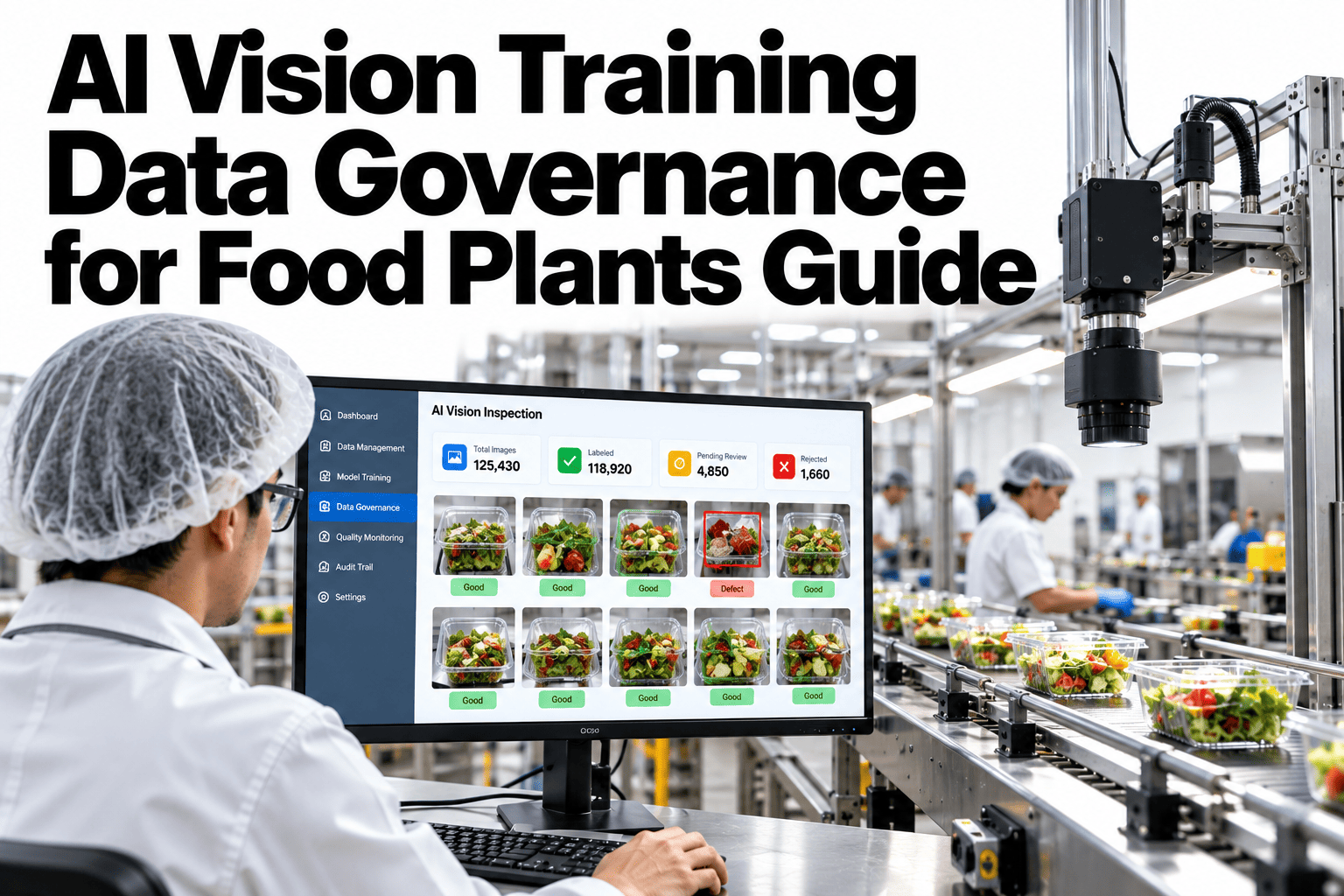
Every image a food plant labels today may be asked for again later, whether by a quality manager, a customer or an auditor. Without clear governance, datasets drift, labels disagree and nobody can say which images trained which model. AI vision training data governance sets rules for versioning, labeling quality and retention so each labeled image stays useful and defensible. It matters most on multi-line sites where several teams label in parallel. To see how this could work in your plant, you can review a data governance setup with our team.
AI quality inspection and computer vision
Govern Your Vision Training Data So Every Labeled Image Can Stand Up to an Audit
iFactory AI helps food plants version datasets, check labeling quality and set retention rules, so models stay traceable from image to decision.
Four rules for trustworthy vision data
VersionLabelRetainProve
Why governanceGood Models Fail on Unmanaged Data
Vision models learn from whatever images and labels they are given. If those are unmanaged, the model's behaviour is hard to explain.
Images collected
Each line saves its own samples
Labels applied
Different people label in different ways
Model retrained
Nobody records which data was used
Audit question
Why was this item passed or rejected?
Governance closes that gap. It ties each decision back to the model version, the dataset and the labeled examples behind it.
The governance stackFour Layers of Control Around Training Data
Policy
Who owns the data, what it may be used for and how long it is kept.
Dataset versioning
Every training set has an ID, a date and a change record.
Labeling quality
Rules, reviews and tests that keep labels consistent.
Retention and access
Storage periods, permissions and secure deletion.
Keep policy short and practical. A one-page policy that teams follow beats a long document nobody opens.
Dataset lifecycleSix Stages From Image to Retirement
1
Collect
Capture images with line, product, batch and time recorded.
2
Label
Apply agreed defect classes using written guidelines.
3
Review
A second person checks a sample of every batch of labels.
4
Version
Freeze the dataset with an ID and change notes.
5
Train and test
Train models and test against a locked reference set.
6
Retire
Archive or delete data when its retention period ends.
Each stage should leave a record. The record is what turns a pile of images into audit evidence.
See How Your Image Data Would Be Governed
Share how your lines collect and label images today and see how iFactory AI would add versioning, review and retention rules.
Labeling qualityChecks That Keep Labels Consistent
| Check | What it does | How often |
|---|
| Written label guide | Defines each defect with example images | Updated when products change |
| Second-person review | Checks a sample of each labeler's work | Every batch of labels |
| Agreement test | Compares labels from two people on the same images | Monthly |
| Locked reference set | A fixed, trusted set used to test every model | Every release |
| Disagreement log | Records unclear cases and the final ruling | Continuous |
Ambiguous cases need a ruling, and the ruling needs to be added to the guide so nobody has to decide the same case twice.
Weak versus strongWhat Separates Governed Data From Unmanaged Data
Unmanaged
Images saved in personal folders
Labels depend on who did the work
Dataset changes are not recorded
Models cannot be traced to their data
Governed
Images stored with line, batch and time
Labels follow a written guide and are reviewed
Every dataset version is recorded
Each model links to its training data
The cost of governance is small compared with the cost of explaining a decision nobody can trace.
Where label errors come fromKnow the Usual Sources of Bad Labels
Label errors have predictable causes. This split is an illustrative example.
35 percent: Unclear defect rules
People interpret the same defect in different ways.
25 percent: Poor images
Blur, glare or low resolution hide the defect.
25 percent: Fatigue and speed
Long labeling sessions lower accuracy.
15 percent: Tool mistakes
Wrong class chosen by accident.
Fixing guidelines and image quality removes most errors before any extra review is needed.
RetentionDecide What to Keep, for How Long and Why
Storing everything forever is costly and unnecessary. A simple grid helps decide.
Image value
High audit value
Low audit value
High storage cost
Keep selectively
Keep evidence images and samples
Keep fully
Keep and secure as audit evidence
Low storage cost
Delete early
Short retention, then secure deletion
Keep a sample
Keep a representative sample only
Retention periods should reflect customer contracts, certification schemes and local rules, which differ. To set yours, ask our team for a retention planning worksheet.
Multi-line sitesKeep Every Line on the Same Governed Dataset
Several lines labeling separately create several versions of the truth.
Line 1 imagesLine 2 imagesLine 3 images
Central governed dataset
Model trainingAudit evidenceReports and reviews
Local labeling can continue, but every label goes through the same guide, review and versioning.
Common pitfallsFive Mistakes on Multi-Line Rollouts
1
Different label guides per line
The same defect gets different names and rules.
2
Lost image context
Without batch and time, images cannot support an investigation.
3
No locked test set
Models cannot be compared fairly between releases.
4
Retention left undecided
Storage grows and nobody knows what is safe to delete.
5
No owner
Governance fades once the project team moves on.
RolloutFive Steps to Govern Your Vision Data
1
Inventory
List where images and labels are stored today.
2
Write the guide
Define defect classes with images and rulings.
3
Set versioning
Give each dataset an ID and a change record.
4
Add review
Sample every batch of labels for quality.
5
Set retention
Agree storage periods and access rules.
Dataset owner named for each line
Written label guide with example images
Second-person review of every label batch
Locked reference test set
Version ID and notes for every dataset
Images stored with line, batch and time
Retention periods agreed with quality and legal
Access limited by role and logged
Expert reviewWhat a Food Safety and Quality Auditor Would Check First
Expert review
Auditors want to see a clear line from the product decision to the evidence behind it. Governed data makes that line short and easy to follow.
VerdictStrong when every model links to a versioned dataset and a reviewed label set.
Watch forEvidence images with no batch information or retention rule.
Do nextPick one line, version its dataset and trace one decision end to end.
Frequently asked questionsWhat Food Plants Ask About Vision Data Governance
How do we version a training dataset?
Give every frozen dataset a unique ID and date, record what was added or removed and link it to the model trained on it. Store the label guide version alongside it. This lets you recreate any past model and explain its behaviour.
See a dataset versioning example.
How much labeling review is enough?
A sample review of every batch, plus a regular agreement test between two labelers, catches most problems. Increase checks where defects are subtle or costly. Keep a log of disagreements and use it to improve the guide.
Ask about review sampling.
How long should we keep training images?
It depends on customer contracts, certification schemes and local rules, so there is no single answer. Keep evidence images and key samples longer, and delete low-value images on a set schedule with secure deletion.
Discuss retention options.
Can images include people, and does that matter?
Images may capture operators, which can raise privacy issues. Position cameras to avoid faces where possible, limit access and follow your company's data protection rules. Check local requirements with your legal team.
Ask about privacy settings.
Who should own vision data governance?
One named owner, usually in quality or data operations, should be accountable, with line representatives helping. Without an owner, rules fade once the project team moves on. Review the process every quarter.
Plan ownership with our team.
Traceable from image to decision
Make Every Labeled Image Audit-Ready
Book a session with iFactory AI to review your datasets, set labeling quality checks and build retention rules that hold across every line.