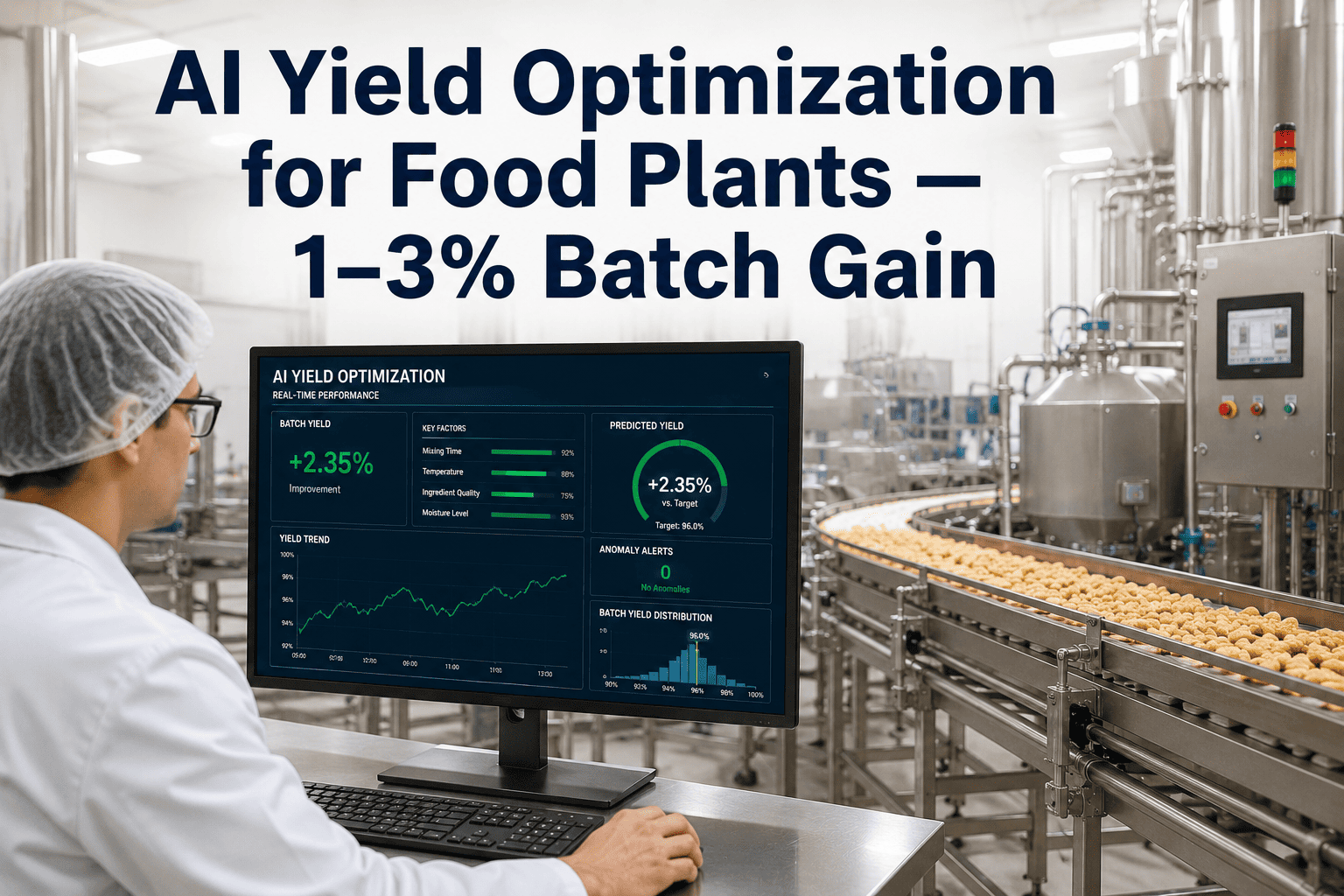
A 1-3% yield improvement sounds small until it is multiplied across every batch a plant runs in a year, at which point it becomes one of the largest cost levers available that does not require reformulating a single product or renegotiating a single supplier contract. Most of that gain is sitting inside process parameters and recipe tolerances that are already validated but rarely tuned to their actual optimum, because doing so manually across dozens of variables is not realistic for a human operator. This guide covers where yield actually gets lost in food plants and how AI-driven tuning recovers it within existing validated ranges. You can book a demo to see this modeled against your own recipe data.
Recover 1-3% Batch Yield Without Touching the Recipe Sheet
AI-driven tuning works within your already-validated recipe and process ranges, finding the combination that reduces give-away and rework without introducing a single new ingredient or specification.
It Rarely Leaves Through One Big Hole
Yield loss in food manufacturing is almost never one dramatic failure, it accumulates in small, recurring amounts across give-away on fill weights, minor rework on out-of-spec batches, quality rejects caught late, and downtime-related waste during changeovers. Because each source looks small on its own, it rarely gets prioritized for attention, even though the combined total is often the single largest recoverable cost in the plant.
Typical distribution of recoverable yield loss sources across a mid-size food production line, based on common industry patterns.
What Actually Gets Tuned
AI-driven yield optimization does not invent new process steps, it searches within the ranges your process already allows for the combination that wastes the least material while still hitting specification.
Find Out Which Lever Matters Most on Your Line
Bring a few weeks of batch and fill data to the call. We will show which of the three levers has the largest recoverable gain for your specific process.
Why This Is Hard to Do by Hand at Scale
A skilled process engineer can absolutely tune two or three variables manually, the difficulty is doing it across dozens of interacting variables, continuously, without the tuning drifting back out of optimum as ingredient lots and seasons change.
| Factor | Manual Tuning | AI-Driven Tuning |
|---|---|---|
| Variables Considered | Typically two to three at a time, based on engineer experience | Dozens simultaneously, including interactions between them |
| Update Frequency | Reviewed periodically, often quarterly or after a problem | Continuously monitored against live batch outcomes |
| Response to Ingredient Variance | Adjusted reactively after a batch runs off-spec | Adjusted proactively based on incoming material data |
| Consistency Across Shifts | Varies by which engineer or supervisor is on shift | Applied uniformly regardless of shift or personnel |
Optimization Without Reformulation Risk
The single most important guardrail in AI-driven yield optimization is that every adjustment stays within ranges that have already been validated for food safety and quality, meaning the model is searching for the best point inside an approved space, not proposing changes outside it.
What Plant Teams Ask Before Trying This
See Your Recoverable Yield, Not a Generic Estimate
iFactory tunes recipe and process parameters within your validated ranges, with every recommendation logged and reviewable. Book a demo to see it against your own product line.