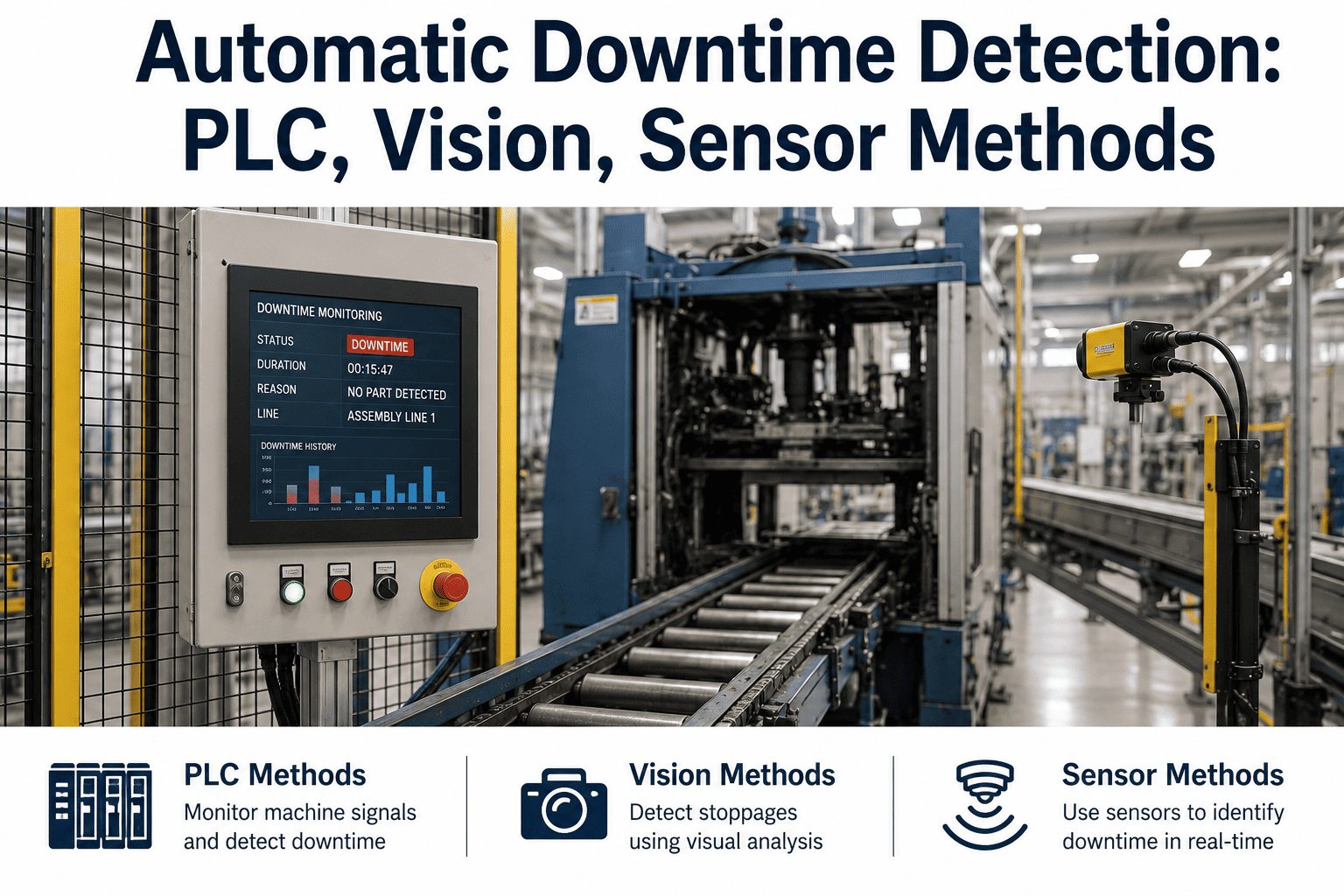
The word automatic gets used loosely in downtime detection, and it covers a wider range of actual methods than most buyers realize going in. Pulling a run signal straight from a PLC is automatic. So is a vision system watching a conveyor for gaps between products, and so is a vibration sensor bolted onto a motor housing. Each of these approaches has a genuinely different accuracy profile, cost structure, and deployment timeline, and choosing the wrong one for a given line is a common reason automatic detection projects stall or get quietly abandoned six months in. Food plants tend to run a mix of older and newer equipment, which means the right answer is rarely a single method applied uniformly across every line. iFactory supports all three approaches and helps plants match the right method to each line's actual constraints. You can book a demo to walk through which method fits your specific equipment.
DETECTION METHODS · PLC · VISION · SENSOR
Three Ways To Detect Downtime Automatically, One Right Answer Per Line
iFactory pulls signals from PLCs, vision systems, and standalone sensors, matching the method to each line's controls maturity, budget, and accuracy requirement.
PLC Signal
Fastest to deploy on modern lines
Vision System
Best for legacy equipment with no signal access
Retrofit Sensor
Middle ground on cost and accuracy
WHY MANUAL DETECTION FALLS SHORT
A Person Cannot Watch Every Line Every Second
Manual downtime detection depends entirely on someone noticing a stop, walking over, and logging it, which works reasonably well for a long changeover and almost never works for a fifteen-second micro-stop buried inside a busy shift. Automatic detection removes that dependency by tying the record directly to a physical signal rather than a person's attention span.
95%+
Typical accuracy of PLC signal-based detection on properly configured modern lines
85-92%
Typical accuracy range for well-tuned vision-based detection on legacy equipment
2-6 wks
Typical deployment window depending on detection method and line complexity
METHOD ONE
PLC Signal Detection: The Fastest Path When Available
Where a line already runs a modern PLC, pulling run and fault signals directly is usually the fastest and most accurate detection method available, since the equipment is already generating the exact data needed without any additional hardware.
01
Signal Mapping
Identify which existing PLC tags correspond to run state, fault codes, and speed.
02
Protocol Connection
Connect through the existing industrial protocol without modifying the control logic itself.
03
Threshold Tuning
Calibrate what counts as a stop versus a normal speed fluctuation for that specific line.
Find Out Which Detection Method Fits Your Lines
Bring your line list and controls inventory to a demo and we will map out the right detection approach for each one. Book a session to get started.
METHOD TWO AND THREE
Vision And Retrofit Sensor Detection For Legacy Equipment
Older equipment without an accessible PLC signal still needs a path to automatic detection, and the choice between vision and retrofit sensors usually comes down to the specific physical layout of the line.
Vision-Based Gap Detection
A camera watches product flow on a conveyor or filler and flags a stop when the expected pattern breaks.
Vibration And Current Sensors
Retrofit sensors on a motor or drive detect a stop through the absence of expected vibration or current draw.
Light Curtain And Proximity Sensors
Simple presence detection at a fixed point on the line, useful where product flow is highly regular.
Acoustic Detection
Sound signature monitoring for equipment where a stop produces a distinct audible change.
CHOOSING BETWEEN THE THREE
Accuracy, Cost, And Deployment Compared
No single method wins on every dimension, which is why most food plants end up running a mix across their line portfolio rather than standardizing on one approach everywhere.
| Factor |
PLC Signal |
Vision System |
Retrofit Sensor |
| Accuracy |
Highest, direct from control logic |
High, depends on tuning and lighting |
Moderate to high, depends on placement |
| Hardware Cost |
Lowest, uses existing infrastructure |
Higher, camera and mounting required |
Moderate, per-point sensor cost |
| Deployment Speed |
Fastest where signal access exists |
Slower, requires calibration period |
Moderate, one sensor at a time |
| Best Fit |
Modern lines with existing controls |
Legacy equipment, no signal access |
Single problem points on older lines |
WHO THIS SERVES
Mixed-Age Equipment Fleets Benefit Most
Detection method flexibility matters most for plants that have grown through acquisition or gradual equipment replacement, resulting in a genuine mix of controls generations across the floor.
Multi-Generation Equipment Fleets
Plants with a mix of modern PLCs and decades-old mechanical lines need more than one method.
Recently Acquired Facilities
Newly acquired plants often inherit inconsistent controls standards across lines.
Budget-Phased Rollouts
Plants deploying detection line by line can start with the lowest-cost method where accuracy allows.
High-Precision Packaging Lines
Lines where micro-stops matter most tend to justify the higher accuracy of PLC or vision detection.
FREQUENTLY ASKED QUESTIONS
Questions About Choosing A Detection Method
Can we mix detection methods across different lines in the same plant?
Yes, and this is actually the most common setup in practice, since a single plant usually has a genuine mix of controls generations across its lines rather than uniform equipment throughout. The reporting layer combines data from all three methods into one consistent view regardless of how each line's detection is implemented.
Book a demo to see a mixed-method deployment example.
How long does vision-based detection take to calibrate accurately?
Initial calibration for a vision system typically takes one to two weeks of observation to account for lighting changes, product variation, and normal line behavior before accuracy stabilizes at a usable level. Ongoing accuracy is then monitored and retuned automatically as conditions shift over time.
Contact our support team to discuss a calibration timeline for your line.
What is the cost difference between PLC and vision-based detection?
PLC signal detection is generally the least expensive option since it relies on infrastructure the line already has, while vision-based detection carries additional camera hardware and mounting costs on top of the software. The actual gap depends heavily on how many detection points a given line needs and its physical layout.
Book a demo to get a cost comparison specific to your equipment.
Will adding sensors or cameras require production downtime to install?
Most retrofit sensor and camera installations are designed to be completed during a scheduled maintenance window rather than requiring dedicated downtime, since mounting points are chosen specifically to avoid interfering with the production process. The exact installation plan is confirmed together with your maintenance team before any work begins.
Contact our support team to plan an installation window.
How do you handle false positives from vision or sensor detection?
Detection thresholds are tuned against a baseline period of normal operation for each specific line, and the system continues learning from confirmed and corrected events over time to reduce false positives further. Operators can flag a misclassified event directly, which feeds back into the tuning process.
Book a demo to see how detection accuracy is monitored and improved.
Match The Right Detection Method To Every Line
iFactory supports PLC, vision, and sensor-based detection in one platform, so every line gets the right approach for its equipment. Book a demo to map out your plant.