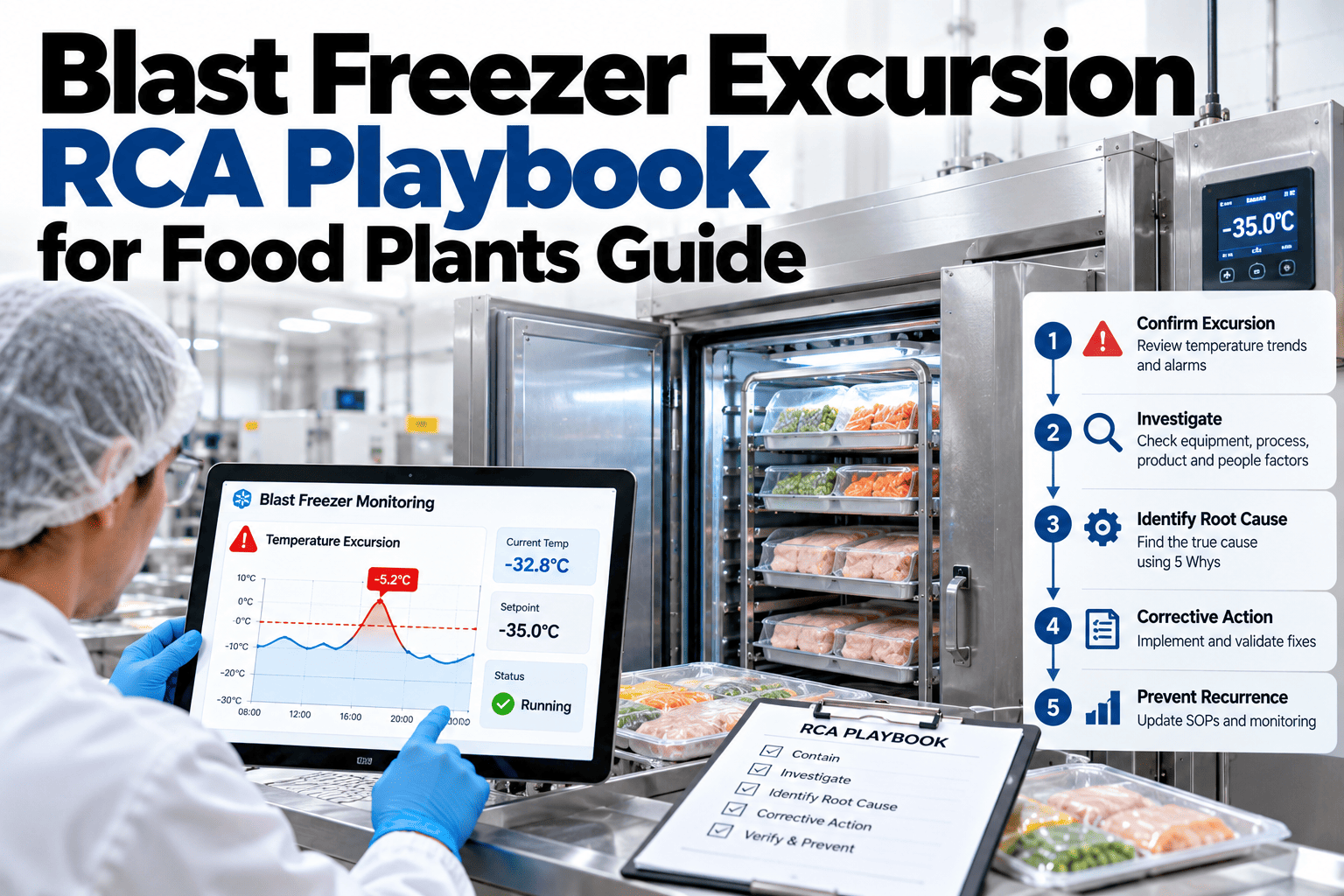
When a blast freezer starts running warm, the instinct is to blame the compressor. In practice the compressor is rarely the cause. Door seals, evaporator ice buildup, airflow blockage, defrost cycle faults and sensor placement cause most warm-drift events, and each leaves a different signature in the data. Chasing the compressor first wastes the narrow window a team has to fix the real problem before product is affected. Reliability teams can run a blast freezer through the five-cause diagnostic on iFactory AI and see which signature actually matches their event.
Five Causes Behind Almost Every Blast Freezer Drift
iFactory AI walks a warm-drift event through five likely causes in order, using the data signature each one leaves behind.
Why the Order Matters
These five causes are listed roughly from most to least common in practice, and from cheapest to most expensive to fix. Working the list in order avoids tearing into refrigeration hardware before checking a door gasket.
A worn or iced gasket lets warm, humid air in continuously.
Ice buildup on coils blocks airflow and cuts heat transfer.
Overstacked product or a blocked return starves circulation.
A stuck or mistimed defrost cycle leaves the coil iced or overheats the space.
Reduced capacity from a mechanical or charge issue.
The Five-Cause Diagnostic, Step by Step
Check door cycle data
Does the drift track with door openings or gasket age?
Check defrost alignment
Does the temperature spike line up with defrost cycles?
Check room uniformity
Is one zone warmer, pointing to blocked airflow?
Check compressor run pattern
Is it cycling normally or running continuously without effect?
Run Your Last Freezer Event Through the Diagnostic
Bring a recent warm-drift event to a 30-minute session and see which of the five causes actually matches.
Signatures at a Glance
| Cause | Data Signature | Typical Fix |
|---|---|---|
| Door seal | Drift tracks with door cycles | Replace gasket, check door closer |
| Evaporator ice | Gradual rise, normal run time | Manual defrost, inspect drain |
| Airflow blockage | Uneven room temperature | Reduce stacking, clear returns |
| Defrost fault | Spike aligned with defrost schedule | Check timer, heater, termination sensor |
| Compressor or refrigerant | Continuous run, no recovery | Refrigerant check, compressor service |
A Composite Scenario: The Freezer Everyone Blamed on the Compressor
Picture a blast freezer that keeps drifting warm every afternoon. The team schedules a compressor inspection, which comes back clean, and the drift continues.
Working the five causes in order would have shown the spike lining up with a mistimed defrost cycle, not the compressor. A timer adjustment resolves the event in an afternoon instead of a wasted service call and a lingering risk.
Where iFactory AI Fits
Matches the signature
Compares the event's data pattern against the five known signatures automatically.
Tracks door and defrost data
Correlates drift timing with door cycles and defrost schedules.
Maps room uniformity
Shows whether one zone runs warmer, pointing to airflow issues.
Narrows the work order
Sends the crew to the likely cause instead of a general inspection.
Expert Review
A refrigeration reliability engineer's perspective, reviewed for accuracy before publication: in the field, door seals and evaporator ice account for the large majority of blast freezer warm-drift calls that get escalated as compressor problems. The compressor is usually working exactly as designed, fighting a heat load the room should never have had. Checking the cheap, fast causes first saves both the service call and the time the room spends out of spec.
Frequently Asked Questions
Why is the compressor rarely the cause of a blast freezer warm drift?
Compressors are built for sustained duty and tend to fail in more obvious, continuous ways rather than causing an intermittent afternoon drift. Door seals, ice buildup and defrost timing are mechanically simpler, fail more often, and create patterns that look like a refrigeration problem without being one. Checking them first saves time and avoids unnecessary service calls. See how the five-cause check would run against your freezer data in a short session.
How do we tell a door seal problem from an airflow problem?
A door seal issue usually tracks closely with door cycle counts and shows a fairly uniform temperature rise across the room. An airflow blockage instead creates uneven temperatures, with one zone warmer than the rest while others stay near set point. Comparing multiple sensor points inside the room is what separates the two. Ask for a review of your room's sensor layout for this kind of comparison.
Can a defrost cycle really cause a visible temperature spike?
Yes. Defrost intentionally raises coil temperature to melt ice, and a normal cycle causes a brief, expected rise that recovers quickly. A fault shows up as a spike that runs longer, happens at the wrong time, or fails to recover, which is why comparing the event against the defrost schedule is one of the fastest checks in the diagnostic. Explore how your defrost schedule compares with your logged events.
What if none of the five causes match the event?
That is uncommon but possible, particularly with an unusual mechanical fault or an external event such as a prolonged power loss. In that case the diagnostic still narrows the search by ruling out the common causes first, which saves time even when the final answer needs a deeper refrigeration inspection. Try a walkthrough of what the escalation path looks like beyond the five causes.
How often should blast freezers be checked for these five causes proactively?
Door seals and defrost performance are worth a scheduled check on a regular cadence rather than waiting for an event, since both degrade gradually. Continuous monitoring can also flag early drift before it becomes a full excursion, giving maintenance a planned fix instead of a reactive one. Join a session on setting a proactive check schedule for your freezers.
Stop Starting Every Freezer Call at the Compressor
iFactory AI matches the warm-drift signature so your team fixes the real cause first. Book a walkthrough on your own blast freezers.