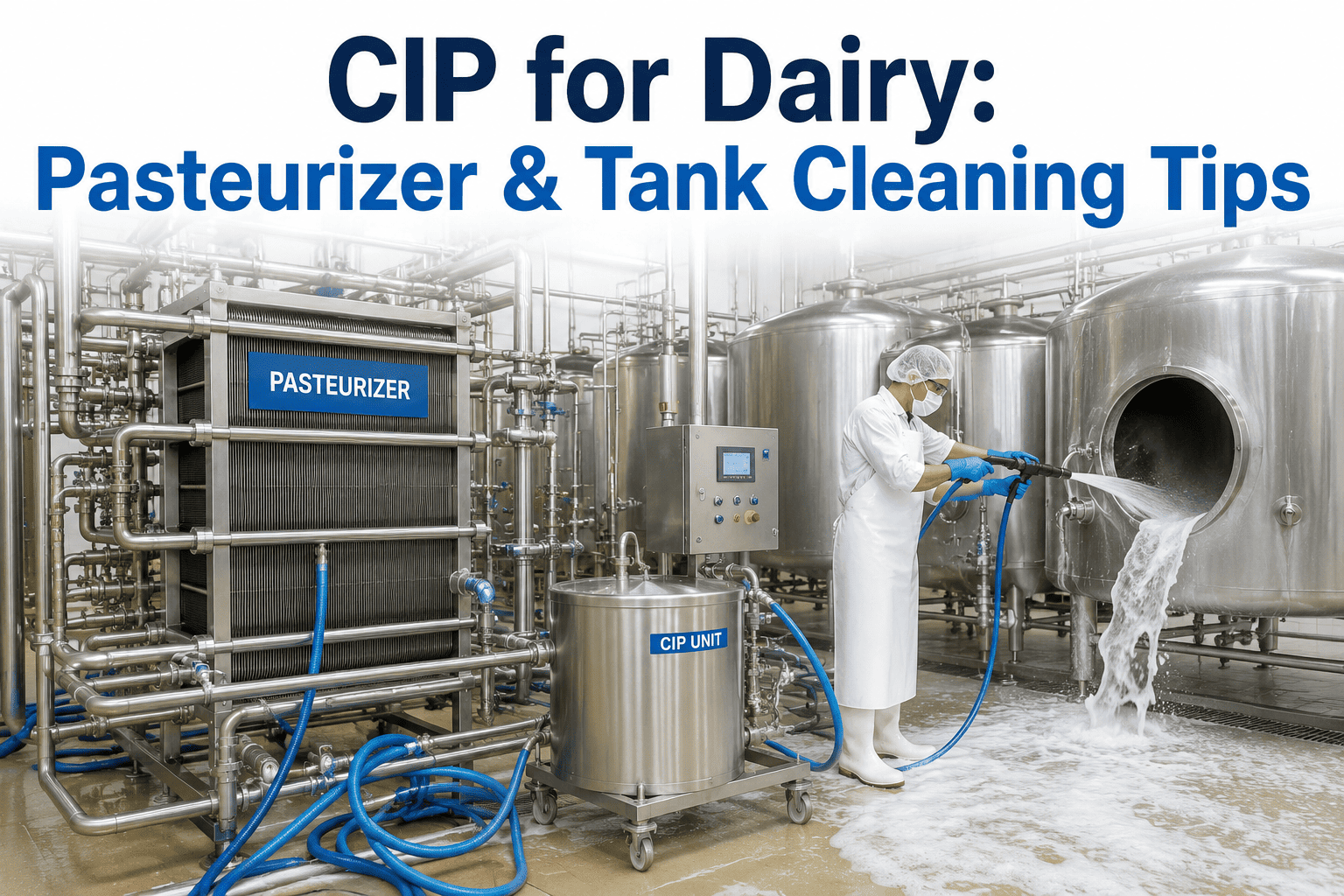
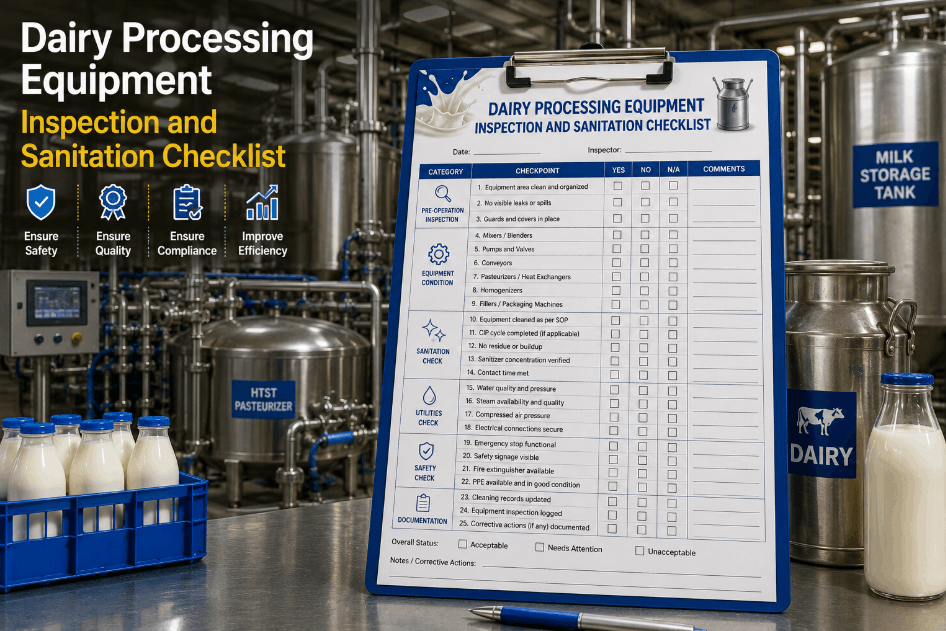
Milk residue behaves differently on a stainless tank wall than it does inside the fine channels of an HTST pasteurizer plate pack, and a single generic CIP program applied across both is how dairy plants end up with recurring milkstone buildup nobody can fully explain. Pasteurizers, cream separators, storage silos, and filling lines each carry different soil characteristics, flow paths, and heat exposure, and each deserves a cleaning program built around that reality rather than a one-size-fits-all cycle. iFactory helps dairy processors design and validate equipment-specific CIP programs, with the complete methodology at iFactory support.
Equipment-Specific CIP Design · Dairy Processing
CIP for Dairy: One Cleaning Program Rarely Fits Every Piece of Equipment
iFactory helps dairy plants design CIP programs matched to the actual soil and flow characteristics of pasteurizers, separators, silos, and filling equipment — not a single generic cycle stretched across all of them.
Equipment-by-Equipment
Four Dairy Assets, Four Different Cleaning Challenges
HTST Pasteurizers
Heat-denatured protein bakes onto plate surfaces during the hold tube and regeneration sections, requiring a caustic cycle strong enough to lift protein soil without damaging plate gaskets.
Cream Separators
High-speed bowl assemblies with fine clearances trap fat and protein residue in ways flat surfaces don't, demanding a rinse and caustic sequence tuned to disc stack geometry.
Storage Silos
Large surface area and slower flow velocity during CIP mean spray ball coverage and cycle duration matter more here than chemical concentration alone.
Filling Machines
Product contact surfaces near fill nozzles carry the highest contamination risk if under-cleaned, making rinse verification especially critical at this stage.
Milkstone Doesn't Build Up Overnight — It Builds Up From Small Gaps in Cycle Design
iFactory validates CIP cycle parameters against each equipment type's actual soil load, not a generic assumption borrowed from a different asset class.
The Standard Dairy CIP Cycle
Six Stages, Each Tuned to the Equipment Being Cleaned
Generic vs. Equipment-Specific CIP
What Changes When Programs Match the Asset
Factor
Generic CIP Program
Equipment-Specific Design
Milkstone Buildup
Recurring in high-heat and fine-clearance areas
Targeted caustic strength and duration by zone
Chemical Usage
Often over-dosed to compensate for under-cleaned zones
Calibrated to actual soil load per equipment type
Cycle Time
Uniform duration regardless of equipment complexity
Matched to flow path and soil characteristics
Verification
Visual inspection at scattered intervals
Continuous conductivity and flow validation per cycle
Field Case
Eliminating Recurring Milkstone in an HTST Pasteurizer
A mid-size dairy plant had run the same CIP cycle parameters across its HTST pasteurizer and its storage silos for years, despite recurring milkstone buildup in the pasteurizer's regeneration section that required manual descaling every few months. Reviewing actual soil load and flow velocity data showed the pasteurizer's caustic concentration was tuned for the silo's slower, larger-volume flow rather than the pasteurizer's high-velocity plate pack. Adjusting caustic strength and cycle duration specifically for the pasteurizer eliminated the need for manual descaling over the following two full production quarters.
2 quartersWithout manual descaling needed
1Cycle parameter set redesigned
0Unplanned descaling stops since
Chemistry Considerations
Getting Caustic and Acid Concentration Right for Milk Soil
Milk soil is a mixed matrix of proteins, fats, and minerals, and each component responds differently to cleaning chemistry, which is part of why a program tuned for one equipment type rarely transfers cleanly to another. Caustic wash stages primarily target protein and fat, with concentration and temperature both playing a role in how effectively denatured protein is lifted from a heat-exposed surface like a pasteurizer plate. Acid wash stages address mineral deposits, particularly calcium and magnesium salts that build into visible milkstone over repeated cycles if caustic alone is relied upon. Water hardness in a given facility's supply also affects how quickly milkstone accumulates, meaning two plants running identical CIP programs on paper can see very different fouling rates depending on local water chemistry. Getting the caustic-to-acid balance right, and validating it against real soil load data rather than a generic vendor recommendation, is often the difference between a program that holds up over years and one that requires escalating manual intervention.
Operational Discipline
Why Even a Well-Designed Program Needs Consistent Execution
Spray Ball Maintenance
A partially clogged or misaligned spray ball silently reduces coverage in a tank even when the CIP cycle completes on schedule and within normal parameters.
Chemical Concentration Drift
Caustic and acid tanks that aren't regularly titrated can drift in concentration over weeks, quietly weakening cleaning effectiveness without any alarm triggering.
Frequently Asked Questions
Dairy CIP Design — Common Questions
Why can't one CIP program work across all our dairy equipment?
Different equipment produces different soil types under different flow conditions — a pasteurizer's plate pack sees heat-denatured protein under high velocity, while a storage silo sees larger volumes at lower velocity with different soil concentration. A caustic strength and cycle time tuned correctly for one will often under-clean or over-clean the other, which is why milkstone recurs in specific zones even when the overall CIP program looks compliant on paper.
Book a Demo to review your current cycle parameters by equipment type.
How is cleaning validated beyond a visual check?
Continuous conductivity monitoring during rinse phases confirms that caustic and acid are fully flushed before the next stage begins, while flow rate and temperature sensors confirm that each zone actually received design-spec cleaning conditions rather than just completing the cycle timer. This gives a data-backed verification record rather than relying solely on periodic visual or swab testing.
Will equipment-specific CIP increase our chemical costs?
Often the opposite — many plants are over-dosing certain zones to compensate for under-cleaning elsewhere, and calibrating each cycle to actual soil load frequently reduces total chemical use even as cleaning effectiveness improves.
Contact support to review chemical usage patterns for your current program.
Does this require new CIP equipment or just reconfiguration?
Most dairy plants can implement equipment-specific programs through reconfiguration of existing CIP skid parameters and improved monitoring instrumentation, without replacing the underlying CIP system. Facilities with significantly undersized pumps or spray coverage for certain equipment may need targeted hardware upgrades identified during the review process.
How long does a full CIP program redesign take?
A single-line review covering two to three major equipment types typically takes two to four weeks from soil load assessment to validated new cycle parameters. Plant-wide redesigns across a full dairy processing line generally take six to ten weeks.
Book a Demo for a timeline specific to your equipment mix.
Give Every Piece of Dairy Equipment the CIP Program Its Soil Load Actually Requires
Equipment-specific CIP design with continuous cycle validation, live in as little as two weeks.