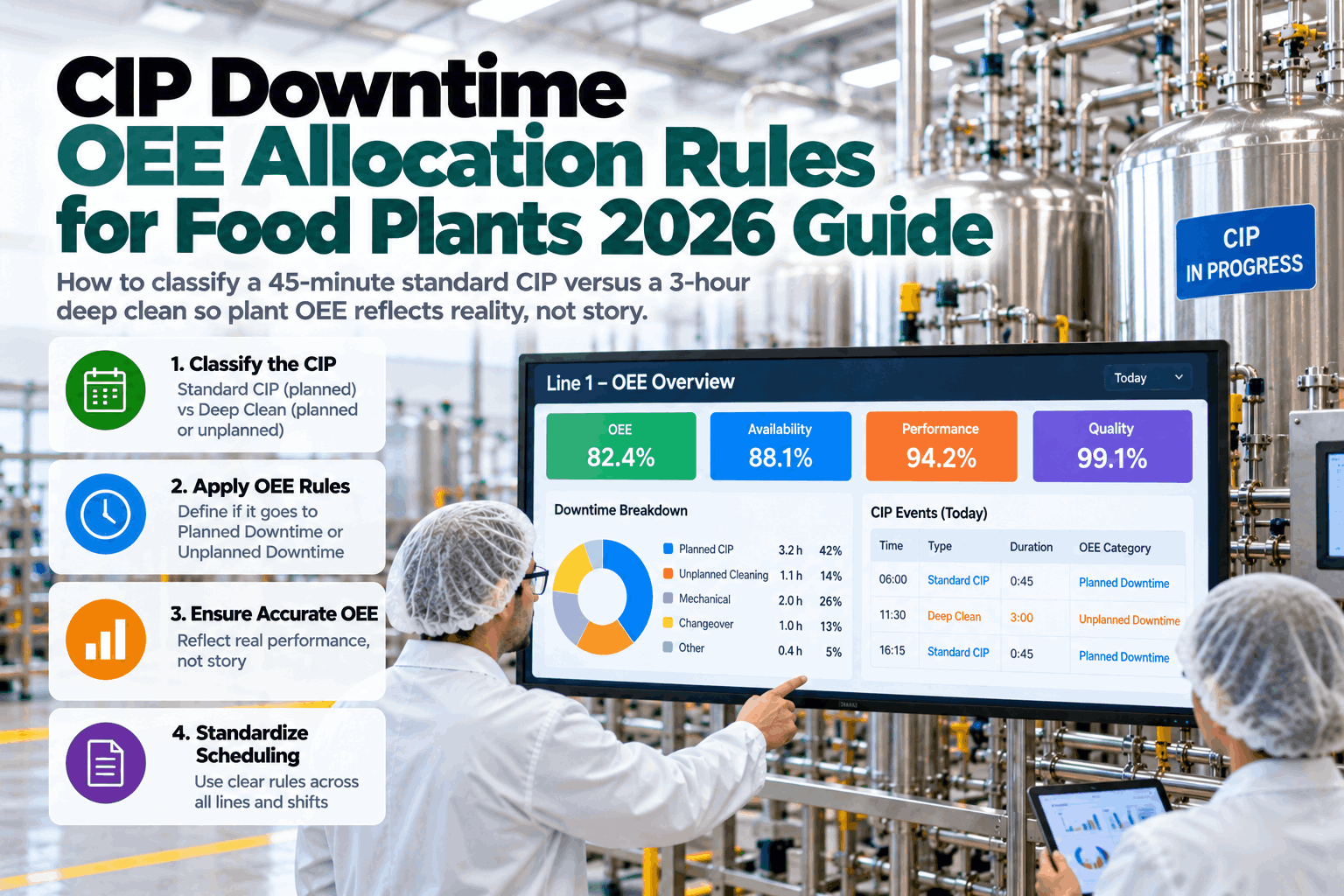
Two food plants clean the same way, yet one reports 85 percent OEE and the other 95. Often the only difference is where CIP time was booked. Clear rules fix that, from a 45-minute CIP to a 3-hour deep clean. To check how your plant books cleaning time, book an OEE rules review.
CIP Downtime OEE Allocation Rules for Food Plants
Six simple rules for booking standard CIP, deep cleans, overruns and re-cleans, so plant OEE shows where time really goes and cleaning stops hiding inside a number that looks better than it is.
- Where each kind of CIP time belongs in OEE
- Standard CIP versus deep clean, settled
- Reason codes that keep the data honest
Standard CIP
Scheduled, at its standard length.
Planned loss · countedDeep clean
Weekly or periodic, in a gap with no production planned at all.
Outside planned time · trackedOverrun
Any minutes beyond the circuit's standard CIP length.
Unplanned loss · countedRe-clean
A repeat clean after a failed verification check.
Unplanned loss · countedIf a deep clean pushes out production that was planned, it counts as a planned loss instead. The rule follows the schedule, not the name of the clean.
Why CIP Time Breaks OEE Comparisons
OEE is only as honest as the rules for what counts as planned time.
OEE divides good production time by planned production time. Whatever you take out of planned time disappears from the score. Food plants clean a lot, so CIP is the easiest place for time to vanish, sometimes by design, often by habit. Nobody sets out to flatter the number. It drifts there one booking at a time. Our OEE support team can help you see how your lines book it today.
Everything called "planned"
Overruns and re-cleans booked as planned CIP, so they never show up as losses or get fixed.
Different rules per line
One line counts CIP, the next excludes it. Their OEE cannot be compared, yet they often are.
No standard length
Without a standard CIP time, nobody can say what an overrun is, so nobody owns it.
Manual booking
Operators pick a reason at the end of the shift, from memory, and "planned CIP" is the easiest choice.
When CIP is hidden
- OEE looks high, but output does not match
- Shorter CIP cycles never improve the score
- Overruns and re-cleans are invisible
- Lines cannot be compared fairly
When CIP is booked by rule
- OEE matches what the line really produced
- Every minute saved on CIP shows in the score
- Overruns and re-cleans have owners
- Lines and plants compare like for like
Calling CIP planned does not make its length untouchable. A planned loss is still a loss, and still worth reducing. Keeping it inside OEE is what makes a shorter CIP show up as a better score.
The Six CIP Allocation Rules
Six rules cover almost every minute of cleaning time.
These are our recommended rules. OEE standards differ in the detail, and some plants exclude all planned cleaning. What matters most is one written rulebook, used the same way on every line and agreed by operations, quality and finance. To adapt these rules to your plant, book a rules workshop.
Three questions decide every case
- Was it on the schedule? If not, it is unplanned.
- Did it run to standard? Extra minutes are unplanned.
- Was production planned then? If not, it sits outside OEE.
Two small extras
- Waiting for CIP. Skid busy or no operator: unplanned, coded "CIP wait".
- Quick wipe-downs. A few minutes in a run: small stops, under performance.
Three tricky cases, settled
Longer than standard
An allergen changeover clean needs its own standard length. Booked against it, it is planned. Booked against the normal CIP standard, it would look like an overrun every time.
CIP during a meal break
If the line was not planned to run during the break, the CIP sits outside planned time. If the line normally runs through breaks, it counts as planned.
CIP pushed back
Running past a scheduled CIP gains time today but may lengthen the next clean. Track it, so the trade-off is visible, and make sure it stays within your food safety rules.
The Same Day, Booked Two Ways
One line, one 24-hour day, booked first with all cleaning hidden as planned stops, then with the six rules. The run time never changes.
Standard CIP Versus Deep Clean: Where the Line Falls
It depends on the schedule, not on how long the clean takes.
A 45-minute standard CIP between runs is part of making product, so it stays inside OEE. A 3-hour weekly deep clean often happens in a gap with no production planned, so it sits outside, tracked on its own. If that deep clean pushes out planned production, it comes back inside, because the line lost time it was meant to run. Our engineers can help you draw the line for each of your lines.
Standard CIP
- When. Between runs or at set intervals.
- Length. A standard time per circuit, such as 45 minutes.
- OEE. Planned loss, counted.
- Goal. Shorten it safely, and see the gain in OEE.
Deep clean
- When. Weekly or periodic, often at weekends.
- Length. Hours, such as 3, with strip-down and checks.
- OEE. Outside planned time, unless it displaces production.
- Goal. Plan it well, and track it in its own report.
Shifting a CIP into a gap with no production planned is fine if it frees real capacity. Doing it only so the minutes leave the OEE calculation helps nobody. Track total cleaning hours alongside OEE, so both stay visible.
Cleaning hours
All CIP and deep clean time, per line, per week, whatever side of OEE it sits on.
Overrun minutes
Minutes beyond standard, with causes and owners.
Re-clean count
Repeat cleans after failed checks, by circuit.
CIP share
Cleaning as a share of scheduled time, trended monthly.
Reason Codes and Data You Can Trust
Rules only work if every minute gets the right code, automatically.
Reason codes picked from memory at the end of a shift drift towards "planned", because it is the answer nobody questions. The answer is to take CIP start, end and outcome straight from the CIP skid, compare each cycle with its standard length, and code the minutes by rule. To plan your reason codes, book a reason code session.
Start and end
CIP start and end times read directly, not typed in later, down to the minute.
Standard length
Each circuit's standard time, so overruns are calculated, not guessed.
Verification result
A failed check turns the next clean into a re-clean, coded as unplanned, and linked back to the cycle that failed.
Setting a standard CIP length
- Start from the recipe. Validated phase times for each circuit.
- Add the real waits. Normal fills, heat-up and drains.
- Check against history. Most normal cycles should finish inside it.
- Review twice a year. Or after any recipe change.
Common booking mistakes
- One standard for every circuit on a line
- Standards padded to absorb overruns
- Re-cleans booked as normal CIP
- Deep cleans booked on the wrong side of the line
How iFactory Applies the Rules for You
Cleaning time booked by rule, every cycle, on every line.
iFactory reads CIP start, end and outcome from your skids, matches each cycle to its circuit's standard length, and joins verification results and the production schedule. It codes every minute by your written rules, then shows OEE with cleaning losses clear to see, line by line and shift by shift. Questions on fit go to our support desk.
Apply the rules to one line first and run them alongside your current booking for a month. The gap between the two numbers is usually the best argument for rolling the rules out, because everyone can see exactly where the minutes went.
Write the rules once
Your rulebook set up in the system, the same for every line and every plant.
Code automatically
Planned, overrun, re-clean and deep clean minutes, coded from skid data, with no end-of-shift guessing.
Show both views
OEE by the rules, plus total cleaning hours, side by side, so neither number can hide the other.
Explain the losses
Every overrun and re-clean linked to its likely cause.
The six rules are our recommendation, not an industry standard. OEE methods differ on cleaning. iFactory can apply whichever written rules your plant chooses, and keep them the same on every line.
Turnkey AI: Delivered, Connected and Live in 6–12 Weeks
You do not build this. It arrives ready.
iFactory ships as a pre-configured NVIDIA AI server, racked and ready, with the software pre-loaded. Rack it, plug in power and Ethernet, and the AI is live on your network.
Our team handles cabling, network setup, PLC and SCADA integration, operator training and 24×7 remote monitoring. The server sits inside your own network, so CIP and production data stay on site. For a scope matched to your plant, request a turnkey quote.
Ship, network and data
Server installed. CIP skids, line states and production schedules connected. Rulebook agreed.
Model training and pilot
Rules applied on one line, checked against manual booking by your team for a full month.
Go-live and training
Rule-based OEE live on every line. Supervisors trained. 24×7 remote monitoring begins.
Frequently Asked Questions
Should CIP count against OEE?
Standard, scheduled CIP is usually best kept inside planned production time as a planned loss. That way, a shorter CIP shows up as a better OEE. Some plants exclude it. Either can work, as long as the rule is written down and the same on every line. Mixing the two is what makes OEE numbers impossible to compare.
Is CIP planned or unplanned downtime?
Both, depending on the minutes. Scheduled CIP up to its standard length is planned. Overruns, re-cleans and unscheduled cleans after a breakdown or spill are unplanned, and should be coded that way. Splitting one long stop into its planned and unplanned parts is what keeps the data honest.
How should a weekly deep clean be treated?
If it happens in a gap with no production planned, keep it outside planned production time and track it in its own report. If it pushes out production that was planned, count it as a planned loss inside OEE.
What is a CIP overrun?
Any minutes beyond the circuit's standard CIP length. A 45-minute standard that takes 70 minutes has a 25-minute overrun, booked as an unplanned loss with its own reason code. The standard comes from your validated recipe plus normal fills and drains, not from a wish.
Where do quick cleaning stops go?
A few minutes of wiping or clearing during a run are usually treated as small stops, which fall under performance loss rather than availability. Set a clear time threshold so everyone books them the same way, for example anything under five minutes. Pick a figure that suits your lines and write it down.
Will these rules lower our OEE?
Possibly, if cleaning losses were hidden before. That is a more honest starting point, not a worse plant. Tell leadership before you switch, and show both numbers for a few months so the change is understood as a new rule, not a worse plant.
Can iFactory code CIP time automatically?
Yes. It reads CIP start, end and outcome from your skids and applies your written rules, so nobody has to choose a reason code from memory. To see it on your data, contact our team.
Make Your OEE Tell the Truth About Cleaning
In thirty minutes we go through how your lines book CIP today, compare it with the six rules, and show what your OEE would look like with cleaning losses in plain view. You keep the notes whether or not you go further with iFactory.
- 1Your current OEE definitions
- 2Downtime reason codes in use
- 3Standard CIP times by circuit
- 4A month of CIP start and end times
- 5Your deep clean schedule