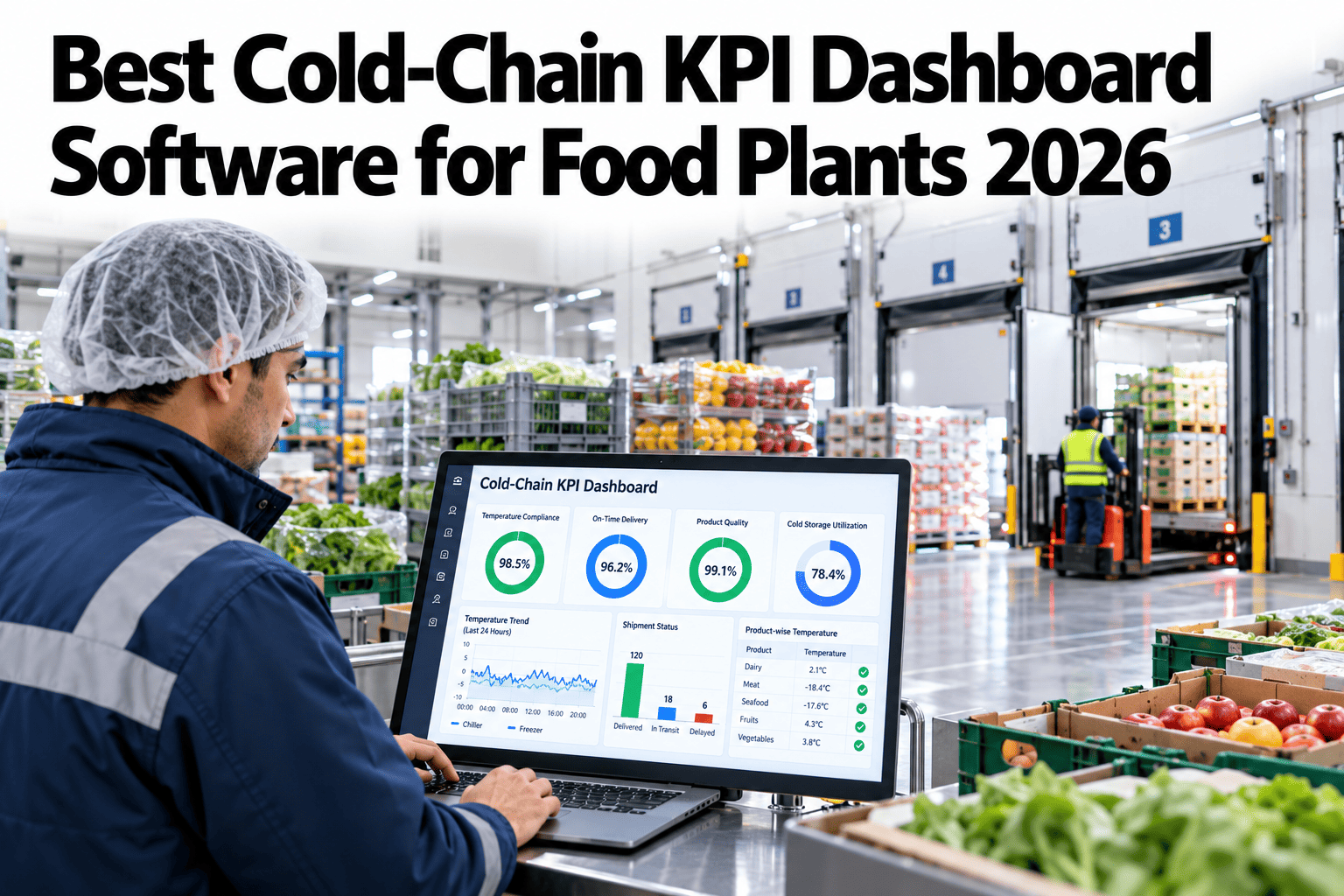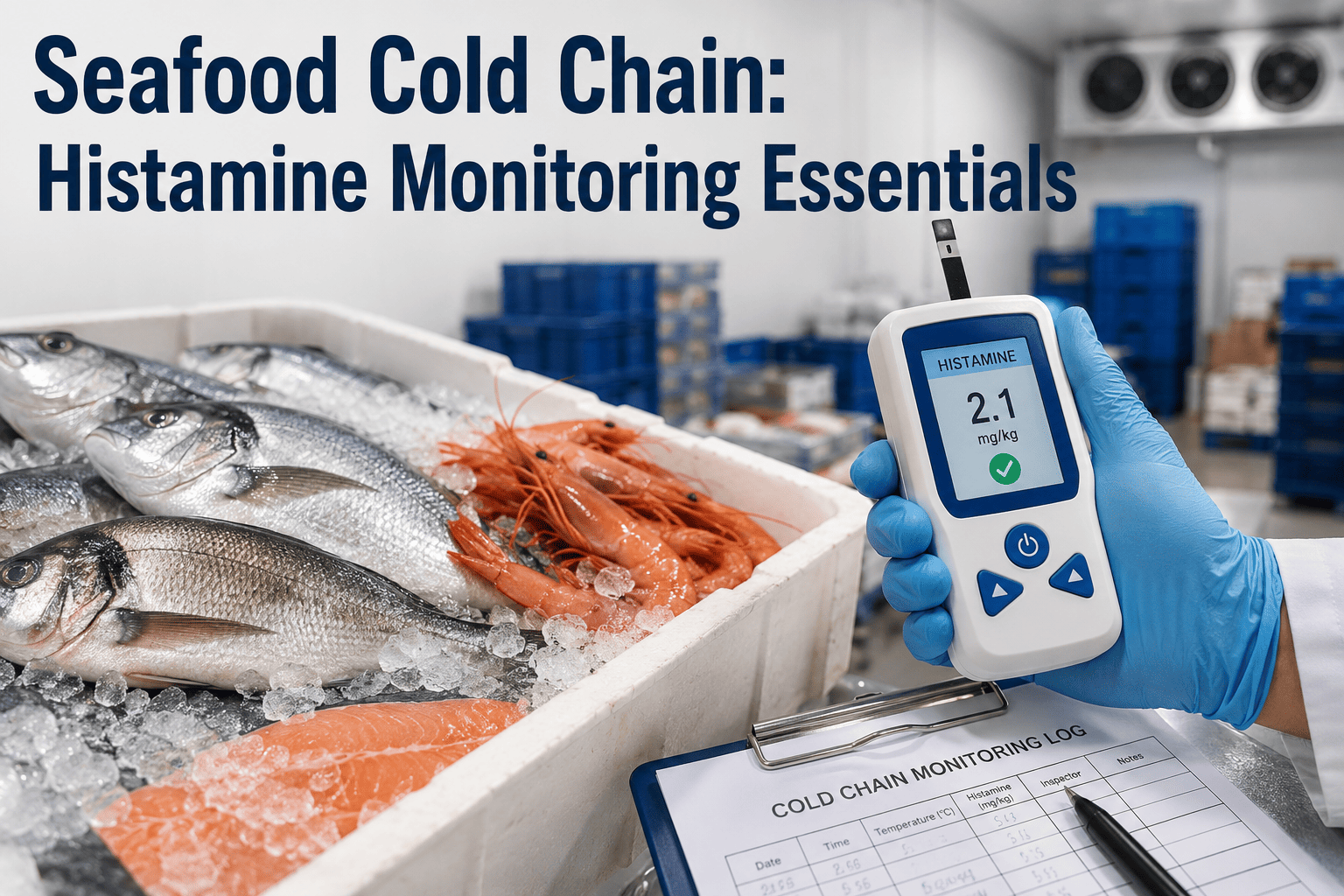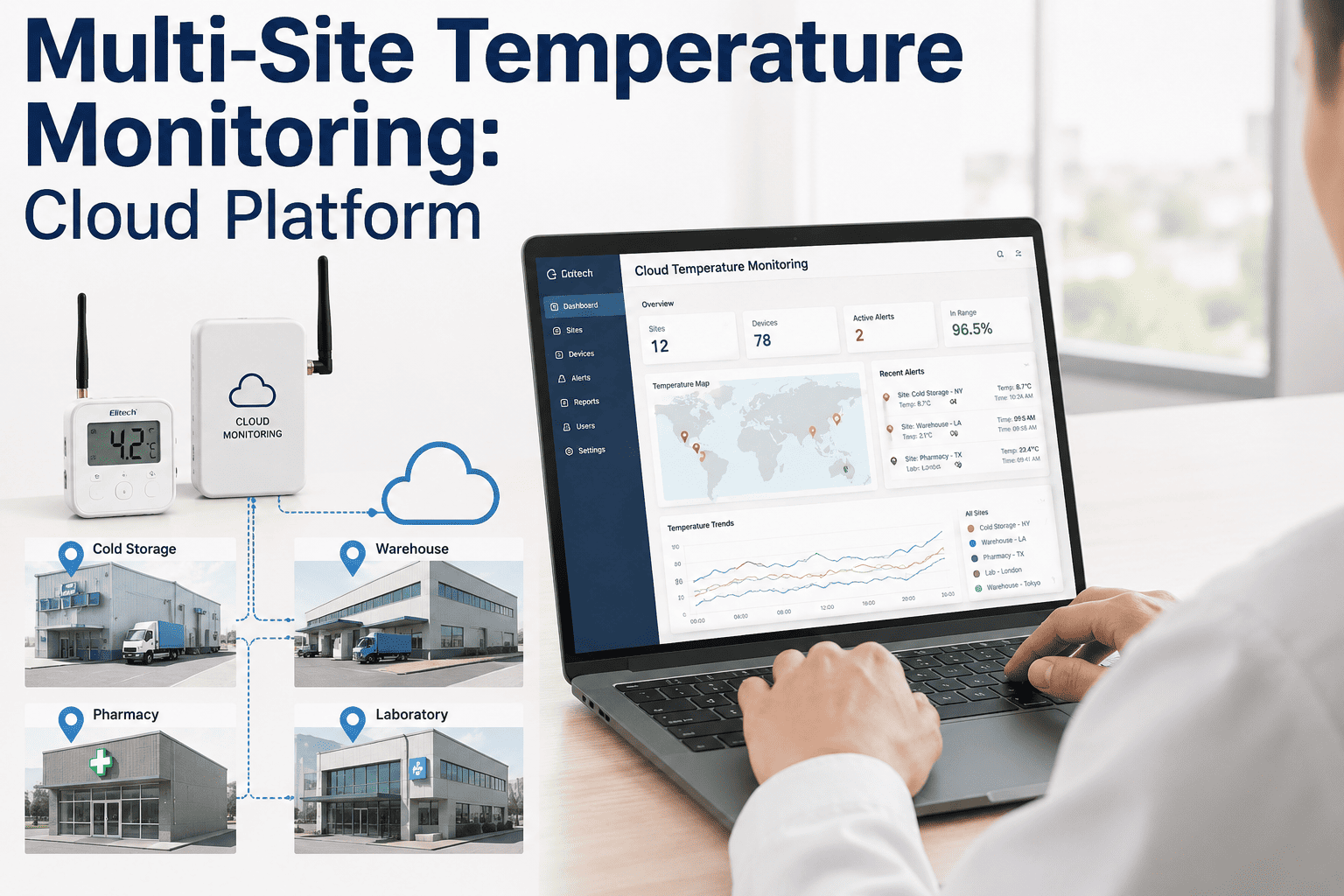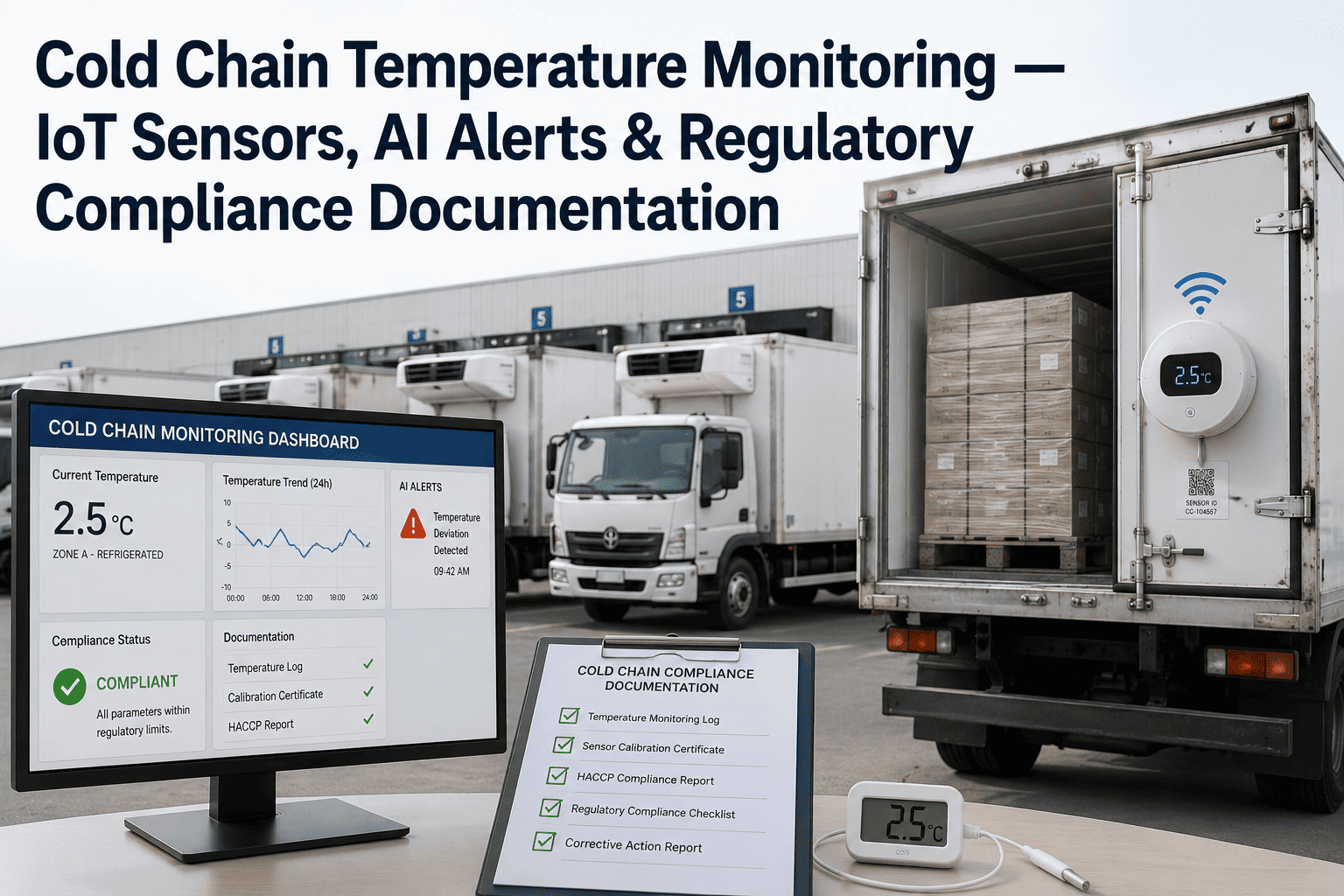
A cold chain is only as strong as its weakest handoff, and most food safety failures do not happen because any single facility mismanaged temperature control. They happen in the gaps between stages, when a pallet sits on a loading dock longer than expected, when a reefer trailer's door stays open during a delivery stop, or when a retail backroom cooler runs a few degrees warmer than its display case for reasons nobody notices until a spot check flags it. Farm-to-fork visibility means tracking temperature continuously across every one of those handoffs rather than relying on isolated checkpoints at each facility, and building that visibility has become one of the clearest ways food companies reduce spoilage loss and strengthen food safety compliance at the same time.
Cold Chain Monitoring: Building End-to-End Farm-to-Fork Visibility
Connecting temperature monitoring across harvest, processing, distribution, and retail into a single continuous record, with IoT sensor deployment, cloud dashboards, and real-time alerting built for food supply chains.
The Four Stages Where Cold Chain Visibility Typically Breaks
Most food companies have reasonably solid temperature monitoring inside their own four walls, whether that is a processing facility, a distribution center, or a retail store. The visibility gap almost always appears at the transitions between organizations, where responsibility for the product changes hands and monitoring systems that work well individually do not talk to each other. A farm-to-fork monitoring approach treats the entire journey as one continuous chain rather than four separate custody periods, which is the only way to actually catch a temperature excursion that happens during a handoff rather than at a monitored facility.
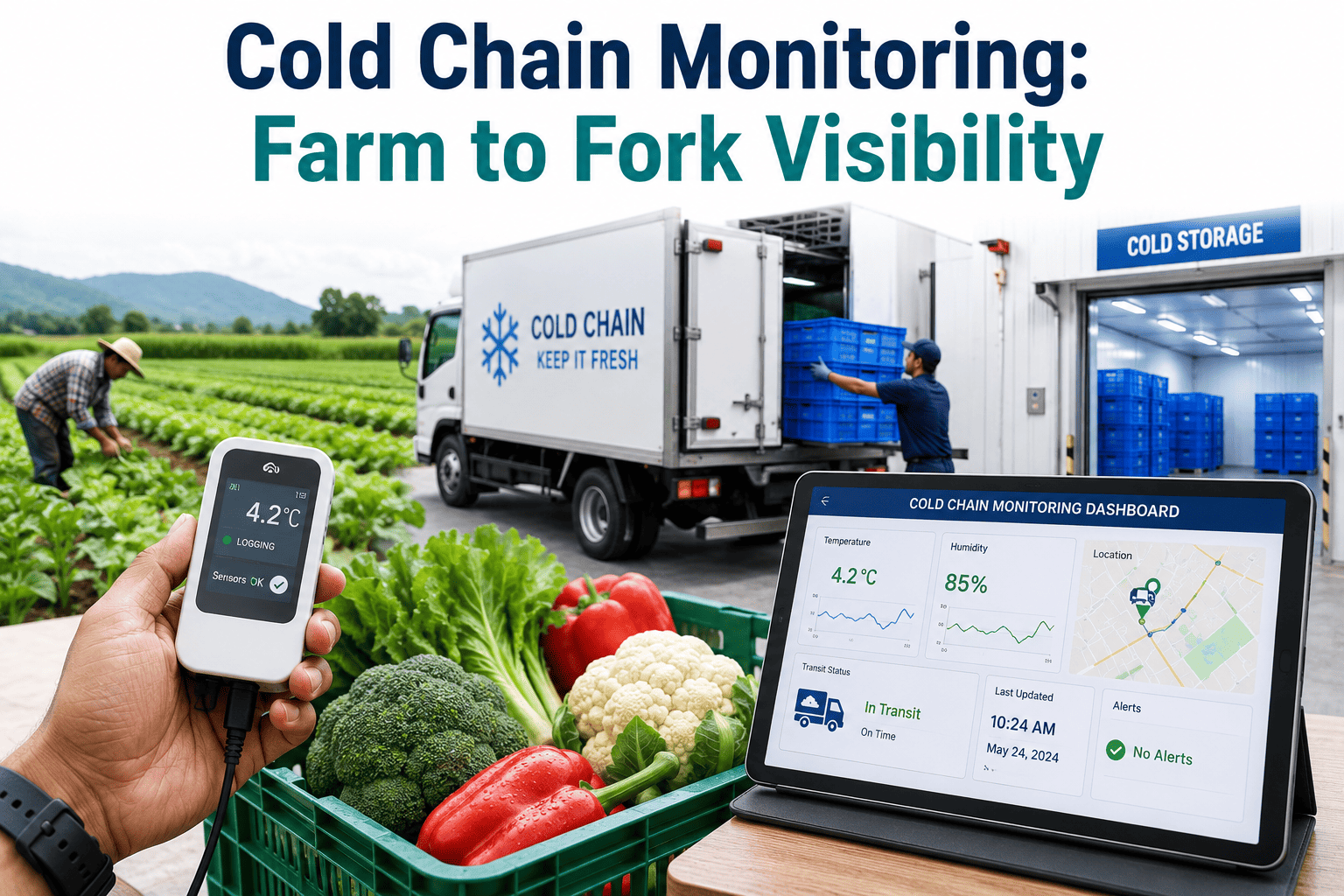
Harvest & Field Cooling
Initial temperature monitoring begins at harvest, tracking pre-cooling time and field-to-cooler transition speed, which sets the baseline quality trajectory for the entire chain.
Processing & Storage
Continuous sensor monitoring across processing lines and cold storage rooms tracks temperature stability during handling, packaging, and holding periods before shipment.
Distribution & Transport
GPS-linked temperature sensors on refrigerated trailers track conditions in transit, flagging door-open events and temperature drift during multi-stop delivery routes.
Retail & Final Handling
Backroom cooler and display case monitoring closes the loop, giving retailers and their suppliers a complete temperature record from harvest through the point of sale.
What Continuous Visibility Actually Prevents
The financial and safety case for farm-to-fork visibility comes down to catching excursions early enough to act, rather than discovering spoilage or a compliance gap after the product has already reached a customer. A temperature deviation caught within minutes at a distribution center can be corrected with a maintenance call or a rerouted shipment. The same deviation discovered days later during a customer complaint investigation has already cost the product, the customer relationship, and potentially triggered a broader recall review.
Building the Monitoring Layer: Sensors, Connectivity, and Dashboards
A farm-to-fork monitoring deployment combines several sensor and connectivity types across the chain, since a fixed cold storage room, a moving reefer trailer, and a retail display case each require a different monitoring approach even though the data ultimately needs to flow into the same platform. Book a Demo to see how sensor data from each stage of your supply chain would be unified into a single dashboard view.
| Chain Stage | Sensor Type | Connectivity | Alert Trigger |
|---|---|---|---|
| Field & Harvest | Portable temperature loggers | Bluetooth sync to gateway | Delayed pre-cooling time |
| Processing & Storage | Fixed wireless sensors | Wi-Fi or LPWAN | Room temperature drift, door-open duration |
| Distribution Transport | GPS-linked reefer sensors | Cellular | Temperature excursion, route delay, door-open event |
| Retail | Case and backroom sensors | Wi-Fi or LPWAN | Case temperature drift, compressor fault signal |
See Your Entire Cold Chain in One Continuous View
iFactory's cold chain platform unifies sensor data from harvest through retail into a single dashboard, with real-time alerting that catches temperature excursions at the exact stage and location where they happen.
From Raw Sensor Data to Actionable Alerts
Sensor deployment alone does not create visibility if the resulting data sits in disconnected systems that nobody reviews until an audit requires it. The platform layer that turns raw temperature readings into a usable operational tool is what actually delivers the farm-to-fork visibility benefit, and it needs to work for both real-time operational response and after-the-fact compliance documentation.
Real-Time Alerting
Threshold-based alerts route to the right team the moment an excursion begins, rather than surfacing during a scheduled review cycle.
Unified Chain-of-Custody Records
Every stage's temperature history is linked to the same lot or shipment identifier, creating one continuous record from harvest to retail.
Predictive Spoilage Risk Scoring
Cumulative time-temperature exposure across all stages feeds a shelf-life risk score, helping teams prioritize product before quality actually degrades.
Compliance-Ready Reporting
Automated report generation for HACCP and customer audit requirements pulls directly from the continuous monitoring record.
Cold Chain Monitoring — Frequently Asked Questions
Cross-company visibility typically works through a shared data platform where each participant in the chain, whether a grower, processor, distributor, or retailer, contributes sensor data tied to a common lot or shipment identifier without needing to give other parties direct access to their internal systems. Data sharing agreements define what level of detail each party can view, so a retailer might see aggregate temperature compliance for an incoming shipment without seeing a processor's full internal facility monitoring data. This structure lets a genuinely continuous chain-of-custody record exist even though no single company owns every stage of the supply chain.
Field and harvest-stage monitoring often relies on portable data loggers that record temperature locally and sync to a gateway device via Bluetooth once the product reaches a location with better connectivity, rather than requiring continuous cellular connection at the point of harvest itself. For farms with partial network coverage, LPWAN technologies such as LoRaWAN offer longer range and lower power consumption than standard Wi-Fi or cellular, making them a practical middle-ground option. The right choice depends on the specific farm's infrastructure and how quickly harvest-stage data needs to reach the broader monitoring platform.
GPS-linked reefer sensors with cellular connectivity typically transmit temperature and door-open event data at short intervals during transit, allowing an excursion alert to reach a dispatch or quality team within minutes of the threshold being crossed rather than only becoming visible when the driver returns and downloads a data logger. This near-real-time alerting is what allows a company to intervene, such as rerouting a delivery or adjusting a reefer unit remotely, before the product is fully compromised, rather than only learning about the issue after delivery.
Yes, this is one of the most valuable outputs of a truly continuous monitoring system, since shelf life is affected by cumulative time-temperature exposure rather than any single stage's conditions in isolation. A product that experienced a brief warm excursion during processing and another during transport has a different remaining shelf life than one that stayed within range at every stage, even if both arrive at retail showing an acceptable temperature at that final checkpoint. Predictive scoring models use the full time-temperature history to estimate remaining quality life and help teams prioritize distribution decisions accordingly.
Companies moving from checkpoint-only monitoring to continuous farm-to-fork visibility typically start with the highest-risk stage in their chain, often distribution transport or a specific processing bottleneck, before expanding sensor deployment and platform integration to additional stages over subsequent phases. This phased approach lets a team validate alerting accuracy and operational response processes on a smaller scope before committing to a full supply chain rollout. Book a demo to map out a phased rollout plan for your specific supply chain structure.
Turn Disconnected Checkpoints Into One Continuous Cold Chain Record
iFactory unifies sensor data across harvest, processing, distribution, and retail into a single platform with real-time alerting and compliance-ready reporting.