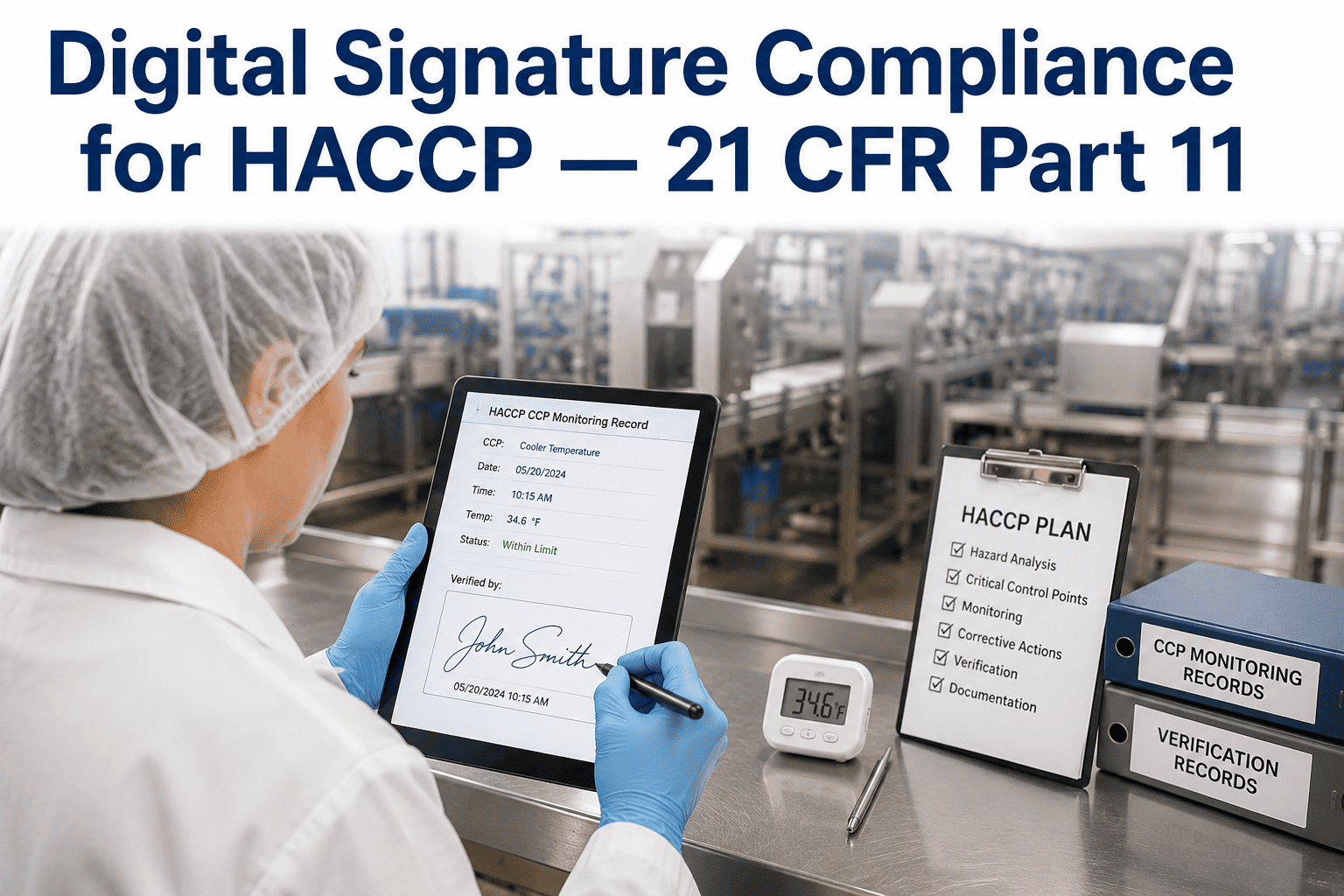
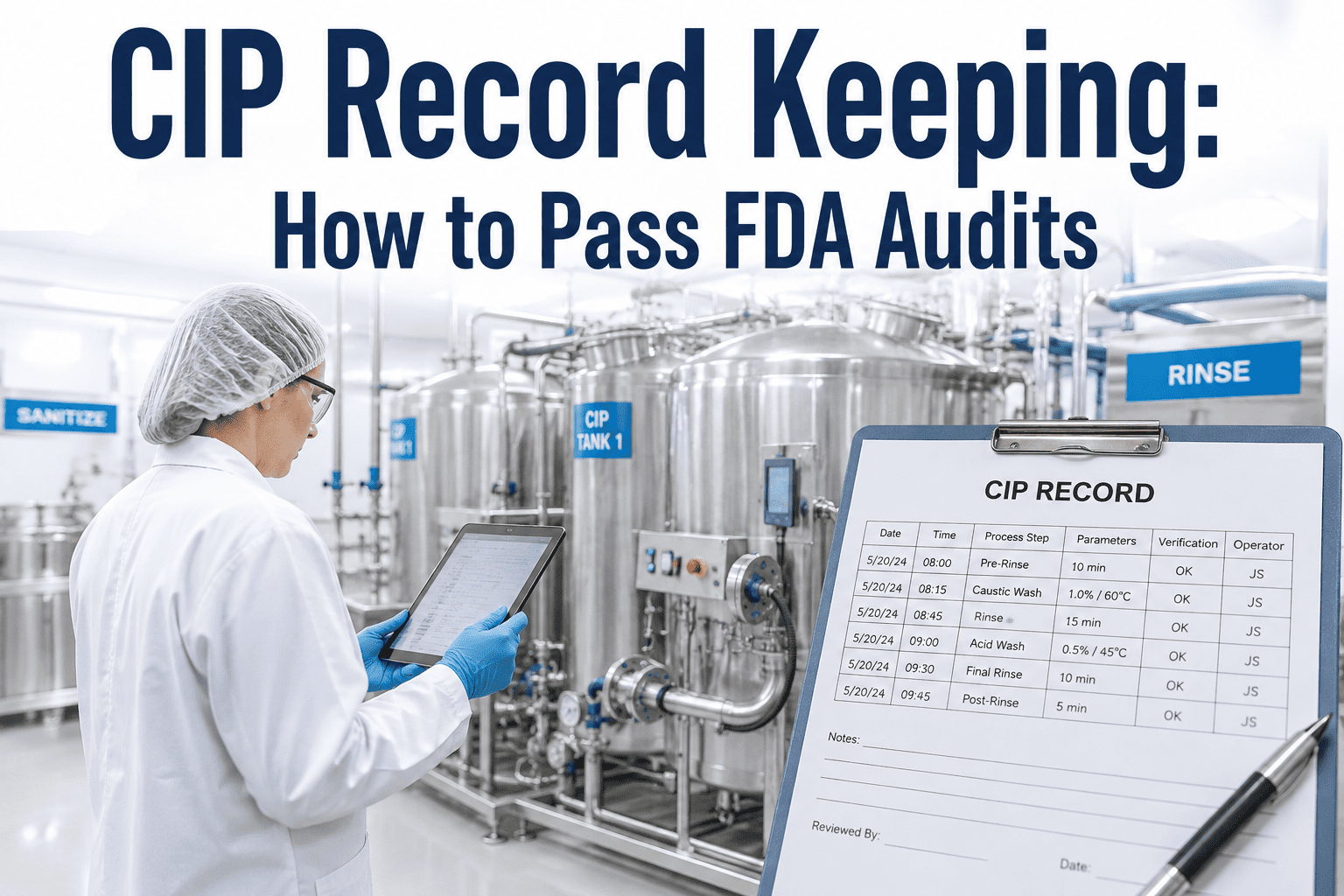
When an FDA investigator arrives at your cold storage or CCP monitoring station, the first thing they examine is not whether temperatures were in range — it is whether the electronic records proving it can be trusted. A timestamp that does not match the server clock, a reading entered by "admin" instead of a named operator, or an excursion record deleted rather than corrected: each is a data integrity failure that turns a passing audit into a Form 483 observation regardless of the actual temperatures. Regulatory assessments consistently find that 40 to 60% of food and pharmaceutical manufacturers have significant gaps in Part 11 compliance — primarily in audit trail completeness, electronic signature implementation, and system validation. This guide covers every requirement your temperature monitoring stack must satisfy, the ALCOA+ principles FDA applies, the seven gaps that generate 483 observations, and the technical controls that close them before inspection. Teams ready to map their system against Part 11 can start with a 30-minute demo.
Data Integrity for Electronic Temperature Records — 21 CFR Part 11 Compliance
ALCOA+ requirements, audit trail specifications, electronic signature validation, and the seven gaps that generate FDA 483 observations on temperature records. A complete implementation guide for food manufacturers building tamper-proof, inspection-ready electronic documentation.
Any food manufacturer that captures temperature records electronically to satisfy an FDA requirement — HACCP CCP logs, cold storage monitoring, pasteuriser hold-time records, receiving dock checks, or ingredient storage. If the digital record replaces a paper log, Part 11 applies to it.
What 21 CFR Part 11 Actually Requires
Part 11 is not a software certification — it is nine technical and procedural controls that together make an electronic record trustworthy enough to substitute for a signed paper log. Four surface in virtually every FDA temperature record inspection.
System Validation
The system that captures, stores, and retrieves temperature records must be validated for its intended use — IQ, OQ, and documented evidence of accuracy.
Audit Trail
A secure, computer-generated, time-stamped trail must record the date, time, and user identity for every entry, modification, or deletion. Read-only. Changes must not obscure the previous value.
Access Controls
Unique credentials for every authorised individual. Shared accounts and generic logins such as "admin" are non-compliant regardless of the data underneath them.
Electronic Signatures
Signatures on excursion acknowledgments and CCP reviews must be linked to the specific record with the signer's full name, timestamp, and meaning of the signature.
The ALCOA+ Framework — Nine Attributes FDA Applies to Every Record
Inspectors apply ALCOA+ — nine attributes that define a trustworthy GMP record — to every temperature data point they review. A record that passes all nine is inspection-ready. A record that fails any one can invalidate the entire HACCP evidence package for that lot.
The Seven Gaps That Generate FDA 483 Observations
FDA Form 483 observations for data integrity and Part 11 violations have increased 35% over the past three years. These are the findings that repeat across food and pharmaceutical inspections — every gap below has been cited in Warning Letters involving temperature records specifically.
Disabled or Incomplete Audit Trails
The audit trail is switched off to save storage, or captures only manual entries. Audit trails must track creation, modification, or deletion of data and all actions at the record or system level including access attempts. Missing trail entries on a CCP log can invalidate the entire HACCP evidence package for that lot.
Shared User Accounts
Multiple operators under a single account means no entry can be attributed to a specific individual. Inspectors often find that generic logins are shared, making it impossible to attribute actions. Every record entered under a shared account fails the Attributable requirement immediately.
System Clock Desynchronisation
The sensor timestamps at 14:32, the gateway at 14:35, the server at 14:29. Three clocks, one record that cannot prove contemporaneous capture. NTP synchronisation across every layer is a Part 11 prerequisite, not an IT nicety.
Deletion of Out-of-Spec Readings
An excursion reading is deleted rather than investigated with an explanation. Selective retention is one of the most serious data integrity violations and grounds for product recall. The correct response is documentation, root cause, and corrective action — with the original reading preserved.
Printout Treated as the Original Record
The monitoring programme retains only the paper printout and discards the electronic original. The electronic record — not a printout — must be retained with its metadata for the full retention period.
Unvalidated Manual Override
Operators can enter manual temperature corrections without a system-enforced reason code or approval chain. Any system that allows a change without capturing who, when, and why fails Part 11 regardless of whether the original reading is still visible.
No Audit Trail Review Process
The audit trail exists but nobody reviews it. Lack of regular audit trail review compromises the Attributable and Traceable requirements. FDA expects the quality unit to periodically review audit trails as part of their oversight function, not just generate them.
What FDA Inspectors Actually Look At First
Based on published 483 trends, investigators typically spend their first thirty minutes on three areas: the audit trail configuration to confirm it captures all event types, the user access log to verify no shared credentials, and a sample of out-of-spec readings to confirm they were retained and investigated. If those three checks pass, the rest of the inspection is usually routine. If any one fails, the investigation typically expands to the full data lifecycle.
The Technical Controls Checklist
Before your next FDA inspection, every item on this list must be in place for every electronic temperature monitoring system in scope. A single unchecked item is a potential 483 observation.
An inspection-ready temperature record is an automated record — not a discipline problem.
The most common Part 11 gaps are not fraud — they are systems that let operators work around controls because nothing enforces them. iFactory enforces every ALCOA+ requirement in software: unique credentials, immutable audit trails, NTP-synchronised timestamps, mandatory reason codes on corrections, and auto-generated compliance reports. Live in 12 weeks. A 30-minute demo shows the audit trail and e-signature controls on your temperature data.
Frequently Asked Questions
Does 21 CFR Part 11 apply to all our temperature sensors, or only certain ones?
Part 11 applies to electronic records used to satisfy an FDA regulatory requirement — not every digital thermometer on site. The critical question is whether a specific sensor's record is used to demonstrate HACCP CCP compliance, FSMA preventive control verification, or GMP cold-storage requirements. If yes, the electronic record is in scope. If the record is informational only and never used in a regulatory submission or inspection, it may fall outside scope. When in doubt, treat it as in scope — remediation cost is far lower than a 483 observation. Contact iFactory Support to scope your monitoring points.
What does a compliant electronic signature look like on a temperature excursion record?
A Part 11-compliant signature must include three components embedded in the record: the signer's full legal name, the date and time of signing, and the meaning of the signature — for example "Reviewed and accepted." It must be cryptographically linked to the specific record so it cannot be copied to another document. A typed name in a text field without system-enforced authentication is not compliant. The system must require the operator to re-authenticate at the point of signing, separate from their session login, to meet the §11.200 requirement. Book a demo to see how iFactory implements this.
How long must electronic temperature records be retained?
Retention requirements depend on the predicate rule. Under 21 CFR Part 111 (dietary supplements) the requirement is 2 years beyond shelf life or 2 years beyond date of manufacture, whichever is longer. FSMA preventive controls records require a minimum of 2 years. HACCP records under 21 CFR Part 123 (seafood) require 1 year for perishables, 2 years for shelf-stable products. Critical point: electronic records must remain accessible and retrievable in a human-readable format throughout the entire retention period — including through software version changes, vendor changes, or system migrations.
What happens if temperature readings were deleted before we implemented proper controls?
Start with a documented gap assessment that identifies the scope, date range, and impact on lot decisions. If the affected records supported CCP decisions or lot releases, those lots may require voluntary risk assessment. Going forward, implement technical controls that make deletion impossible without a documented deviation. FDA's standard expectation is that facilities identify gaps proactively, document them transparently, and implement sustainable fixes rather than discovering them during inspection. Contact iFactory Support for a gap assessment template.
What is the difference between "Part 11 compliant" and "Part 11 ready" when evaluating software?
Part 11 compliant means the entire system — hardware, software, procedures, and validation documentation — meets Part 11 requirements in your specific environment. Part 11 ready means the software has the features needed, but compliance is the facility's responsibility through validation, SOPs, and training. No software vendor can make a facility compliant. When evaluating platforms, ask for the vendor's Part 11 feature checklist and their validation support documentation, then build your own IQ/OQ on top of it. Book a demo to review iFactory's Part 11 feature checklist and validation package.
Score your temperature records against ALCOA+ before the next inspection does.
Unique credentials, immutable audit trails, NTP-synchronised timestamps, mandatory reason codes, electronic signatures, and continuous retention — all nine ALCOA+ attributes, all nine technical controls, one gap assessment session. A 30-minute demo maps your temperature monitoring stack against every Part 11 requirement and identifies the gaps before an FDA investigator does. Sessions available this week.