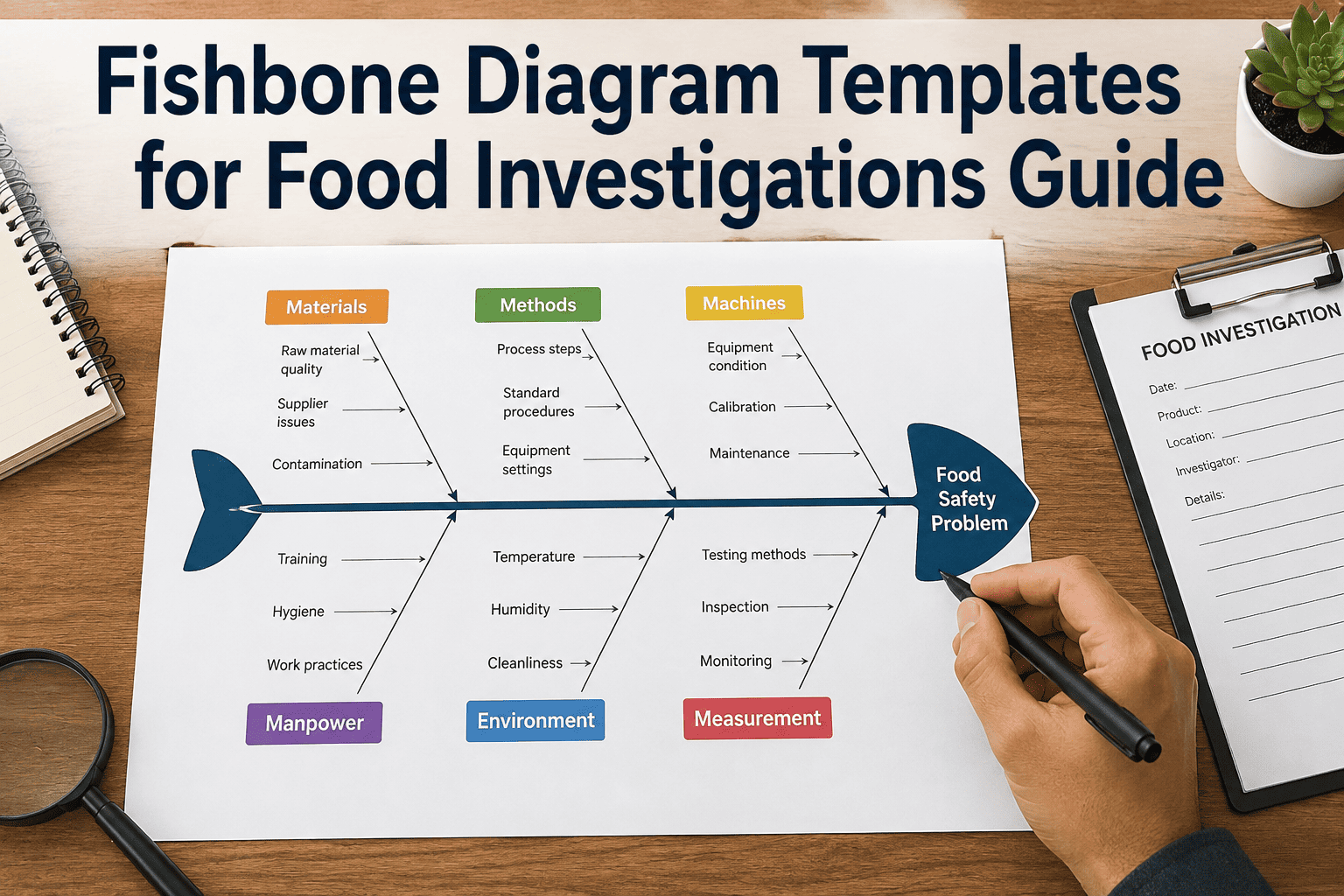
A generic fishbone diagram template — the standard six bones of man, machine, method, material, measurement, and environment borrowed straight from automotive or general manufacturing quality training — misses most of what actually causes failures on a food production line. Sanitation cycles, allergen cross-contact risk, cold chain integrity, and regulatory hold status don't map cleanly onto categories built for a machine shop, and a team forcing a food safety investigation into that generic structure ends up with branches that don't prompt the right questions. A fishbone template built with food-specific sub-categories under each of the six bones prompts investigators toward the causes that actually matter in this industry, which is why iFactory's reliability engineering team builds sector-specific templates rather than handing food plants the same generic diagram used everywhere else.
Food & Beverage · Investigation Templates
Fishbone Diagram Templates Built for Food Plant Investigations
The standard 6M fishbone structure — man, machine, method, material, measurement, environment — rebuilt with food-specific sub-categories so investigations actually surface sanitation, allergen, and cold chain causes instead of forcing them into categories that don't fit.
Why Generic Templates Fall Short
The 6M Structure Is Right — The Sub-Categories Usually Aren't
The six-category fishbone structure — sometimes called the 6M model — has survived for decades because the underlying logic is sound: most manufacturing failures trace back to some combination of people, equipment, procedure, materials, measurement systems, and environmental conditions. That top-level structure works perfectly well in food and beverage manufacturing exactly as it does anywhere else. The problem shows up one level down, in the specific sub-categories a team is prompted to consider under each bone, and that's where a template built for general discrete manufacturing leaves real gaps for a food plant.
Under "Method," a generic template prompts questions about work instructions and process sequencing, but rarely prompts a specific check of sanitation and CIP cycle timing, even though a shortened or skipped clean-in-place cycle is one of the more common and consequential method failures in food production. Under "Material," a generic template asks about raw material specification and supplier quality, but doesn't specifically prompt allergen cross-contact risk from shared equipment or ingredient substitution during a supply shortage — both frequent root causes in food manufacturing that a generic prompt won't surface unless someone happens to think of it unprompted. Under "Environment," temperature and humidity get a general mention, but cold chain integrity across a specific transfer point — the exact moment product moves between a chiller and a production line, for instance — needs a much more targeted prompt than "check the environment" provides.
None of this means the 6M model itself needs to change. It means the sub-categories underneath each bone need to be built for the industry running the investigation, and a template that does this consistently produces measurably more thorough investigations than one that leaves investigators to remember the food-specific angles on their own, under time pressure, during an active production issue.
Food-Specific Sub-Categories
What Belongs Under Each of the Six Bones
Man
Sanitation procedure training currency, allergen handling certification, fatigue during extended sanitation shifts, and cross-training gaps on food-safety-critical control points.
Machine
CIP system nozzle coverage and pressure, metal detector and X-ray calibration drift, filler and capper wear affecting seal integrity, and refrigeration unit performance at product transfer points.
Method
CIP cycle time and chemical concentration adherence, changeover sequencing between allergen and non-allergen runs, HACCP critical control point monitoring frequency, and batch record completion timing.
Material
Allergen cross-contact risk from shared lines or equipment, supplier ingredient substitution without change notification, packaging material seal compatibility, and raw material cold chain handling before receipt.
Measurement
Thermometer and probe calibration currency, metal detection sensitivity verification frequency, moisture and water activity testing accuracy, and net weight check-weigher calibration drift.
Environment
Cold chain integrity at transfer points between storage and production, ambient humidity affecting product texture or shelf stability, pest control program gaps, and sanitation zone segregation between raw and ready-to-eat areas.
See the Template Filled Out Live
Watch a Food-Specific Fishbone Built From a Real Investigation
iFactory's reliability engineering team will walk through a completed fishbone diagram for an actual food plant failure, showing how the food-specific sub-categories surfaced a cause a generic template would likely have missed.
Generic vs. Food-Specific
What Changes When the Template Fits the Industry
| Bone | Generic Prompt | Food-Specific Prompt |
|---|
| Method | "Check work instructions" | "Check CIP cycle time and chemical concentration logs" |
| Material | "Check supplier quality" | "Check allergen cross-contact and ingredient substitution history" |
| Environment | "Check temperature and humidity" | "Check cold chain integrity at the specific transfer point" |
| Measurement | "Check instrument calibration" | "Check metal detector sensitivity and check-weigher drift specifically" |
Building One Correctly
Step-by-Step: Running a Food-Specific Fishbone Session
01
State the Effect Precisely
Write the observed problem at the head of the fish in specific, measurable terms — "12% increase in metal detector rejects on Line 3" rather than "quality issue on Line 3."
02
Assemble a Cross-Functional Team
Include operators, maintenance technicians, and a quality or food safety representative, since food-specific causes often live in the intersection between these roles rather than inside any single one.
03
Work Through Each Bone With the Food-Specific Prompts
Use the sub-category prompts as a checklist under each of the six bones rather than relying on the team to generate food-specific angles from memory under time pressure.
04
Flag Candidate Causes for Evidence Review
Mark which branches have supporting evidence already available and which need additional data collection before the team can confirm or rule them out.
05
Narrow to the Most Likely Branch and Drill Down
Once the fishbone has surfaced the plausible cause categories, run a focused 5 Whys investigation on the branch with the strongest supporting evidence rather than trying to fully resolve every branch simultaneously.
What a Good Template Delivers
The Practical Difference for Food Plant Teams
Fewer Missed Food Safety Causes
Sub-category prompts specific to sanitation, allergen risk, and cold chain integrity catch causes that a generic checklist relies on someone remembering unprompted.
Faster Investigation Sessions
Teams spend less time deciding what questions to ask under each bone and more time actually gathering evidence, since the food-specific prompts are already built into the template.
More Consistent Investigations Across Shifts
A standardized template means an investigation run by the night shift covers the same ground as one run by the day shift, rather than depending on which team happened to be more thorough.
Better Handoff Into 5 Whys or CAPA Tracking
A completed fishbone with evidence flags gives the next stage of investigation a clear starting branch instead of an unstructured list of possible causes to sort through from scratch.
Common Questions
Frequently Asked Questions
Do we still need the standard six categories, or can we add our own?
The six standard categories — man, machine, method, material, measurement, environment — remain the right top-level structure for the large majority of food manufacturing investigations, since they map cleanly onto the actual sources of process variation in a plant. What benefits from customization is the sub-category prompts underneath each bone, which should reflect food-specific risks rather than staying generic. Some plants do add a seventh bone for management or systemic factors, and
iFactory's reliability engineering team can help decide whether that fits your specific investigation needs.
How is a fishbone diagram different from a 5 Whys investigation?
A fishbone diagram is a divergent tool — it's meant to broadly survey many possible cause categories before narrowing down, which makes it well suited to the early stage of an investigation when the likely cause isn't yet clear. A 5 Whys investigation is a convergent tool — it drills sequentially deep into one specific causal path once you've identified which branch is worth pursuing. Most thorough food plant investigations use a fishbone first to map the field, then run 5 Whys on the most evidence-supported branch that the fishbone surfaced.
Who should be in the room when building a food-specific fishbone?
The most useful sessions include a cross-functional mix — an operator who runs the affected equipment daily, a maintenance technician who understands the mechanical failure modes, and a quality or food safety representative who can speak to sanitation, allergen, and regulatory considerations that the other two roles may not have visibility into. Investigations run by a single department alone tend to over-index on causes within that department's expertise and under-explore the others.
Can the fishbone template be customized further for our specific product category?
Yes — a dairy plant, a bakery, and a ready-to-eat meat processor each carry somewhat different food safety risk profiles, and the sub-category prompts can be tailored further to reflect the specific hazards and critical control points relevant to your product category rather than stopping at a general food-and-beverage template. This level of customization tends to pay off most for plants running frequent investigations across a narrow, specialized product line.
How do completed fishbone diagrams connect to our broader CAPA and audit records?
When a fishbone diagram is built inside a structured investigation platform rather than on a physical whiteboard, the completed diagram, the evidence attached to each branch, and the corrective actions that follow from it stay linked in a single searchable record that can be pulled directly for an internal audit or a regulatory review. This connection is what turns a one-time investigation exercise into a reusable piece of your plant's documented food safety history.
Booking a demo is the fastest way to see how that record structure works in practice.
Investigate With a Template Built for Food Plants
Get Fishbone Templates With Food-Specific Sub-Categories Built In
iFactory's reliability platform gives your team fishbone diagram templates pre-built with sanitation, allergen, cold chain, and food-safety-specific prompts under each of the six bones, connected directly to evidence tracking and closed-loop CAPA.