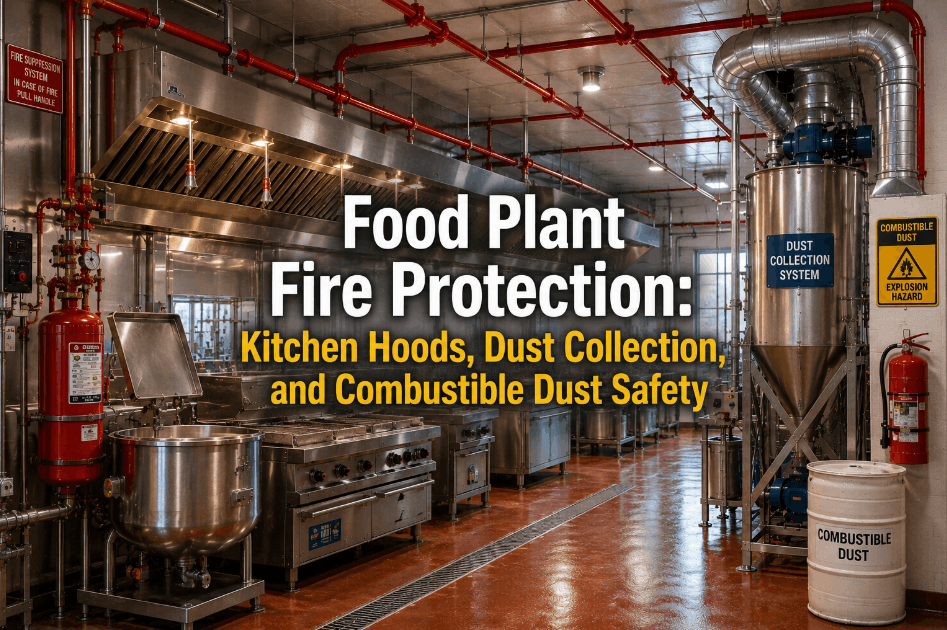
In the volatile environment of food manufacturing, fire isn't just a safety hazard—it's a catastrophic threat to business continuity and personnel safety. From the grease-laden exhausts of industrial kitchen hoods to the explosive potential of airborne sugar, flour, and starch dust, food plants house unique combustible risks that traditional fire protection systems often overlook. iFactory's AI-Driven Compliance Tracking platform transforms passive fire suppression into an intelligent, proactive defense network—tracking grease accumulation levels, dust concentration trajectories, and suppression system readiness in real time. Our platform ensures that fire hazards are detected and neutralized weeks before they trigger an NFPA violation or a facility-wide emergency. Book a Demo to see how leading food plants maintain 100% fire safety readiness with automated compliance tracking.
FIRE PROTECTION · COMBUSTIBLE DUST COMPLIANCE
Secure Your Facility Against Explosive Dust and Grease Fires.
Discover how iFactory's compliance platform links every fire suppression node and dust collection sensor to an immutable safety ledger, ensuring 100% NFPA 652 readiness and instant hazard containment.
The "Invisible" Fuse: Why Traditional Fire Inspections Fail in Food Processing
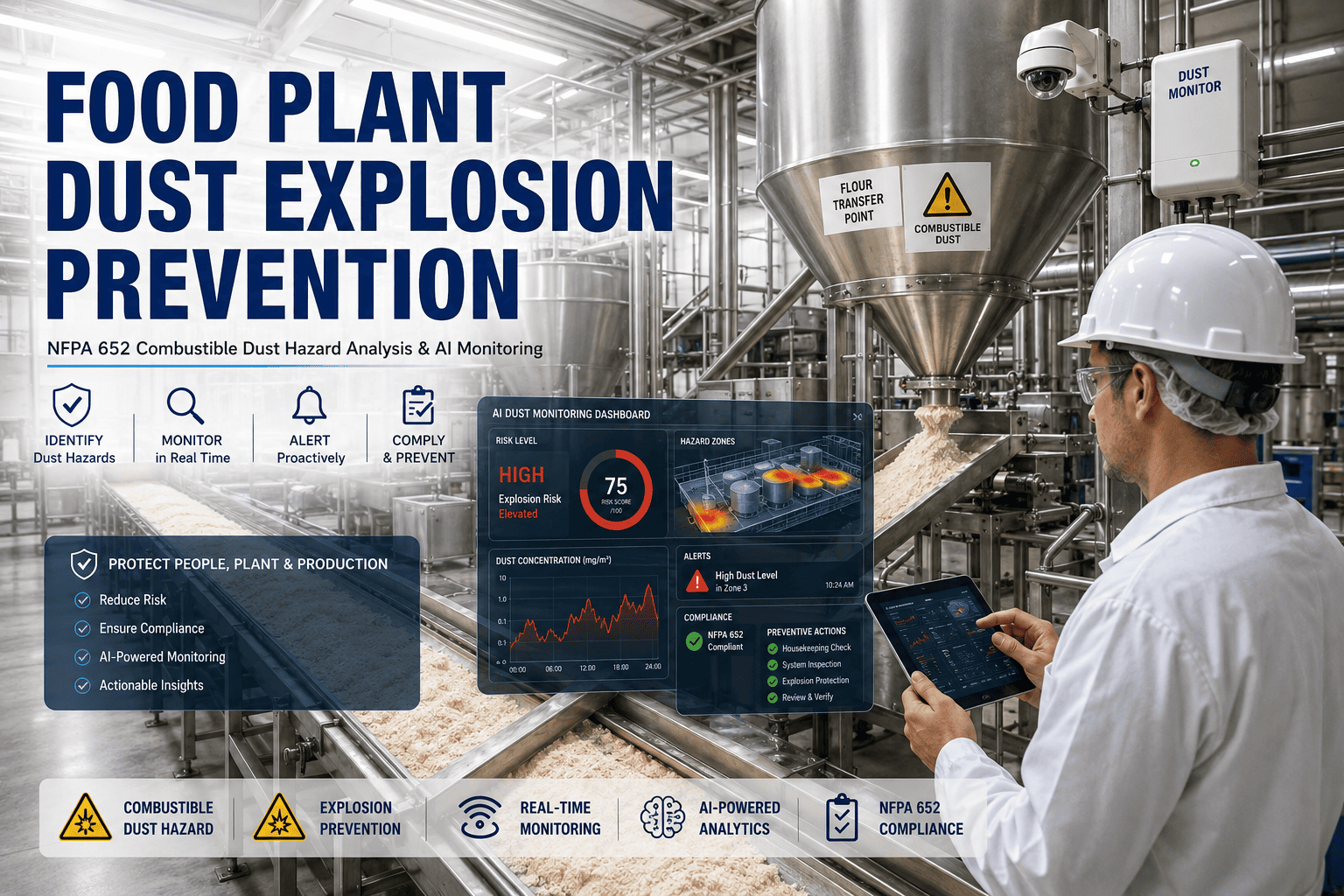
Traditional fire safety in food plants relies on semi-annual manual inspections of fire extinguishers and kitchen hoods. However, in high-volume production, grease buildup in an exhaust duct can reach combustible levels in just weeks, and explosive dust (sugar, flour, starch) can accumulate on overhead surfaces between scheduled cleaning shifts. This "inspection gap" is where most industrial fires originate. NFPA 652 now mandates continuous Dust Hazard Analysis (DHA) for food facilities. AI-driven compliance tracking eliminates these structural vulnerabilities by creating a continuous "Safety Audit Trail," updated in real-time by thermal sensors, air quality monitors, and IoT-enabled suppression nodes.
How AI-Driven Fire Protection Operates at Production Speed
The iFactory platform uses a multi-layered sensor mesh to monitor the "Fire Vitals" of your facility. In industrial kitchens, ultrasonic sensors track grease thickness in hoods. In dry-processing zones, laser particulate counters monitor airborne dust concentrations, while differential pressure sensors track baghouse filter loading in dust collection systems. AI models continuously analyze these inputs to predict "Ignition Windows"—ensuring that your facility stays safe without disrupting production cycles. Book a Demo to see our real-time fire risk visualization engine.
Kitchen Hood Grease Analytics
Monitoring grease accumulation levels in real-time using IoT sensors. AI identifies when buildup exceeds NFPA 96 thresholds, automatically scheduling professional cleaning before flashover risks materialize.
Combustible Dust Hazard Analysis
Continuous tracking of airborne dust particulate sizes (flour, sugar, starch). Smart contracts automatically flag "Explosive Concentration" events, triggering secondary dust extraction or process shutdowns instantly.
Suppression System Readiness
Tracking the pressure and status of wet-chemical and CO2 suppression tanks. iFactory provides real-time alerts for tamper events or pressure drops, ensuring systems are 100% ready for deployment.
Dust Collection Filter Monitoring
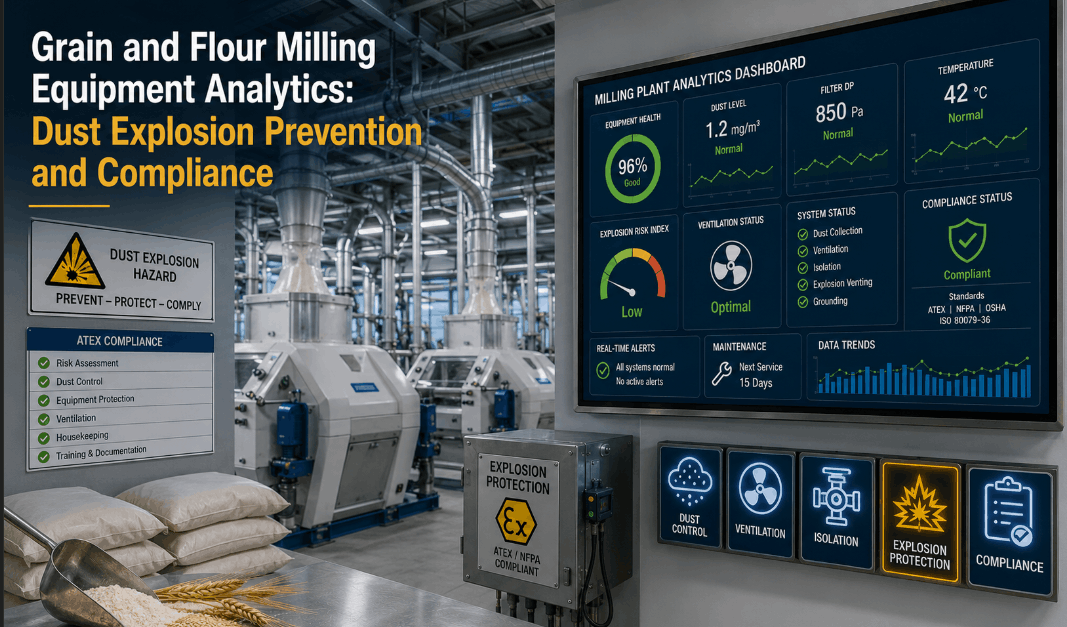
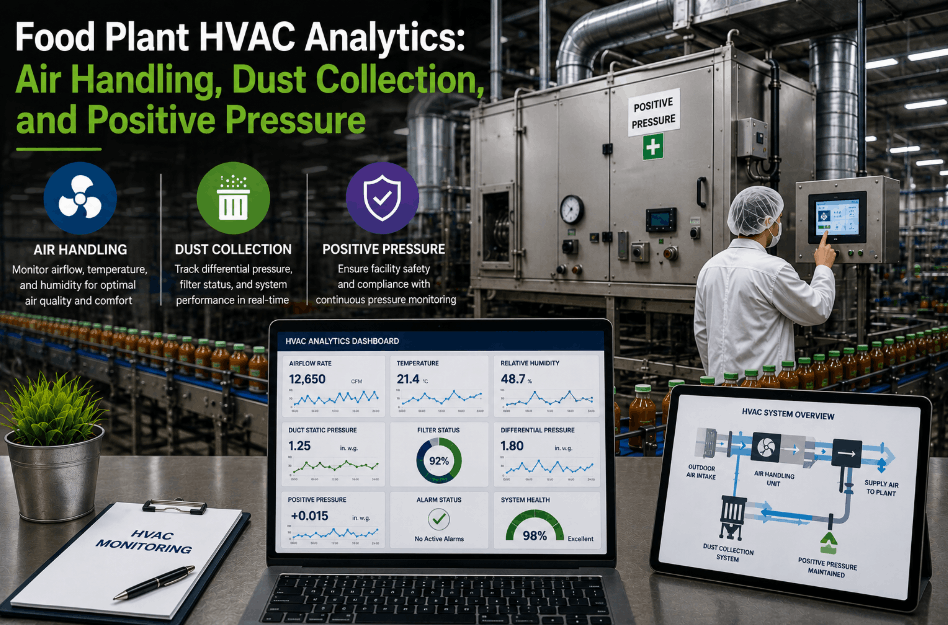
Tracking "Delta-P" across baghouse and cyclone filters. AI predicts filter failure or "bridging" that leads to sparking, ensuring that dust collection remains a safety asset rather than an explosion hazard.
Quantifying Fire Risk: Manual Inspections vs. AI-Driven Compliance Tracking
The transition to automated fire protection is a critical step in NFPA 652 compliance and overall facility resilience. Moving from reactive response to proactive prevention reduces fire-related downtime by 85% and optimizes insurance premiums. Understanding the comparative metrics is essential for modern safety and compliance managers. Book a Demo to see our fire safety ROI dashboards.
| Safety Dimension | Manual/NFPA Checklist | iFactory AI-Driven Tracking | Operational Impact |
|---|---|---|---|
| Dust Accumulation Tracking | Visual Inspection (Daily/Weekly) | Laser Particulate Monitoring | Zero Explosive Dust Build-up |
| Kitchen Hood Grease Status | Quarterly Inspection | IoT Ultrasonic Monitoring | Eliminates Duct Flash Fires |
| Suppression Ready-Status | Annual Tagging | 24/7 IoT Pressure Sensing | Guaranteed System Response |
| NFPA 652 Audit Preparation | Weeks of Record Gathering | Instant Digital Audit Trail | 100% Audit Readiness |
| Explosion Isolation Valves | Manual Functional Tests | AI-Driven Status Verification | Instant Hazard Containment |
| Sprinkler Flow Monitoring | Mechanical Alarms (Local) | Digital Tamper & Flow Analytics | 99.9% System Reliability |
| Compliance Documentation | Manual Paper Logs | Auto-Generated OSHA/NFPA Logs | Zero Document Lag |
Precision Hazard Containment: Isolating Fires Before They Scale
In a traditional fire event, the response time is often limited by human detection. AI-driven compliance tracking enables "Sub-Second Containment" by identifying thermal anomalies or particulate surges that indicate a pre-ignition state. By integrating with explosion isolation valves and kitchen suppression systems, iFactory ensures that a localized incident—such as a fryer fire or a dust surge in a mixer—is contained within its zone, preventing the facility-wide fires that lead to total plant loss. Book a Demo to see our hazard containment simulators in action.
Compliance Automation: Meeting NFPA 652 and OSHA Safety Standards
The Occupational Safety and Health Administration (OSHA) and the National Fire Protection Association (NFPA) have introduced stringent requirements for "Dust Hazard Analysis" (DHA). iFactory's platform is purpose-built to automate these technical logs. By integrating thermal imaging with our AI engine, we ensure that your facility is "Audit-Ready" every second of every day, providing tamper-proof evidence of cleaning cycles and system tests. Book a Demo to see our NFPA compliance dashboard.
Automated Dust Hazard Analysis (DHA)
iFactory automatically captures airborne dust concentrations and cleaning timestamps. This creates a permanent, unalterable record that satisfies NFPA 652 requirements for continuous hazard monitoring.
Kitchen Hood NFPA 96 Records
Our platform logs grease accumulation levels and automated cleaning cycle triggers. This ensures that industrial kitchens remain in strict compliance with fire-code mandates for grease management.
Digital Fire Alarm Ledger
Replace manual fire alarm test logs with a digital ledger that records every detector trip, battery test, and system fault in real-time, providing instant verification for insurance audits.
Suppression System Inventory
Track the serial numbers and inspection history of every fire extinguisher and suppression tank via QR/RFID, ensuring that no safety asset falls out of compliance during rotation.
Predictive Safety: Using AI-Driven Analytics to Forecast Ignition Risks
Fire protection is no longer just about suppression; it's about predicting the conditions that lead to ignition. iFactory uses machine learning to correlate process data (e.g., grinder heat, fryer oil temperature) with dust concentration levels to predict "Ignition Windows." This allows production teams to adjust speeds or schedule cleaning cycles *before* a fire starts. When combined with infrared thermal mapping, this "Safety Score" becomes a verifiable metric for operational risk management.
AI-Driven Risk Forecasting: Identifying Fire Hazards Before They Scale
The ultimate ROI of a fire safety-AI integration is the ability to forecast hazards before they materialize. By analyzing patterns across thousands of sensor entries, iFactory identifies "Risk Signatures"—such as a fryer duct's recurring grease spikes or a dust collector's differential pressure drift that indicates a pending explosion hazard. Book a Demo to see our predictive fire risk dashboards.
Grease Flashover Prediction
AI models analyze historical grease buildup and cooking temperatures to rank hood zones by "Flashover Probability." This allows cleaning teams to focus on the highest-risk hoods first.
Dust Explosion Risk Mapping
By correlating airborne dust counts with machine vibration and heat, AI predicts the "Explosive Potential" of each zone, enabling smarter cleaning rotation and faster hazard intervention.
Suppression Pressure Decay
The platform identifies subtle, long-term pressure leaks in suppression cylinders, allowing maintenance to recharge tanks before they fall below the legal NFPA operating pressure.
Thermal Drift Analytics
AI constantly monitors thermal images for "Hot Spots" in motors and gearboxes located in dry zones, flagging potential ignition sources for combustible dust before they spark.
The Financial Case: ROI of AI-Driven Fire Protection Compliance
The business case for fire protection in food manufacturing is built on asset preservation and insurance optimization. While a single avoided dust explosion can save $50M+ in facility loss, the daily savings from reduced manual inspection hours and optimized insurance rates provide a compelling 12-18 month payback period. For large-scale mills and industrial bakeries, the data veracity provided by blockchain-backed logs is the ultimate risk mitigation tool.
Implementation Roadmap: Integrating Fire Safety into Your Production Workflow
Deploying AI-driven fire protection is a strategic progression from reactive response to predictive prevention. iFactory's phased model ensures immediate safety gains by focusing on highest-risk nodes (Kitchens and Dry Zones) first.
Critical Zone Risk Assessment & Node Deployment
Deployment of IoT grease sensors in kitchen hoods and laser particulate counters in dry processing zones. Establishing real-time compliance alerting and digital audit log foundations for instant audit readiness.
- Grease accumulation baseline established
- Particulate concentration sensors activated
- Instant SMS/Email safety alerts
Suppression System & Valve Integration
Connecting existing suppression tanks and explosion isolation valves to the platform. AI starts learning pressure decay patterns and verifies system ready-status 24/7/365.
- Suppression pressure IoT integration
- Isolation valve status tracking
- Automated system test logging
Process-Linked Thermal Intelligence
Integrating thermal imaging and process data to identify ignition windows. The platform correlates equipment heat with dust levels to provide real-time "Ignition Probability" scores.
- Infrared thermal mapping of motors
- Ignition window predictive modeling
- Process-linked safety dashboards
Automated NFPA/OSHA Digital Twin
Full ecosystem synchronization. The platform generates an automated, unalterable Digital Twin of all fire safety events, satisfying 100% of NFPA 652 and OSHA record-keeping mandates.
- Autonomous DHA record generation
- One-click insurance audit reporting
- Plant-wide Predictive Safety Score
NFPA COMPLIANCE · EXPLOSION PREVENTION · TOTAL READINESS
Secure Your Plant with iFactory Fire Protection Compliance.
From kitchen hood grease to combustible sugar dust—iFactory's compliance platform ensures that your fire risks are monitored, your audits are instant, and your facility is safe.
Frequently Asked Questions
What is AI-driven fire protection in food manufacturing?
It is the use of IoT sensors and machine learning to monitor fire hazards—like grease buildup and combustible dust—in real-time, providing predictive alerts and automated compliance records before a fire or explosion occurs.
Why is combustible dust such a high risk in food plants?
Finely ground sugar, flour, and starch are highly explosive when suspended in air. A localized spark can trigger a primary explosion, which then kicks up more dust, causing a massive, facility-wide secondary explosion.
How does iFactory help with NFPA 652 compliance?
NFPA 652 requires a Dust Hazard Analysis (DHA). iFactory automates the record-keeping for this requirement by continuously logging dust levels and cleaning cycles in an immutable format that is ready for regulatory inspection.
Can the system monitor older kitchen hood suppression systems?
Yes. We use "Overlay" IoT sensors to monitor the tank pressure and discharge status of existing systems (like Ansul or Kidde) without requiring a full system replacement.
How does grease analytics prevent kitchen fires?
Most kitchen fires occur when accumulated grease in the exhaust duct ignites. Our sensors monitor grease thickness and identify when it reaches critical NFPA 96 levels, ensuring cleaning is done *before* ignition can occur.
Does the system integrate with my building's main fire alarm?
Yes. iFactory can pull data from existing fire panels (Notifier, Simplex, etc.) to digitize your alarm ledger, providing a single source of truth for all safety events and test records.
What is a "Dust Hazard Analysis" (DHA)?
A DHA is a systematic review to identify and evaluate potential fire and explosion hazards from combustible dust. iFactory's platform provides the continuous data logging necessary to prove you are managing these risks daily.
What is the typical ROI for fire safety analytics?
Most plants achieve full ROI within 12-18 months through reduced manual inspection labor, lower insurance premiums, and the prevention of unplanned safety-related production halts.
FIRE SAFETY LEADERSHIP · NFPA 652 READINESS
Stop Reacting to Alarms. Start Predicting Hazards.
Join global food leaders who are transforming their fire safety from a liability into a predictive advantage. Secure your entire facility on a single, data-driven safety map today.