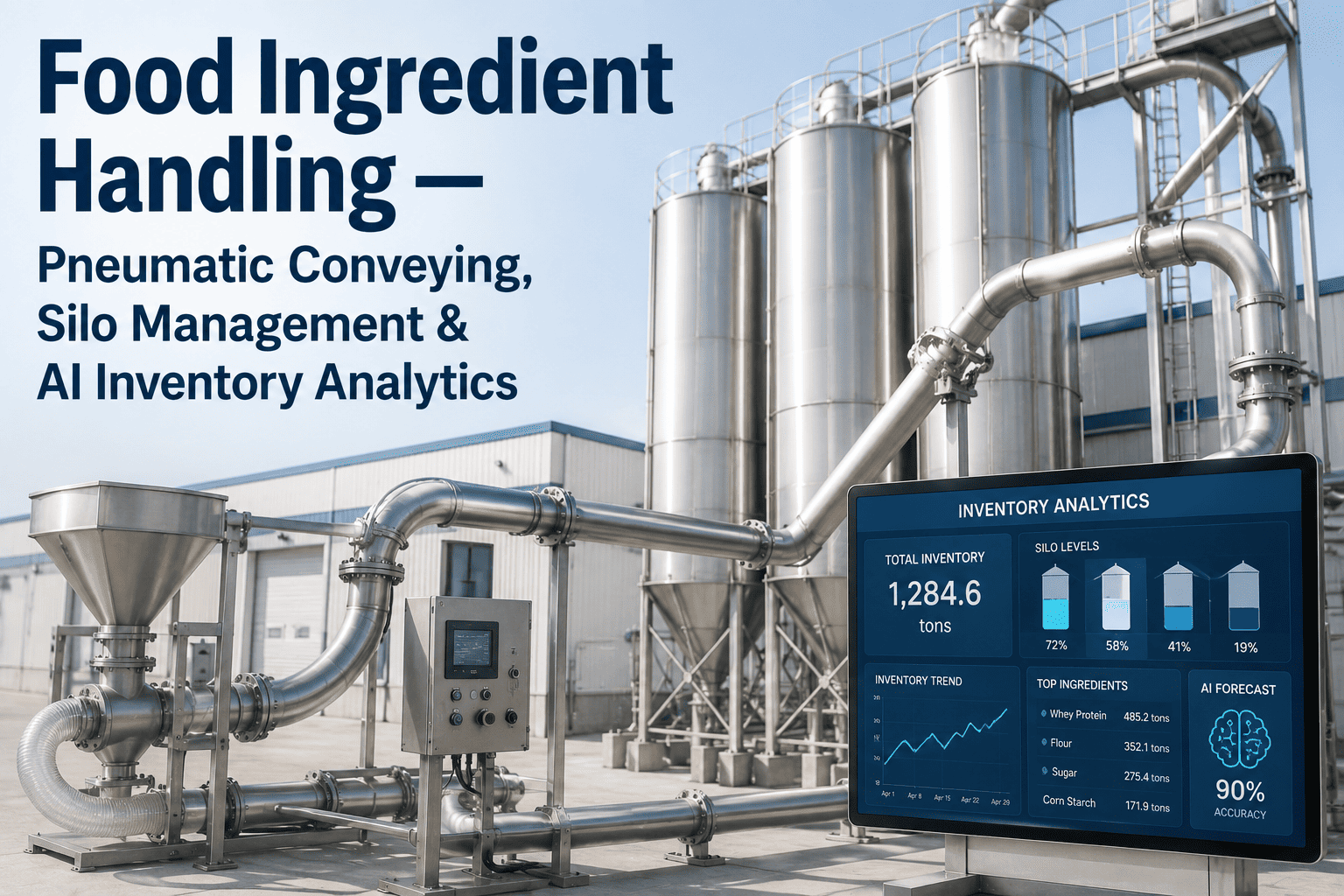
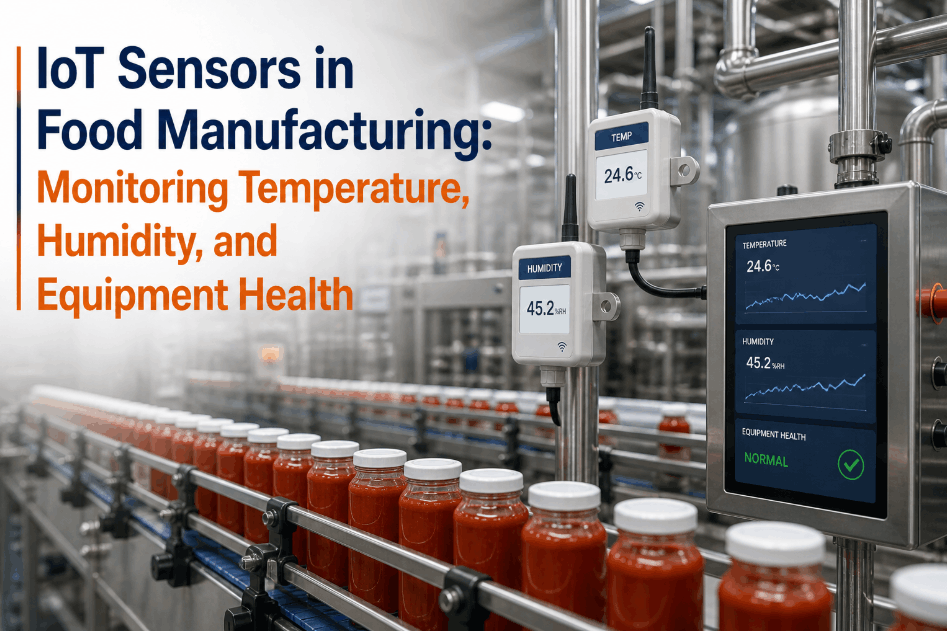
A flour silo running empty during second shift does not just stop the mixer. It stops the oven schedule behind the mixer, delays the packaging line waiting for baked product, pushes the truck loading window past its departure slot, and turns a $200 ingredient shortage into a $15,000 production loss before anyone finishes the phone call to the supplier. The same dynamic plays out in liquid sugar tanks, oil storage vessels, dairy ingredient silos, and flavoring vats across every food and beverage manufacturing facility that still relies on manual dipstick checks, scheduled visual inspections, or the operator's best guess about when to reorder. IoT level sensors eliminate the guessing by providing continuous, real-time measurement of every silo and tank in the facility — powder, liquid, or viscous — and feeding that data into automated inventory dashboards, low-level alerts, and reorder triggers that prevent stockouts before they reach the production floor. The question is not whether continuous level monitoring pays for itself — it does, usually within the first avoided stockout event — but which sensor technology is right for each material type, vessel geometry, process temperature range, and sanitary requirement in your specific facility. iFactory integrates IoT level sensor data with production scheduling and inventory management to create a single view of ingredient availability across the plant — explore the integration with a Book a Demo.
You Cannot Schedule Production Around an Ingredient Level You Cannot See
iFactory connects IoT level sensors across every silo, tank, and vessel in your facility to a real-time ingredient inventory dashboard — with automated low-stock alerts, consumption trend tracking, and reorder triggers that prevent the production stops caused by running out of what you need most.
Not Every Sensor Works with Every Ingredient — Matching Technology to Material Is the First Decision
Food manufacturing facilities store three fundamentally different material types — dry powders and granules, clean liquids, and viscous or semi-solid materials — and each type presents different measurement challenges that determine which sensor technology will produce accurate, reliable readings over time without excessive maintenance, false readings, sanitary compliance problems, or the gradual accuracy drift that causes inventory discrepancies between what the sensor reports and what is actually in the vessel.
Dry Powders and Granules
Flour, sugar, starch, powdered milk, cocoa, spice blends, baking mixes, animal feed ingredients, salt, and granulated additives.
Measurement Challenges
Dust generation that interferes with ultrasonic signals and coats sensor faces. Uneven surface profiles caused by angle of repose and cone-shaped fill patterns that make single-point measurement unreliable. Material buildup on vessel walls and sensor probes that causes false high readings over time. Bridging and ratholing in cohesive powders that create air pockets below an apparently full surface.
Recommended Technology
80 GHz radar (non-contact, unaffected by dust, narrow beam penetrates uneven surfaces). Guided wave radar for narrow or obstructed vessels. Load cells as a weight-based alternative when surface measurement is unreliable due to extreme bridging.
Clean Liquids
Water, liquid sugar, vegetable oil, fruit juice concentrates, vinegar, alcohol, milk and dairy liquids, liquid flavorings, and cleaning solutions.
Measurement Challenges
Foam formation on the surface during filling or agitation that reflects ultrasonic signals prematurely and produces false high readings. Condensation inside the vessel headspace that accumulates on sensor faces. Temperature fluctuations that change liquid density and affect hydrostatic pressure readings. Turbulence during filling and draining operations that creates unstable surface conditions.
Recommended Technology
Radar (non-contact, reads through foam and condensation). Hydrostatic pressure sensors for simple, cost-effective continuous measurement in stable tanks. Ultrasonic for clean, foam-free liquids in ambient-temperature tanks where budget is the primary constraint.
Viscous and Semi-Solid Materials
Chocolate, peanut butter, tomato paste, honey, syrups, fruit purees, cream cheese, mayonnaise, dough, and high-viscosity sauces.
Measurement Challenges
Material coating and buildup on any probe or sensor surface that contacts the product, causing progressive measurement drift. Highly variable dielectric properties that complicate capacitive measurement. Non-Newtonian flow behavior that means the material does not drain cleanly — residual product on vessel walls inflates level readings after partial draining. Stringent CIP requirements because residual material in sensor cavities creates sanitary risks.
Recommended Technology
Non-contact radar (no product contact, no buildup, no cleaning required on the sensor itself). Load cells for vessels where the material's physical properties make any surface-based measurement unreliable. Guided wave radar only with food-grade, cleanable probe materials and only in applications where the viscosity allows clean drainage from the probe surface.
Five Sensor Technologies Side by Side — Accuracy, Cost, Maintenance, and Food-Grade Suitability
Each sensor technology has specific strengths and limitations that determine where it performs best in a food manufacturing environment. The choice is not about which technology is objectively superior — it is about which technology delivers accurate, reliable, low-maintenance measurement for the specific combination of material type, vessel geometry, temperature conditions, and sanitary requirements in each application. The table below compares the five most common level measurement technologies across the criteria that matter most for ingredient silo and tank applications in food and beverage manufacturing: measurement accuracy, material compatibility across powders, liquids and viscous materials, maintenance requirements, sanitary design availability for food-grade environments, and relative cost including both initial investment and ongoing maintenance.
| Criteria | 80 GHz Radar | Ultrasonic | Guided Wave Radar | Capacitive | Load Cells |
|---|---|---|---|---|---|
| Contact Type | Non-contact | Non-contact | Contact (probe) | Contact (probe) | Non-contact (vessel) |
| Best for Powders | Excellent | Poor (dust interference) | Good | Moderate | Excellent |
| Best for Liquids | Excellent | Good (foam-free only) | Excellent | Good | Excellent |
| Best for Viscous | Excellent | Moderate | Poor (coating risk) | Poor (coating risk) | Excellent |
| Accuracy | High (2-3mm) | Moderate (5-10mm) | High (2-5mm) | Moderate | High (0.1% FS) |
| Dust and Vapor Tolerance | Unaffected | Affected | Unaffected | Unaffected | Unaffected |
| CIP Compatibility | High (no product contact) | High (no product contact) | Requires food-grade probe | Requires food-grade probe | High (external mount) |
| Maintenance Need | Very low | Low to moderate | Moderate (probe cleaning) | Moderate (probe cleaning) | Low (calibration periodic) |
| Relative Cost | Higher initial | Lower initial | Moderate | Lower initial | Higher initial |
Not Sure Which Sensor Fits Your Silos? We Will Map It for You.
Tell us your vessel types, materials stored, and sanitary requirements — iFactory recommends the right sensor technology for each application and shows how the data integrates into your production dashboard.
From Sensor Reading to Reorder Trigger — the Data Flow That Prevents Stockouts
An IoT level sensor on its own produces a number — a distance measurement or a weight reading that tells you how much material is in one vessel at one moment. Integrated into a connected monitoring platform like iFactory, that number becomes an ingredient availability signal that drives automatic reorder alerts, consumption trend analysis, delivery scheduling coordination, production planning decisions, and financial inventory valuation — converting a static measurement into a dynamic operational intelligence layer that touches procurement, production, quality, and finance simultaneously. The data flow from sensor to action follows five stages, and the operational value compounds at each stage because each successive layer adds context that the previous layer could not provide alone.
The level sensor measures the material surface (radar, ultrasonic) or vessel weight (load cell) at a defined interval — typically every 30 seconds to 5 minutes depending on how fast the material level changes during production. The raw measurement is converted to a percentage of vessel capacity and a volumetric or weight quantity.
An IoT gateway aggregates readings from multiple sensors across the facility and transmits the data to the cloud platform or on-premises server via cellular, Wi-Fi, or Ethernet connectivity. Each reading carries a timestamp, vessel ID, and material type identifier for accurate routing into the inventory database.
The iFactory dashboard displays real-time levels for every vessel on a single screen — color-coded by status (adequate, approaching reorder point, critical low). Operators, production planners, and procurement staff all see the same data simultaneously, eliminating the information lag that causes reactive ordering.
When any vessel drops below its configured reorder threshold, the system sends automatic notifications to procurement and production teams via the channel they monitor — SMS, email, dashboard notification, or integration with the facility's ERP purchasing workflow. Alerts include the current level, the estimated time to depletion based on recent consumption rate, and the supplier lead time for that ingredient.
Historical consumption data builds trend models that predict when each ingredient will need replenishment — not based on a fixed calendar schedule, but on actual production consumption patterns. The system identifies consumption anomalies (unexpectedly high usage that may indicate waste or recipe deviation) and optimizes reorder quantities to minimize both stockout risk and excess inventory holding cost.
Common Food Ingredients Matched to Recommended Sensor Technology
The grid below maps the most common food manufacturing ingredients to the sensor technology that delivers the most reliable measurement for that specific material, accounting for the material's physical properties (density, dust generation, viscosity, dielectric constant), typical vessel type and geometry (tall narrow silos, squat wide tanks, conical hoppers, heated vessels), and sanitary requirements (CIP compatibility, FDA-compliant materials, 3A certification). Use it as a starting point for specifying your facility's sensor configuration — each recommendation reflects the technology that balances measurement accuracy, maintenance burden, and food-safety compliance for that particular ingredient and storage scenario.
Flour and Starch
Tall silos, pneumatic fill80 GHz RadarUnaffected by dust; narrow beam handles uneven surfaceGranulated Sugar
Silos, day bins80 GHz Radar or Load CellsLow dust; both options reliable for free-flowing granulesLiquid Sugar and Syrups
Heated tanksRadar or HydrostaticRadar handles vapor; hydrostatic is cost-effective for stable tanksVegetable Oil
Bulk tanksRadarNon-contact avoids contamination risk in edible oil storageMilk and Dairy Liquids
CIP-rated tanksRadar (3A sanitary rated)Non-contact, CIP compatible, handles foam from agitationChocolate and Pastes
Heated vesselsNon-contact Radar or Load CellsViscous material coats any contact probe, making non-contact essentialFruit Juice Concentrate
Chilled tanksRadar or Guided WaveLow viscosity allows probe use; radar preferred for multi-product tanksSpice Blends and Seasonings
Small silos, hoppersCapacitive or RadarCapacitive cost-effective for small vessels; radar for dusty blendsWhat Changes When You Always Know What Is in Every Vessel
The operational value of continuous IoT level monitoring extends far beyond avoiding empty-silo emergencies — though preventing even one stockout-driven production stop typically pays for the entire sensor deployment within the first quarter. When ingredient levels are visible in real time across the entire facility, accessible to procurement, production planning, quality assurance, and financial teams simultaneously on the same dashboard, the ripple effects touch every operational function that depends on knowing what raw materials are available, how fast they are being consumed, and when they need to be replenished.
Without Continuous Monitoring
Procurement orders ingredients on a fixed calendar schedule regardless of actual consumption, leading to either overstocking (increased holding cost and spoilage risk) or understocking (emergency orders at premium freight rates). Operators discover low levels mid-shift when the mixer stops feeding, and the production schedule absorbs the disruption as unplanned downtime.
With iFactory IoT Level Integration
Procurement receives automated reorder alerts with estimated depletion time and supplier lead time built in, so orders are placed based on actual consumption rate — not a calendar guess. Production planners see which ingredients are approaching low thresholds and can sequence batches to use available materials first, avoiding partial batches that waste both ingredients and machine time.
Without Continuous Monitoring
Inventory counts are performed weekly or monthly by operators climbing silos or using dipsticks — a process that is inaccurate (plus or minus 15% to 20% in powder silos), time-consuming (2 to 4 hours for a full plant count), and unsafe (confined space entry, working at height). The resulting inventory data is a snapshot that is already stale by the time it reaches the ERP system.
With iFactory IoT Level Integration
Continuous sensor readings provide perpetual inventory accuracy within 2% to 3%, eliminating manual counts entirely for silo and tank contents. The data feeds directly into the ERP inventory module in real time, so purchasing, production, and finance all work from the same current numbers. Safety risk from manual measurement in confined spaces and at height is eliminated completely.
We had three production stops in one month because flour silos ran empty during overnight shifts when nobody was checking levels. Each stop cost between $8,000 and $14,000 in lost production time, wasted partially mixed batches, and emergency ingredient deliveries. We installed 80 GHz radar sensors on all six silos, connected them to iFactory, and set reorder alerts at 25% capacity. That was eleven months ago, and we have not had a single ingredient stockout since. The sensors paid for themselves in the first six weeks.
Frequently Asked Questions
Q: Do IoT level sensors require any modification to existing silos or tanks for installation?
Most non-contact radar and ultrasonic sensors mount on existing flanged or threaded openings at the top of the vessel — typically a 1.5-inch to 3-inch process connection that is already present on standard food-grade silos and tanks. No vessel modification, welding, or structural changes are required in the majority of installations. For vessels without a suitable top opening, bracket-mounted options and external load cells that attach to the vessel's support legs provide alternatives that avoid any vessel penetration entirely. The IoT gateway that collects sensor data requires power and either a cellular antenna or network connection, both of which are typically installed in the control room or electrical panel area rather than on the vessel itself. Contact Support Contact to discuss your vessel specifications.
Q: How does iFactory handle sensor data from ingredients that are measured in different units — kilograms for powders, liters for liquids?
Each vessel is configured in the platform with its geometry (diameter, height, cone angle for conical hoppers), its material density or specific gravity, and the unit of measurement preferred by the production and procurement teams. The raw sensor reading (distance to surface or weight) is automatically converted to the configured unit — kilograms, metric tons, liters, gallons, or percentage of vessel capacity — so that every team sees the inventory in the units they work with. Recipe management systems that specify ingredients by weight can pull directly from the sensor-derived weight data, while procurement systems that order by volume can use the volumetric conversion. Set up your unit configuration during a Book a Demo session.
Q: What happens if a sensor fails or produces an incorrect reading — does the system flag the anomaly?
The platform monitors sensor health continuously and flags several anomaly types: complete signal loss (sensor offline), readings outside the vessel's physical range (indicating a hardware fault or misalignment), sudden level changes that do not correspond to a fill or draw event (indicating a false reading from buildup, bridging, or condensation interference), and readings that deviate significantly from the consumption trend predicted by recent production data. Flagged readings are quarantined from the inventory calculation and a maintenance alert is generated so the sensor can be inspected and recalibrated before the anomaly affects procurement or production decisions.
Q: Can the system integrate with our existing ERP for automated purchase order generation?
Yes. iFactory integrates with standard food manufacturing ERP systems to pass real-time inventory levels and automated reorder signals directly into the purchasing workflow. When a vessel drops below its configured reorder point, the system can generate a draft purchase order with the correct ingredient, quantity (calculated from the difference between current level and target fill level), preferred supplier, and expected delivery date based on configured supplier lead times. The purchase order is routed to the procurement team for review and approval, or in facilities that have authorized fully automated reordering for specific high-turnover ingredients, released directly to the supplier. Discuss ERP integration options through Support Contact.
Q: Are the sensors and the platform compliant with food safety regulations like FSMA, HACCP, and SQF?
The sensors specified for food manufacturing applications are available in food-grade configurations with 3A sanitary certification, FDA-compliant materials of construction, and IP67 or IP69K ingress protection ratings suitable for washdown and CIP environments. The iFactory platform supports food safety compliance by providing continuous, timestamped, audit-ready records of ingredient receipt (detected as refill events when the level rises), inventory levels at any point in time, and ingredient consumption patterns that support FIFO verification and lot traceability. These records are maintained automatically, eliminating the manual documentation that most HACCP and SQF auditors scrutinize for consistency and completeness. Schedule a Book a Demo to see the compliance documentation features.
Every Empty Silo Is a Production Stop You Could Have Prevented. Start Seeing What Is Inside.
Map your silos and tanks, select the right sensor for each vessel, and connect them to a real-time ingredient dashboard — all configured during a single deployment engagement.