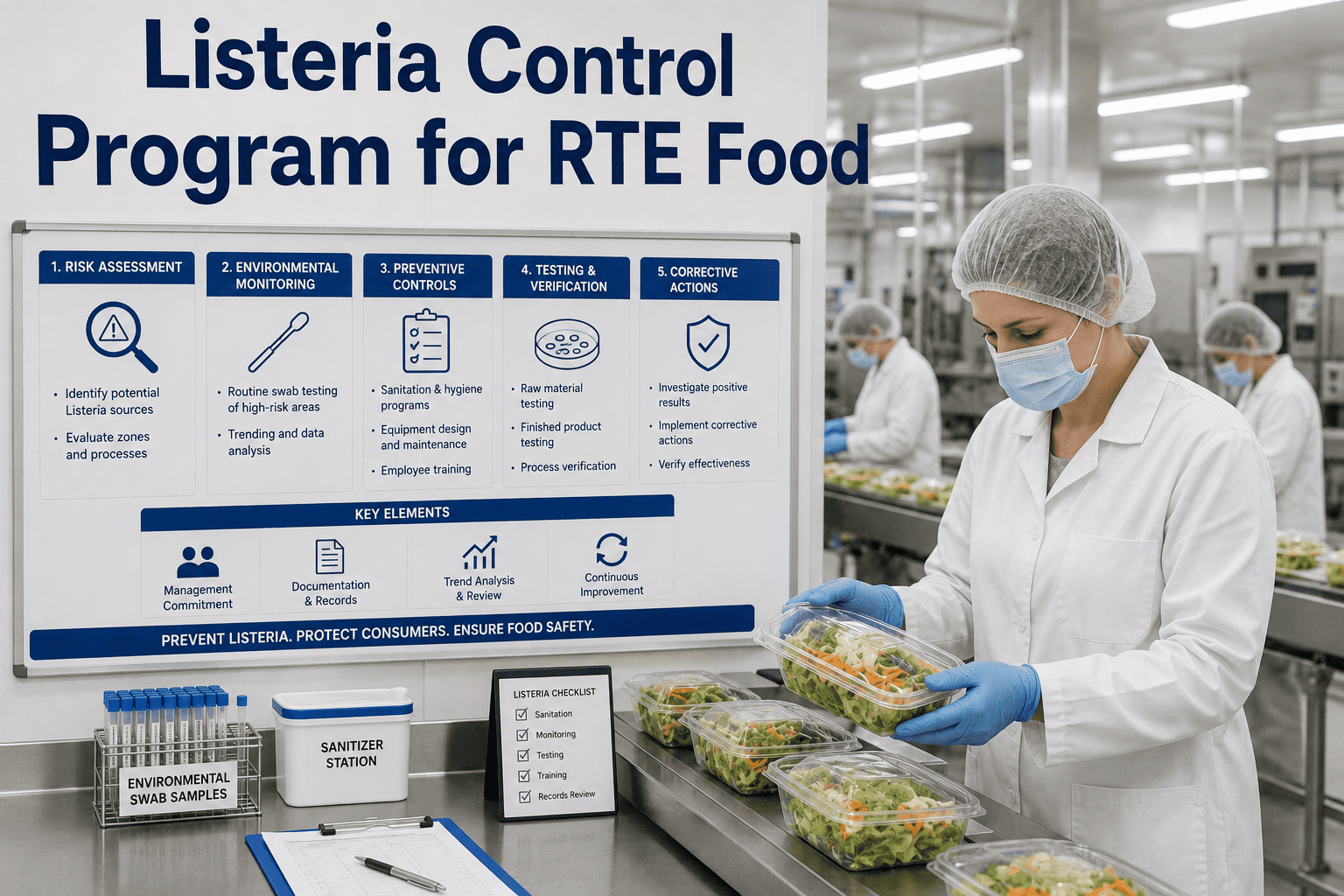
Listeria monocytogenes behaves differently from most foodborne pathogens a plant trains against, which is exactly why it causes so many recalls in ready-to-eat facilities. It survives refrigeration, tolerates salt, and can establish a persistent niche inside a drain, a conveyor seam, or a condensate line for months or years without ever being detected by routine cleaning. A control program built around generic sanitation practices misses this entirely — Listeria requires a purpose-built environmental monitoring system with defined zones, aggressive corrective action triggers, and root cause investigation whenever a positive result appears. This guide breaks down how to structure a zone-based Listeria control program that catches harborage sites before they reach product, with implementation support available on our support page.
Why Listeria Demands a Different Kind of Control Program
Most pathogens of concern in food manufacturing are controlled primarily through a kill step and prevention of post-process contamination. Listeria monocytogenes is uniquely dangerous in ready-to-eat environments because it is a true environmental organism — it lives in the plant itself, not just in raw materials, and can persist in niches that ordinary daily cleaning never reaches. This is why regulatory guidance and GFSI schemes require a dedicated environmental monitoring program specifically for Listeria species, separate from general sanitation verification, built around the zone concept that maps risk by physical distance from exposed product.
Direct Food Contact Surfaces
Any surface that directly touches exposed, ready-to-eat product. Highest sampling frequency and zero-tolerance corrective action.
Non-Contact Surfaces Near Product
Equipment framework, conveyor sides, and controls adjacent to exposed product, where splash or aerosol transfer is possible.
Broader Production Room Environment
Floors, drains, walls, and overhead structures within the production room but not adjacent to exposed product.
Outside the Production Room
Employee break areas, locker rooms, and hallways — lower risk, but a common route for pathogen introduction on footwear.
Not sure your current sampling plan actually covers every zone? Book a demo and we'll review your swab site map against this zone model.
Building the Environmental Monitoring Program
Map Swab Sites by Zone
Identify specific sampling locations within each zone, prioritizing hard-to-clean areas like hollow frames, bearings, and seams.
Set Sampling Frequency
Zone 1 and Zone 2 typically require weekly sampling at minimum, with Zone 3 and Zone 4 on a monthly or quarterly cadence.
Define Positive Result Triggers
Any Zone 1 positive halts affected product and triggers immediate root cause investigation before resuming production.
Root Cause Investigation
Trace positives outward from the swab site, testing adjacent equipment and surfaces to find the actual harborage point.
Verify and Document Closure
Re-sample after corrective cleaning to confirm the niche is actually eliminated, not just temporarily suppressed.
Automate Zone-Based Listeria Monitoring
iFactory tracks swab site results by zone, flags Zone 1 and Zone 2 positives instantly, and manages the full root cause investigation workflow. Book a demo to see it running.
Corrective Action Protocol by Positive Result Type
Not every positive result warrants the same response. The table below outlines a typical escalation structure based on which zone the positive occurred in.
| Result Type | Immediate Action | Investigation Scope |
|---|---|---|
| Zone 1 Positive | Hold affected product, halt line, notify quality lead immediately | Full traceback and adjacent zone sampling |
| Zone 2 Positive | Intensified cleaning of affected area, increase sampling frequency | Investigate transfer pathway to Zone 1 |
| Zone 3 Recurring Positive | Deep clean and disassembly of affected drain or fixture | Map for persistent harborage niche |
| Zone 4 Positive | Reinforce footwear and hygiene protocols at entry points | Review traffic flow into production areas |
Intensified Cleaning Triggers
Beyond routine sanitation, specific conditions should automatically trigger an intensified cleaning response regardless of whether a positive result has occurred yet.
Two Consecutive Positives
Any swab site returning positive results in two consecutive sampling cycles at the same location.
New Equipment Installation
Newly installed or modified equipment before it is cleared for regular production use.
Extended Downtime
Equipment or lines that sat idle for extended periods, allowing moisture and biofilm to accumulate.
Seasonal Humidity Shifts
Periods of elevated ambient humidity that increase condensation risk on overhead structures.
Want help designing a swab site map specific to your production layout? Schedule a demo or contact support for a walkthrough.
Frequently Asked Questions
Catch Listeria Before It Reaches Product
iFactory manages your zone-based environmental monitoring program end to end — sampling schedules, positive result alerts, root cause tracking, and verification, all in one system.