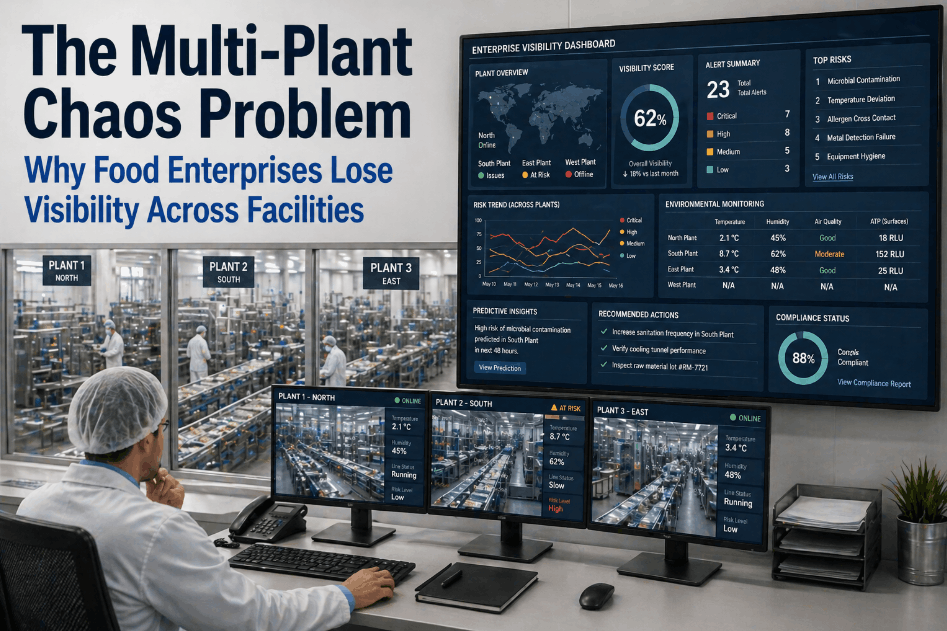
A food manufacturing group with twelve plants rarely has twelve maintenance programs that agree with each other. One site tracks PM compliance in a spreadsheet, another runs a CMMS nobody at corporate can see into, and a third still works from a laminated binder taped to the panel. When leadership asks which plant is actually performing best, the honest answer takes three weeks of manual reconciliation to produce. Industry data shows 60-80% of CMMS projects stall or underperform — not because the software fails, but because the rollout approach does. Book a demo to see how iFactory's phased rollout model gets a food manufacturing network onto one standard without breaking any single plant's production schedule.
Enterprise CMMS → Multi-Plant Rollout Guide for Food Manufacturers
Rolling Out a CMMS to Twelve Plants Isn't Twelve Separate Single-Site Rollouts at All. It's One Governance Problem Wearing Twelve Different Uniforms.
A single-plant CMMS rollout is mostly a change-management problem to solve for. A multi-plant food manufacturing rollout adds a second, genuinely harder layer on top of that: keeping HACCP-critical maintenance standards identical across every site while still letting each plant's real operating conditions shape its own local schedule and staffing pattern.
60-80%
Of CMMS projects stall or underperform due to rollout approach, not underlying software failure
15-25%
Typical maintenance cost reduction once a standardized program reaches full network adoption
3-6 wks
Lag in cross-plant performance visibility when consolidation stays manual and spreadsheet-based across sites
The Governance Model Explained
Who Owns the Standard, and Who Adapts It Locally at Each Site
Every multi-plant rollout that holds together long-term has a clear, written answer to one question: when corporate standard and local plant reality disagree, who decides, and how fast. Without that answer written down and communicated clearly to every single site in advance, the standard quietly erodes within a year as each plant reverts to its own historical habits and local workarounds.
Corporate Steering Committee
Owns the Standard Itself
Defines the master PM template library, the HACCP/CCP asset tagging rules, and the KPI definitions every plant reports against network-wide. Meets on a fixed cadence to review rollout progress and approve any change to the master standard before that change propagates to every plant automatically.
Site Champion
Adapts It Locally
A respected maintenance leader at each plant who translates the corporate standard into that site's actual equipment, shift patterns, and technician workflows — and feeds local exceptions back to the steering committee rather than resolving them quietly and informally on the floor without anyone else knowing.
Global Program Sponsor
Keeps the Rollout Funded and Visible
An executive sponsor who stays engaged through every single phase, not just the kickoff meeting. Rollouts where the sponsor disengages after launch see adoption collapse within weeks, regardless of how strong the initial rollout plan looked on paper before go-live day arrived.
The Full Phased Rollout Timeline
Four Waves, Not One Simultaneous Launch
Enterprises that flip every plant on at once consistently see worse adoption outcomes than those who prove the model at one site first before scaling further. A wave-based rollout lets each phase learn from the one before it — and gives corporate a real, credible pilot to point to when the next plant's plant manager asks the reasonable question "does this actually work, or is this just a mandate handed down from above."
Wave 1
Pilot Plant
One site — chosen for strong local leadership and clean existing data, not the largest or most complex plant — runs the full standard end to end and becomes the training-material source for every wave that comes after it in the sequence.
Wave 2
Fast-Follower Sites
A small group of similar plants adopt the now-validated standard, with the pilot site's champion providing direct peer support rather than a generic corporate training deck nobody fully engages with on their own.
Wave 3
Complex & Regional Sites
Plants with unusual equipment, regional compliance requirements, or language and localization needs roll out once the core model has already proven stable across simpler sites in the earlier waves of the program.
Wave 4
Full Network Governance
Every plant reports against the same standard, and the steering committee shifts from managing deployment waves into ongoing governance — reviewing variance requests and updating the master template library on a regular cycle going forward indefinitely.
See a Full Rollout Plan Built Around Your Own Specific Plant Network
iFactory sequences a wave-based rollout matched to your plants' actual complexity and readiness level — not a generic 12-week template that ignores which sites are genuinely ready first and which still need more preparation time before their scheduled go-live date.
The Standard PM Template Library
One Master Template Set, Configured Per Site — Never Twelve Different Programs
The single biggest structural decision in a multi-plant rollout is whether each plant builds its own PM program or configures a shared master library instead. The second approach is what actually makes cross-plant comparison possible in practice, and it is far more work to retrofit later than to establish correctly and deliberately from the very start of the program.
Master Template Library (Corporate)
Asset classes defined once — pasteurizers, retorts, packaging lines, cold chain equipment — shared consistently across the entire network rather than reinvented independently at each individual plant
PM task frequency and procedure defined per asset class, based on OEM specifications and food-safety requirements that apply regardless of which specific plant is executing the task on a given day
HACCP/CCP criticality tagging applied consistently, so scheduling logic reflects food-safety hierarchy everywhere in the network rather than a locally invented priority system unique to one site
KPI definitions locked at the corporate level — PM compliance, MTBF, MTTR mean exactly the same thing at every single plant in the network, with no room for local reinterpretation
Site Configuration (Local)
Actual equipment inventory mapped against the master asset classes for that specific plant's real production floor and current equipment fleet
Shift patterns, technician assignments, and local escalation contacts configured per site to accurately reflect actual staffing and shift coverage on the ground
Approved local variances — documented and time-boxed against the master standard, not informal workarounds that nobody at corporate ever logs or reviews
Site-specific dashboards built on the shared KPI definitions, not a locally invented scoring system corporate cannot meaningfully compare against other plants
The Variance Rule Explained
When a Plant Needs to Deviate From Standard Practice, There Has to Be a Process — Not Just a Workaround
Standardization does not mean uniformity for its own sake across every plant regardless of local circumstance. A plant running a legacy piece of equipment nobody else in the network has, or operating under a stricter regional food-safety rule, has a legitimate reason to deviate from the corporate standard. The failure mode is not the deviation itself — it is a deviation nobody at corporate ever approved, reviewed, or even logged in the first place, leaving the network blind to its own inconsistency.
1
Request
The site champion documents the proposed deviation and the specific operational or compliance reason driving it, rather than simply implementing the change unilaterally on the floor without any formal record.
2
Review
The steering committee evaluates whether the variance is a genuine local necessity or a workaround for inadequate training or change resistance that should instead be addressed through better support.
3
Approve & Time-Box
Approved variances are logged against the master standard with a defined review date, not left open-ended indefinitely as a permanent, unexamined exception to the network standard.
4
Revisit
At the review date, the variance is either renewed with fresh justification from the site, folded into the master standard if other plants need it too, or retired entirely from the log.
A variance log that is actually reviewed on schedule is what separates disciplined local adaptation from the same slow standard-erosion that undoes an ungoverned rollout within a year or two.
Adoption at Full Scale
Training Twelve Plants Without Twelve Different Versions of the Same Truth
Software configuration is the easier half of a multi-plant rollout, frankly. Getting technicians, planners, and managers at every site to actually use the system the same way is the harder half, and it is where most of the 60-80% underperformance rate actually originates — not in a misconfigured server somewhere, but in a plant floor where the old paper habits never really went away in practice.
Train the Trainer, Not Everyone Directly
Corporate trains the site champion deeply on every role's workflow, front to back. The champion then trains their own plant's technicians, planners, and managers — people trust a peer from their own floor far more than a corporate visitor who leaves after two days and never returns to check in.
Role-Specific, Not Generic
A technician does not need to configure PM schedules, and a planner does not need to know how to close a work order from a mobile device on the floor. Mixed-role training sessions produce confusion; role-specific sessions produce real competence that shows up immediately in day-one adoption rates.
Sequenced Around Go-Live, Not Front-Loaded
Pre-go-live training covers navigation and core daily tasks people need on day one. Post-go-live training shifts to analytics, optimization, and building the ongoing habits that make the standard stick after the initial launch excitement has faded and daily routine sets back in for good.
The pilot site's trained champions become the informal support network for every wave that follows in the sequence — a peer who can say "it actually works, here's exactly how I use it every single shift" carries more genuine weight than any corporate mandate or polished training manual ever will, regardless of how well-produced the official materials are.
Food-Specific Requirements Explained
What a Food Manufacturing Network Actually Needs That a Generic Multi-Plant Rollout Doesn't
A generic multi-plant rollout guide built for automotive or discrete manufacturing misses several requirements that are non-negotiable in food and beverage production, where a missed maintenance step on the wrong piece of equipment is not just a downtime risk but a genuine food-safety event capable of triggering a full product recall across the network.
HACCP/CCP Asset Tagging
Equipment directly governing a Critical Control Point — kill-step systems, temperature monitoring, detection equipment — needs elevated PM priority, shorter intervals, and mandatory pre-return-to-service verification, consistently applied across every plant in the network regardless of local practice history or how each site previously handled this class of equipment.
Calibration Compliance Tracking
Instruments tied to food-safety-critical measurements need calibration records that hold up in an audit at any plant, in the same format, without a corporate reviewer needing to learn each site's local record-keeping system before they can even begin the audit process itself.
Post-Maintenance Sanitation Verification
Corrective maintenance on food-contact equipment requires a documented sanitation check before restart — a step generic multi-plant rollout guides rarely account for, but one that cannot be skipped or informally handled at any single site without real, material compliance risk to the whole network.
What This Looks Like When Applied
The Fourteen-Plant Rollout That Went From Pilot to Full Governance in Just 26 Weeks
A steel manufacturing group facing the same fragmentation problem — different maintenance practices at every location, no reliable way to compare plant performance against a shared standard — sequenced its rollout in four deliberate phases rather than attempting a simultaneous network-wide launch across every mill at once on the same calendar date.
Wks 1-6
Pilot phase at the single site with the most receptive management team and cleanest existing IT infrastructure available
Wks 7-12
Rollout to remaining regional mills, using the pilot site's own newly trained champions for direct knowledge transfer
Wks 13-18
International sites brought on with local IT coordination and full interface localization for regional teams
Wks 19-26
Final wave of sites onboarded, with cultural adaptations and vendor coordination handled last, deliberately not first
Throughout every phase, a global steering committee met on a fixed bi-weekly cadence — reviewing deployment progress, capturing best practices emerging from the earliest sites, and beginning to standardize PM templates in parallel with the rollout itself rather than treating standardization as a separate project to tackle afterward once every plant had already gone live independently. A single respected maintenance director was recruited as a global champion specifically to advocate for the platform across every location, giving plant-level teams a peer voice to trust rather than only a corporate mandate handed down from above without local context.
Common Rollout Mistakes to Avoid
Where Multi-Plant Rollouts Commonly Break Down Over Time
01
Launching every plant simultaneously to "save time" on the calendar.
A simultaneous big-bang rollout removes the proof-of-concept and trained peer-champion advantages a phased approach provides, and it means any early mistake propagates to every site at once instead of being caught and fixed at the pilot before it affects the whole network's confidence in the program.
02
Letting each plant build its own PM templates entirely from scratch.
This produces twelve maintenance programs that cannot be meaningfully compared, defeating the primary reason for standardizing in the first place. The master library has to be built once at the corporate level and configured locally, not rebuilt independently at every individual plant site.
03
Treating variance requests as exceptions to punish rather than signals to evaluate.
A steering committee that reflexively denies every deviation request pushes plants toward informal, undocumented workarounds instead — which is worse for governance than a properly logged and reviewed variance that stays visible to corporate, since at least a documented exception can be tracked, reviewed, and eventually resolved.
04
Losing executive sponsorship after the kickoff meeting.
Roughly two-thirds of failed CMMS implementations show no visible leadership support partway through the rollout, once the initial launch energy fades. A sponsor who disengages after launch signals to every plant that the standard is optional and can be safely deprioritized behind more pressing local concerns.
Common Questions Answered
Multi-Plant CMMS Rollout for Food Manufacturers — Full Frequently Asked Questions
How long does a full multi-plant CMMS rollout typically take for a food manufacturing network?
Timelines vary with network size and how divergent current practices already are, but a wave-based rollout across a dozen plants commonly runs several months from pilot through full network governance, with each wave building on lessons and training materials refined in the one before it, so later waves consistently move faster than the first. Attempting a single simultaneous launch across every plant is usually slower in practice than a phased approach, since it removes the chance to catch and fix problems before they affect the entire network, and a botched simultaneous launch often costs more time in remediation than a phased approach would have taken from the start of the program.
Book a demo to scope a realistic timeline for your specific plant count and complexity.
How do we properly choose which plant should be the pilot site?
The strongest pilot candidates have receptive local leadership, reasonably clean existing asset and maintenance data, and adequate IT infrastructure already in place — not necessarily the largest or most operationally complex plant in the network, since a difficult pilot risks stalling the entire program before it has a real chance to prove itself to skeptical stakeholders elsewhere. A pilot chosen for management buy-in and a realistic chance of early success produces better training materials and a more credible internal success story than one chosen simply because it is the flagship facility leadership wants showcased first to the board.
iFactory helps score plant readiness before committing to a pilot site.
Does standardizing across plants mean every site has to use identical equipment or work exactly the same way?
No — standardization applies to the PM template structure, KPI definitions, and HACCP/CCP tagging logic, not to the specific physical equipment each plant happens to operate on its production floor. A properly governed variance process lets individual sites adapt to real local conditions — a legacy machine, a stricter regional compliance rule — without that adaptation quietly drifting into an ungoverned, undocumented departure from the standard that undermines cross-plant comparison and slowly erodes the value of the whole standardization program over successive years of operation.
What is the single most common reason multi-plant CMMS rollouts fail to reach full adoption?
Big-bang launches without a structured pilot phase and without a trained floor champion at each site are the most consistent driver of adoption failure across CMMS implementations generally, and the risk compounds significantly at multi-plant scale because a failed launch at one site can undermine confidence at every plant still waiting to onboard behind it in the queue. Loss of visible executive sponsorship partway through the rollout is a close second cause, since it signals to plant-level teams that the standard is negotiable and quietly permits the same drift-back-to-old-habits pattern that undoes a well-designed program within a year or two of its original go-live date.
Book a demo to see how iFactory's phased model addresses both risks directly.
How does the governance model stay effective after the initial rollout is complete?
The steering committee's role shifts from managing deployment waves to reviewing variance requests, approving updates to the master PM library, and monitoring whether plant-level practice is quietly drifting from the documented standard — a lightweight but regular cadence rather than a one-time rollout project that is declared complete and never revisited again once every plant has technically gone live. Networks that maintain alignment longest treat governance as an ongoing operating rhythm woven into normal management review, not a temporary project team that disbands the moment the last plant finishes onboarding onto the platform.
Get Every Single Plant Onto One Consistent Standard Without Breaking Any Site's Production Schedule
iFactory sequences a phased, governed rollout across your entire food manufacturing network — master PM library, HACCP/CCP tagging, variance tracking, and a steering committee model built to last well past the initial go-live date rather than fading once the launch excitement inevitably wears off across the network.