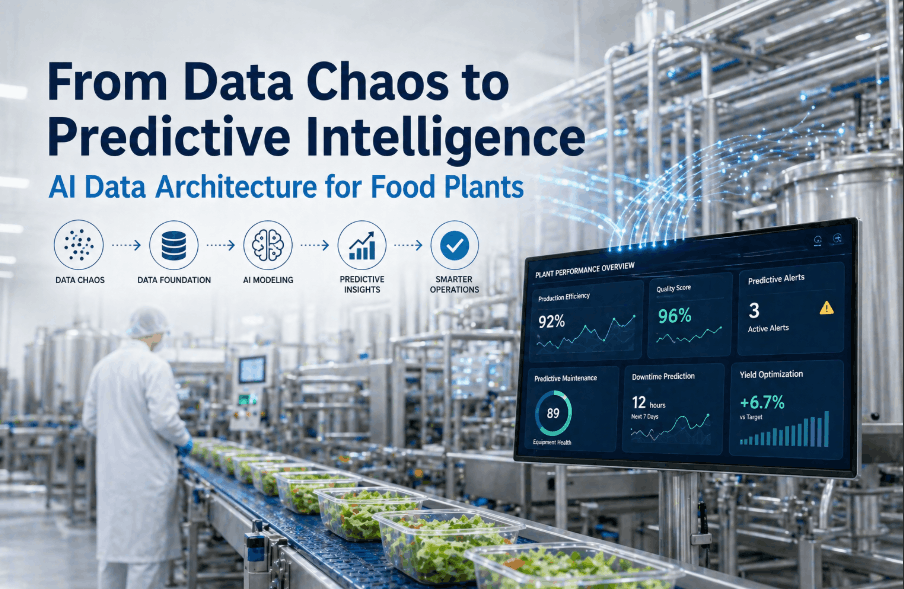
Modern food manufacturing facilities face a troubling paradox: despite substantial investments in industrial automation software and control systems, many plants struggle to extract actionable intelligence from their operations. The question "Are food plants over-automated but under-intelligent?" reflects a critical gap between execution capacity and analytical capability — a gap that costs manufacturers millions in lost efficiency, quality variance, unplanned downtime, and regulatory exposure.
While PLC networks control virtually every process parameter and manufacturing execution systems track production sequences, the intelligence layer that connects operational data to strategic decision-making remains underdeveloped in facilities across North America, Europe, and emerging markets. For plant managers, operations directors, and industrial engineers overseeing food production facilities, closing this automation-intelligence gap is no longer optional — it is the difference between reactive troubleshooting and predictive optimization.
Maximize Uptime Across Every Food Production Line
From mixing systems to packaging lines and pasteurization equipment — discover how AI-driven analytics eliminates unplanned downtime and drives OEE improvement across your entire facility.
The Automation Paradox: Why More Control Doesn't Equal More Intelligence
Food manufacturing facilities today are equipped with sophisticated automation infrastructure — programmable logic controllers governing mixing processes, variable frequency drives managing conveyor speeds, SCADA systems monitoring environmental conditions, and automated inspection systems checking quality parameters at production speeds exceeding human capability. Yet despite this control density, many operations teams lack the analytical tools to answer fundamental questions: Why did Line 3 experience a 14% yield drop last Tuesday? Which process variable correlations predict thermal seal failures?
Understanding the Intelligence Gap in Food Manufacturing Operations
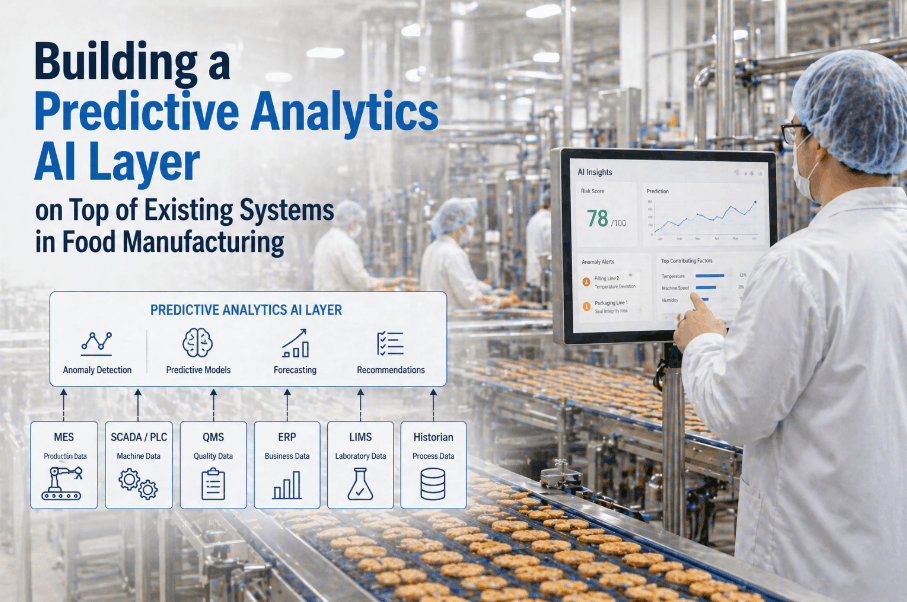
The intelligence gap in food plants is not a technology availability problem — predictive analytics software, machine learning frameworks, and cloud-based industrial IoT platforms are readily accessible. It is an integration and implementation problem. Existing automation infrastructure generates immense data volumes, but that data remains locked in proprietary protocols, incompatible formats, and disconnected historian databases.
Data Silos and Protocol Fragmentation
Food plants operate multi-vendor automation ecosystems with Allen-Bradley PLCs, Siemens controllers, Wonderware SCADA, and SAP ERP. Each system stores data in different formats and timestamps. Without PLC data integration platforms that normalize these streams, cross-system analysis remains manual and error-prone.
Reactive Troubleshooting Culture
Operations teams trained on automation systems are oriented toward reactive problem resolution. Predictive analytics software requires a fundamentally different operational mindset: proactive pattern recognition, statistical process control, and predictive intervention before failures materialize.
Analytics Skill Gap at Plant Level
Process engineers possess deep domain knowledge but often lack data science skills. Operational analytics software must deliver intelligence without requiring users to become statisticians — presenting insights through intuitive dashboards and automated anomaly alerts.
Insufficient Contextualization of Process Data
Raw sensor data lacks operational meaning without context. Intelligent manufacturing systems connect process data to production context, equipment maintenance status, quality test results, and external variables to transform measurements into diagnostics.
Why the Intelligence Gap Costs More Than You Think
Food plants without an analytics intelligence layer operate at a measurable, quantifiable disadvantage. Industry benchmarks show the average food manufacturing plant runs at 65–72% OEE while world-class operations consistently achieve 85%+. That 13–20 point gap represents unlocked capacity sitting idle — not because machinery is inadequate, but because the analytics to drive it are missing. Unscheduled downtime costs food manufacturers up to $50,000 per hour in emergency stoppages, spoiled materials, and production loss. Unlike supply chain disruptions or commodity price swings, this is a risk entirely within operational control — if the right intelligence layer is in place.
$50K/Hour Downtime Exposure
Unscheduled stoppages in food processing cost up to $50,000 per hour once spoiled materials, emergency labor, and missed customer orders are factored in — far exceeding the cost of intelligence platform deployment.
13–20% Capacity Sitting Idle
The OEE gap between average food plants (65–72%) and world-class benchmarks (85%+) represents 13–20% of production capacity going unused — throughput you already paid for in capital equipment but cannot access without analytics.
Contamination Risk Invisible to Alarms
Worn seals, bearing degradation, and lubricant failures create contamination pathways that threshold-only alarm systems cannot detect. A single product recall costs an average of $10 million in investigation, disposal, and brand damage.
Data Exists — Intelligence Doesn't
Most food plants already have sensors, a CMMS, and OEE dashboards. The problem is not data volume — it is that these systems never connect into a single intelligence layer that can reason across all signals simultaneously to catch failures before they happen.
Industrial IoT Platforms: The Foundation of Intelligent Food Manufacturing
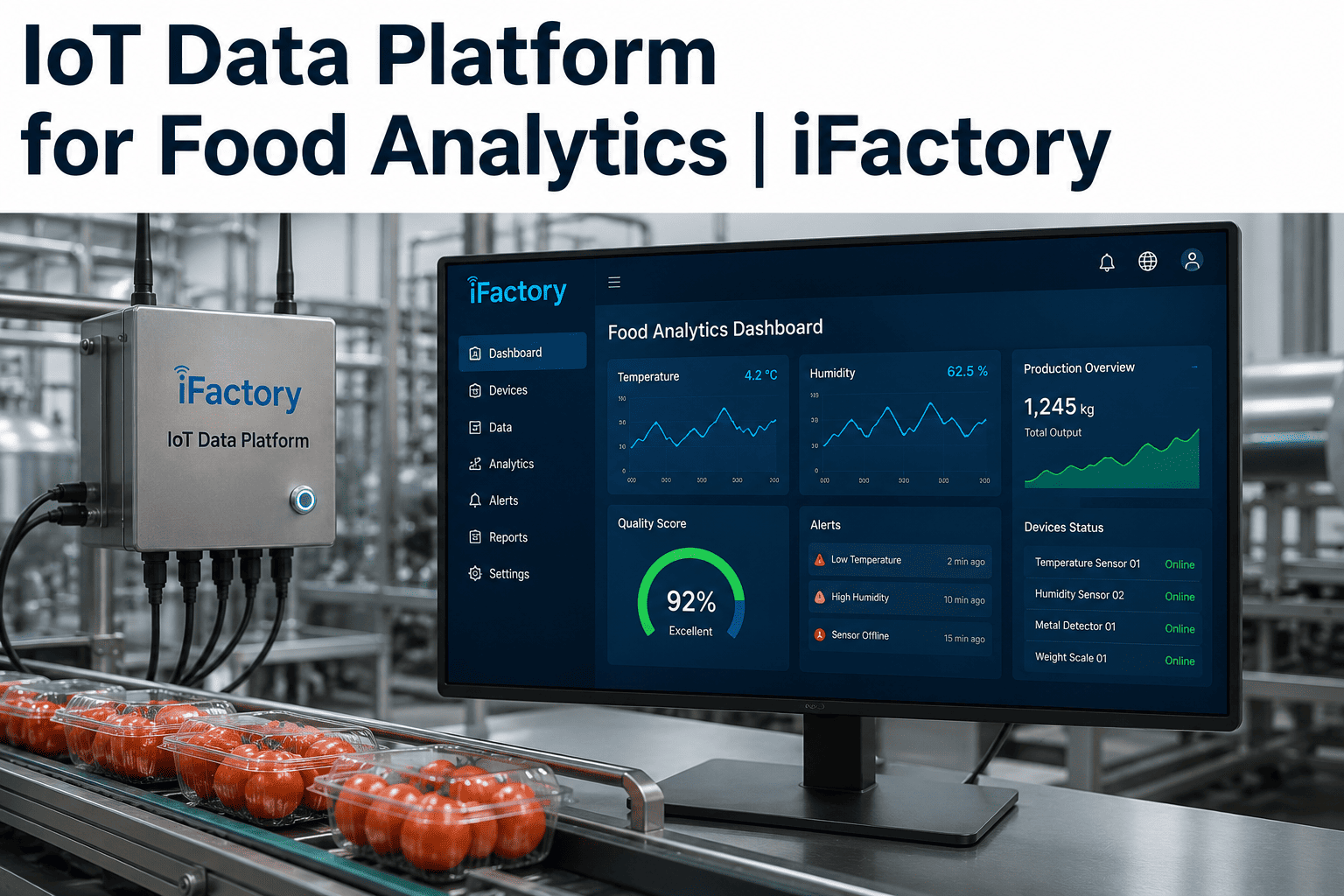
Bridging the automation-intelligence gap begins with industrial IoT platform deployment — unified data infrastructure that connects PLCs, sensors, quality systems, and enterprise software into coherent analytical ecosystems. Unlike traditional SCADA expansions, IoT platforms create bidirectional data flows: pushing operational data to cloud analytics engines and delivering predictive insights back to plant-floor systems. Book a Demo to explore edge and cloud deployment models.
Unified Data Ingestion and Normalization
Industrial IoT platforms connect to heterogeneous automation systems through standard protocols, normalizing data into common time-series formats with consistent metadata tagging for cross-system analytics.
Real-Time Event Stream Processing
Smart factory software processes sensor data streams in real time, applying statistical algorithms to detect anomalies, calculate derived metrics, and trigger automated alerts when conditions deviate from expected ranges.
Contextualized Data Storage
Time-series databases store process measurements alongside contextual metadata — production orders, batch identifiers, equipment records, and quality results for condition-specific process behavior analysis.
Scalable Analytics Infrastructure
AI manufacturing solutions require infrastructure for training models on historical data and deploying them to score new data in milliseconds with elastic compute resources.
Predictive Analytics Software: From Reactive Alarms to Proactive Intelligence
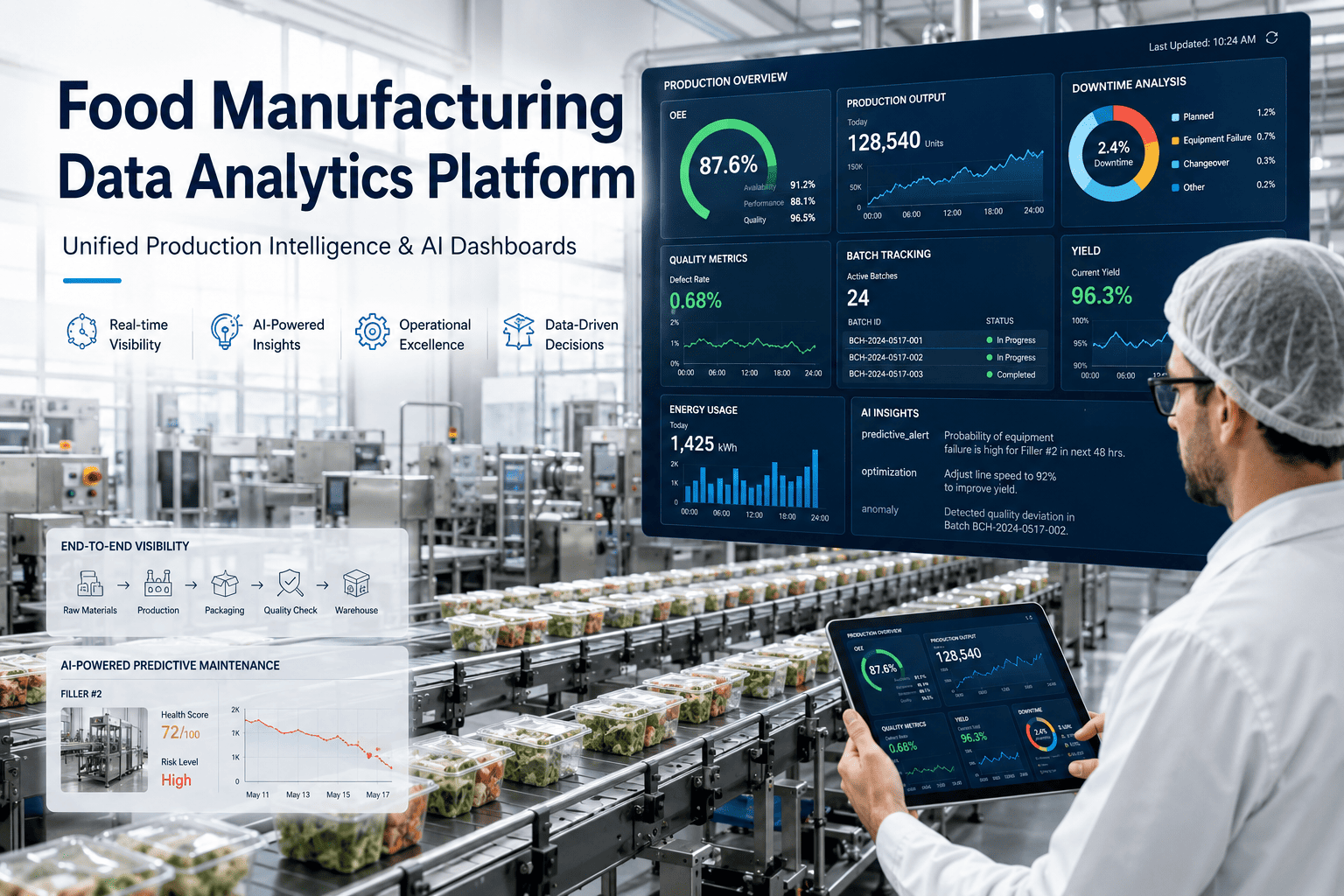
Traditional automation systems rely on threshold-based alarming. Predictive analytics software identifies pre-failure patterns by analyzing multivariate relationships, temporal trends, and equipment behavior signatures that threshold logic cannot detect. Asset performance management algorithms forecast equipment failures based on vibration spectra, oil analysis chemistry, thermal profiles, and operational load history. Book a Demo to see predictive analytics dashboards built for food operations.
Anomaly Detection and Root Cause Analysis
Machine learning algorithms detect statistical anomalies in sensor data streams. Root cause analysis engines automatically correlate anomalous behavior with recent process changes, maintenance activities, or ingredient batch variations.
Remaining Useful Life Estimation
Condition monitoring systems integrated with predictive models estimate remaining useful life of critical assets based on actual operating stress rather than calendar intervals.
Process Parameter Optimization
Multi-objective optimization algorithms analyze relationships between controllable parameters and desired outcomes to recommend adjustments that improve performance across competing objectives.
Quality Prediction and In-Process Control
Predictive quality models correlate real-time process data with lab test results to estimate final product quality before offline testing confirms it — enabling in-process adjustments.
Computer Vision and In-Line Quality Intelligence
AI-powered computer vision systems represent one of the highest-ROI intelligence investments in food manufacturing. Unlike human inspectors who provide intermittent sampling, deep learning vision systems deliver 100% inspection at full line speed — catching microscopic defects in packaging seals, fill levels, label placement, and product integrity that manual quality checks routinely miss. Food manufacturers deploying AI vision inspection report defect detection rates improving by 30–40% compared to traditional sampling-based QC, with corresponding reductions in customer returns, rework costs, and regulatory exposure.
Seal Integrity and Packaging Defect Detection
Vision systems inspect thermal seals, crimps, and closures at production speed — identifying leakers, weak seals, and contamination that would otherwise pass into distribution and trigger recalls.
Fill Level and Weight Verification
AI camera systems verify fill levels across every unit in real time, eliminating underfill liability and overfill waste simultaneously — a direct margin improvement on high-volume lines.
Foreign Object and Contamination Screening
Deep learning models trained on product-specific imagery flag foreign materials, color deviations, and physical contamination indicators that conventional X-ray or metal detection systems cannot identify.
Label Accuracy and Traceability Verification
Vision intelligence cross-references label data against production batch records in real time — ensuring allergen declarations, date codes, and regulatory markings match active production parameters before product ships.
Manufacturing Execution Systems: Bridging Production and Intelligence
Traditional manufacturing execution systems in food plants focus on production tracking and batch genealogy. Next-generation MES platforms integrate with industrial IoT platforms and analytics engines to connect production execution data with process performance, equipment condition, and quality data in unified operational models.
| MES Function | Traditional Capability | Intelligent Enhancement | Business Impact |
|---|---|---|---|
| Production Scheduling | Fixed schedules based on orders | Dynamic scheduling optimized for equipment availability and quality trends | 15-25% throughput increase |
| Recipe Management | Static parameter setpoints | Adaptive recipes adjusted for ingredient variability and equipment condition | 8-12% quality variance reduction |
| Quality Management | Post-production testing | In-process quality prediction with real-time SPC | 30-40% reduction in quality excursions |
| Performance Analysis | OEE reporting by shift | Multivariate loss analysis with automated root cause identification | 20-30% OEE improvement |
Energy Intelligence: The Hidden ROI in Food Manufacturing
Energy represents 15–30% of total operating costs in food manufacturing — yet most plants manage energy through fixed rate schedules and monthly utility bills rather than real-time consumption analytics. AI-based energy management systems analyze power draw across motors, compressors, HVAC, refrigeration, and processing equipment to identify waste patterns, demand spikes, and optimization opportunities that manual monitoring cannot detect. Food manufacturers deploying ML-based energy control systems report energy cost reductions of 15–28% per production unit — achieved without capital investment in new equipment, purely through intelligent load optimization and process scheduling.
Compressor and Refrigeration Optimization
Refrigeration systems are the largest single energy consumer in most food facilities. AI continuously adjusts compressor staging, setpoints, and defrost cycles based on production load, ambient conditions, and thermal mass — eliminating the energy waste of static control logic.
Demand Peak Shaving and Load Scheduling
ML models analyze production schedules alongside utility tariff structures to sequence high-draw equipment operations away from demand charge windows — reducing peak demand penalties that can represent 30–40% of an industrial electricity bill.
Motor and Drive Efficiency Monitoring
Anomalous power consumption in motors and variable frequency drives is both an energy waste signal and an early equipment failure indicator. Energy AI identifies motors drawing above-baseline current — flagging both efficiency loss and impending mechanical failure simultaneously.
Sustainability Reporting and Carbon Tracking
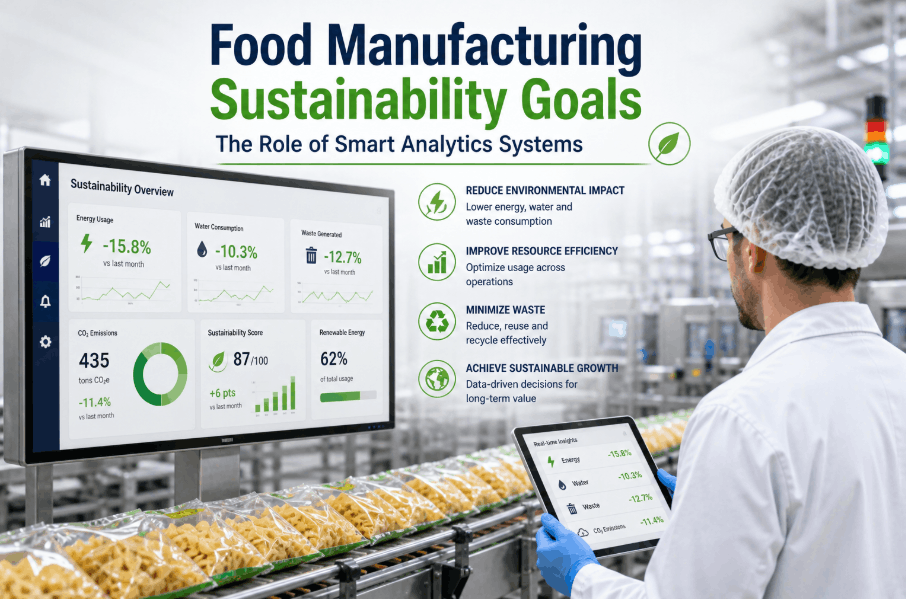
Automated energy intelligence platforms generate per-SKU, per-batch, and per-line carbon intensity reports required by EU sustainability regulations and major retail customer ESG mandates — eliminating manual data collection for compliance reporting.
Digital Transformation: Implementation Strategies That Work
Digital transformation manufacturing initiatives fail when organizations attempt comprehensive intelligence platforms as single monolithic projects. Successful implementations follow staged deployment strategies that deliver measurable value at each phase. Phase 1 focuses on PLC data integration for critical production lines. Phase 2 adds operational analytics software for specific applications. Phase 3 introduces predictive models. Phase 4 scales successful solutions across facilities. Book a Demo to explore staged implementation approaches.
Measuring Success: KPIs for Manufacturing Intelligence Programs
Intelligence platform success must be measured through operational outcomes, not technology deployment milestones. Successful programs establish baseline metrics before implementation, track improvement trends during deployment, and attribute performance changes to specific intelligence capabilities with statistical rigor.
Frequently Asked Questions
What is the difference between automation and intelligence in food manufacturing?
Automation executes programmed control logic while intelligence analyzes operational data to optimize controls, predict failures, and recommend improvements. Intelligence builds on automation by adding analytical capabilities that learn from data.
How do industrial IoT platforms integrate with legacy automation systems?
Modern IoT platforms connect to legacy PLCs through standard protocols including OPC UA, Modbus, and Ethernet/IP. Edge gateway devices perform protocol translation and data aggregation without disrupting production operations.
What ROI should food manufacturers expect from intelligence investments?
Food plants typically achieve 15-30% OEE improvement, 20-35% reduction in unplanned downtime, and 10-20% energy cost reduction within 18-24 months. Total program ROI frequently reaches 200-400% over three years.
Can small manufacturers justify manufacturing intelligence investments?
Cloud-based platforms with subscription pricing make intelligence capabilities accessible without major capital investments. Small manufacturers can start with targeted implementations that demonstrate value with minimal upfront cost.
What cybersecurity risks does manufacturing intelligence create?
Connecting automation to IoT platforms creates attack vectors. Effective security implements network segmentation, encrypted communications, multi-factor authentication, and intrusion detection systems to protect production continuity.
How long does implementation take in a food plant?
Focused deployments for single production lines complete in 6-12 weeks. Comprehensive implementations require 6-12 months for initial deployment. Staged implementations deliver incremental value every 3-4 months.
Transform Your Food Manufacturing Operations with Intelligent Analytics
iFactory's industrial intelligence platform integrates seamlessly with your existing automation infrastructure — delivering predictive insights, AI-powered analytics, and intelligent decision support that turns data into competitive advantage.