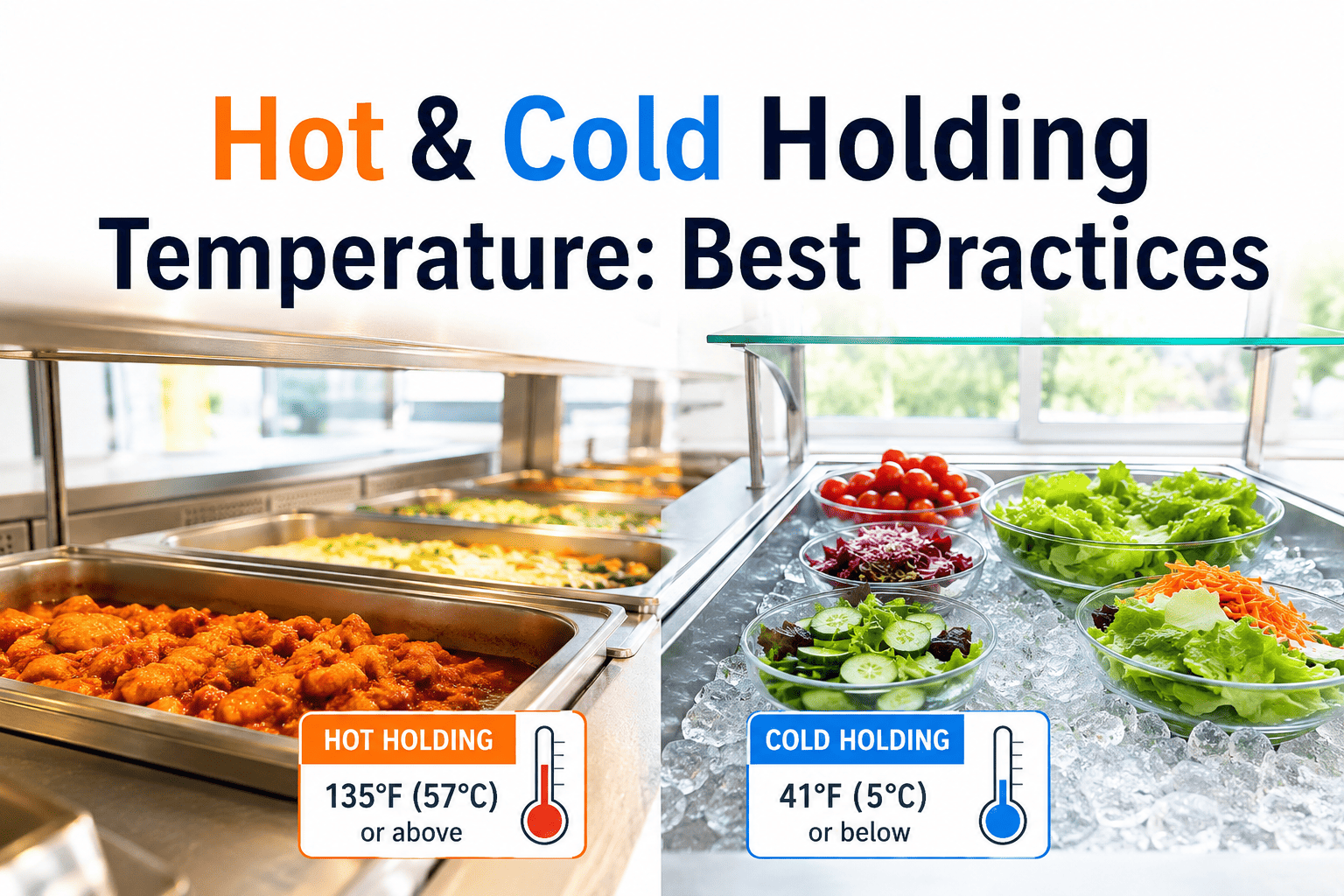
Every kitchen, processing line, and cold case in the food industry operates around one central number: the four hours of cumulative time potentially hazardous food is allowed to spend between 40°F and 140°F before it must be discarded. That window sounds generous until you add up every stage food actually passes through it, cooling after cooking, sitting on a prep counter, waiting during a delivery, or holding just slightly too long in a buffet pan, and realize the clock rarely resets to zero even when a single step looks fine on its own. Preventing temperature abuse means tracking cumulative danger zone time across the entire journey a food item takes, not just checking the temperature at any one point in isolation. See how continuous AI monitoring tracks that cumulative clock automatically when you book a demo.
FOOD SAFETY · TEMPERATURE ABUSE PREVENTION · THE 40F–140F DANGER ZONE
Four Hours Sounds Like a Lot Until You Add Up Every Stage Along the Way
iFactory's AI tracks cumulative danger zone exposure across cooking, cooling, holding, and storage in real time, so the clock never resets unnoticed between one stage and the next.
Post-Cook Cooling
Prep Counter Time
Buffet or Display Holding
Transport and Delivery
WHY THE DANGER ZONE IS HARDER TO MANAGE THAN IT SOUNDS
The Cumulative Clock Problem Most Kitchens Never Actually Track
The FDA Food Code danger zone rule is written as a cumulative limit, which means the clock does not reset every time food moves to a new stage or a new piece of equipment. A batch of soup that spent forty-five minutes cooling on the counter before refrigeration, then sat out for twenty minutes during prep the next day, then held on a buffet line for two hours, has already accumulated over three hours of danger zone exposure before the last stage even begins, and almost no manual tracking system captures that running total accurately across every stage.
2 Hrs
Reduced cumulative limit that applies once food has already spent one to two hours in the danger zone previously.
Doubles
Approximate rate at which many foodborne pathogens can multiply for every 20 minutes spent in the optimal danger zone range.
Multiple Stages
Number of separate points where danger zone time typically accumulates unnoticed across a single food item's journey.
Continuous
Tracking frequency required to catch cumulative exposure accurately, which a periodic manual check cannot provide.
WHERE DANGER ZONE TIME ACCUMULATES
The Four Stages Where Time Adds Up Without Anyone Noticing
Danger zone exposure rarely happens in one dramatic event. It accumulates in small, individually reasonable-looking increments across different stages of food handling, which is exactly why a stage-by-stage view rather than a single spot check is necessary to manage it correctly.
Post-Cook Cooling
Cooked food must pass through the danger zone on its way down to safe storage temperature, and this cooling step is one of the most common sources of accumulated exposure because large batches in deep containers cool far slower than staff typically estimate.
Prep Counter Exposure
Ingredients pulled from refrigeration for active prep work sit at room temperature throughout the prep process, and busy service periods routinely stretch prep windows longer than staff intend, adding time to the cumulative total without a formal check.
Holding and Display
Buffet lines, salad bars, and grab-and-go cases hold food at the edge of the safe range for extended service periods, and any prior exposure from cooling or prep stages compounds directly with holding time toward the four-hour cumulative limit.
Transport and Delivery
Food moving between facilities, to catering events, or through delivery services accumulates danger zone time during transit that is easy to overlook because the receiving location often only checks temperature on arrival rather than tracking total elapsed exposure.
Track the Cumulative Clock, Not Just the Current Reading
iFactory's AI follows food through cooling, prep, holding, and transport, adding up danger zone exposure across every stage automatically so nothing gets served past its true cumulative limit.
RAPID COOLING BEST PRACTICES
Getting Food Through the Danger Zone Faster During Cooling
Since cooling is one of the largest sources of cumulative danger zone exposure, techniques that speed up the cooling process meaningfully reduce total accumulated time before that food ever reaches a holding or service stage.
1
Divide Into Smaller Portions
Splitting large batches into shallow pans or smaller containers dramatically increases surface area relative to volume, allowing heat to escape far faster than a single deep container would permit.
2
Use an Ice Bath or Blast Chiller
Active cooling methods pull heat away far faster than ambient refrigerator air alone, cutting the time spent in the upper danger zone range significantly compared to placing a hot container directly into a standard cooler.
3
Stir Periodically
Stirring redistributes heat from the center of a batch outward, preventing a hot core from lingering in the danger zone long after the outer layer has already cooled to a safe temperature.
4
Track Two-Stage Cooling Checkpoints
Most food safety programs require food to reach 70°F within two hours and then 41°F within an additional four hours, and tracking both checkpoints separately catches a cooling process that starts well but stalls partway through.
MANUAL VS AUTOMATED DANGER ZONE TRACKING
What Changes When Cumulative Time Is Tracked Automatically
The comparison below reflects the operational differences reported by food service and processing teams after adopting continuous AI tracking of cumulative danger zone exposure across every handling stage.
| Tracking Factor |
Manual Stage-by-Stage Checks |
Continuous AI Tracking |
| Cumulative Time Visibility |
Rarely tracked across multiple stages |
Running total maintained automatically |
| Cooling Process Monitoring |
Spot checks at start and end only |
Continuous readings through the full cooling curve |
| Cross-Stage Handoff |
Clock effectively resets at each new stage |
Time carries forward across every stage |
| Discard Decision Confidence |
Based on staff estimation and memory |
Based on documented cumulative exposure data |
| Record for Inspections |
Fragmented across separate logs |
Single continuous record per batch or item |
FREQUENTLY ASKED QUESTIONS
What Food Safety Teams Ask About Danger Zone Prevention
Does the four-hour danger zone limit apply per stage or across the entire life of the food?
The limit is cumulative across the entire life of the food from the moment it first enters the danger zone, not reset at each new stage or location, which means cooling time, prep time, holding time, and transport time all count toward the same running total under most food safety programs based on the FDA Food Code.
Book a demo to see how cumulative tracking follows a single batch across multiple stages.
What should happen once food reaches its cumulative danger zone limit?
Once food reaches its cumulative limit, it should be discarded regardless of how it looks, smells, or how the remaining service period is going, since the risk is based on time and temperature exposure rather than any visible or detectable sign of spoilage, and continuing to hold or serve it at that point creates a genuine food safety hazard.
Contact our support team for discard workflow and documentation guidance.
How can a kitchen realistically track cumulative time across cooling, prep, and holding without adding significant staff workload?
Manual cumulative tracking across multiple stages is genuinely difficult to sustain with paper logs, which is why most operations end up tracking each stage in isolation rather than the true running total. Automated sensor-based tracking removes this burden entirely by following the temperature history of a batch continuously from the moment it first enters the danger zone through every subsequent stage.
Book a demo to see automated cumulative tracking in action.
Is the danger zone range the same for all types of potentially hazardous food?
The 40°F to 140°F range applies broadly to potentially hazardous foods under most food safety frameworks, though the reduced two-hour cumulative limit that applies to food with prior exposure history is a critical distinction that many kitchens overlook, effectively cutting the available time in half for food that has already spent time in the zone earlier in its handling.
Contact our support team for guidance specific to your product categories.
Can this kind of tracking help identify which specific stage in a process is causing the most danger zone exposure?
Yes, continuous stage-by-stage data makes it possible to see exactly where cumulative time is accumulating fastest, whether that is a slow cooling process, an overly long prep window, or extended holding time, giving operations teams a specific, data-backed target for process improvement rather than a general sense that something needs to change.
Book a demo to see stage-by-stage exposure breakdowns for your process.
Four Hours Adds Up Fast Once You Count Every Stage Food Actually Passes Through
iFactory's AI tracks cumulative danger zone exposure continuously across cooling, prep, holding, and transport, so nothing crosses the line unnoticed. Book a demo and see the cumulative tracking applied to your process.