A chiller failure at 2 PM on a 95 degree day is not a maintenance event. It is a financial event: $134,000 emergency procurement, $200,000 displaced research, and reputational exposure to faculty whose samples degraded before power returned. In 2026, unplanned facility failures are among the most avoidable financial risks on a university balance sheet. Institutions that closed this exposure stopped discovering failures on the worst possible day. Book a free demo to see how iFactory eliminates unplanned downtime before it costs your university.
Downtime Scenarios With the Largest Financial Footprint
The direct cost is only part of the exposure. Each scenario below carries hidden costs that most institutions do not account for until after an incident occurs. Contact our support team to see how iFactory scopes the downtime risk profile for your specific portfolio.
Warning Signs: Is Your Campus Already at Risk?
Most institutions underestimate their downtime exposure because the signals accumulate slowly and stay invisible until a major failure occurs. Review both columns honestly before your next budget cycle.
- Reactive work orders exceed 40% of total maintenance volume
- HVAC or central plant equipment is past its 20-year design life
- No IoT monitoring on chillers, boilers, or electrical distribution panels
- Chiller inspections are calendar-based, not condition-based
- Emergency repair spend is not tracked at the building level
- No Facility Condition Index data to support capital requests
- Research labs operate single-point cooling with no escalation alerts
- Predictive alerts flag equipment degradation 2 to 4 weeks before failure
- Reactive-to-planned ratio is tracked per building and trending downward
- Critical equipment is monitored via vibration, temperature, and run-hours
- Emergency spend per building is visible in the CFO monthly dashboard
- FCI score per building is updated from live work order data
- Research lab cooling has dedicated monitoring with auto-escalation
- Preventive maintenance completion is above 90% with a digital audit trail
How One Failure Cascades Across a Campus
A single chiller bearing failure does not stay a chiller problem. Within 72 hours it becomes a financial, academic, and reputational event. The cascade below reflects a real failure pattern documented at research universities.
How iFactory Eliminates Unplanned Downtime
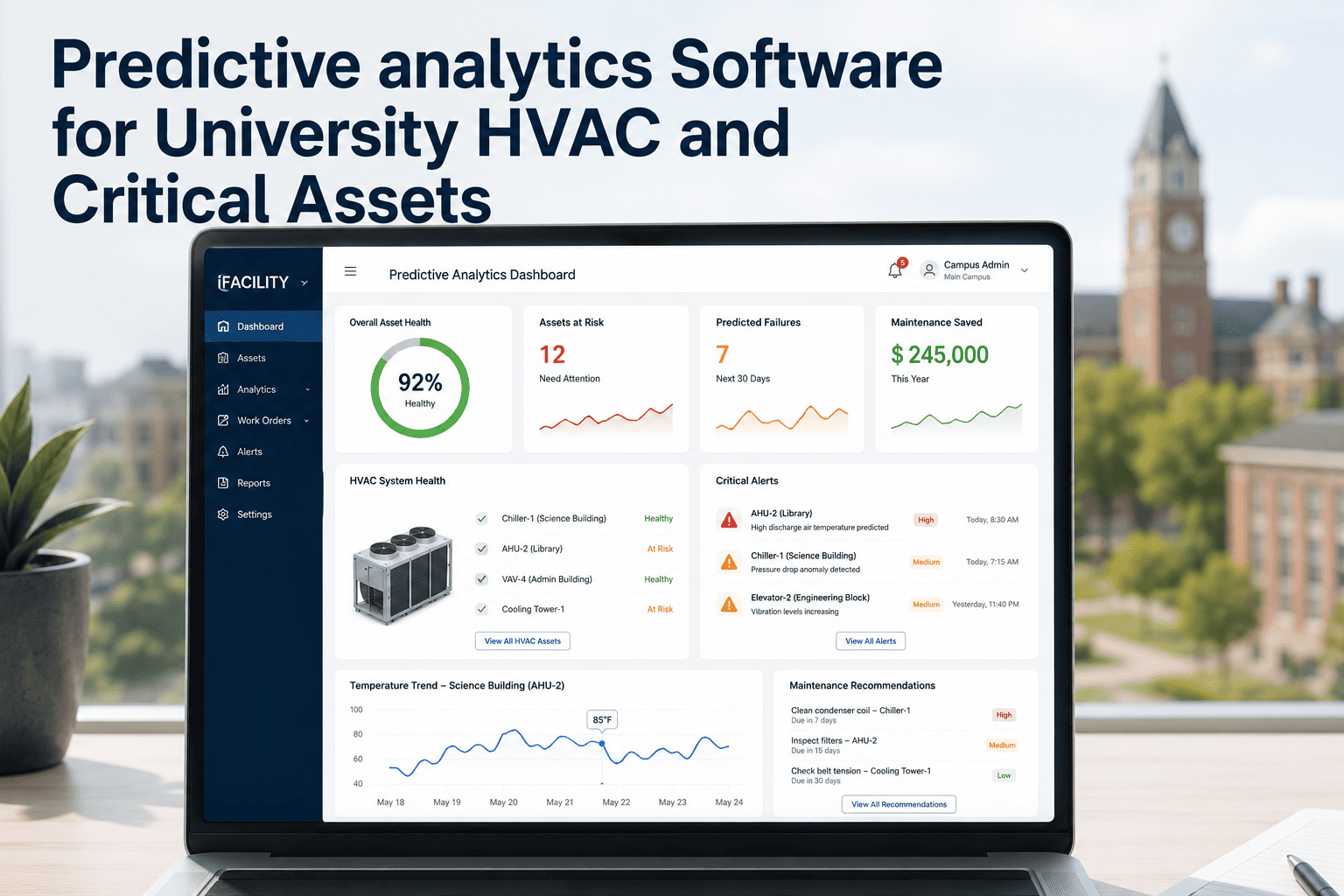
iFactory gives facilities teams the intelligence to act before failure occurs. Four core capabilities address the downtime risk directly.
| Capability | What It Does | Key Outcome |
|---|---|---|
| Predictive Monitoring | IoT sensors, operational telemetry, and maintenance history flag equipment 2 to 4 weeks before failure. Vibration, temperature, run-hours, and energy draw anomalies generate work orders automatically so teams act in scheduled windows instead of crisis mode. | 75% of HVAC failures preventable with early detection |
| Critical Asset Protection | Research lab cooling, ULT freezers, central plant chillers, boilers, and fire safety systems get dedicated monitoring profiles with auto-escalation rules. The right person is notified the moment a threshold is crossed, not after a building tour discovers the problem. | Up to 50% reduction in unplanned downtime incidents |
| Cross-Campus Learning | When a failure is logged at one campus, the AI identifies every identical asset across the entire system and generates proactive inspection work orders with the specific failure mode to check for. Campuses B through K never experience the same unplanned downtime. | One failure at any campus protects identical assets everywhere |
| Downtime Cost Reporting | Emergency spend per building, reactive-to-planned ratio, and avoided downtime cost are tracked continuously and reportable in board-ready formats. CFOs and provosts see the financial exposure in real time alongside the avoidance record that justifies the predictive maintenance investment. | Board-ready risk and cost avoidance reports from live operational data |
FAQ: Campus Downtime Risk Management
Central plant chillers and boilers, electrical distribution panels, research lab cooling systems, ULT freezers, and campus water mains carry the highest risk because a single failure takes down multiple buildings simultaneously. A ULT freezer failure can destroy irreplaceable research samples worth $500,000 to $1 million.
Book a free demo to see iFactory map your campus highest-risk assets in real time.
Contact our support team to discuss your specific campus configuration and asset inventory.
The platform monitors conditions that precede failure, not the failure itself. For HVAC and chillers, key signals include vibration increases indicating bearing wear visible 3 to 6 weeks ahead, temperature differentials outside operating parameters, energy draw increases, and run-hour accumulation above maintenance thresholds.
Contact our support team to discuss your specific equipment inventory and monitoring requirements.
Downtime cost has three layers. Direct costs include contractor rates of $125 to $200 per hour versus $60 to $85 planned, rental equipment, and expedited parts. Operational costs include displaced students and paused research. Reputational costs include media inquiries, grant notifications, and enrollment signal damage.
Book a free demo to see the cost avoidance and emergency spend reporting dashboard live.
Contact our support team for ROI modeling specific to your institution size and baseline.
No replacement required. iFactory connects to your existing BAS via BACnet and standard protocols, reads the telemetry your existing Rockwell, Siemens, Wonderware, or Johnson Controls systems already generate, and adds predictive analytics on top. Your controls infrastructure stays in place completely.
Book a free demo to see the full BACnet and ERP integration architecture running live.