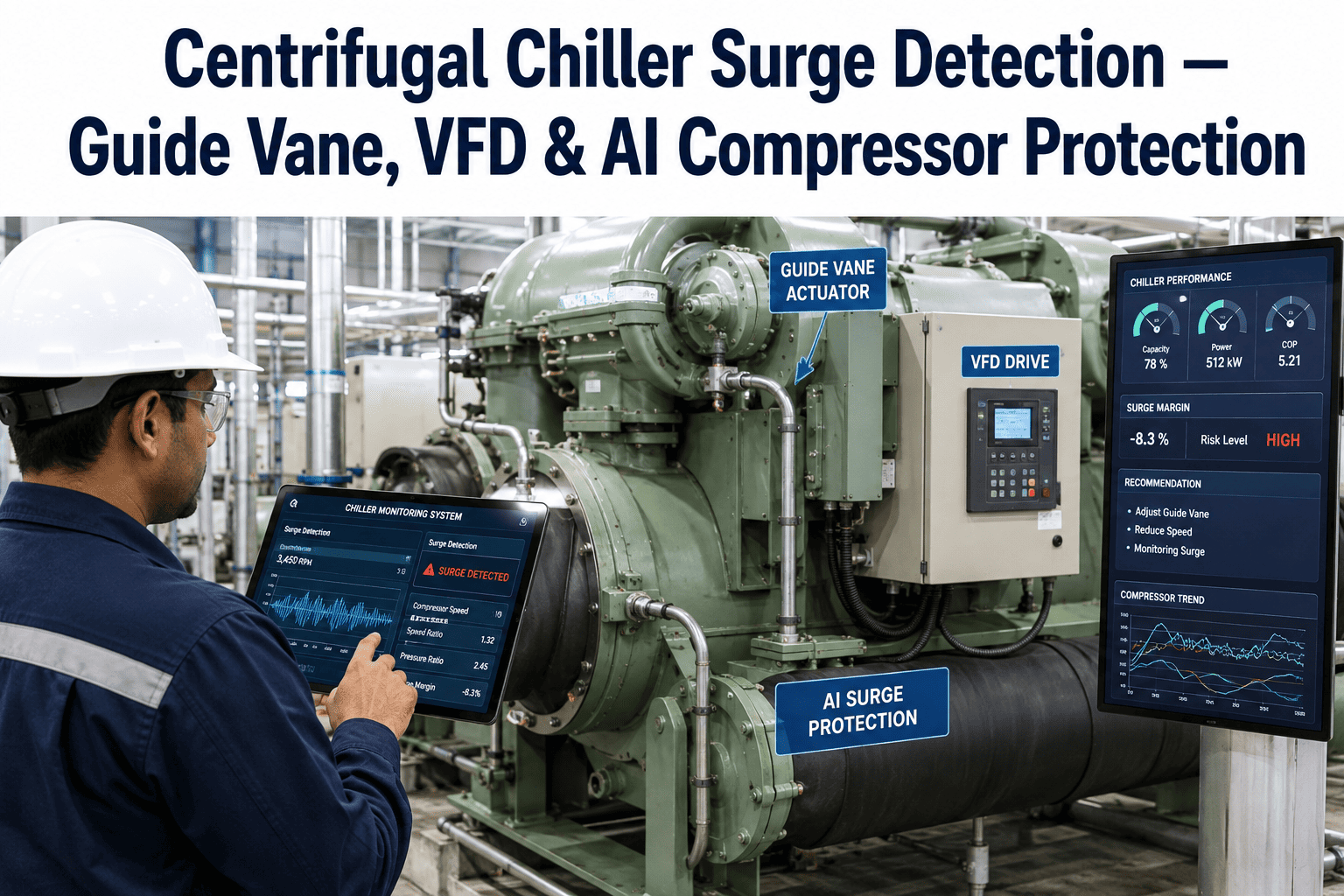
Surge is the failure mode that scares reliability engineers more than almost anything else in a mechanical room, because it does not give a slow warning the way bearing wear or tube fouling does. A centrifugal compressor in surge reverses flow through the impeller dozens of times a second, hammering thrust bearings and impeller shrouds with forces they were never designed to absorb, and a few uncontrolled cycles can turn into a compressor teardown that costs more than the rest of the chiller combined. Guide vane position and VFD load data already carry the early signature of an approaching surge condition, most plants just are not watching them closely enough to catch it in time. See how continuous surge monitoring works at ifactory support.
Catch a Surge Condition Before the Compressor Ever Reaches It
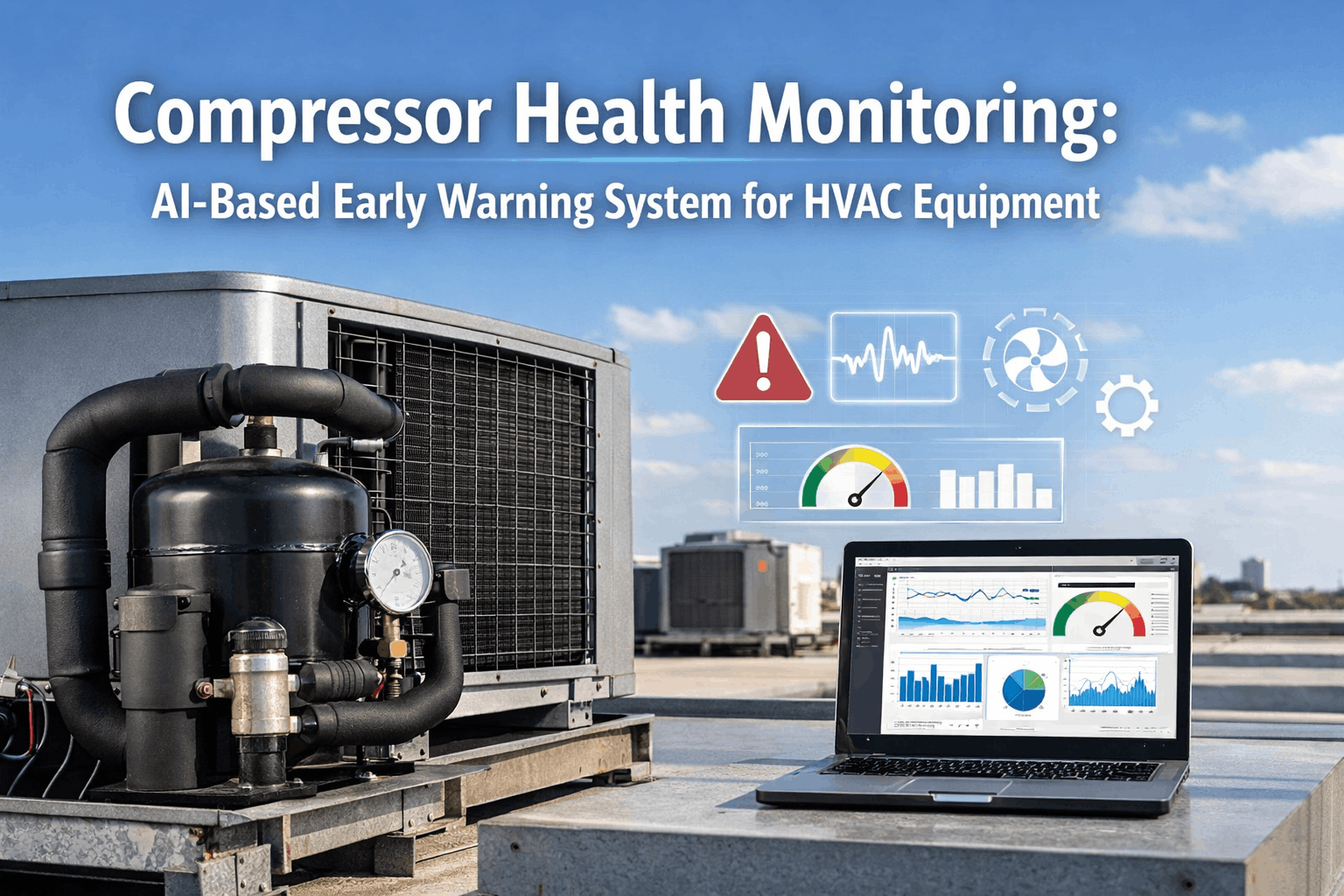
AI reads guide vane position, VFD load, and lift ratio together in real time, flagging the operating window where surge risk rises long before the compressor actually cycles.
Why Surge Damage Is So Disproportionate to the Event That Causes It
A surge event can start from something as ordinary as a rapid drop in building load, a fouled condenser pushing lift higher than the compressor map allows, or a guide vane that closes faster than the control loop can react to falling flow. None of those triggers are unusual on their own. What makes surge dangerous is what happens next: once flow reverses across the impeller, the compressor cycles between forward and reverse flow multiple times per second, and every cycle slams the rotor axially against its thrust bearing. A control system that lets even a handful of these cycles occur before intervening can turn a routine load swing into bearing damage, impeller shroud cracking, or a full compressor teardown.
The frustrating part for most reliability teams is that the built-in anti-surge logic on the chiller controller is reactive by design. It watches for surge and responds once it has already started, opening guide vanes or triggering hot gas bypass after the compressor has already cycled once or twice. That protects against catastrophic failure, but it does nothing to prevent the wear those cycles still cause, and it gives no advance notice that the chiller has been operating closer and closer to its surge line for weeks. AI-based monitoring closes that gap by watching the trend in guide vane position, VFD load, and lift ratio continuously, flagging when the operating point is drifting toward the surge boundary long before the built-in protection logic would ever engage.
A guide vane position that no longer matches this expected curve at a given load, opening further than normal to deliver the same flow, is often the earliest measurable sign of approaching surge risk or actuator wear.
Bring Your Compressor Map to a 30-Minute Review
We will plot recent operating points against your surge line and show how much margin your chiller is actually running with today.
Four Layers Between Normal Operation and a Surge Event
Effective surge protection is not one control loop, it is a stack of layers that each catch a different stage of the problem. Most chillers already have the last layer built in. The value of AI monitoring is filling in the layers ahead of it, the ones that prevent the built-in protection from ever needing to activate in the first place.
What a Surge Event Actually Costs
Reliability engineers who have lived through a surge-related compressor failure rarely need convincing on this point, but it is worth stating plainly for anyone building the business case for continuous monitoring. A single uncontained surge event can produce thrust bearing damage, impeller shroud cracking, or seal failure, and depending on severity the repair can range from a bearing replacement during a planned outage to a full compressor teardown and rebuild.
| Surge Severity | Typical Damage | Repair Cost Range | Downtime Impact |
|---|---|---|---|
| Isolated, brief event | Minor bearing wear, no immediate failure | $50K - $80K | Days, scheduled repair |
| Repeated cycling over weeks | Accelerated bearing and seal wear | $80K - $140K | 1-2 weeks, unplanned |
| Severe, uncontained event | Impeller shroud cracking, compressor teardown | $140K - $200K+ | 4-8 weeks, full rebuild |
Why Reliability Engineers Treat Surge Differently From Other Faults
Most compressor faults, bearing wear, oil contamination, motor winding degradation, share a common trait: the equipment keeps running through the early and middle stages of the failure, giving continuous monitoring a wide window to catch the trend before anything breaks. Surge behaves differently. The event itself is the damage mechanism, not a symptom of damage that already happened elsewhere. A compressor can be mechanically pristine right up until the moment it surges, and the surge event is what introduces the wear in the first place. That inverts the usual monitoring logic: instead of watching for a slow decline in the compressor's own condition, the priority is watching for the operating conditions that make a surge event more likely to occur at all.
This is also why a reliability engineer's relationship with surge risk tends to be more proactive and more procedural than the relationship with other failure modes. Rather than waiting for a monitoring system to flag an already-degrading component, the useful practice is tracking the operating margin to the surge line as a standing metric, the same way a pilot tracks fuel margin rather than waiting for a low-fuel warning light. A chiller that spends most of its operating hours with a comfortable margin to the surge line, verified continuously rather than assumed from the original compressor selection, is a chiller that is very unlikely to ever need its last line of defense to activate.
How Load Management Actually Prevents a Surge Event
The load management layer described earlier deserves a closer look, because it is often the single most effective intervention available once a rising surge risk has been flagged. Many surge events are triggered by rapid, large load changes, a major process load switching off suddenly, multiple air handlers staging down within the same minute, or a building management system commanding an aggressive setpoint change. In each case, the compressor is asked to move a large distance across its operating map faster than its control loop can track cleanly, and that fast transition is exactly the condition where flow can momentarily reverse across the impeller.
Staged load management addresses this directly by smoothing out those transitions before they reach the compressor, ramping setpoint changes over a period of seconds or minutes instead of applying them instantaneously, and coordinating large simultaneous load changes across multiple air handling units so they do not all hit the chiller plant in the same moment. None of this requires hardware changes to the compressor itself; it is a control strategy layered on top of the existing building automation system, informed by the same data that flags rising surge risk in the first place.
Frequently Asked Questions
Get Continuous Surge Margin Visibility on Your Centrifugal Chillers
Bring your compressor map and recent load data to the call, and we will show exactly how close current operation runs to the surge line.