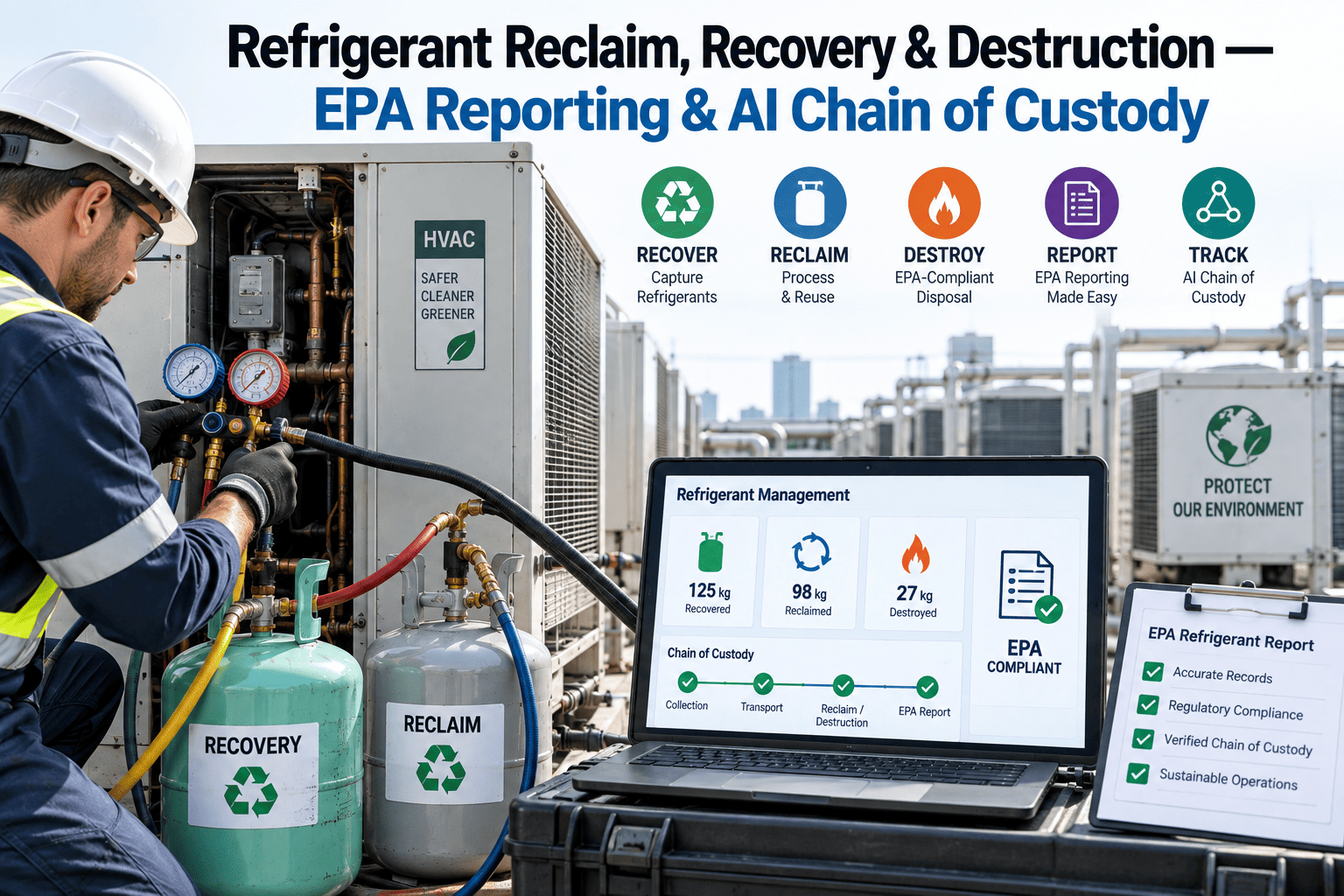
Every pound of refrigerant recovered from decommissioned equipment carries a legal trail behind it: how much was actually recovered, which certified reclaimer took custody, whether it was reclaimed for resale or sent for destruction, and whether a certificate exists to prove any of it happened. Under Section 608 and the AIM Act's HFC phase-down, that trail isn't optional paperwork — it's the record regulators ask for when refrigerant quantities on a compliance report don't match what a facility's equipment inventory would suggest. Most facilities still track this chain across separate technician logs, reclaimer invoices, and disposal certificates that rarely get reconciled against each other until an audit forces the question. AI-based chain of custody tracking closes that gap by tying recovery weight, reclaimer certification, and destruction documentation into one continuous record. See what a defensible refrigerant custody record looks like for your fleet.
A Broken Chain of Custody Is a Compliance Gap Waiting to Be Found
Recovery, reclaim, and destruction each generate their own paperwork, rarely reconciled until an audit forces the question. AI custody tracking ties the whole chain together automatically.
the EPA regulation governing refrigerant recovery, reclaim, and recordkeeping obligations for regulated equipment
HFC production and consumption reduction already underway under the AIM Act's phase-down schedule
minimum documents needed to prove a single recovery event — technician log, reclaimer receipt, and destruction certificate
The Custody Chain, Link by Link
Every stage of a refrigerant's post-recovery life needs its own verified record, and a gap at any single link undermines the whole chain.
Recovery at the Equipment
A certified technician recovers refrigerant from decommissioned or serviced equipment, logging recovered weight against the equipment's known charge as the first verifiable data point in the chain.
Transfer to a Certified Reclaimer
Recovered refrigerant moves to an EPA-certified reclamation facility, generating a transfer receipt that should match the weight logged at recovery within an expected tolerance.
Reclaim or Destruction Decision
Refrigerant that meets purity standards gets reclaimed for resale; contaminated or obsolete refrigerant is routed to a certified destruction facility instead, each path requiring different documentation.
Certificate of Destruction or Reclaim
A final certificate closes the loop, documenting exactly what happened to the recovered quantity and completing the record a compliance report or audit would need to see.
Why the AIM Act Phase-Down Makes Documentation More Urgent
As HFC production allowances shrink under the AIM Act's phase-down schedule, reclaimed refrigerant becomes a more valuable and more scrutinized supply source rather than a formality. Regulators increasingly cross-reference reported recovery volumes against equipment inventories and service records, which means a facility with incomplete custody documentation isn't just missing paperwork — it's carrying compliance exposure that grows as allowances tighten. A recovery event without a matching reclaimer receipt, or a reclaim record without a corresponding destruction or resale certificate, is exactly the kind of gap that surfaces during an EPA audit or a customer's supply chain due diligence request, and it's far cheaper to close that gap with continuous tracking than to reconstruct it after the fact.
Find the Gaps in Your Current Custody Records
iFactory reviews your recovery logs, reclaimer receipts, and destruction certificates to show exactly where the chain of custody is incomplete today.
Custody Stage, Required Documentation, and Typical Gap
Each stage of the chain has its own documentation standard, and the gap between what's required and what most facilities actually have on file widens the further along the chain you look.
What AI Custody Tracking Actually Verifies
Three checks together catch the discrepancies that manual reconciliation tends to miss until an audit forces a closer look.
Recovery Weight Verification
Logged recovery weight is checked against the equipment's documented charge, flagging discrepancies that suggest incomplete recovery or logging error.
Reclaimer Certification Validation
Every transfer is matched against the receiving facility's current EPA certification status, catching an expired or invalid reclaimer before it becomes a compliance finding.
Destruction Certificate Audit Trail
Certificates of destruction are reconciled against the original recovery quantity, closing the loop so every pound recovered has a documented end state.
What Changes When the Chain Is Tracked Continuously
Figures reflect typical outcomes within the first two quarters after moving from manual reconciliation to continuous custody tracking across a multi-site refrigerant program.
A Compliance Officer's View on Custody Documentation
We found out how fragile our documentation was the first time a customer's supply chain audit asked us to prove where refrigerant from a specific decommissioning project actually ended up. It took us nearly three weeks to reconstruct the chain from technician logs, reclaimer emails, and a destruction certificate that had been filed under the wrong project number. Having that chain tracked continuously now means the next request like that takes an afternoon instead of a scramble.
The Bottom Line on Refrigerant Custody Compliance
A refrigerant compliance program is only as strong as its weakest documented link, and most programs have at least one — a missing transfer receipt, an expired reclaimer certification, a destruction certificate that never got matched back to the original recovery event. As AIM Act phase-down pressure increases scrutiny on reclaimed refrigerant supply, those gaps carry more compliance risk than they used to. Continuous, automated custody tracking closes them before an audit or a customer inquiry ever finds them.
Frequently Asked Questions
What exactly does Section 608 require for refrigerant recordkeeping?
Section 608 requires technicians and facility owners to maintain records of refrigerant recovered from and added to certain equipment, along with documentation showing recovered refrigerant was transferred to a certified reclaimer or destruction facility when applicable. The exact recordkeeping threshold and retention period depend on equipment type and refrigerant charge size. Book a review to see how this applies to your specific equipment fleet.
How does the AIM Act phase-down affect existing refrigerant already in service?
The AIM Act phase-down primarily restricts production and import of virgin HFCs, which increases reliance on reclaimed refrigerant to service existing equipment as new supply tightens. This makes accurate reclaim documentation more valuable, both for regulatory compliance and because reclaimed refrigerant is becoming a more significant part of the overall supply a facility depends on.
What happens if a recovery weight doesn't match the reclaimer's receipt?
A mismatch between logged recovery weight and the reclaimer's receipted quantity can result from measurement variance, evaporative loss during transfer, or a genuine documentation error, and each of these has a different resolution path. Flagging the discrepancy early, rather than discovering it during an audit, gives a facility time to investigate and correct the record while the details are still fresh.
Can this track refrigerant custody across multiple facilities and service vendors?
Yes — a multi-site program typically involves several service vendors and reclaimers, and continuous tracking consolidates records from all of them into a single system rather than requiring each site to maintain separate documentation that has to be manually reconciled at the corporate level during a compliance review.
How is a reclaimer's certification status actually verified?
Reclaimer certification status is checked against current EPA-certified reclaimer listings at the time of each transfer, rather than assumed to be valid based on a certification date recorded once when the vendor relationship began, since certifications can lapse or be revoked between transactions. Talk to a specialist about connecting this verification step to your existing vendor management process.
Close the Gaps Before an Audit Finds Them
Book a 30-minute assessment. iFactory reviews your refrigerant recovery, reclaim, and destruction records and shows exactly where the chain of custody needs work.