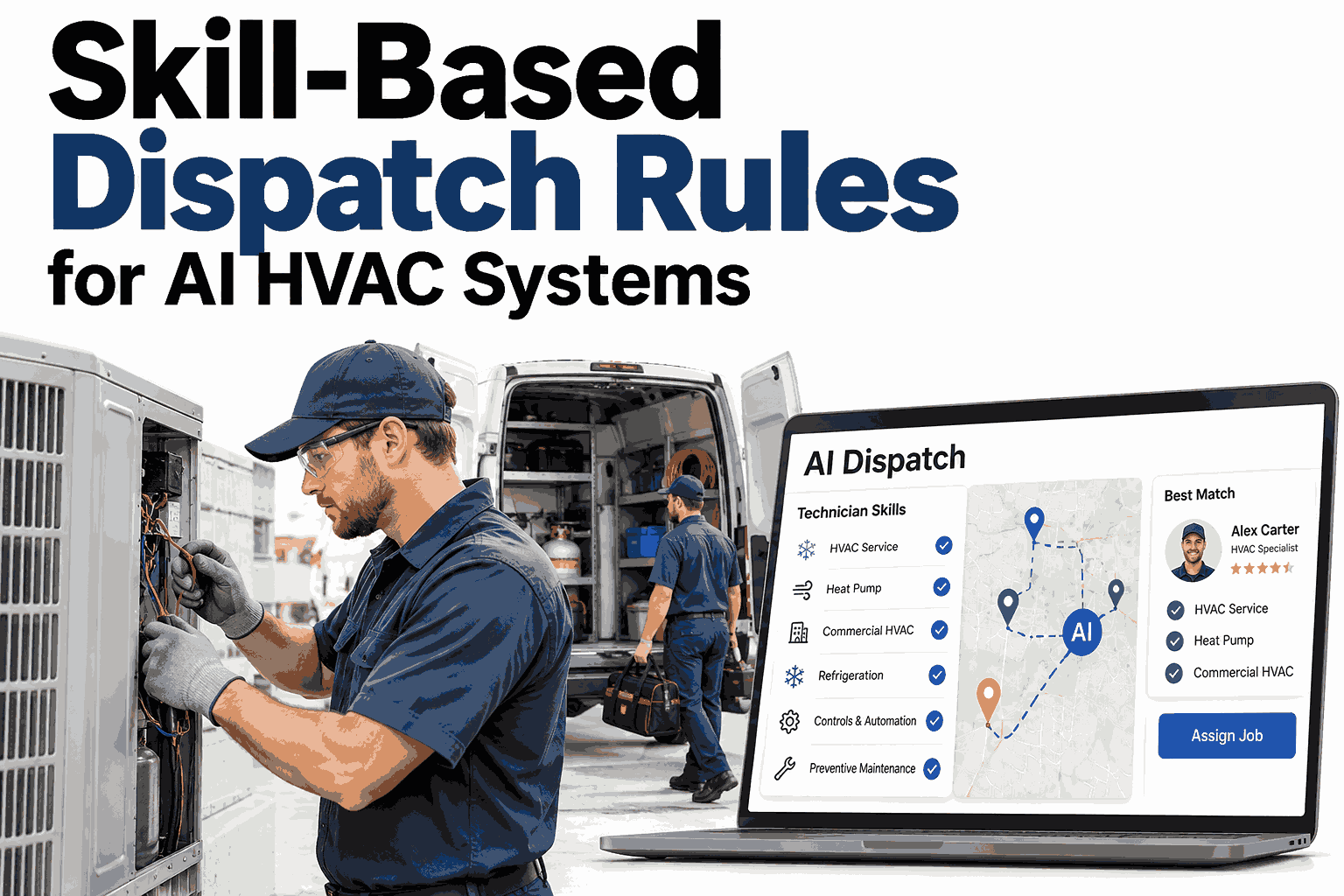
Every HVAC dispatcher has sent a technician to a job and watched the call come back with "need a different tech." The truck rolled, the hours were billed, and the equipment is still down, all because the person assigned was available but not qualified for that refrigerant, that controller, or that fault. Skill-based dispatch fixes this by treating certification, equipment familiarity, and job complexity as hard routing inputs instead of notes in a dispatcher's head. The teams that get this right in 2026 write explicit rules and let software apply them to every ticket, and a demo of iFactory's dispatch engine shows those rules running on your own work orders.
AI HVAC DISPATCH AND ROUTING
Skill-Based Dispatch Rules That Put the Right Tech on the Right Job
iFactory scores every HVAC job for complexity, checks every technician for certification and equipment familiarity, and routes the match automatically.
THE COST OF A BAD MATCH
Why Nearest Available Is the Wrong Dispatch Rule
Proximity-only dispatch optimizes for drive time and ignores whether the technician can actually finish the repair once on site.
The Return Visit
A tech without the right controls training diagnoses the symptom, orders a part, and leaves. A second truck roll finishes what the first one started.
The Compliance Gap
Refrigerant work requires the right EPA certification. Sending an uncertified tech to a recovery job is a legal exposure, not a scheduling inconvenience.
The Senior Tech Drain
When rules are missing, dispatchers send the most experienced person to everything. Senior techs burn out on filter changes while complex jobs queue up.
The Slow Learning Curve
Junior techs never get matched to jobs that stretch them safely, so skills stay flat and the team depends on the same few people.
Each of these problems traces back to the same gap: skills live in people's heads, not in the dispatch system.
THE THREE RULE LAYERS
Certification, Familiarity, and Complexity Work Together
A reliable skill-based dispatch model stacks three layers, and a job must pass them in order before a technician is assigned.
LAYER 1
Certification Gate
A hard pass or fail. If the job requires a credential and the tech lacks it, they are excluded.
LAYER 2
Equipment Familiarity
A ranking. Among certified techs, those with more history on this make and model rank higher.
LAYER 3
Complexity Match
A balance. The job's complexity score is matched to a tech's proven level, with room for growth.
Gate first, rank second, balance third. Reversing that order is how teams end up with a fast but unqualified assignment.
LAYER ONE
Building the Certification Gate
The gate should reflect what the work legally and practically requires, and every credential should map to specific job types.
EPA 608 Type I
Small appliances with factory-charged refrigerant systems.
EPA 608 Type II
High-pressure systems, including most commercial rooftop and split units.
EPA 608 Type III
Low-pressure systems such as centrifugal chillers.
EPA 608 Universal
Covers all three types and unlocks the widest job pool.
NATE Specialty
Proof of competency in areas such as air conditioning, heat pumps, or commercial refrigeration.
State or Local License
Required in many regions for unsupervised work or gas and electrical tie-ins.
Safety and site credentials such as OSHA training, confined-space or lift certification, and customer-specific site access belong in the gate too.
EXPIRY AND RENEWAL
Credentials That Expire Should Quietly Remove Techs From the Pool
A gate is only trustworthy if it stays current, so every certification record needs an expiry date the dispatch engine can read.
1
Record the Credential
Store type, issue date, expiry date, and issuing body against each technician profile.
2
Warn Ahead of Expiry
Alert the tech and their manager well before the date so renewal never becomes an emergency.
3
Block on Lapse
The moment a credential lapses, jobs that need it stop routing to that tech without a dispatcher doing anything.
4
Restore on Renewal
Uploading the new credential returns the tech to the eligible pool automatically.
LAYER TWO
Scoring Equipment Familiarity
Two techs can hold the same certification and still perform very differently on a specific controller or compressor platform.
Completed jobs on the same make and model
Manufacturer training on record
First-visit fix rate on this equipment class
Recency of last job on this equipment
The bars above show a sample weighting. Your own mix should reflect which signals best predict a clean first-visit fix in your portfolio.
FAMILIARITY LEVELS
Four Proficiency Tiers Dispatchers Can Actually Use
Converting history into a small number of tiers keeps the rules readable for dispatchers and techs alike.
TIER 1
Aware
Has seen the equipment. Can assist, not lead.
TIER 2
Practiced
Handles routine service and standard faults alone.
TIER 3
Proficient
Diagnoses uncommon faults and works across firmware versions.
TIER 4
Authority
Mentors others and takes escalations on this platform.
See your own jobs scored and matched by skill
Bring a week of work orders and watch iFactory apply certification, familiarity, and complexity rules to each one.
LAYER THREE
The Complexity Score Behind Every Ticket
A complexity score turns a vague "hard job" into a number the dispatch engine can compare against technician level.
Fault history on this asset
Controls and integration involvement
Site access and safety constraints
Combine these factors into a single score, then map score ranges to the proficiency tiers above.
SCORE BANDS
From Score to Assignment
Bands translate a numeric score into a plain instruction the dispatcher and the engine both understand.
Low
Routine Service
Filter changes, belt checks, and scheduled inspections. Route to Tier 1 or 2 techs, and use them as growth jobs.
Medium
Standard Repair
Common component failures with known diagnostics. Route to Tier 2 or 3 techs with matching certification.
High
Complex Diagnosis
Repeat faults, controls issues, and multi-system problems. Route to Tier 3 or 4 techs only.
Critical
Mission-Critical Failure
Chillers, data halls, or healthcare space. Route to the best available authority and notify a supervisor.
THE RULE ORDER
The Dispatch Decision Ladder
Order matters. Each rung removes unqualified options before the next rung ranks what remains.
01Filter by certification and site credentials
02Filter by shift, availability, and parts on the truck
03Rank by equipment familiarity tier
04Check complexity score against tier and workload
05Break ties on drive time and route fit
06Assign, notify, and log the reason for the choice
Logging the reason on rung six is what lets dispatchers trust the engine and coach it when something looks off.
JOB TO SKILL MAP
Sample Matching Matrix by Job Type
This sample shows how common HVAC jobs translate into dispatch requirements. Adjust it to your equipment mix.
| Job Type |
Certification Needed |
Familiarity Tier |
Complexity |
| Preventive maintenance visit |
Basic license where required |
Tier 1 or higher |
Low |
| Refrigerant leak repair and recharge |
EPA 608 matching system type |
Tier 2 or higher |
Medium |
| BMS controller fault |
Controls or manufacturer training |
Tier 3 or higher |
High |
| Chiller compressor failure |
EPA 608 Type III or Universal |
Tier 4 |
Critical |
| Repeat comfort complaint |
Standard plus system familiarity |
Tier 3 or higher |
High |
RULES IN ACTION
Three Dispatch Scenarios, Before and After
Real dispatch pressure rarely looks like a clean example, so these scenarios show how the rules behave under common conditions.
Rooftop Unit Down at 2 PM
Without rules: The nearest tech is sent and cannot read the controller.
With rules: A certified Tier 3 tech on that platform is assigned and arrives with the likely part.
Chiller Alarm After Hours
Without rules: A dispatcher calls techs one by one, hoping someone qualified answers.
With rules: Only Type III certified authorities are paged, in ranked order, with fault context attached.
Routine Filter Rounds
Without rules: A senior tech is pulled off diagnostics to cover the route.
With rules: Tier 1 and 2 techs take the rounds, and seniors stay free for high-complexity work.
The pattern is consistent: rules protect scarce expertise and shorten the path from ticket to fix.
RULE DESIGN PITFALLS
What Good Rules Do, and What Breaks Them
Skill rules fail in predictable ways, and most are avoidable with a little design discipline up front.
Keep Doing
Treat certification as pass or fail and familiarity as a ranking.
Keep tier definitions short enough for every tech to recall.
Show the reason behind every assignment.
Let first-visit fix results update familiarity over time.
Stop Doing
Hard-coding a single hero tech for every difficult job.
Letting expired credentials stay in the eligible pool.
Scoring complexity once and never revisiting it after repeat visits.
Using drive time as the first rule instead of the last.
HOW IFACTORY DELIVERS IT
From Skill Spreadsheet to Live Routing
iFactory connects your technician records, equipment registry, and work order history, then applies your rules to live dispatch.
Phase 1
Skills and Asset Import
Load technician credentials, equipment lists, and past work orders into one profile per tech and asset.
Phase 2
Rule Calibration
Set certification gates, tier thresholds, and complexity weights against your own job history.
Phase 3
Shadow Dispatch
Run the engine beside your dispatchers and compare its picks to theirs before going live.
Phase 4
Live Routing
Switch on automated assignment with dispatcher override and a full reason log for each decision.
Timing depends on how clean your skill and asset data is today, which is a good topic to cover in a short demo.
FREQUENTLY ASKED QUESTIONS
What HVAC Teams Ask About Skill-Based Dispatch
Can a dispatcher override the system's assignment?
Yes. Overrides are part of the design, since dispatchers know things no rule can see, such as a customer relationship or a tech's recent fatigue. Every override is logged with a reason so it can inform future rule tuning.
See the override workflow in a live walkthrough on your own data.
How do we handle technicians who are still building skills?
Rules can reserve a share of medium-complexity jobs as stretch assignments, paired with a Tier 3 or 4 mentor. This lets junior techs grow without risking a failed first visit on critical equipment.
Ask our support team about mentorship pairing rules for your crew.
What if our certification records are scattered or incomplete?
That is the most common starting point. Credentials can be imported from spreadsheets or HR exports, and gaps are flagged so managers can fill them before go-live. Techs with missing records are simply excluded from gated jobs until verified.
Review your data readiness with a specialist before rollout.
Does skill-based routing slow down emergency response?
It usually speeds it up, because the engine removes unqualified techs in seconds instead of a dispatcher making phone calls. For emergencies, drive time can be weighted more heavily among already-qualified techs.
Contact support to configure emergency priority for your service levels.
Can different sites or contracts use different rules?
Yes. A hospital contract may require extra credentials and a higher minimum tier, while an office park may not. Rules attach to site, contract, or asset class so each customer gets the matching standard.
Walk through multi-site rule setup in a short session.
THE RIGHT TECH, EVERY TIME
Stop Dispatching on Availability Alone
iFactory turns certification, equipment familiarity, and complexity into dispatch rules that run on every ticket, so first-visit fixes go up and wasted truck rolls go down.