Adaptive SPC in Mining Conveyor Systems: Operators Playbook
By Grace on June 13, 2026
Every shift on a mining conveyor system follows the same rhythm. The belt runs. Material moves. The operator watches vibration gauges, motor current draw, belt speed, and tracking alignment. When a reading drifts outside the static Upper Control Limit or Lower Control Limit printed on the shift log, the operator flags it. The supervisor logs an observation. A maintenance ticket opens. And yet — the splice failure that stops production for six hours, the belt tear that spills 40 tons of ore, the bearing seizure that takes out an entire idler station — these events keep occurring against every operator's control chart. The defect repeats because the SPC limit that should have caught the drift was calibrated for a different feed rate, a different belt tension setting, or a different ambient condition. Static limits treat every operating regime as identical. They are not. Adaptive SPC fixes this at the control-chart level — and gives operators a tool that finally reflects what the belt is actually doing right now, not what it was doing when the capability study was run 18 months ago.
Operators Who Maintain Conveyor Defect Rates Below 2% in Mining Share One Common Practice: Their Control Limits Move With Their Belt.
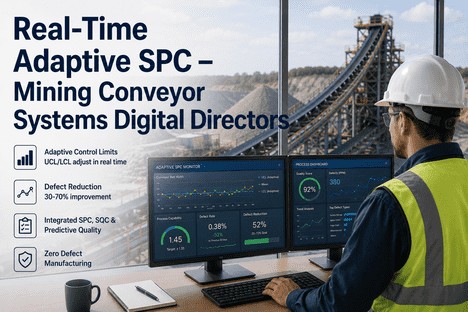
iFactory's adaptive SPC platform gives mining conveyor operators dynamic control limits that recalibrate to every feed change, belt speed transition, material variation, and load regime shift — with predictive defect forecasting, belt vision integration, and audit-ready compliance records built in from day one.
Conveyor defect reduction documented across mining operations using adaptive SPC with dynamic control limits and real-time belt monitoring
92%
Defect prediction accuracy achieved by AI-native SPC systems analysing hundreds of conveyor process parameters simultaneously
50–70%
False alarm reduction when adaptive ML control limits replace static operator charts — restoring SPC alert credibility on the shop floor
15%
Overall conveyor system yield improvement when AI-SPC predicts belt defects and splice failures before they cause production stops
The Core Problem for Conveyor Operators: Why the Same Defects Keep Appearing on Your Shift Log
A belt misalignment is corrected. The tracking sensor shows green. The operator resets the alarm and logs the observation. Two weeks later — under a different feed material, a different belt load, or a different ambient temperature — the same misalignment pattern returns. The operator investigates the same idler station. The same tracking roller adjustment is made. The corrective action log has a different date, but the description reads identically to the last one. This is not an operator failure. It is a control-limit failure. The static UCL and LCL on the operator's SPC chart could not distinguish between a normal shift in belt behaviour caused by changing load conditions and an abnormal drift that signals genuine splice deterioration or idler misalignment. Adaptive control limits make this distinction automatic — and eliminate the root cause of recurring conveyor defects.
The Five Root Causes of Recurring Conveyor Defects — and How Adaptive SPC Eliminates Each One
01
Static Limits Ignore Feed Material Variation
When the conveyor feed switches between ore types — harder material from a different mining face, wetter material after a rainfall event, finer material from a crusher change — the normal operating range for motor current draw, belt speed, vibration signature, and chute loading all shift simultaneously. Static control limits calibrated on last quarter's feed specification fire false alarms on legitimate material transitions and miss genuine belt drift because the limits no longer bound the actual defect risk zone.
Adaptive SPC fix: Feed material change registered by the system. Control limits recalibrate to new baseline within a configurable transition window — no false alarms during the regime shift.
02
Belt Tension and Load Regime Shifts Go Undetected
Conveyor belts operate at different tension profiles depending on tonnage, start-stop cycles, and gradient loading. A belt carrying 70% of its rated capacity has a different vibration signature and tracking behaviour than one running at 30%. Static SPC limits set for average loading conditions flag the 70% regime as abnormal when it is perfectly normal — and miss the tracking deviation that indicates a real idler failure developing under the 30% regime. Every load transition resets the operator's baseline, but the static chart cannot know this happened.
Adaptive SPC fix: Load regime detected algorithmically. Limits adapt to tension profiles without operator intervention — every alert reflects a genuine deviation from the current operating state.
03
Idler and Pulley Wear Progression is Masked by Static Bands
As idlers wear, bearing friction increases gradually — not suddenly. A static control limit set at 3-sigma from a six-month-old baseline will not detect this progression until the bearing is near failure, because the gradual increase in vibration amplitude remains within the wide static band. By the time the static limit fires, the idler has already damaged the belt underside. Operators who wait for static limits to flag bearing wear are operating on maintenance lag, not predictive lead time.
Adaptive SPC fix: Adaptive limits track gradual wear progression and tighten as the process baseline shifts — detecting bearing degradation weeks earlier than static limits can.
04
Operator Alert Fatigue From False Positives
The cumulative effect of root causes one through three is a control room where operators have learned to ignore SPC alerts. When 60 to 80% of alarms during feed changes, load transitions, and start-up sequences are false positives, the auditory alert becomes background noise. The one genuine splice-deterioration warning that fires during a tonnage ramp looks identical to the fourteen false alarms that preceded it. Operators stop responding. The defect that the SPC system was installed to prevent occurs because the system cried wolf too many times.
Adaptive SPC fix: False alarm rate drops 50–70%. Every alert reflects a genuine deviation requiring operator attention. Credibility restored.
05
Belt Splice Deterioration Is Invisible Until the Static Limit Breaks
Splice degradation follows a non-linear curve — slow progression for weeks, then rapid failure in hours. Static control limits sampled at 15-minute intervals cannot capture the accelerating trend because the early-stage increase sits well within the static band. Operators discover the splice issue only when the belt tears or the splice separates at the pulley — a catastrophic failure mode that produces unplanned downtime measured in shifts, not minutes.
Adaptive SPC fix: Rolling-window analysis detects the acceleration curve and generates a predictive splice alert 24–48 hours before failure. Operators act on lead time, not post-mortem data.
Root Cause Analysis · Adaptive Limits · Cross-Shift Traceability · ISO 9001 Audit Ready
When the Same Conveyor Defect Reappears on Three Different Shift Logs, the SPC System Is Not the Safety Net — It Is the Source of the Gap. Adaptive Limits Close It.
iFactory builds the distinction between a process change and a process deviation directly into the limit calculation — so conveyor operators receive alerts that reflect genuine belt risk, not limits that stopped tracking reality at the last quarterly capability study.
How the Adaptive SPC Architecture Works for Conveyor Operators
The iFactory adaptive SPC platform operates as a three-layer quality intelligence system for conveyor operations — adaptive real-time control at the sensor level, predictive defect forecasting at the shift level, and audit-ready documentation at the compliance level. Each layer serves a distinct operator function, and all three run continuously without requiring operator intervention to maintain.
Layer 01
Adaptive Real-Time Belt Monitoring
Dynamic UCL/LCL that move with every conveyor regime shift
The adaptive control layer ingests every conveyor process variable — motor current, belt speed, vibration from idler stations, belt tracking offset, pulley temperature, material flow rate, and chute impact measurements — and maintains a rolling statistical model of the current belt operating baseline. Control limits are recalculated continuously against this model. When the belt is stable and tracking is within tolerance, limits tighten to increase sensitivity to emerging defects. When a legitimate regime change is detected (feed material change, tonnage ramp, speed transition), limits move with the process to the new baseline without generating false alarms during the transition. The operator sees live control charts where every alert reflects a genuine deviation from the current belt condition, not from the condition logged three months ago on a different feed type.
Continuous limit recalculation
Regime change detection
Transition window management
Layer 02
Predictive Conveyor Defect Forecasting
Forecast belt defects 2–24 hours before the splice fails or the motor overheats
The predictive layer uses an ML model trained on historical conveyor process variable patterns and their correlation with defect outcomes — belt tears, splice failures, idler seizure, motor overcurrent trips, and belt tracking loss. When the current combination of belt parameters matches a pattern historically associated with a pending defect, the system generates a predictive alert before the physical failure occurs. For splice deterioration, which progresses slowly for weeks then accelerates in hours, this provides the operator with an intervention window measured in days — enough time to schedule a planned splice inspection during a maintenance window rather than reacting to a catastrophic belt separation during production. This predictive lead time is the defining capability that separates adaptive SPC from traditional monitoring: it does not wait for the defect to appear on the control chart — it forecasts the defect from the pattern.
Splice failure forecast
Belt tear prediction
Motor overload alert
Layer 03
Audit-Ready Operator Logs and Compliance Records
Automated ISO 9001 documentation from every shift
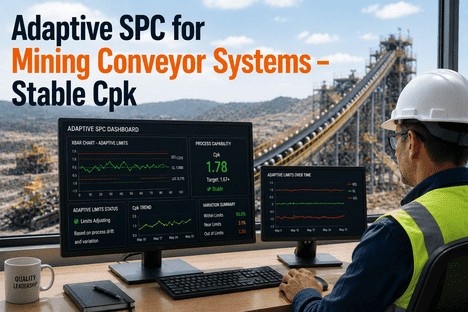
Every adaptive limit change, every predictive alert, every operator action, and every belt inspection result is logged automatically with a timestamp and process context — feed material ID, belt load range, speed setting, and shift identifier. This creates the documentation chain that ISO 9001 Clause 7.5 and 10.2 require: not just a record that a defect occurred, but a record showing what the adaptive system detected before the defect was confirmed, what action the operator took, and what the post-intervention Cpk trend confirms. For mine site compliance audits, this demonstrates that the conveyor quality programme is proactive — a materially stronger position than a programme that documents conveyor failures after they cause downtime. Cpk trend reports by belt line, CAPA linkage records, and process capability histories are all generated automatically and exportable for any date range, belt segment, or shift period.
ISO 9001 shift records
CAPA linkage by belt line
Cpk history per belt segment
What the Adaptive SPC Operator Dashboard Shows You Every Shift
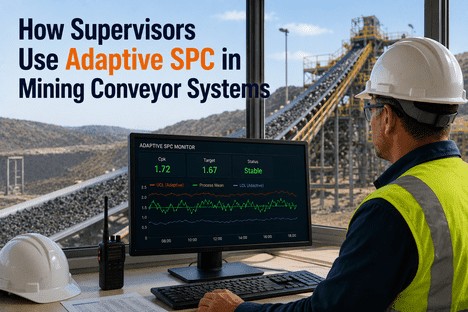
The operator's view of the adaptive SPC system is not a complex process control interface filled with engineering parameters — it is a belt-quality management dashboard designed around the questions that matter every shift: Is the belt running in control right now? What is the current defect risk and which parameter is driving it? Is the Cpk trend moving toward or away from target? And when the next audit file request arrives, is the documentation ready to export?
Operator View 01
Live Belt Health Status by Conveyor Segment
A single-screen view of belt health status across all monitored conveyor segments — head pulley zone, carry side, return side, tail pulley zone, and transfer points. Each segment displays a current status indicator based on adaptive limit compliance rate, the top-ranked parameter driving any elevated risk, and the time since the last predictive alert. Operators see the entire belt line health status in one glance without navigating machine-by-machine or waiting for the shift supervisor to compile reports.
Operator action: Prioritise belt walkdown inspection by segment risk level. Elevated segments receive immediate visual inspection.
Operator View 02
Cpk Trend by Critical Belt Parameter
Cpk is calculated continuously for each critical belt parameter — belt tracking offset, motor current variation, vibration amplitude at each idler station, and belt speed consistency — and displayed as a live trend line with the current value and the projected Cpk at current trajectory. Operators see whether belt capability is improving, holding, or declining in real time, not as an end-of-shift report. A falling Cpk trend on belt tracking triggers an investigation before it crosses the warning threshold.
Operator action: Declining Cpk initiates a pre-maintenance check before the parameter drifts out of spec.
Operator View 03
Conveyor Defect Pareto — Ranked by Type and Shift
The defect Pareto view ranks conveyor defect occurrences by category, belt segment, shift, and material type. An operator who sees that 65% of belt tracking alarms occur within the first two hours after a feed material change has a pattern to act on — not an isolated event to log and close. The Pareto is generated automatically from the adaptive SPC event log without manual data compilation at shift handover.
Operator action: Pareto patterns feed into shift handover briefings — operators entering the next shift know what to watch for based on the material running.
Operator View 04
Predictive Alert Feed — What to Watch Next Shift
The predictive alert feed shows the operator which belt segments have generated a forecasted defect risk for the upcoming shift, ranked by probability and estimated time to failure. A splice deterioration alert projected at 73% probability within 18 hours appears on the feed alongside the recommended operator action — reduced belt speed, increased visual inspection frequency, or preparation for planned splice replacement. The operator does not need to interpret ML model outputs; the system translates the forecast into an actionable task.
Operator action: Review predictive feed at start of shift. Act on alerts ranked high probability before production ramp.
Operator View 05
CAPA Effectiveness — Did the Fix Actually Work?
Every operator action recorded against an adaptive SPC alert is tracked through to confirmation of effectiveness. If the same parameter combination generates another alert within a configurable window after the corrective action was closed — for example, belt tracking deviation at the same idler station within 30 days of an alignment correction — the system flags the CAPA as ineffective and re-opens the investigation automatically. Operators do not need to remember what they fixed last shift; the system links the recurrence to the previous event and escalates it.
Operator action: CAPA flagged ineffective if the same parameter combination alerts again within the effectiveness window.
Operator View 06
Machine Vision Integration — Belt Surface Inspection at Line Speed
For conveyor operations deploying machine vision cameras at transfer points or along the belt path, iFactory integrates vision inspection outputs directly into the adaptive SPC control chart as additional quality data streams. Vision-detected surface defects — belt cover cracks, edge fraying, splice gap widening, or material carryback accumulation — are logged against the belt segment record and contribute to the Cpk calculation for physical belt condition. This gives operators a continuous visual inspection record alongside the vibration and current data, closing the coverage gap between periodic walkdown inspections and real-time monitoring.
Operator action: Vision defect data feeds into the adaptive SPC chart automatically. No separate visual inspection log to maintain.
"
Our conveyor SPC system had been running static limits for years. Every time we changed feed material — from primary crusher to secondary stockpile — the control chart would fire dozens of false alarms for the first two hours of the shift. Our operators stopped looking at the chart entirely. They told us the system was more trouble than it was worth. We switched to adaptive limits and within the first week, the false alarm rate dropped so dramatically that one of our senior operators called the control room to ask if we had turned the alerts off. We had not. The alerts that remained were real — a tracking deviation at idler station 47 that turned out to be a seized bearing. That bearing would have run to failure under the old static system. The operator caught it on a walkdown because the adaptive alert gave him a specific location to check. That was the moment the control room started trusting the SPC system again.
— Shift Supervisor, Copper Concentrator Conveyor System — 4 km Overland Belt, 8,000 tph Rated Capacity
Conclusion
Conveyor defect elimination in mining is not a maintenance scheduling problem — it is a detection architecture problem. When the SPC system generates alerts that do not reflect current belt conditions, when operators have learned to ignore false alarms because the limits were set for a different operating regime, and when splice deterioration goes undetected until the belt tears at the pulley, defects recur because the monitoring system is structurally unable to prevent them. Adaptive SPC addresses all three dimensions simultaneously: limits that move with the conveyor process so every alert reflects genuine risk, cross-shift pattern detection that surfaces systemic causes from the Pareto view, and predictive forecasting that provides intervention lead time measured in shifts rather than post-failure analysis.
The industry evidence from 2025 and 2026 is clear: AI-powered SPC systems that predict yield issues 24 hours ahead and analyse hundreds of process parameters simultaneously have documented 92% forecast accuracy and 15% overall yield improvement in mineral processing environments comparable to conveyor operations. The 30 to 70% conveyor defect reduction range is not a projection — it is the documented outcome range from mining operations that moved from static SPC to adaptive quality management. The operators achieving the upper end of that range are the ones who deployed adaptive limits early, configured cross-belt traceability from feed to discharge, and used the Pareto and CAPA effectiveness tracking to convert individual belt corrections into systemic conveyor protocol improvements.
iFactory's adaptive SPC platform is designed for mining conveyor operators and quality leaders who need to eliminate recurring belt defects, not just manage them shift by shift. Book a Demo to see the adaptive SPC system configured for your conveyor profile and material types, or talk to an expert about a free Cpk and belt health assessment for your conveyor system quality programme.
Frequently Asked Questions
The adaptive SPC system recognises conveyor start-up and shut-down as discrete process states with their own statistical baselines. During start-up, motor inrush current, belt stretch dynamics, and tracking transients produce readings that would fire false alarms against steady-state limits. The system detects the start-up sequence from motor current signature and speed ramp rate, then applies a separate adaptive limit model calibrated for transient operation. When the belt reaches steady-state speed and load, the system transitions to the production limit model seamlessly. Operators see a clear state indicator on the dashboard — "Start-Up Mode," "Production Mode," "Shut-Down Mode" — so they know which limit set is active. This eliminates the most common source of false alarms during shift start: limits that expect steady-state performance from a belt that is still accelerating. The same logic applies to emergency stops, rapid load dumps, and speed changes during production. Talk to an expert about configuring start-up and shut-down limit models for your specific conveyor drive system.
The adaptive SPC platform integrates with existing conveyor sensor infrastructure without requiring additional hardware in most cases. It ingests data from motor current transducers, belt speed sensors, vibration accelerometers at idler stations, belt tracking sensors, pulley temperature probes, and PLC-based flow rate measurements — the same data sources the operator control system already uses. If the conveyor has existing condition monitoring sensors (vibration, temperature, oil analysis on gearboxes), those data streams are incorporated as additional SPC variables. The system also accepts manual inspection data entered by operators — walkdown observations, visual belt condition notes, splice inspection results — which are plotted alongside sensor data on the same control chart. For operations without existing sensor coverage, iFactory provides a sensor retrofit package (wireless vibration nodes, belt tracking cameras, motor current clamps) that connects directly to the platform without separate gateway infrastructure. Book a Demo to see a typical conveyor sensor integration architecture for your operation's existing monitoring setup.
The adaptive model establishes a statistically reliable baseline within 7 to 14 days of continuous conveyor operation — approximately 150 to 300 data points per monitored parameter at typical sampling intervals. During this initial learning period, the system runs in shadow mode, calculating adaptive limits and generating internal alerts without displaying them to the operator. The quality leader and shift supervisor review the shadow-mode alert log against actual conveyor events to validate that the adaptive limits are calibrated correctly before going live. For conveyors with multiple distinct operating regimes (different feed types, multiple speed settings, seasonal material moisture variation), the system continues refining regime-specific baselines over the first four to six weeks as each regime is encountered. After the initial learning phase, the operator dashboard goes live with validated adaptive limits. The predictive ML model for splice failure and belt tear forecasting requires a longer training period — typically 3 to 6 months of paired sensor-to-defect outcome data — and deploys in shadow mode first before becoming a primary operator decision input. Book a Demo to see the learning curve validation dashboard and accuracy data from comparable conveyor deployments.
Yes. iFactory's conveyor architecture registers each belt line as a separate asset with its own specification profile — belt width, rated speed, motor power, idler spacing, and length — and each belt segment within the line as a monitored zone. The operator dashboard displays all conveyor lines on a single screen with health status per line, and the operator can drill into any line to see per-segment control charts and predictive alerts. When a conveyor is down for maintenance, the dashboard shows it in bypass mode with the last recorded state for shift handover reference. Historical Cpk data, defect Pareto, and CAPA records are segmented by conveyor line automatically, so the quality leader can compare performance across the overland conveyor, the in-plant transfer system, and the stacker feed belt without manual data sorting. For mines operating multiple conveyor lines with different material types and speeds, the system maintains separate adaptive models per line — each learning its own normal operating range and detecting its own deviations independently while presenting a unified view to the operator. Book a Demo to see multi-conveyor adaptive SPC configured for a typical mineral processing operation with 8 to 12 conveyor lines.
Conveyor Defects That Recur Across Shifts Have a Pattern. Adaptive SPC Finds It Before the Next Splice Fails. Get a Free Cpk and Belt Health Assessment for Your Conveyor System.
iFactory's adaptive SPC platform for mining conveyor operations — dynamic limits that adapt to every feed change and load regime, predictive defect forecasting up to 24 hours ahead, CAPA effectiveness tracking, and ISO 9001-aligned audit documentation generated automatically from the belt sensor data your conveyor system already produces.