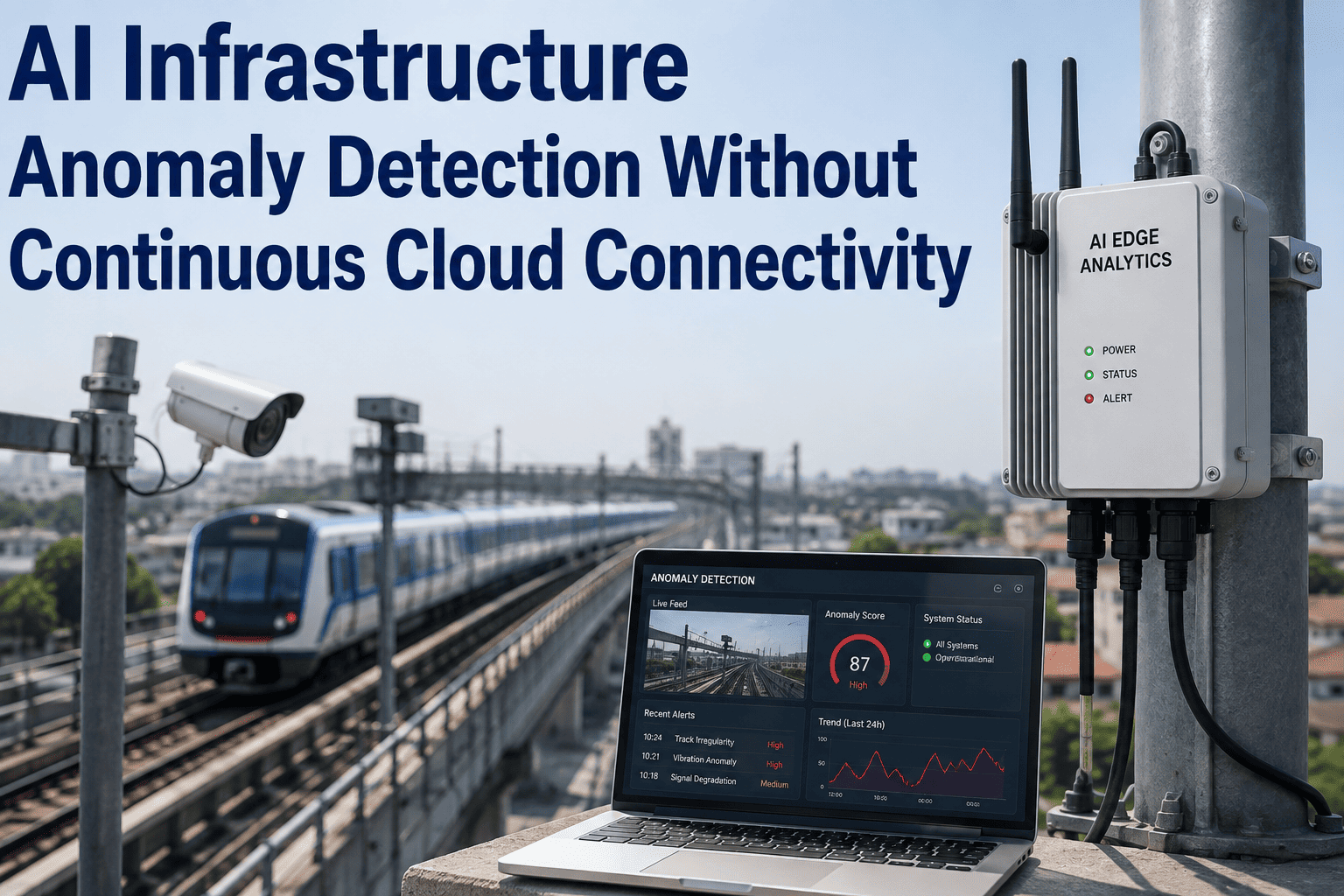
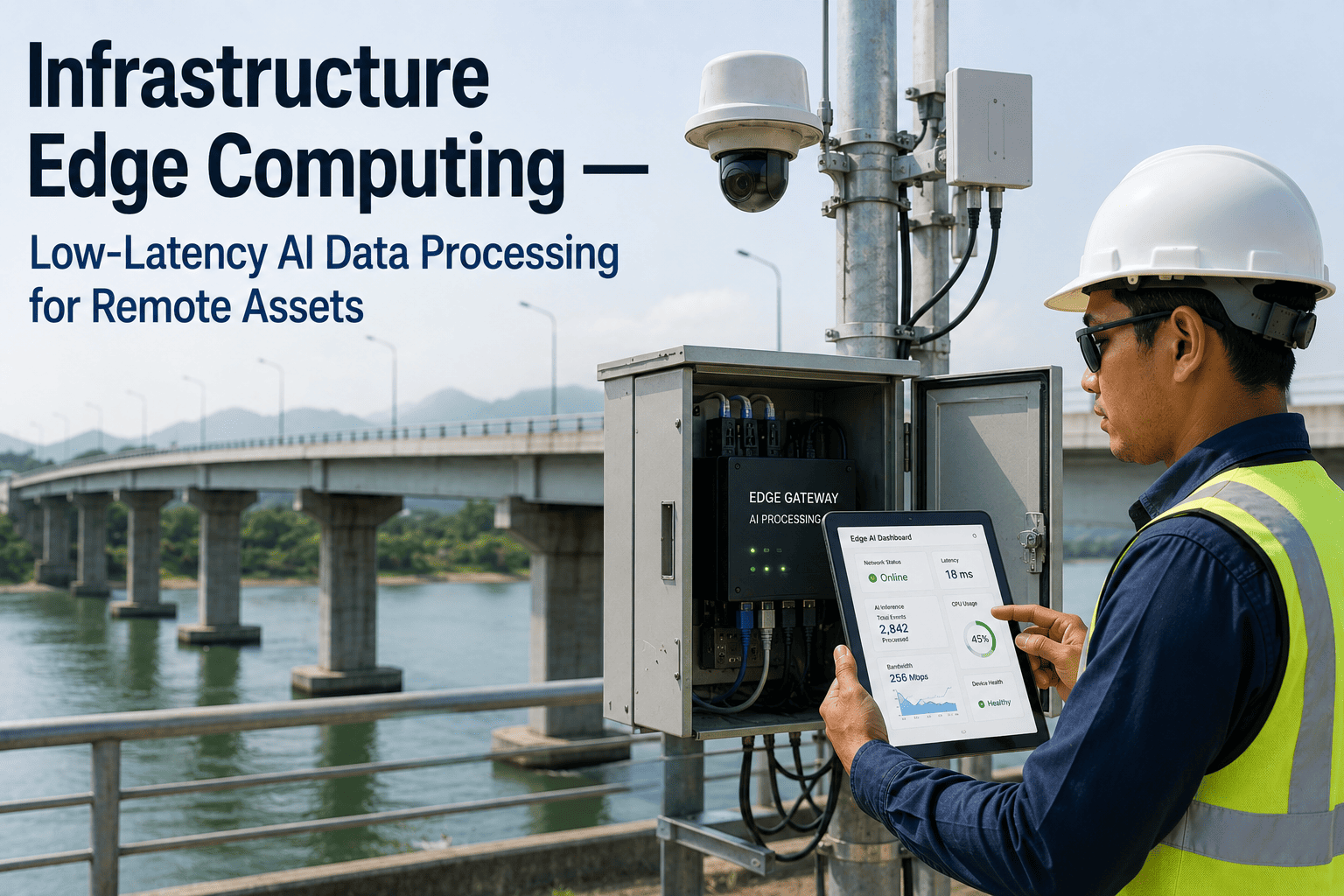
Infrastructure monitoring systems have traditionally assumed reliable internet connectivity as a given, but the reality for most remote and semi-remote industrial assets tells a completely different story. Oil pipelines stretching across hundreds of miles of wilderness, wind turbines positioned on isolated ridgelines, water treatment facilities serving rural communities, and mining operations located far from cellular coverage all share a common challenge: their most critical monitoring moments often coincide with their worst connectivity. When a cloud-dependent anomaly detection system loses its connection, it does not simply pause and resume where it left off. It goes silent at exactly the moment when the anomaly it was tracking may be escalating from early warning to critical failure. Edge AI changes this equation by running the intelligence locally on hardware at the site, ensuring that anomaly detection continues without interruption regardless of network status. Learn how iFactory brings resilient anomaly detection to the edge.
EDGE AI · ANOMALY DETECTION · OFFLINE MONITORING
Anomaly Detection That Never Stops, Even When Connectivity Does
Run AI-powered infrastructure anomaly detection locally at the edge, maintain full monitoring capability through connectivity drops, and sync intelligently when the network returns.
Full Cloud
All features active, real-time dashboard
Intermittent
Local detection runs, syncs when available
Zero Connectivity
Full local AI, local alerts, data queued
THE SILENT FAILURE PATTERN
What Actually Happens When Cloud-Only Monitoring Loses Its Connection
Most organizations discover the limitations of cloud-dependent monitoring only after an outage has already exposed them. The failure pattern follows a predictable sequence that turns a manageable network interruption into an unmonitored critical window. Understanding this sequence is the first step toward building a monitoring architecture that does not have this vulnerability.
Hour 0
Connectivity Drops
A satellite link, cellular connection, or microwave backhaul goes down due to weather, equipment failure, or interference. The monitoring system immediately stops receiving new sensor data.
Hour 1-4
Blind Monitoring Window Opens
Cloud-based anomaly detection cannot process data it never receives. Any developing equipment issue, vibration shift, temperature drift, or pressure anomaly goes completely undetected during this period.
Hour 4-12
Historical Gap Widens
The data gap grows, and when connectivity is restored, the system has no visibility into what occurred during the outage. Trend analysis and baseline calculations become unreliable or require manual reconstruction.
Hour 12-48
Anomaly May Escalate Unnoticed
If an anomaly began developing before or during the outage, it continues to progress without any alert or intervention. By the time monitoring resumes, the situation may have moved from early warning to active failure.
Post-Restore
False Confidence Returns
Connectivity is restored and dashboards show current readings, but the system has no context for what happened during the gap. An anomaly that developed during the outage may now appear as a sudden shift rather than a gradual trend.
EDGE-FIRST ARCHITECTURE
Three Layers That Work Independently and Together
iFactory's edge anomaly detection is built on a three-layer architecture where each layer can function autonomously. The critical insight is that the middle layer, the edge processing unit, carries enough intelligence to detect anomalies, trigger local alerts, and store results without any dependency on the cloud layer above it. The cloud becomes an enhancement for historical analysis and fleet-level insights rather than a requirement for basic monitoring functionality.
Cloud Platform
Fleet-wide analytics, historical trending, cross-site comparison, model retraining, and long-term data retention. Active when connectivity allows, never a dependency.
Available when connected
Edge Processing Unit
Local AI model execution, real-time anomaly detection, local alert generation via SMS or SCADA integration, buffered data storage, and automatic sync queue management. Runs fully autonomous.
Always active
Sensors and Equipment
Vibration sensors, temperature probes, pressure transducers, current transformers, and other field instrumentation generating continuous data streams for local processing.
Always active
See How Edge AI Keeps Monitoring Running Through Any Outage
iFactory demonstrates full anomaly detection capability running on local edge hardware with the cloud connection physically disconnected. Book a demo to see it in action.
WHERE THIS MATTERS MOST
Industries Where Connectivity Is Never Guaranteed
Certain industries operate in environments where reliable connectivity is structurally difficult to achieve, not just occasionally interrupted. For these organizations, cloud-dependent monitoring was always a compromise that traded reliability for convenience. Edge AI removes that compromise by placing the detection capability where the asset is, not where the network happens to reach.
Oil and Gas Pipelines
500+ miles between access points
Pump stations and compressor stations along transmission pipelines often rely on satellite or microwave links with limited bandwidth. Anomaly detection on vibration, pressure, and flow must continue through weather-related satellite degradation that can last hours or days.
Wind Energy Farms
50-200 turbines per site
Wind farms are deliberately sited in exposed, isolated locations with poor cellular coverage. Each turbine generates vibration, temperature, and pitch data that needs continuous analysis, but connectivity to individual turbines is often unreliable.
Mining Operations
Deep terrain with no line of sight
Open-pit and underground mines present extreme connectivity challenges with terrain blocking signals, dust interfering with equipment, and operations extending far from any fixed infrastructure. Processing equipment and conveyors need local monitoring.
Water and Wastewater
Facilities spread across rural regions
Lift stations, remote reservoirs, and treatment plants serving rural communities often have minimal or no connectivity. Pump failures and pipe bursts can cause environmental damage before anyone notices without local detection.
LOCAL VS CLOUD PROCESSING
What the Edge Handles Independently
A common misconception about edge AI is that it provides a degraded subset of cloud capabilities. In iFactory's architecture, the edge runs the same anomaly detection models as the cloud, just optimized for the local hardware profile. The distinction is not about capability but about scope: the edge handles everything related to the individual asset or site, while the cloud handles cross-site patterns and long-term analytics that require aggregated data from multiple locations.
Vibration anomaly detection against learned baselines
Temperature threshold and rate-of-change alerts
Pressure deviation detection with trend analysis
Current signature analysis for motor health
Local alert generation via SMS, email, or SCADA
Short-term historical data buffering
Model inference for all connected sensors
Automatic sync queue management
Fleet-wide anomaly pattern recognition
Cross-site baseline comparison and normalization
Long-term degradation trending over months
Model retraining with expanded datasets
Regulatory compliance reporting and audit trails
Multi-site dashboard aggregation
Historical data archival and retrieval
Predictive maintenance scheduling optimization
THREE OPERATING MODES
How the System Adapts to Connectivity Conditions
Rather than failing when connectivity degrades, iFactory's edge detection system transitions smoothly between three operating modes. Each mode is designed to maximize monitoring capability given the available network conditions, and transitions between modes are automatic and seamless. The system does not require any manual intervention or reconfiguration when connectivity changes.
Full Connectivity Mode
Real-time data streaming to cloud, live dashboards, remote model updates, fleet analytics active, full historical sync, cross-site comparison enabled. All edge and cloud features operational simultaneously with zero gap between local and remote visibility.
Intermittent Connectivity Mode
Local anomaly detection runs continuously without interruption. Data is buffered locally and synced to cloud during connectivity windows. Alerts are generated locally first, then propagated to cloud when available. No detection capability is lost during disconnected periods.
Zero Connectivity Mode
Full local AI inference continues on all sensor streams. Local alerts fire via SMS, SCADA integration, or on-site alarms. All detection results and raw data are stored in local buffer for later sync. Monitoring confidence remains unchanged from connected operation.
EDGE CAPABILITIES
What Local AI Detection Actually Covers
The range of anomaly types that can be detected at the edge is broader than most organizations assume. Modern edge hardware, including industrial PCs and dedicated AI accelerators, can run sophisticated machine learning models that handle multivariate analysis, temporal pattern recognition, and domain-specific fault classification. The following capabilities all execute entirely on local hardware without any cloud dependency.
DEPLOYMENT CONSIDERATIONS
What You Need at the Edge
One of the most common questions about edge AI deployment is what hardware and infrastructure is actually required at the remote site. The answer depends on the number of sensors, the complexity of the detection models, and the desired buffering capacity for offline periods. However, the requirements are generally modest compared to the value delivered, and many sites already have suitable hardware in place.
Edge Processing Hardware
An industrial PC or ruggedized edge gateway with a modern processor is sufficient for most single-site deployments. Dedicated AI accelerators are optional and only needed for high-sensor-count installations. Hardware cost typically ranges from $1,500 to $5,000 per site.
Local Storage
SSD storage of 256GB to 1TB provides weeks of buffered data for sync after extended outages. The system automatically manages storage by prioritizing detection results over raw data when buffer capacity approaches limits.
Local Alert Pathways
SMS modems, SCADA system integration via OPC-UA or Modbus, or local alarm relays provide alert delivery without cloud dependency. The system supports multiple simultaneous alert channels with configurable escalation rules.
Connectivity (When Available)
Any available connectivity, whether satellite, cellular, microwave, or wired, is used for cloud sync when operational. The system adapts its sync strategy based on available bandwidth, prioritizing anomaly alerts over bulk data transfer.
FREQUENTLY ASKED QUESTIONS
Questions Infrastructure and IT Teams Ask First
How much processing power is actually needed at the edge to run anomaly detection?
Most single-site installations with 10 to 50 sensor channels run comfortably on an industrial PC with a modern Intel Core i5 or equivalent AMD processor, without requiring any dedicated AI accelerator hardware. The models are optimized for edge deployment through techniques like quantization and pruning that reduce computational requirements while maintaining detection accuracy. For larger installations with hundreds of sensor channels or particularly complex multivariate models, a GPU-enabled edge device or dedicated AI inference accelerator may be warranted, but this is the exception rather than the rule. Power consumption for typical edge deployments ranges from 15 to 50 watts, which is easily supported by existing site power systems or small solar installations at truly remote locations.
Book a demo to review hardware requirements for your specific sensor count and model complexity.
What happens to the data buffered during a long outage when connectivity is finally restored?
When connectivity is restored after an outage, the system initiates an intelligent sync process that prioritizes data based on its importance and relevance rather than simply uploading everything in chronological order. Anomaly detection results and alert events are synced first so that the cloud platform immediately gains visibility into any issues that occurred during the outage. Raw sensor data is then synced in a compressed format, with the system adapting the transfer rate to the available bandwidth to avoid consuming the entire connection. If the buffer capacity was exceeded during an extended outage, the system preserves detection results and summary statistics while selectively discarding the oldest raw data, ensuring that no anomaly information is lost even if some granular detail is.
Contact our support team to discuss sync strategies for your typical outage durations.
Can the AI models at the edge be updated without physical site visits?
Yes, model updates are delivered through the same sync channel used for data transfer, with the system automatically downloading and deploying updated models during connectivity windows. The update process includes a validation step where the new model runs in parallel with the existing model temporarily to confirm that its behavior is consistent before the old model is replaced. If a site has been offline for an extended period and misses multiple model updates, the system will download the latest version directly rather than applying each update sequentially. For sites with extremely limited or expensive connectivity, model updates can be configured to occur only during specific windows or only when the update includes significant detection improvements rather than minor optimizations.
Book a demo to see how model updates are managed for your connectivity profile.
How does local alerting work when there is no cloud connection to route notifications?
The edge system supports multiple local alert pathways that function entirely independently from the cloud. SMS alerts can be sent through a local cellular modem that may have connectivity even when the primary data link is down, since SMS requires far less bandwidth than data transmission. For sites with SCADA systems or distributed control systems, alerts are pushed via standard industrial protocols like OPC-UA or Modbus TCP, integrating directly into existing operator interfaces. Physical relay outputs can trigger on-site alarms, beacons, or override controls for critical safety scenarios. All alert pathways are configurable with independent escalation rules, so you can have SMS go to the on-call technician while SCADA alerts go to the control room, with different thresholds and escalation timing for each channel.
Contact our support team to discuss alert integration with your existing site systems.
Does running AI at the edge mean we sacrifice detection accuracy compared to cloud processing?
The detection models running at the edge are the same architectures used in the cloud, optimized through quantization and compression techniques that reduce computational requirements with minimal impact on accuracy. In benchmark testing across standard industrial anomaly detection tasks, the edge-optimized models typically achieve 97 to 99 percent of the accuracy of their full-precision cloud counterparts, a difference that is practically insignificant in operational contexts where the alternative during an outage is zero detection capability. Furthermore, the edge models benefit from processing data with zero transmission latency, which means they can detect fast-developing anomalies that might be smoothed out or delayed by the round-trip to a cloud server. The net result is that for real-time anomaly detection on a single site, edge processing often delivers equal or better practical outcomes than cloud processing even when full connectivity is available.
Book a demo to review accuracy benchmarks for your specific anomaly detection use cases.
Stop Accepting Monitoring Gaps as Unavoidable
Your infrastructure does not stop developing anomalies just because the network goes down. iFactory's edge AI ensures detection never stops, alerts always fire, and no critical window goes unmonitored. Book a demo to see how it works on hardware like what sits at your remote sites today.