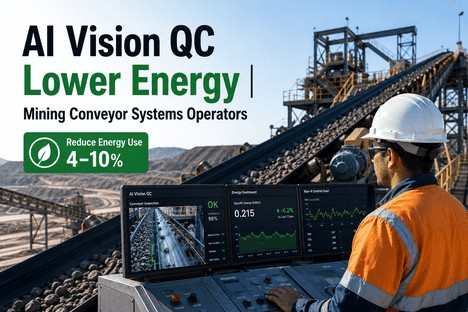
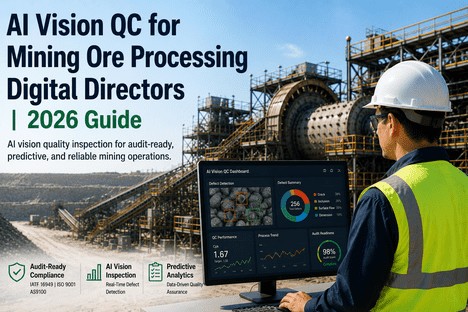
Every ton of ore that moves through a processing plant carries an invisible cost. The energy consumed to crush it, grind it, float it, and filter it is the single largest controllable expense on a shift supervisor's P&L, yet most supervisors see energy data as a monthly report rather than a real-time lever. AI vision quality for mining ore processing changes that — not by adding more screens, but by giving supervisors a direct line between what the camera sees and what the meter reads. When machine vision detects oversize particles before they reach the mill, when deep learning classifies ore grade variations on the belt, and when every defect flag triggers an energy-aware adjustment, the 4-10% energy reduction that AI quality systems deliver stops being a benchmark and starts being a shift outcome.
The Energy Leak in Ore Processing Is Invisible to the Naked Eye
Ore processing is the most energy-intensive stage in the mining value chain. Comminution alone — crushing and grinding — consumes 3-4% of global electrical energy, and in a typical concentrator, 50-60% of total site energy goes into grinding ore that may or may not be on-spec for downstream recovery. The inefficiency is not mechanical; it is informational. When feed grade shifts, particle size coarsens, or hardness varies, the grinding circuit keeps drawing the same power — but the energy-to-value conversion drops. Without continuous quality feedback, supervisors discover the gap only when the shift report arrives.
AI vision quality for mining ore processing closes this information gap at the point where energy is spent. Cameras mounted over conveyor belts, feed chutes, and flotation cells feed real-time images into deep learning models that classify ore characteristics, detect particle size deviations, and flag surface defects on concentrate — all within milliseconds. The result is not just a quality score; it is an energy signal that tells the operator exactly where power is being wasted on out-of-spec material.
The 4 Energy-Intensive Ore Processing Circuits Where AI Vision Quality Delivers the Largest Impact
Energy waste in ore processing concentrates in four circuits. Each has a distinct signature that AI vision models can detect and correct in real time, and each represents a measurable reduction in kWh per ton when machine vision quality control is applied at the right intervention point.
Vision systems on feed conveyors classify ore hardness and particle size distribution before material enters the mill. When the model detects coarser feed or harder ore, it adjusts feed rate or alerts the operator — preventing the energy waste of recirculating oversize material through an overloaded circuit. Cemex and other major operators have documented mill throughput increases of 8-12% with vision-based feed optimisation, directly translating to lower kWh per ton milled.
Flotation circuits consume energy through pumps, agitators, and air blowers — much of it wasted when reagent dosing or pH drift pushes recovery off target. Computer vision models that analyse froth characteristics in real time detect changes in bubble structure, froth velocity, and colour that precede recovery loss. Supervisors receive a quality-adjusted energy efficiency score that tells them when flotation energy is producing concentrate versus when it is simply churning off-spec slurry. BHP's Escondida operation demonstrated the model: AI-driven concentrator recommendations generated $18.9M in operational uplift through improved recovery and reduced energy waste.
Dewatering is the last major energy consumer before product shipment. When underflow density drifts or flocculant dosing is suboptimal, filtration energy per ton increases sharply as pumps work harder and filter cycles extend. Vision-based monitoring of thickener bed level and underflow clarity, combined with predictive models trained on historical energy-quality correlation, alerts supervisors to energy inefficiency before it compounds into moisture-spec failure. Operations using vision-assisted thickener control report 8-12% energy reduction in dewatering circuits alongside improved moisture compliance.
Material handling systems — conveyors, transfer points, and feeders — consume significant energy moving material that may not meet process specifications. AI vision systems at transfer points detect contamination, belt misalignment, and material carryback that increase friction and motor load. When vision detects oversize material or debris on the belt, the system can trigger a quality hold or routing adjustment before that material reaches energy-intensive downstream processes. This early rejection saves both the energy of processing waste and the maintenance energy cost of handling abrasive or problematic feed.
How AI Vision Quality Converts Inspection Data Into Energy Savings
The connection between quality inspection and energy consumption is not automatic. A vision system that detects defects without linking those defects to energy use is a quality tool, not an energy tool. The shift happens when the inspection output becomes an input to process control. Here is how AI vision quality for mining ore processing creates the energy-quality feedback loop that supervisors need to achieve 4-10% energy reduction:
What 4-10% Energy Reduction Actually Means on a Shift
Energy reduction targets are abstract until they are translated into what a shift supervisor controls. The 4-10% reduction that AI vision quality systems deliver comes from three specific sources, each with a measurable operational signature:
What iFactory Delivers for Ore Processing Supervisors
iFactory connects AI vision quality, real-time energy tracking, and closed-loop quality documentation into a single platform designed for the shift supervisor in mining ore processing. The platform does not replace operator judgment; it amplifies it by delivering the right quality-energy decision point — specific to the circuit, the material, and the energy target — before the window closes.
Frequently Asked Questions
Traditional machine vision in mining operates on fixed rule sets — a dimension check, a colour threshold, a presence-absence test. It flags what it has been explicitly programmed to flag and cannot adapt to variation it has not seen before. AI vision quality uses deep learning models trained on thousands of labelled images of ore, froth, and concentrate. It detects defects and deviations that no single threshold can capture: subtle grade shifts visible only in texture patterns, particle size distributions that drift gradually, froth characteristics that precede recovery loss by 30-60 minutes. The model improves over time as more process data becomes available. For supervisors, this means fewer false alarms, earlier detection of developing quality issues, and a direct line between what the camera sees and what the energy meter reads. Get In Touch to see how iFactory's AI vision layer trains on your specific ore characteristics.
Most modern ore processing plants already have the foundational layer: cameras on conveyors, feed chutes, and flotation cells are standard in greenfield and brownfield operations. The requirement for AI vision quality deployment is connectivity — cameras need to feed images to an edge or cloud inference engine, and the inference output needs to reach the control system or operator dashboard. iFactory integrates with standard industrial camera systems, SCADA platforms, and process historians. Plants with existing camera infrastructure can typically connect and start receiving quality-energy alerts within weeks. The initial model training requires 2-4 weeks of labelled image data from your specific ore types and process conditions. For plants without camera infrastructure, iFactory's deployment team provides camera selection guidance and installation support. Book a Demo to discuss your plant's current infrastructure and deployment timeline.
The energy reduction from AI vision quality is measured as specific energy consumption — kWh per ton of on-spec product produced — before and after deployment, with all other process variables controlled. The documented 4-10% reduction comes from peer-reviewed studies and operational deployments across multiple mining operations, including Metso's AI integration reports showing 12% plant-level energy reduction, MDPI studies documenting 20-30% transport and processing energy savings from sensor-based ore sorting, and IEEE-published research on AI-driven mineral processing showing 8-15% comminution energy reduction through vision-based feed optimisation. iFactory tracks this at the circuit and plant level, providing daily, weekly, and shift-level specific energy consumption reports that supervisors can validate against meter readings and production records. Every quality event, energy measurement, and operator action is logged — making the energy reduction auditable and repeatable across shifts. Get In Touch to start tracking energy per quality outcome in your circuits.
Conclusion
The ore processing plants that will capture the 4-10% energy reduction documented in AI vision quality deployments are not the ones with the most advanced control rooms or the largest engineering teams. They are the ones whose shift supervisors see the energy-quality connection in real time — who receive an alert when oversize feed is consuming mill power without contributing to recovery, who adjust reagent dosing based on froth vision analysis rather than end-of-shift assays, and who close every shift with a complete energy-quality audit trail that requires zero manual data entry.
The AI vision quality for mining ore processing market is growing at 41.9% annually because the gap between plants that use machine vision for energy optimisation and those that do not is measurable, widening, and directly visible on the shift report. iFactory's platform connects deep learning defect detection, continuous quality tracking, and energy impact scoring into a single system that ore processing supervisors can act on during the shift — not after it. The energy is being spent in your circuits right now. The question is whether the quality feedback loop is fast enough to make every kWh count. Book a Demo to see iFactory running on ore processing circuit data, or Talk to an Expert to start building the AI vision quality foundation for your operation.